‘Full Metal Jacket’: The Forever War of Stanley Kubrick
A week of Kubrick features kicks off with a look at one of the director's most divisive films.


Programming note: Since the recent release of the Criterion Collection’s The Complete Kubrick has brought the work of Stanley Kubrick back into the conversation (not that it ever really left), we’ve opted to make this week’s features Kubrick-focused, starting with this look at one of the director’s most divisive (some might say misunderstood) films.
In the summer of 1950, Stanley Kubrick quit his job at Look magazine with the intention of starting a career making feature films. He had one documentary short to his name and another that would soon follow. He also had an idea for a war movie inspired by the works of Joseph Conrad and the still-ongoing conflict in Korea, which Kubrick had avoided being drafted into thanks to a student deferment. It would be the story of four soldiers trapped behind enemy lines, an idea he’d recruit his high school friend Howard Sackler to develop into a screenplay. Sackler, who’d also scripted Kubrick’s second feature, Killer’s Kiss, would later become a Pulitzer-winning playwright but, like Kubrick, he was then just starting out. That didn’t stop them from pressing on with what would become Kubrick’s first full-length film, Fear and Desire, an independent production made with funds largely contributed by Kubrick’s friends and family.
The results were, to put it mildly, not to Kubrick’s satisfaction. Shot over six months in 1951, Fear and Desire debuted at the Venice Film Festival in 1952 before receiving a modest release after being cut down from its already slim 70-minute running time. In 1994, as the film resurfaced despite his attempt to suppress it, Kubrick would describe Fear and Desire as “a bumbling amateur film exercise.” But he was already trying to figure out what went wrong as early as 1957, when he blamed its failure on his decision to make the four soldiers citizens of a never-named country fighting in a never-named conflict. “How can you hope to interest the viewer,” he said in an interview with French journalist Raymond Haine, “if from the start you tell him that everything he will see concerns an army that is completely made up?”
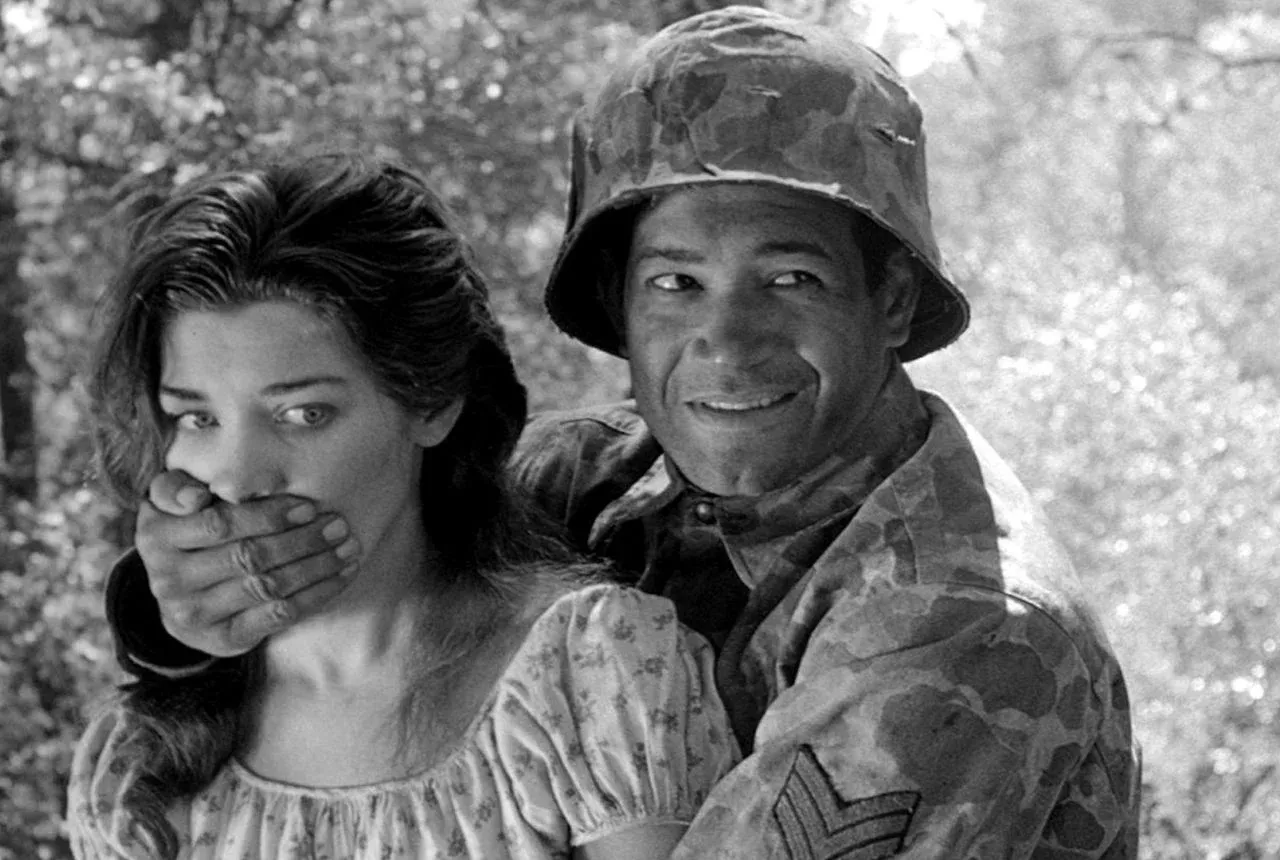
It’s not a mistake he would make again, but even this early quote suggests that Kubrick saw war as an essentially unchanging pursuit however much the details might vary between conflicts—be they World War I, the Third Servile War, the Seven Years’ War, or the Vietnam War, the lattermost the setting of his penultimate film, Full Metal Jacket, released in the summer of 1987.
Like every film Kubrick made after Dr. Strangelove, Full Metal Jacket received a mixed reception upon release. While some critics hailed it as a masterpiece, others treated it as a confirmation that Kubrick’s “control freak” tendencies were (again) getting the better of his artistry. Even positive reviews tended to espouse an opinion that’s since become something like accepted wisdom, that the opening segment, which depicts the basic training regimen employed at the Marine Corps’ Parris Island facility, is much stronger than the sections that follow, set in Vietnam. “The first half is so strong [...] that the second half suffers in comparison, as it covers more familiar ground, while keeping emotions in check,” the review in Leonard Maltin’s Movie Guide surmised. Others went so far as to think of the film as a double feature in all but name. “Structurally, Full Metal Jacket is two films,” Duane Byrge wrote in The Hollywood Reporter.
In many respects, this impression is understandable. The Parris Island segment is distinct and self-contained in a way the episodic Vietnam segments are not. But even when one scene doesn’t seem that connected to the next, much of the film’s cumulative power comes from telling a single story, that of Private James T. “Joker” Davis (Matthew Modine), a man trying to hold onto his humanity in the midst of experiences that threaten to eliminate it.
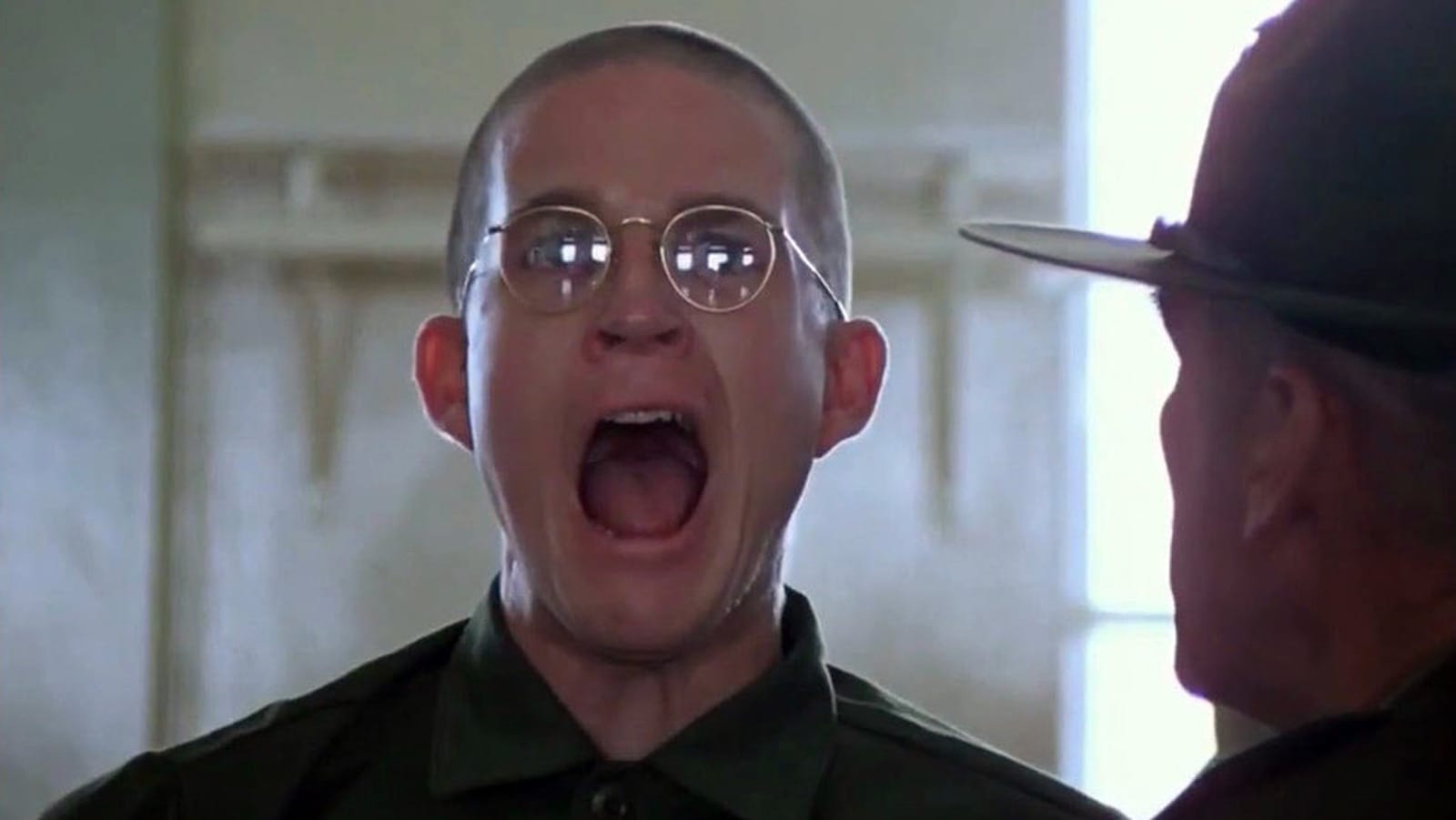
Missing this is kind of understandable, too. Were it not for the occasional voiceover, it wouldn’t even be clear that Joker is the film’s protagonist in the Parris Island opening. He’s one of dozens of recruits we first meet as they have their heads buzzed to a standard length as interchangeable as the uniforms they wear. Their training, pitiless and conducted with dark, profane wit by Gunnery Sergeant L. Hartman (R. Lee Ermey, who’d performed the job in real life), is designed to do for their minds and bodies what the Corps has already done to their appearance.
For the film’s first 20 minutes, the only interaction we see is between the recruits and Hartman as he barks orders and distributes abuse in the name of turning them into Marines. None of the privates speak to one another until Hartman pairs Joker with a clumsy, overweight recruit named Leonard (Vincent D’Onofrio)—to whom Hartman has given the cruel nickname “Gomer Pyle”—in the hopes that Joker can help whip Leonard into shape. Even a later attempt to teach Leonard a lesson by beating him as he sleeps is staged as if it were an instinctual group impulse rather than a plan, one Joker at first resists joining then throws himself into with more zeal than the others. The moment establishes a pattern of reluctant, regretful, but ultimately total conformity from which Joker can find no escape.
We're keeping our Kubrick week content free to all readers but we hope you'll become a paid subscriber. Paid subscriptions unlock everything we do at The Reveal (and other perks) and allow us to keep this independent movies newsletter going.
Kubrick considered many projects in the years after The Shining, landing on what would become Full Metal Jacket after reading Gustav Hasford’s slim, nightmarish The Short-Timers, a 1979 novel inspired by the writer’s own Vietnam experiences. The film’s script, a collaboration between Kubrick, Hasford, and war correspondent Michael Herr (whose book Dispatches previously landed him the job of writing the voiceover narration for Apocalypse Now) faithfully adapts the novel’s Parris Island opening then freely reworks the rest of the book, condensing the second part then essentially throwing out the final third while freely drawing from bleak, biting observations and the dark absurdism of Hasford’s novel.
A vein of black comedy reminiscent of Catch-22 runs through The Short-Timers that makes it easy to see why it appealed to the director of Dr. Strangelove. But it’s the book’s depiction of how individuals get swept along by the tides of history, no matter how strongly they might resist, that makes it feel ready-made for Kubrick. Procedural military face-saving leads to the death of innocent men in Paths of Glory. In Barry Lyndon, Barry escapes the army only to get crushed by the aristocratic world in which he seeks shelter. A series of mistakes turns the Cold War hot enough to destroy the world in Strangelove. Throughout Kubrick’s work, those who think they’re above and beyond the world around them invariably encounter rude awakenings.
That’s true of Joker as well. In that same Hollywood Reporter review, Byrge describes Joker as “[c]arrying the filmmaker’s political banner” by
playing a smart and smarmy countercultural Marine recruit. In essence, Modine’s just the kind of soldier the military can’t handle: He’s not like the other malleable, young Marine grunts — he questions things, has a mind of his own. In the chessboard script by Kubrick, Michael Herr and Gustav Hasford, he’s their spokesperson, taking on the ogre-ish, double-talking military figures.
Again, it’s understandable why some might see the film this way, viewing Joker as a kind of voice of reason, a sensitive, sarcastic Hawkeye Pierce (the Alan Alda version) forever appalled at the madness around him. But that’s less who Joker is than who he’d like to be. As a rebel, he repeatedly falls down on the job.
That begins on Parris Island, where both Joker’s kindness and his cruelty align him with the aims of the Marines’ training program of turning Leonard into a viable soldier (with a disastrous outcome). It continues in Vietnam, where he works as a journalist for Stars and Stripes. In the film’s most bitingly satirical scene, Joker participates in an editorial brainstorming session. After failing to raise an alarm concerning rumors about the upcoming Tet holiday cease fire, the best defense he can offer against his editor’s instructions to add false information to a story for propaganda purposes is a smirk and a sarcastic reply.
These weapons prove even less effective in the field, up to and including a horrifying climax that concludes with Joker’s encounter with the sniper who’s been taking out other members of his squad. He’s horrified to discover the sniper is a teenage girl but, in the end, it’s Joker who administers the kill shot, partly out of mercy—others suggest they leave her to a slow, painful death—but seemingly just as much out of a desire to move the operation along and continue on to whatever the Marines need them to do next. At one point Joker ineffectually attempts to explain his decision to wear a peace symbol button and a helmet with the words “Born to Kill” written on it as an attempt to symbolize a Jungian notion about the duality of man. By the film’s end, his actions suggest only one of those objects still applies to him.
Modine’s sensitive performance makes Joker the sort of character far easier to identify with—particularly those with none of the wartime experiences Hasford and Herr drew on—than most of those surrounding him, like the brutal Animal Mother (Adam Baldwin), an alpha of alphas who lives only to fight and dominate, or the never-seen Hand Job, an unfortunate who dies before he can be discharged for his compulsive masturbation. For all the dark humor, the film has its share of genuinely moving moments, like when Joker reunites with his basic training companion Cowboy (Arliss Howard) and their war-hardened expressions melt into joy and relief. (As usual with Kubrick, there’s a beating heart at the center of Full Metal Jacket, however deeply it might be buried.) Yet ultimately Joker’s inability to transcend his circumstances lets nobody off the hook. You might think you’d be the one who could find a way to not surrender to the violence and insanity of war, to do what’s right no matter what the cost while surrounded by those doing wrong. But Joker undoubtedly thought that as well.
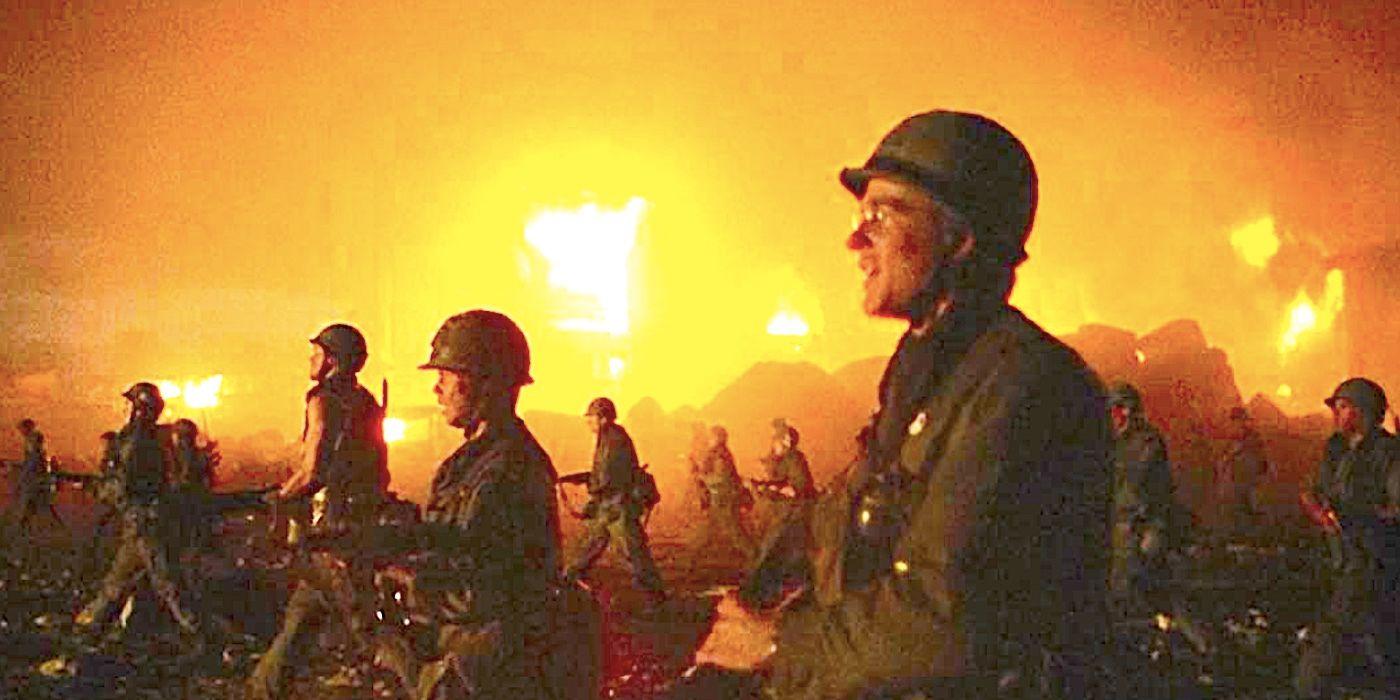
Kubrick and his screenwriters considered several different endings for Full Metal Jacket. There’s one in which Joker dies in the war andanother in which he would die after returning home. But the haunting final moments in which Joker joins his fellow soldiers as they march against a fiery landscape while chanting the Mickey Mouse Club theme feels like the right, maybe only choice for Full Metal Jacket. It’s a scene from Vietnam but also, chant aside, an image abstracted to the point where it could be any war anywhere at any time, a full circle moment that brings Kubrick all the way back to Fear and Desire. “Don’t worry,” one of the soldiers tells the others in that earlier film, “we’ll all get back and be ourselves again.” With the anonymous characters of his first film Kubrick didn’t quite have the tools to say of war what Joker’s experiences in Full Metal Jacket convey so well: one way or another, there is no coming back.
Discussion