It’s October So I Watched A Horror Movie I’d Never Seen Before: ‘Alice, Sweet Alice’
A season of spookiness at The Reveal kicks off with a look at a nasty '70s shocker.

I’ve seen a lot of horror movies, but not as many as I’d like. As usual, I’m spending part of October filling in some of the gaps.
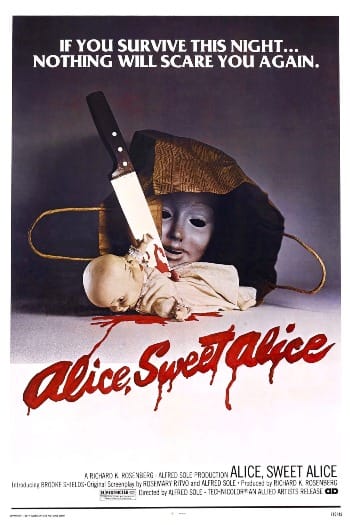
When Alice, Sweet Alice premiered in Paterson, New Jersey in November of 1976 under its original title, Communion, Paterson’s Evening News wasn’t sure what to make of it. The paper’s review, written by Barbara Klein, was largely positive and suggested that, when the film received a wider distribution, “thriller fans have something to look forward to.” But the article wrapped around the review, also by Klein, referred to the film’s champagne-soaked premiere as a “very peculiar happening,” one in which both Communion’s stars and Paterson community leaders came out to celebrate a film that made the town in which it was filmed as “the next to last place anyone would want to go,” a city of “decrepit factories, garbage-clogged waterways, empty liquor bottles, a rat, and old, unattractive housing.”
Of course, the opinion of the review doesn’t exactly cancel out the observations of the article with which it was paired. Set in 1961, Alice, Sweet Alice, the title under which the film is now most widely known*, is a poisoned valentine made by one of Patterson’s native sons, an unsparing depiction of a city in decline, those who live there, and the strict brand of Catholicism that permeated every aspect of everyday life. An early scene, in which a girl is strangled and set on fire moments before her first communion plays like a statement of purpose, a “fuck you” that immediately establishes Alice as a film determined to push past the boundaries of piety and good taste.
[* It premiered under the name Communion but was also released at various times as The Mask Murders and Holy Terror. The credits of the version currently on streaming services still features the Holy Terror title.]
Beyond a desire to cast a jaundiced eye at his upbringing, director Alfred Sole had his own particular reasons to be unhappy with Paterson. A successful restorational architect and interior designer, he’d first attempted to break into filmmaking via the pornographic 1972 film Deep Sleep, a choice of genres dictated, as Sole told it, mostly by practical concerns, pornography being the easiest and most newcomer-friendly way to turn a profit in the early 1970s. Whatever his reasoning, Deep Sleep attracted the wrong kind of attention and led Sole to be hit with charges that included the antiquated crime of “private lewdness.” It also led to the director’s excommunication, in part due to scenes shot in front of the house of an archbishop.
Given that history, it would be easy to see Alice, Sweet Alice as an act of revenge, but it’s too disturbing to be purely a product of spite. The film opens with the sound of ringing church bells, the first indication that Paterson is a place where the Catholic Church is an inescapable part of everyday life. The film doesn’t cast Catholicism in an entirely bad light, however. In the opening scene, Catherine (Linda Miller) brings the two daughters she’s raising alone after a divorce to visit the young priest Father Tom (Rudolph Wilrich). Tom is friendly and compassionate with both 12-year-old Alice (Paula Sheppard**) and 10-year-old Karen (Brooke Shields, in her film debut). He’s approachable and down-to-earth, more friend than authority figure. Some around him live their faith differently, however.
[** A diminutive actress who was 18 when shooting began but small enough to pass as a child, Sheppard’s only other credit is in another film with a cult following, Liquid Sky.]
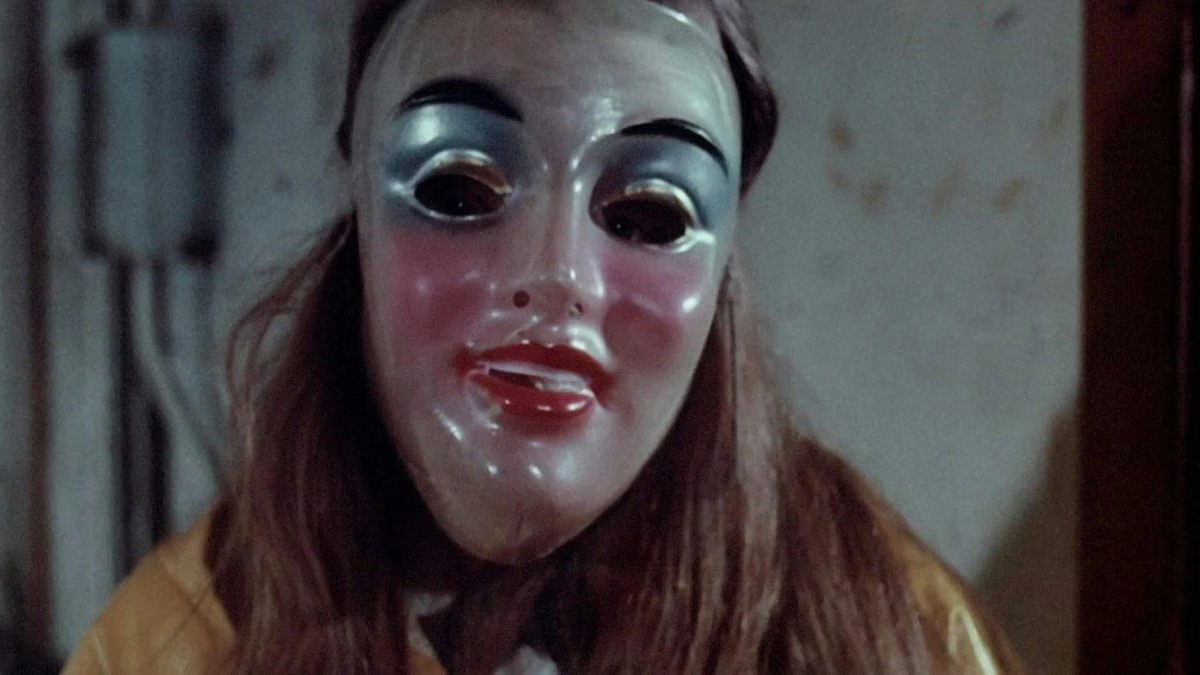
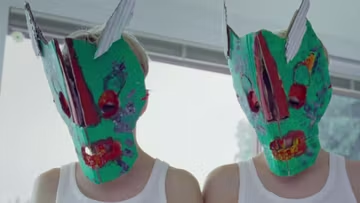
Alice’s bullying, which includes menacing her sister while wearing a translucent Halloween mask, defines the sisters’ relationship, so it’s not that shocking when suspicion falls on Alice after Karen’s death at the hands of a murderer clad in one of the yellow raincoats that are standard issue at the girls’ school. For both those around her and those in the audience, Alice looks like the prime, perhaps only, suspect. (That the killer also wears a mask identical to the one previously worn by Alice doesn’t help her case.) Alice, Sweet Alice does little to remove this doubt for much of the film, depicting Alice as a troubled kid prone to acting out who’s been deeply scarred by her parents’ divorce, a fact only underscored by her father Dominic’s (Niles McMaster) return to aid in the investigation of Karen’s death. But when other bodies start to pile up, it becomes apparent that the killer’s ambitions extend beyond a single victim. That the other victims also have connections to Alice makes her innocence look even more questionable.
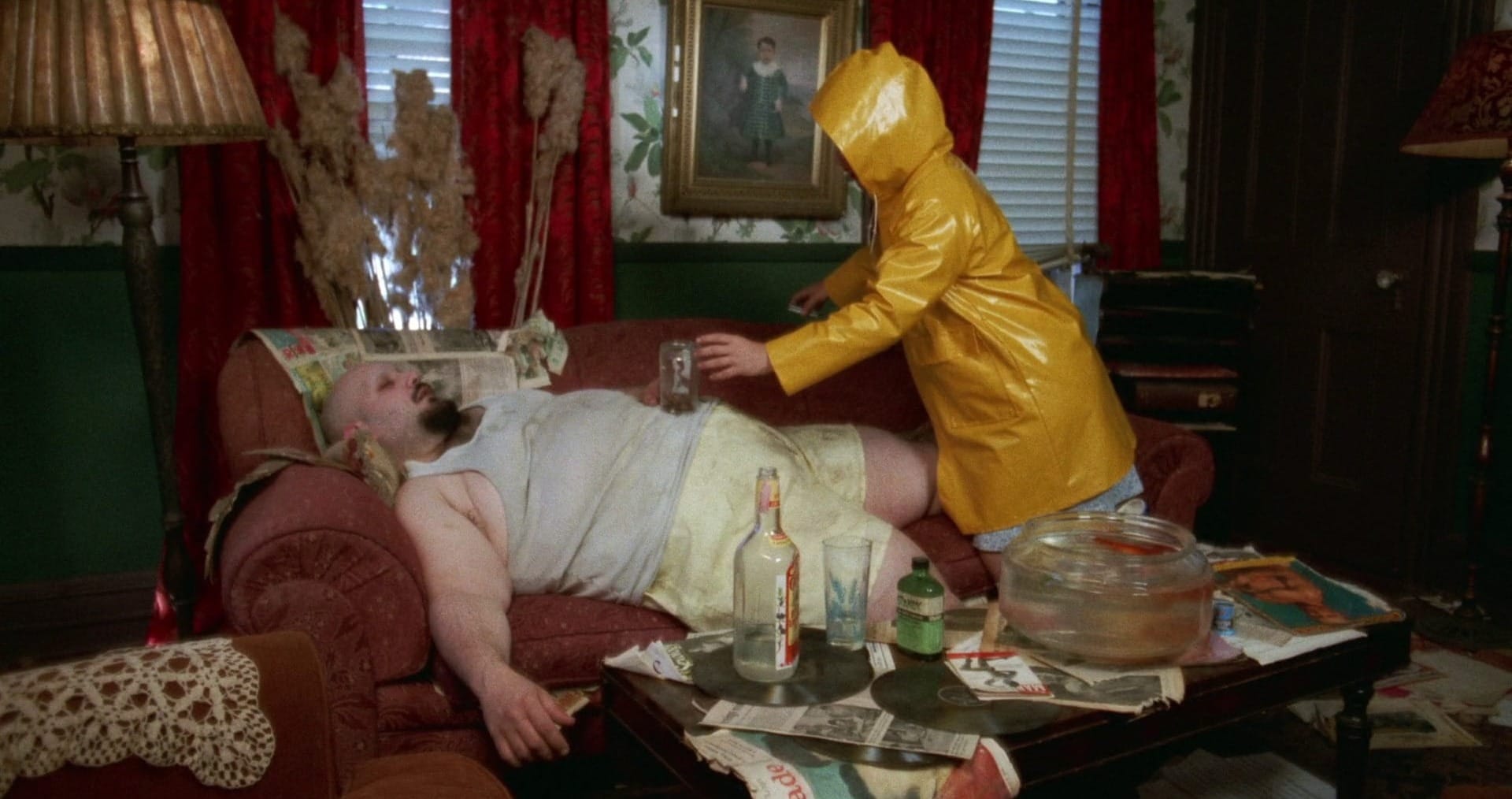
The film, co-written by Sole and Rosemary Ritvo, makes a virtue of its low budget and access to grimy locations, like an abandoned factory, dirty alleys, and a police station covered in pin-ups. It also surrounds Alice with colorful grotesques. These include a hateful aunt (Jane Lawry) and a neighbor named Mr. Alphonso (Alphonso DeNoble), a bald, obese man in a heavily stained t-shirt who attempts to molest Alice then becomes the target of his would-be victim’s acts of revenge. Both Mr. Alphonso’s unsavory appearance and living situation—a trash-strewn apartment filled with cats—and DeNoble’s acting style would make the character a perfect fit for one of John Waters’ ’70s movies.
Alphonso isn’t the only element seemingly on loan from another movie. Sole openly admitted to borrowing the raincoat-clad killer from Nicolas Roeg’s Don’t Look Now, but rather than attempt to mimic Roeg’s dreamy lyricism, Alice, Sweet Alice uses an inspired spin on the stock ’70s American B-movie, shooting mundane settings from disquieting angles and letting the editing and Bernard Herrman-inspired score come to life when the killing starts.
As for the real killer, I won’t spoil the mystery here, but the identity aligns with the film’s other concerns. Sole portrays Paterson as a city dominated by a tradition-bound culture that’s smothering the younger generation while also depicting Alice as the victim of a broken family. The changing times have opened up a gap between the oppressive morals of the church and the freedoms offered by a new era, freedoms that sometimes resulted in families falling apart. Nothing can prevent Alice—overlooked at the beginning of the film, hated for much of it, then forgotten again by its final scene—from falling into that gap. She might make it out of the film alive, but she still lives in a crumbling world, one filled with ways to get lost from which there’s no coming back.
![It’s October So I Watched a Bunch of Horror Movies I’d Never Seen Before: The ‘[REC]’ Franchise](https://storage.ghost.io/c/42/23/42231cd8-5ad8-43fe-b33e-9befc0119959/content/images/size/w360/format/avif/2025/10/Recheader.jpg)

Discussion