‘Spy Hard’ Revisited: An Origin Story
One of many forgotten Leslie Nielsen spoofs released after the success of 'The Naked Gun,' 'Spy Hard' debuted 30 years ago. For one of The Reveal's writers, it was a momentous occasion.

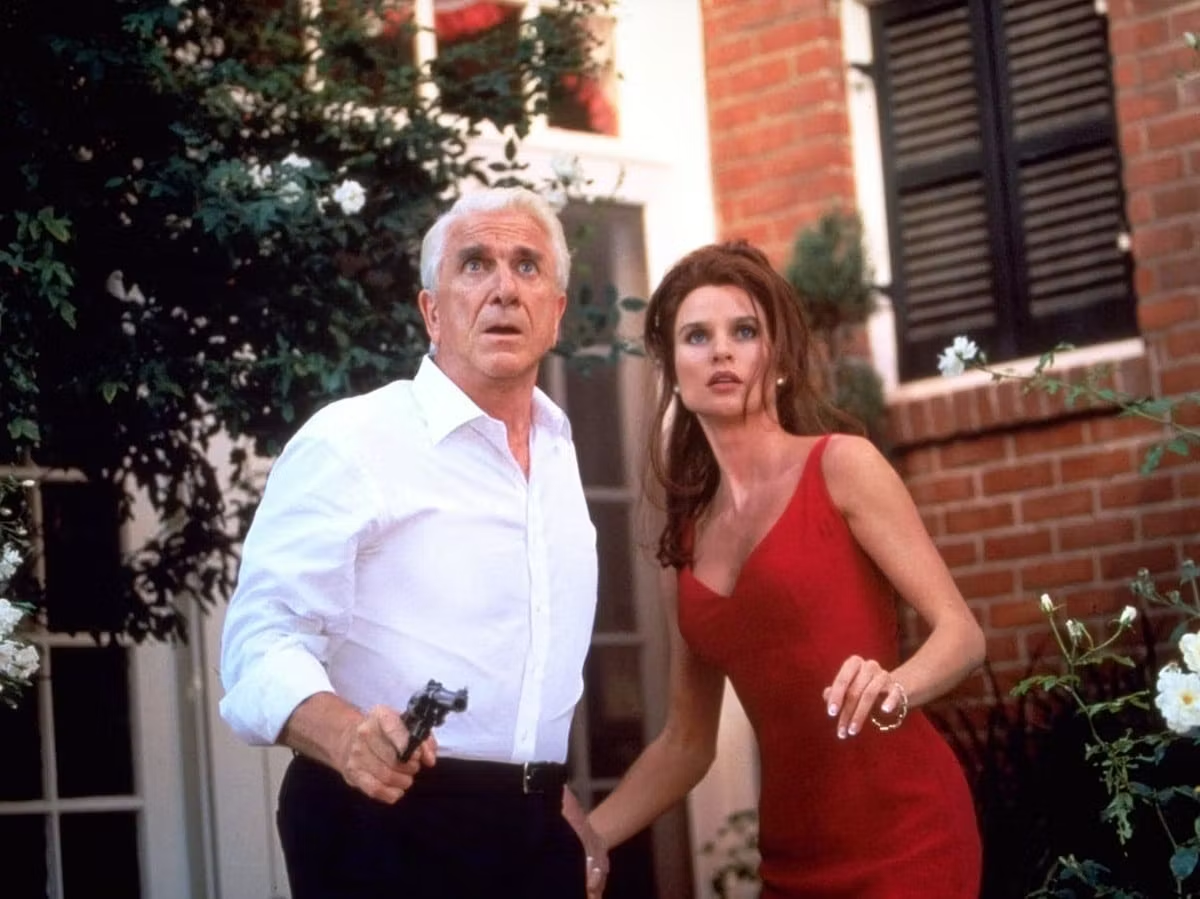
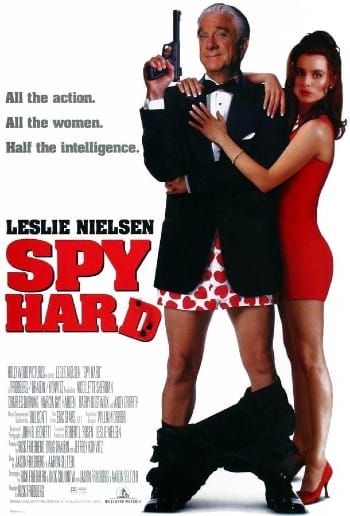
On May 24th, 1996, Hollywood Pictures released Spy Hard, a spy movie parody starring Leslie Nielsen. This was, in the grand scheme of things, neither a consequential moment in cinematic history nor a date likely to be meaningful to anyone not involved in the making of the film. Except for me. Spy Hard was the first movie I got paid to review, my point of entry into a career writing about movies that I’ve now sustained for 30 years. (It was also the first movie review I’d written since working for my junior high paper.) Since then I’ve written hundreds of reviews in addition to longer form pieces and a book that currently has a semi-respectable 3.75 out of 5 rating on Goodreads. I’ve also served as an editor at three publications and have hosted or co-hosted several movie podcasts (including the long-running The Next Picture Show, with The Reveal’s Scott Tobias and our longtime collaborators Tasha Robinson and Genevieve Koski). But it all began with Spy Hard, a movie I did not enjoy at all at the time. Nonetheless, its 30th anniversary seemed like a good time to revisit it, and the moment that put me on this path.
I saw Spy Hard as a Friday matinee at the since-demolished University Square 4 theater in Madison, WI. But the story of how I got there starts with seeing the movie Babe. Although, when I think about it, the first rustling of butterfly wings that led to me buying a Spy Hard ticket 30 years ago probably occurred during an ominous conversation the previous fall.
I moved to Madison in the late summer of 1995 to attend grad school in the English department. The plan was to get a masters degree, then move onto the doctoral program and become a professor. I loved literature (still do) and count the English professors I had as an undergrad among the most influential people in my life. They approached literature as a way to understand the wider world, how the currents of history shape how we think, and what’s eternal to the human experience, no matter how much the language used to describe it changes over the centuries. I left undergrad wanting to join their ranks, open students’ eyes as mine were opened, and maybe contribute something to our understanding of a favorite author, like Chaucer or Joyce.
Enjoying The Reveal? Now's a great time to become a paid subscriber. You'll get access to everything we publish—from articles to audio commentaries—and help support independent film criticism.
It didn’t work out. I’m still not sure what went wrong for me in grad school. In retrospect, enrolling immediately after graduating college—and moving to a city where I didn’t really know anyone apart from an old high school friend who was busy finishing up an undergrad degree—may not have been the best idea, though I didn’t really know what else to do. I felt lonely and isolated for much of the single year I spent in grad school. The classes were intense and leaned heavily on au courant ’90s literary theory that often left my head swimming. (To be clear, I see this as my problem. All respect to Hélène Cixous, Jacques Derrida, and the rest. I think I mostly understood you, at least some of the time.) Maybe I could have played the game better. A classmate I befriended referenced the theories of Marxist literary critic Frederic Jameson in every paper he wrote, then casually told me he’d never actually read Jameson. But the real “uh oh” moment came when a fellow student said to me, “I don’t think anyone’s here because they like to read.”
I was there because I liked to read.
I also liked to watch movies and probably spent time that might have been better used for studying seeing movies in theaters or renting tapes from Four Star Video Heaven, which had movies I’d only read about in books (I’d later work there), and Woodman’s, a massive grocery store with a surprisingly robust, and cheap, selection of VHS tapes. I devoured movie reviews where I could find them and, in those days, that was still mostly in print publications. I subscribed to Entertainment Weekly and faithfully picked up The Isthmus, Madison’s alt-weekly (to which I'd also later contribute), and The Onion, the satirical newsweekly whose back half contained a publication within a publication called The A.V. Club and featured informed, irreverent reviews of movies, music, and books.
I knew nothing of where this paper came from or who created it beyond it being locally produced until a classmate suggested I might like her boyfriend Rob Siegel, who had a lot of pop culture obsessions that overlapped with my own. Rob was also the editor of The Onion. We made plans to go see the movie Babe together in the spring of 1996 and Rob, later to become a screenwriter (The Wrestler), filmmaker (Big Fan) and TV showrunner (Pam & Tommy) himself, became a friend I’ve kept to this day. (Babe had played first-run theaters in the fall but was still lingering in second-run houses, which don’t really exist anymore.) Some time later, I mentioned liking the movie reviews and wondering if they needed any additional contributors. Rob put me in touch with A.V. Club editor Stephen Thompson.
In the years that followed, Stephen would reshape my raw prose, tolerate my company, quell my fears, talk me out of taking a technical writing job that would have prevented me from pursuing any freelance writing, hire me as an assistant editor as The A.V. Club began evolving into an entity, and introduce me to my wife. I owe him a stack of debts I’ll never be able to pay. The first among them: he sent me to see Spy Hard.

By this point, I’d received my MA but decided not to pursue a Ph.D. (My grades included several Bs, the grad school equivalent of an undergrad F, at least in this program, and I was not offered a TA position and could not go forward without one.) Nonetheless, I decided to stay in Madison, a city more or less divided between students and those who weren’t in school but decided to stick around anyway. I joined their ranks, making ends meet with help from my parents and a series of terrible temp jobs. (A low point: I did such a poor job filling in at a reception desk, a caller on the other end of the line asked, “Are you on drugs?”) I had nothing going on that Friday, however, so I went to the movies. Besides, it was a paying job. I’d be receiving $5 for the review. (You have to take inflation into account. In 1996 dollars, this was… still not a lot of money.)
I don’t remember much about the Spy Hard screening beyond being more or less alone in the theater, a shoebox-sized house that was part of a ’70s-era multiplex located just off campus. (It only rarely showed good movies but at least it was conveniently located.) After the movie I probably stopped by the arcade next door after the movie and played a round of Virtua Fighter 2 (another grad school-era distraction; I got pretty good at playing as Pai Chan) then went home to write the review on my blocky Macintosh Classic. I’d later hand deliver it to Stephen on a 3.5 inch floppy disc, because how else am I supposed to get a 300-word, single paragraph piece to my editor?
I no longer have the review nor, if I’m being honest, would I want to see it again. I lost my extensive stash of Onion back issues in a basement flood over a decade ago and it’s not part of The A.V. Club’s online archives, which are doubtlessly filled with other pieces I’d be embarrassed to resurface. There’s a Lou Reed album title that I tend to think of when I remember those years: Growing Up in Public. I imagine my Spy Hard piece was filled with attempts to sound smart and witty that ended up sounding cheap and snarky instead, despite Stephen’s (and maybe, if I recall correctly, Rob’s) best efforts to bring it in line. Still, I’m glad I got that sort of writing out of my system when not too many readers were paying attention. If you don’t move past it, it can become your whole personality.
Later the next week I found myself lingering outside The Den, a convenience store located in the same complex as the theater where I watched Spy Hard for the delivery of the newest edition of The Onion. When I turned to The A.V. Club, there it was: my byline on a piece of film writing. And, 30 years later, here it is again.
Oh yeah, Spy Hard: I rewatched it again the other day. It’s still really bad.
Discussion