The ‘80s in 40: ‘Breakin’’ (May, 1984)
In early 1984, a low-budget film set in the Los Angeles breaking scene arrived at just the right moment to become a box-office sensation.

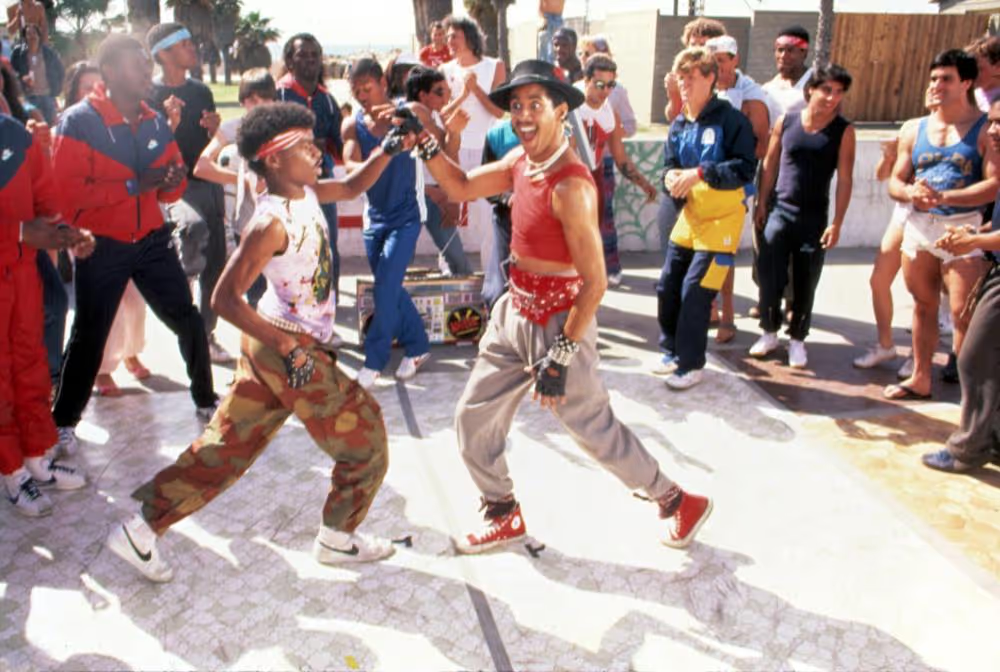
The ‘80s in 40 revisits the decade of the 1980s choosing four movies a year, one from each quarter. This entry covers the second quarter of 1984.
Here’s a memory from my ’80s childhood: It must have been the fall of 1984, maybe the last day before Thanksgiving break, and our 6th grade class had a meaningless day to burn off. So the students from all four of our homerooms squeezed into a single classroom to watch a movie. We had three choices that would be decided on via a show of hands. (Maybe, if you want to find some educational value here, we learned a bit about democracy.) These were: Star Wars, Raiders of the Lost Ark, and Breakin’. Both Star Wars and Raiders of the Lost Ark received a handful of votes—four for Star Wars and three for Raiders, if I remember correctly—but the overwhelming majority of my classmates voted for Breakin’. (For the record, I voted for Raiders of the Lost Ark.)
So how could a low-budget film from the Cannon Group win out over two of the most popular movies of all time? It was 1984 and breaking was having a moment. So was Breakin’, which had premiered on May 4 that year and topped that weekend’s box office, edging out another, more high-profile premiere: Sixteen Candles. (That movie ended up doing OK, however.) The art, originally a long-gestating New York phenomenon, had been inching into the mainstream for years thanks to the PBS documentary Style Wars, amused local news segments, and shows like Late Night with David Letterman. Letterman featured a performance by Crazy Legs and Ken Swift of the Rock Steady Crew on the heels of their appearance in what was likely the biggest catalyst for more widespread attention, Flashdance. A popular item at my deeply suburban Ohio elementary school that year: colorful breakdancing-themed pencils with silhouettes illustrating how to perform moves like “The Frog,” “The Detective,” and “The Tick.”
Breaking had arrived and, released at the height of mainstream awareness, Breakin’ surfaced at just the right moment to ride the wave of newfound popularity—and to serve as a rare example of Cannon’s Menahem Golan and Yoram Globus being at the fore of a cinematic trend rather contributing to one that was already in existence. It almost wasn’t so, however. Cannon hurried Breakin’ into production in an ultimately successful attempt to get the movie into theaters ahead of Beat Street. An Orion release produced by Harry Belafonte, Beat Street attempted to squeeze the entirety of early ’80s New York hip-hop—breaking but also graffiti, rap, and DJing—into a single film via the story of a handful of young New Yorkers. Breakin’ had the more modest ambition of building a ramshackle plot about a handful of struggling dancers around some performances by L.A.’s most talented breakers. More divides the films than the distance between the two coasts yet both work best as records of discrete moments in a fast-changing culture that resisted being easily repackaged for the masses but found masses willing to embrace those repackagings anyway.

This post is for paying members only
Sign up now to read the post and get access to the full library of posts for subscribers only.
✦ Sign up