The Deepest Cut: 'Star Wars' (1977) vs. 'Star Wars: Episode IV — A New Hope' (Special Edition, 1997 + subsequent additions)
New Feature: The Deepest Cut considers alternate versions of the same movie starting with 'Star Wars' and its Special Edition re-release.

New Feature: The Deepest Cut compares different versions of films that exist in alternate cuts to determine if later versions improve on those that played theaters in their original release.
Late last year, Lucasfilm announced it would be re-releasing the original theatrical cut of the 1977 film Star Wars to theaters in February 2027 as part of the company’s yearlong celebration of its 50th anniversary. I’ve already warned my family that, when we go see it, I may cry. I was just old enough—four, to be exact—to see Star Wars in its first theatrical run. And for 20 years, my relationship with that movie and its sequels was pretty simple: I loved them, first as a child in awe of the imagination and spectacle then, as I got older, with a better understanding of their place in film history, the sources from which they drew, and the craft involved in making them. And whenever I wanted to watch the Star Wars movies, I’d rent them from the video store or, later, pop my own VHS copies into the VCR and watch the same movie I’d seen the first time. Toward the end, you could even watch them in letterboxed editions that restored the original aspect ratio.
Enjoying The Reveal? Now's a great time to become a paid subscriber. You'll get access to everything we publish—from articles to audio commentaries—and help support independent film criticism.
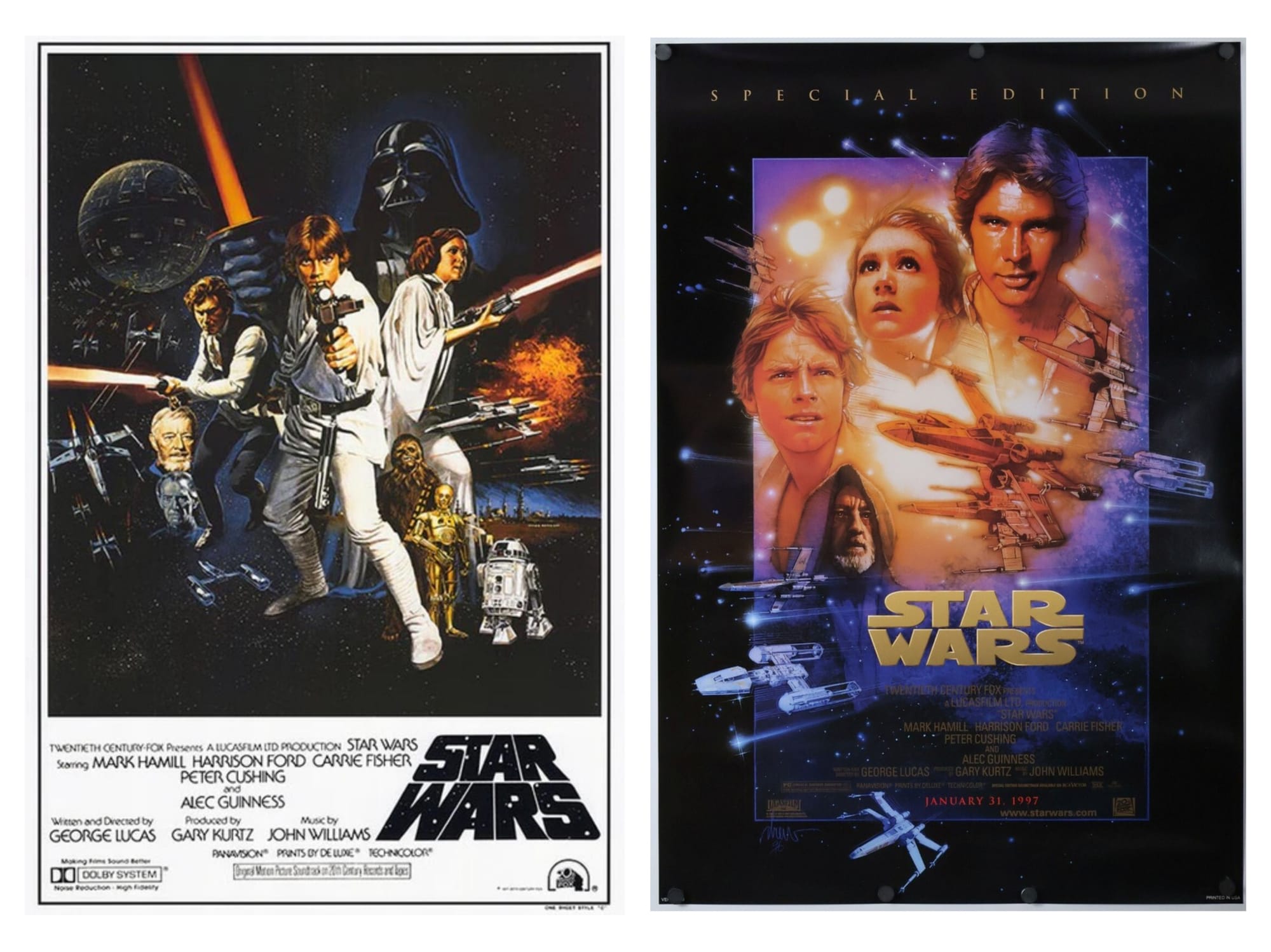
Then, in celebration of Star Wars’ 20th anniversary in 1997, George Lucas re-released Star Wars, The Empire Strikes Back, and Return of the Jedi in new “Special Edition” cuts that both added new scenes—some shot specifically for the new versions, others reworked deleted scenes—and made changes to existing scenes, mostly via the addition of new effects. Like a lot of original fans, I did not care for these. But I also felt like I could live with them until they effectively replaced the original cuts. The movies I’d loved, as I knew them, were consigned to a vault. These were now the official versions.
Whenever I watched them, each change felt like a speed bump. I found myself cruising through a string of familiar scenes and images and then, bam, what was that? What are these ’90s CGI effects (of wildly variable quality) doing in this 1977 film? Why does the Death Star explosion now look like an admittedly pretty cool screensaver? Who shot first? Where did that werewolf guy go?
Ultimately the unavailability of the original cuts, more than the changes made, has been the biggest problem with the Special Editions. Those who wanted the original films could not access them, whether out of a desire to watch the films they knew or to watch the films as they looked and sounded when they first played theaters. I’m not really a purist on this issue and understand those who grew up watching the Special Editions now outnumber older fans. I get it. I first saw and fell in love with Blade Runner when Ridley Scott’s director’s cut played in theaters in 1992. I’ve watched the film many times since and should probably watch the original cut at some point out of historical interest. But, that’s not my Blade Runner.
Unlike Lucas, Scott never tried to overwrite the original version with the director’s cut or, later, the “Final Cut,” letting them all live side-by-side. The handling of Blade Runner on home video has, like Criterion’s treatment of Brazil, been a model of how a filmmaker can present a preferred version (or two) of a film without losing valuable context or alienating admirers. The original Star Wars trilogy movies, by contrast, were locked away—apart from the release of some cruddy, unremastered versions as DVD bonus features in 2006—creating such a deep need that dedicated fans did their own extra-legal “despecialized” restorations.
Optimistically, it looks like that era will come to an end next year. So, with that on the horizon, and this week’s premiere of The Mandalorian and Grogu, now seems like a good time to revisit the Special Edition changes made to Star Wars (the original film, though I’ll probably get to The Empire Strikes Back and The Return of the Jedi) in an attempt to make peace with them before, hopefully, never having to think about them again. Were they really that bad?
To that end, I decided to assess each on a five point scale ranging from -2 (a truly awful change) to +2 (a change that appreciably improves on the original version). All the time codes refer to the cut currently streaming on Disney+. For the original versions, I drew on the “despecialized” cuts referenced above. (Shh…) For the changes, I drew on two sources: A Wookiepedia entry and a seemingly exhaustive article at movie-censorhip.com, a site dedicated to comparing differences between movies that exist in multiple cuts. For the final grade, I added up the score for each. Will it be a net positive or a net negative? The answer may surprise you! (But probably will not.)
Updated 20th Century Fox Logo (0:00:00)
This isn’t really that big a deal except for hardcore nostalgists.
Rating: 0
Updated Lucasfilm logo (0:00:06)
Ditto. It’s just anachronistic-looking enough to be a little annoying but we’re not into the proper movie yet. It’s not really worth a complaint.
Rating: 0
Updated font for “A long time ago in a galaxy far, far away… (0:00:20)
OK, honestly, I probably wouldn’t have noticed this if others didn’t point it out. I don’t love it but whatever.
Rating: 0
“Episode IV: A New Hope” (0:00:43)
This one’s a little more difficult. To me, this movie is called Star Wars. Not A New Hope, or Star Wars: Episode IV — A New Hope, or ANH. Just Star Wars. That’s the title under which it played theaters in 1977 so that’s the title. This change has been in place since 1981, but I don’t think anyone started calling the movie itself A New Hope (etc.) until the release of the prequels. But since this is just a change to the opening crawl and not a change to the title screen (which still reads simply “Star Wars”), let’s just see it as a net neutral.
Rating: 0
R2-D2 travels across a canyon at dusk (0:11:22)
Jawas bring R2-D2 back to their sandcrawler at sunset (0:13:09)
One of the cool things about digital photography is that even amateurs can dramatically alter their work using programs like LightRoom. With some careful cropping and judicious adjustment to the sliders, a seemingly mundane image can really pop. But with this power comes the temptation to take it too far, cranking up the clarity and contrast and, wow, hey, with a little masking you can just drop out the old background and put in a new one. Why not? By the end, your photo doesn’t look mundane anymore. It just looks as garish as a Thomas Kinkade painting. Anyway, this isn’t a great change. But, as unnecessary polishing goes, it could be worse.
Rating: -1
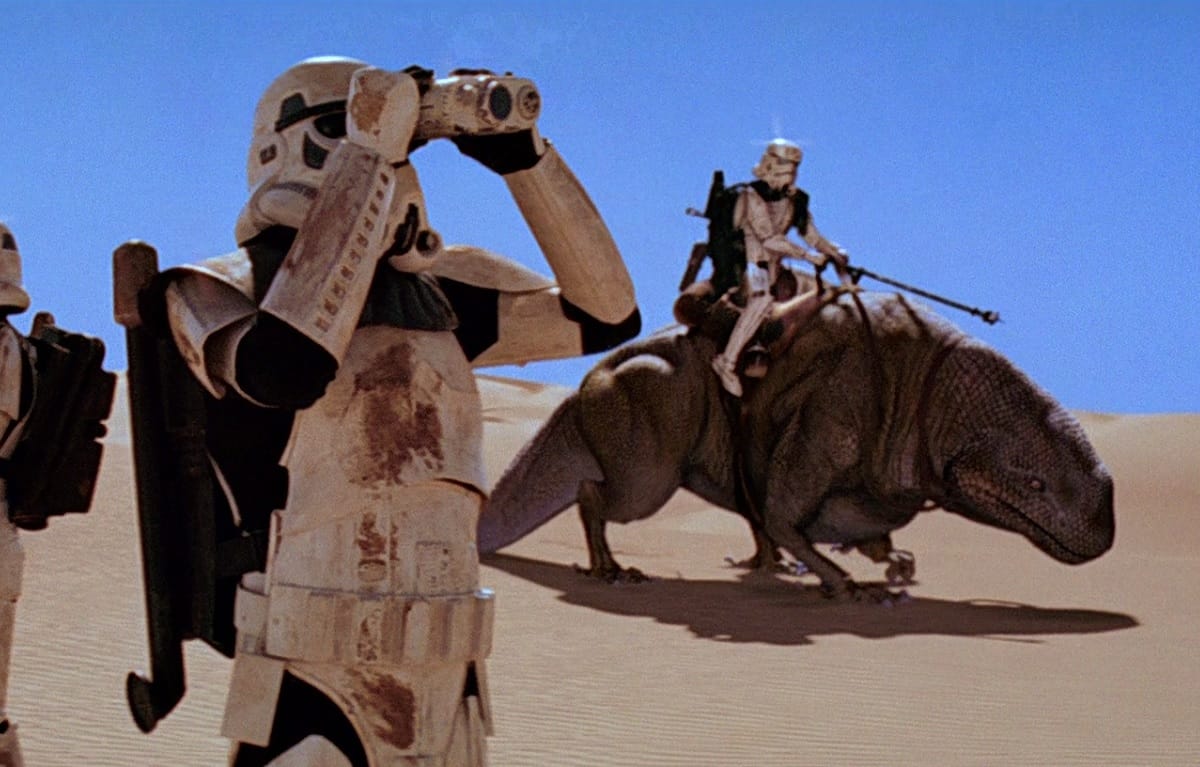
Stormtroopers ride around on Dewbacks as they search for C-3Po and R2-D2 (0:15:09)
Lucas shot some new footage and altered old footage to extend this search scene. It’s the first truly major change in the Special Editions and, frankly, it stinks. Even if the mid-’90s CGI effects weren’t so unpersuasive, these shots would look distractingly overcrowded. Some of the changes Lucas made in revisiting and revising Star Wars seemed driven by the logic that busier is always better. Here that instinct dramatically alters what was once a stark moment that suggested the barrenness of the Tatooine wasteland. Still, much worse was to come, so this doesn’t get the lowest possible rating.
Rating: -1
A shot of the Jawas' Sandcrawler has been replaced with a new effect (00:15:39)
This short shot of the Sandcrawler, well, crawling across the stand is totally different. It’s also not bad, the sort of small change that wouldn’t feel like a big deal were the original still officially available.
Rating: 0
A wider shot is used when the Jawas bring out their droid wares at Uncle Owen and Aunt Beru’s farm (00:16:48)
The Special Edition offers a wider view of the Jawas’ traveling swap meet that allows us to see more farming machines in the background. There’s also a subtle zoom that makes the moment feel less static. To be honest, the matte painting of the original version could look a little better. This isn’t a bad change at all.
Rating: +1
Luke's Landspeeder casts a different shadow (00:27:45)
The Landspeeder’s shadow now better conforms to the shape of the Landspeeder itself. Sure. Why not? Ditto the improved animation of the Landspeeder moving through the canyon, which always looked a bit janky. Later shots make the same no-big-deal adjustments and they look fine.
Rating: +1
Obi-Wan’s makes a fearsome new sound when he scares off the Tusken Raiders (00:29:46)
It’s now less a scream than a roar. It’s kind of a silly change, but not an awful one.
Rating: 0
Obi-Wan Kenobi gets new desert digs (00:32:33)
Instead of a tight shot of Kenobi’s clay house with Luke’s Landspeeder parked outside, we get a long shot of a completely different, and slightly more elaborate, dwelling on the edge of a cliff. This change might be strictly a matter of taste, but I prefer the simpler and more intimate original version. The original looks like a hermit’s home where the newer take looks like the Tatooine equivalent of a cabin made for a weekend getaway.
Rating: -1
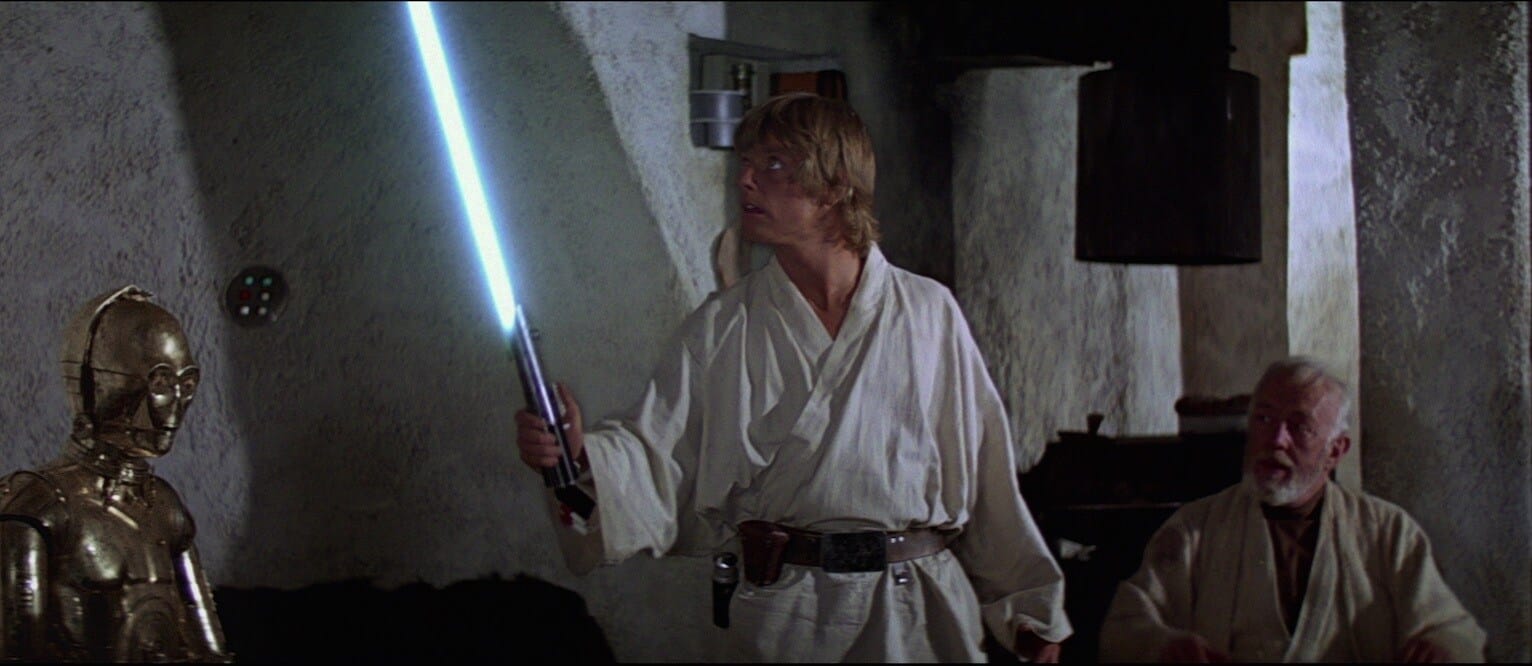
Luke’s lightsaber looks different (00:33:47)
I guess? I’m just going to trust the sources that say this effect has been redone. I can’t see much of a difference.
Rating: 0
Mos Eisley appears further in the distance than before (00:42:35)
Not a big deal, really.
Rating: 0
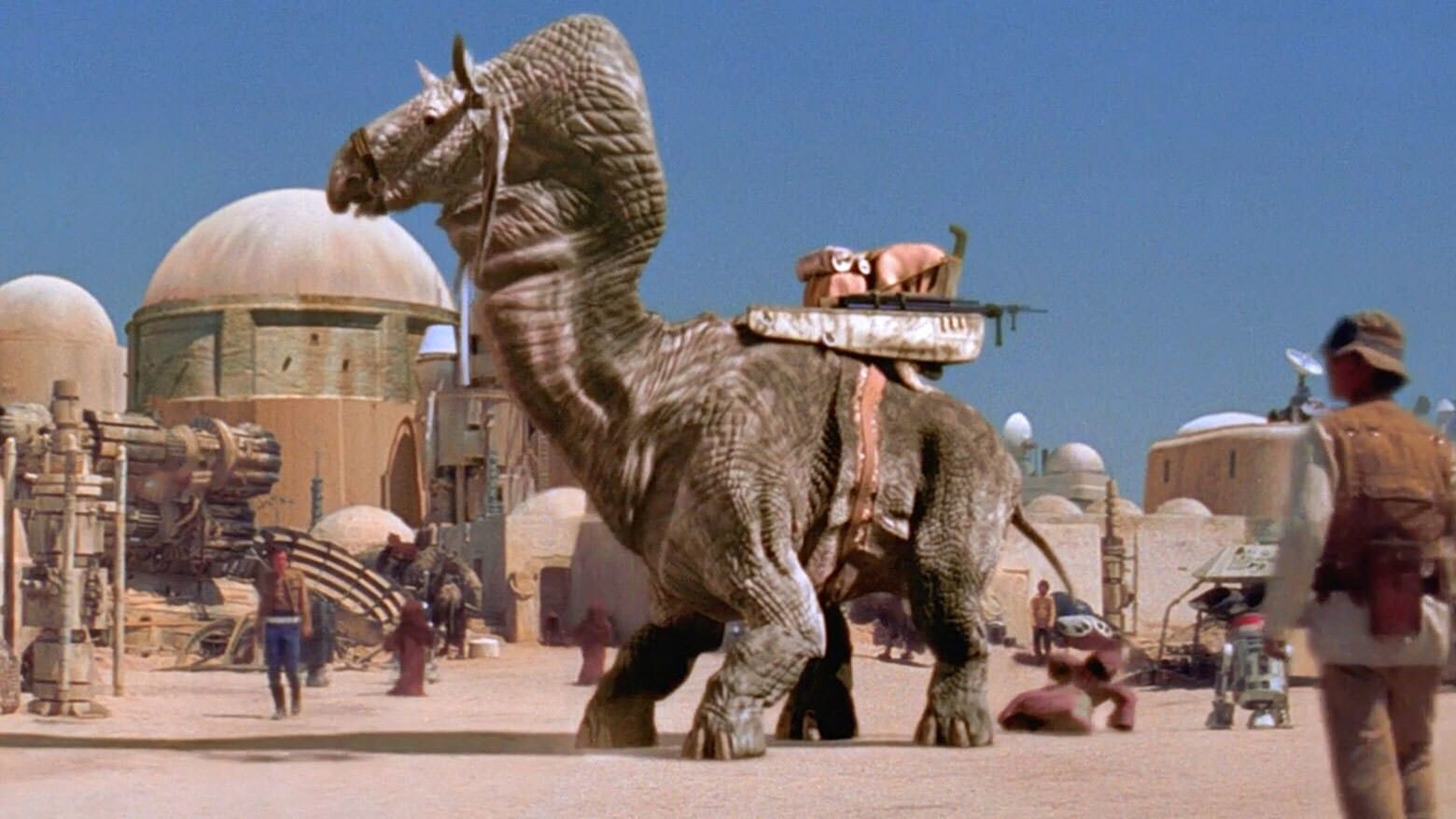
The arrival at Mos Eisley / Stormtrooper questioning / parking at the cantina (00:42:47)
Oh… no. No. This long stretch is just awful now. The digital landspeeder that looks nothing like the landspeeder seen in the rest of the film would be bad enough even if the Special Edition didn’t add droids and Jawas doing slapstick gags as it sped past them. The space behind the stormtrooper who questions Luke and Obi-Wan never felt empty without a droid breezing through but one has been added anyway. These are the first truly painful changes, and the first that play like the work of a filmmaker with a much different, and sillier, sensibility than the one who made the original film. (See also: later shots that drop in an animated dewback and assorted flying things.)
Rating: -2
Whither the werewolf? (00:45:00)
To save time and money, Lucas and make-up artist Rick Baker filled out the Mos Eisley cantina with a creature Baker had crafted years earlier, one that looks a lot like a werewolf because it was designed to look like a werewolf. Lucas has apparently always been a little embarrassed by this horror movie image intruding on his space opera, so the special edition replaces this creature with two new ones. They’re not bad-looking Star Wars designs, but the change doesn’t take into account the years first-generation Star Wars fans spent obsessing over every fleeting detail. “What’s the deal with that silver droid that looks like C-3PO we see for a second in the opening scene?” “What happened to R5-D4?” (A question later answered by The Mandalorian.) “Who’s that werewolf man?” Now we ask a new question: “Where did that werewolf man go? I miss him!”
Rating: -1
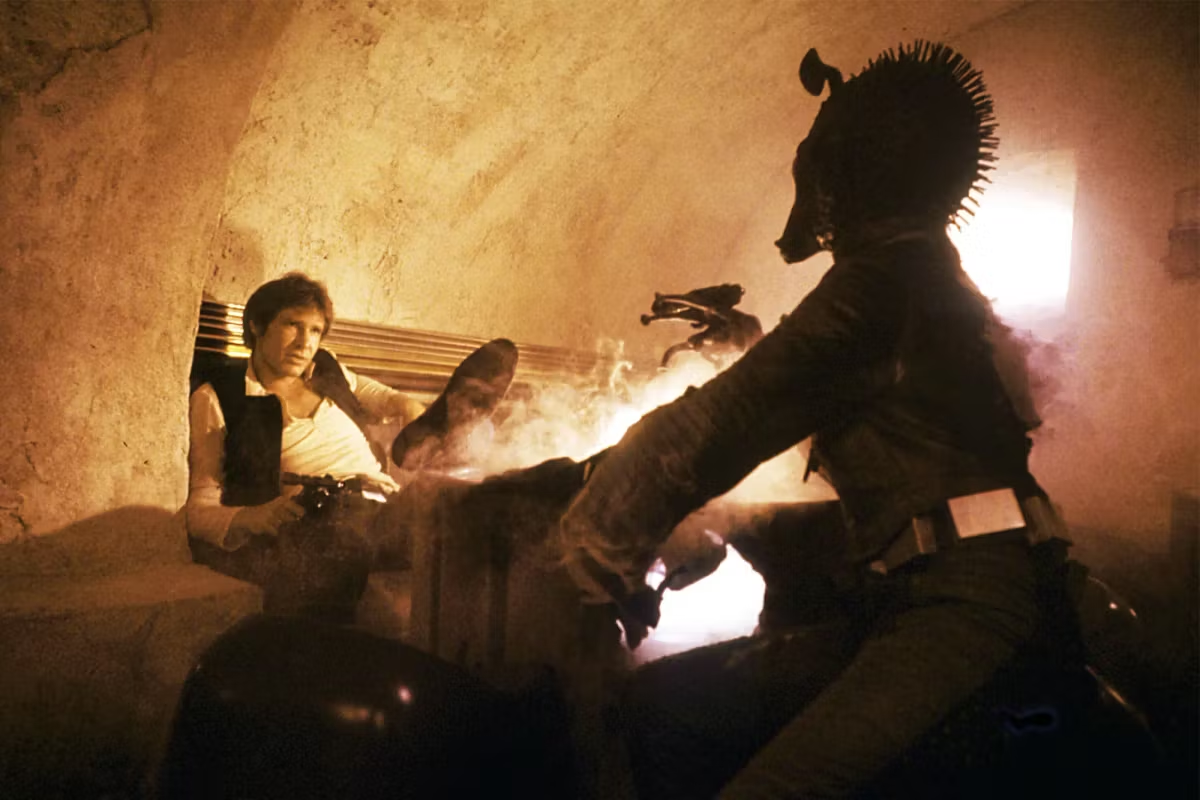
Greedo shoots first (00:50:52)
This moment has been litigated to death so I’ll just restate the two main objections, which I share: 1) Having Greedo shoot first waters down Han Solo’s character in an attempt to make him less morally ambiguous, not realizing that moral ambiguity is a big reason Han Solo is cool while setting the stage for Han to evolve over the course of the trilogy. 2) It looks awkward, in part because Greedo’s aim is way off despite the point blank range. Lucas has reworked this scene several times, each less effective than the last. In one version, Han and Greedo shoot at about the same time. In the final, and worst, attempt, Greedo offers an untranslated last word: “MacClunkey.” Yes, that’s right, Greedo. It’s extremely MacClunkey.
Rating: -2
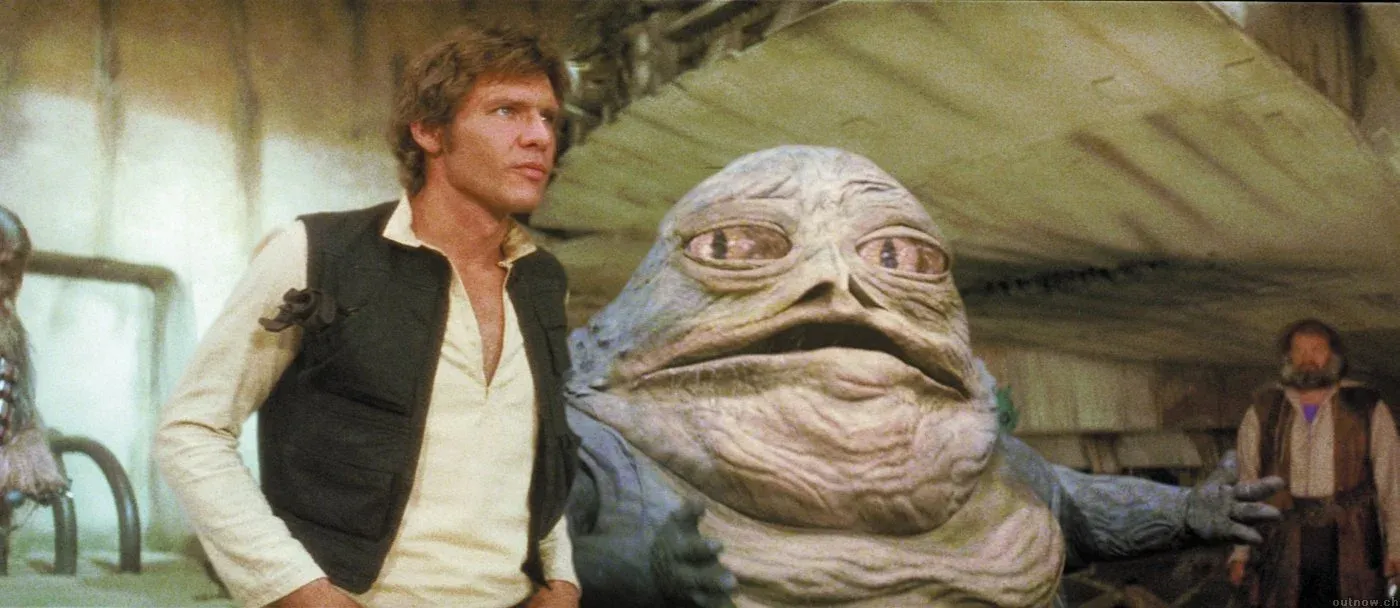
Hey look! It’s Jabba the Hutt! (00:52:39)
Even with Greedo shooting first behind us, we haven’t yet left this Special Edition’s heart of darkness. In a scene cut from the original film, Han talks to Jabba the Hutt, the gangster to whom he owes a lot of money after being forced to dump a load of smuggled goods. This was originally shot with Harrison Ford playing opposite a human actor speaking English. The special edition drops in a CGI Jabba that looked terrible when the Special Edition played theaters in 1997 and looks only slightly better in the updated form now available on Disney+ and elsewhere. But even if the effect was perfect and it appeared as if Ford were interacting with the animated Jabba—which it never really does—this would still look like a special effects touch from a 1990s film dropped into a 1970s film. And the moment when Han steps on Jabba’s tail, making his eyes bulge? It’s so awful I still wonder why audiences didn’t riot and tear down screens in 1997. (Also hanging around: Boba Fett, who now gets an unceremonious introduction in this film.)
Rating: -2
The Millennium Falcon takes off (00:55:35)
The good news: We’re through the worst of it. The bad news: There’s still more than half the movie to go. We’re going to jump to hyperspace for most of the back half, especially when addressing minor changes like this extended look at the Millennium Falcon leaving Mos Eisley. And I’m not going to get into the weeds with purely cosmetic changes like the erasing of the visual mattes surrounding the Tie Fighters, which are definitely improvements. (See below.) As for this moment, it’s an unnecessary change—there really are no necessary changes—but not a terrible one.
Rating: 0
The destruction of Alderaan (00:59:07)
Would an exploding planet put out a ring of shock waves? I don’t know. This isn’t a bad effect, just one that, once again, looks out of place in a film made in the 1970s.
Rating: -1
The Death Star’s landing bay has more visible details (1:05:56)
It’s shinier, too.
Rating: +1
The Imperial officer’s laser wound is less fiery. (1:14:35)
Barely noticeable.
Rating: 0
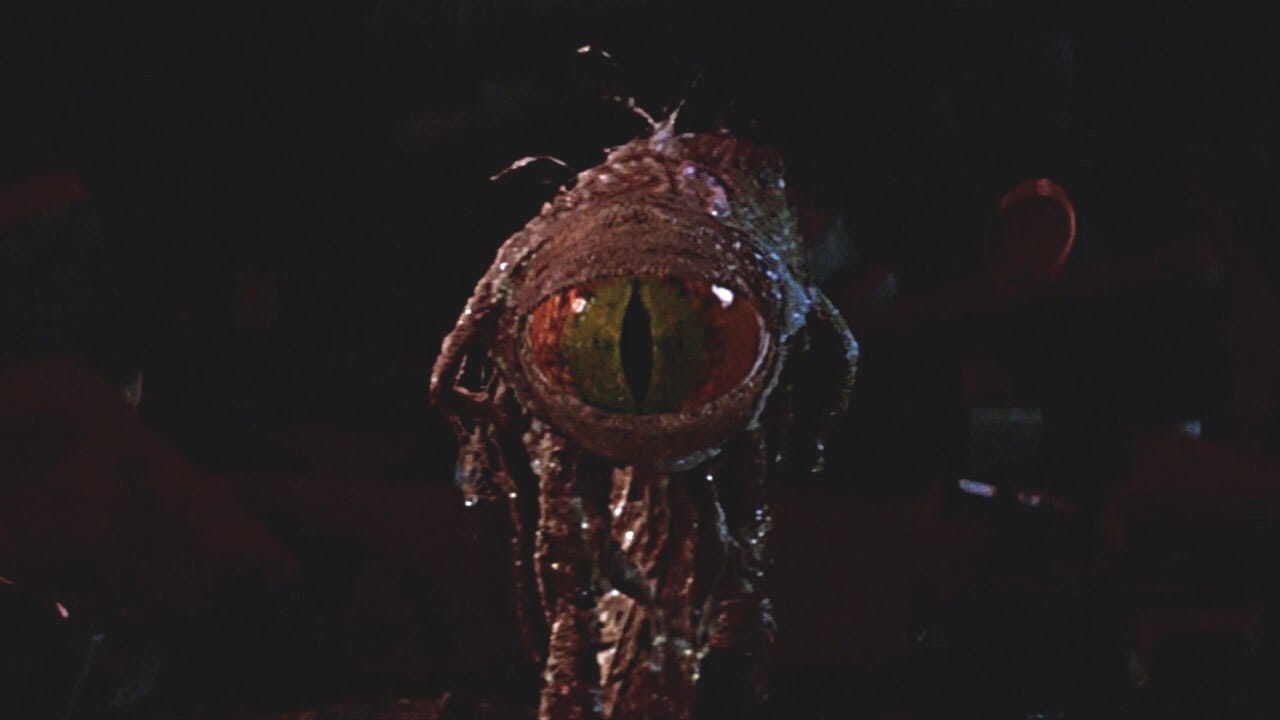
The trash compactor monster now blinks its single eye (1:20:18)
Unnecessary.
Rating: -1
While chasing the stormtroopers, Han and Chewie find themselves outnumbered by a far greater number than before (1:27:40)
Han and Chewie pursuing stormtroopers who catch on mid-chase that they don’t need to run and should be chasing Han and Chewie instead is a fun, well-executed gag in the original version. The Special Edition turns it into a Looney Tunes moment.
Rating: -1
Arriving at Yavin 4 (1:38:06)
There’s nothing really awful about the many small changes made to the Millennium Falcon’s arrival at the Rebel base on Yavin 4, but the changes don’t really make them better either.
Rating: -1
Luke reunites with his old pal Biggs (1:43:14)
Ah, this is nice. Nobody cares about Biggs, but good for them.
Rating: 0
The Rebel fleet takes off and assembles (1:45:03)
The Special Edition offers a closer look at the Rebel ships taking off and a smoother shot of them gathering in formation. It’s slicker than the original shot, but was anyone complaining before?
Rating: -1
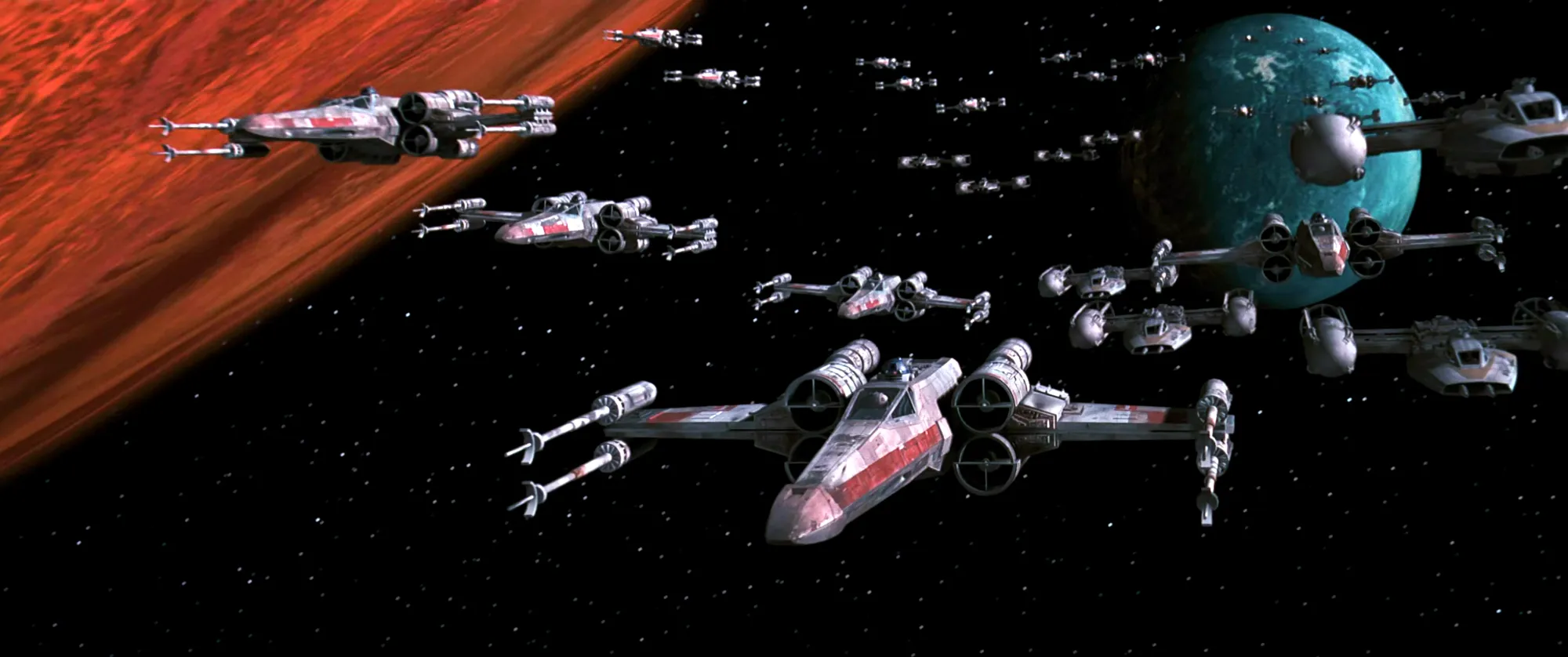
The many small cosmetic changes made to the dogfight outside the Death Star and elsewhere (N/A)
Lucas took the opportunity to erase the matte lines visible around various ships (especially Tie Fighters) and to make other changes that cleaned up the existing effects in ways that still felt true to the original effort. Only a hardened purist could object to such attempts to paper over cracks.
Rating: +2
The many small but substantial changes made to the dogfight outside the Death Star (1:45:46)
Unless you’ve seen Star Wars many, many times, you might not even notice the little adjustments and digital replacements in this sequence, not the blemish removals referenced above, but the new shots and altered editing that’s especially prevalent in the early parts of this sequence. Though relatively small, the changes here also exemplify why the Special Editions were so fundamentally misguided. Part of what made the climax to Star Wars so impressive is that it’s a magic trick Lucas and his team pulled off within the limitations of mid-’70s special effects technology, limitations they pushed to their limit. Of course, some of the shots could look more polished using ’90s technology, but where’s the magic in that?
Rating: -1
BOOM! (1:57:17)
As with Alderaan, the Death Star now gets destroyed via a more spectacular yet somehow less impressive explosion.
Rating: -1
The Closing Ceremony (1:58:5o)
Rather than receiving their awards before a matte painting of Rebels standing stiffly at attention our heroes no stand before a CGI effect of Rebels standing stiffly at attention.
Rating: 0
James Earl Jones is now listed in the credits (2:00:44)
At last, an undeniable change for the better, but not a big enough change to score the maximum number of points
Rating: +1
GRAND TOTALS
Positive changes: 5 totaling +7
Neutral changes: 12
Negative changes: 14 totaling -17
Final Tally: -11
Winner: Star Wars (1977)
Discussion