‘The Purge’ Saw All This Coming
The horror franchise’s vision of an authoritarian dystopia echoes throughout the news of the day.

What if the clearest vision of where America was headed was folded into a film franchise that nobody took seriously? When The Purge debuted in 2013, its vision of the United States in the near-future year of 2022 seemed ludicrous. And, in some respects, its central premise was ludicrous then and (hopefully) remains ludicrous now. But the same can’t be said of many of the details that surround it. A just-around-the-corner dystopia in which power had been seized by an authoritarian government with ideas and policies that made The Handmaid’s Tale’s Republic of Gilead look progressive? It’s a lot harder to say it couldn’t happen here now than it was just a little over a decade ago.
Here’s a Purge refresher: For 12 hours each spring, all crime is legal in the United States, ostensibly so the populace can use this window to vent all its violent impulses in a contained stretch of time. On Purge Night, those who can afford to hunker down in safety can choose to do that. Those who want to take to the streets, run riot, and kill whoever they wish can do that too. And everyone else, those who just want a safe, quiet night? Well, they’re screwed. Not only will law enforcement look the other way, the government actively encourages all citizens to participate in Purge Night for the greater good of the country.
This, almost certainly, will never happen. If nothing else, the plan falls apart the minute you try to game out how it might work. (If you murder someone five minutes before Purge Night starts or five minutes after it ends, who’s going to know? Etc.) Beyond being far-fetched, the series’ core idea is logistically unsound. Why, then, does so much else that The Purge and its sequels predicted seem prescient?
Maybe that’s because James DeMonaco, the writer of all five (to date) Purge films and the director of the first three entries, never seems to be trying to look that far ahead. Set in 2022, five years after the first national Purge Night, The Purge doesn’t look particularly futuristic. apart from the high-end security systems sold by James Sandin (Ethan Hawke). James’ success has allowed him and his family to build an expansion onto the already-luxurious house in the secluded upscale suburb they call home, a place they believe to be safe from The Purge, which they can watch on television from the safety of their own home. (Or, as James suggests, maybe watch a movie instead. Why not make a family night of it?)
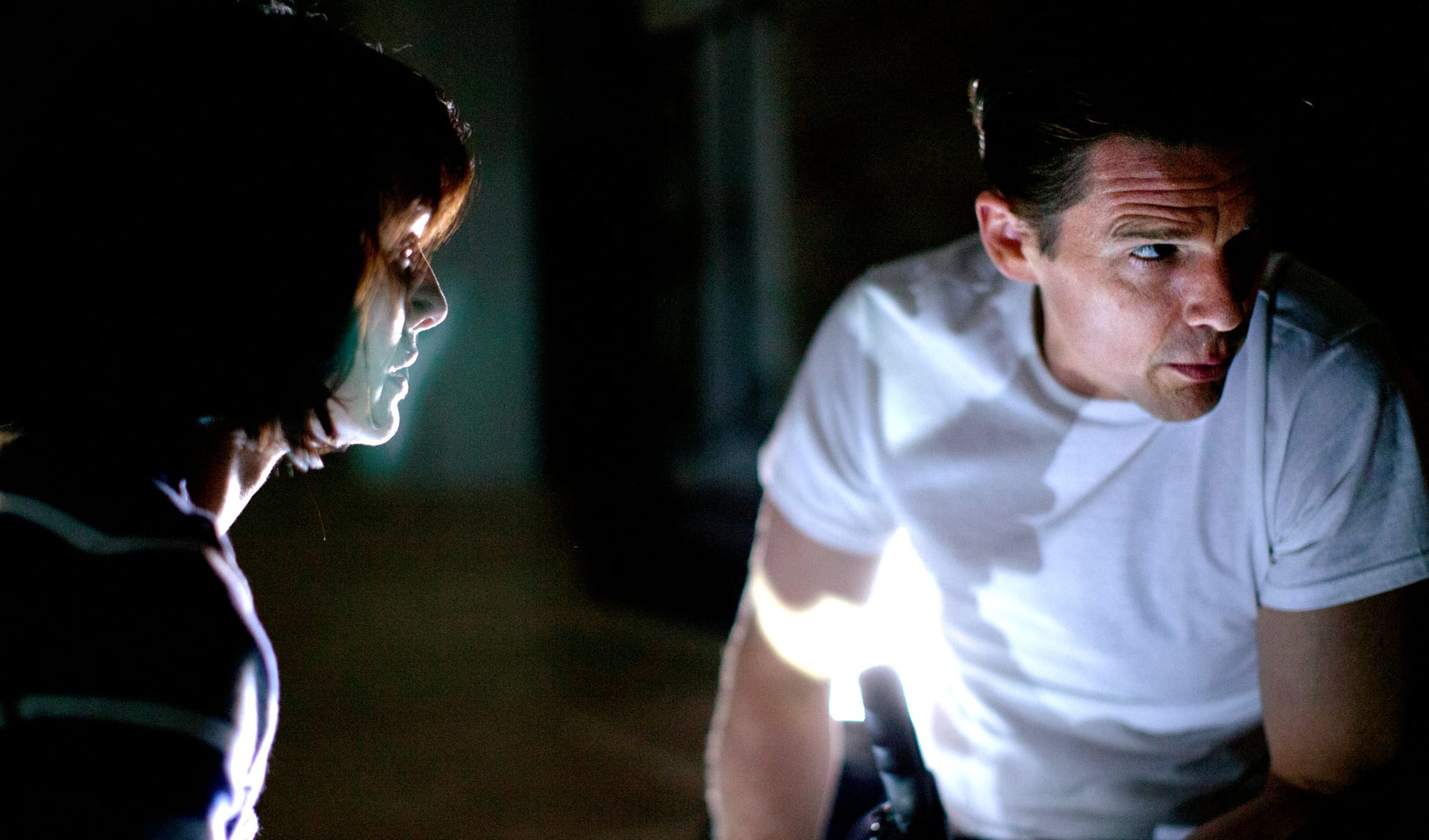
It’s the film’s media reports that first suggest DeMonaco understood how fascism might ooze into everyday life. As James drives home, he listens to a radio call-in show that makes clear that The Purge has become a widely accepted tradition. Whatever outrage might have greeted the introduction of Purge Night has faded. A caller announcing plans to kill his boss prompts the host to point out that more people than ever will be purging this year. Another who raises the objection that the poor suffer disproportionately to the rich—a key element that runs through all the movies—gets a shrugging response. “We all got our own opinions,” the host replies. “That’s what makes this country great.” At home, James’s wife Mary (Lena Headey) watches a labcoat-clad scientist talk about the psychological benefits of The Purge, the first of several examples of crank science being used as an excuse to enact authoritarian policy. (The government’s stance on vaccines remains unmentioned.)
In short, they normalized it. The Overton Window has shifted to the point where legalized murder has become not just a legitimate topic of public discussion but something of a settled matter, at least based on all evidence made available in the 2013 film. This, thankfully, still seems unlikely. Less so: the words of a Purge participant who unexpectedly shows up at the Sandlin house in pursuit of a nameless stranger (Edwin Hodge)* the youngest Sandlin child has let into the house out of mercy. The stranger is Black, wears an army jacket, and does not have the resources to defend himself. Speaking politely, the stranger’s chief pursuer, a sharply dressed twentysomething blonde man (Rhys Wakefield), asks James, “Why haven’t you delivered the filthy swine to me yet?” (It's one of the film's best, really only, jokes that he wears a mask that more or less matches his real face.) His casual delivery makes clear that this is just the way people in his circle talk about those like the stranger. You know, those people. Revisiting the film, I found myself thinking about how the President of the United States’ referring to Somali Americans as “garbage” barely creates a ripple in the news and how long-discarded slurs have been reintroduced into mainstream discourse. It’s just how a class of people talk in public now. If we’re not used to it, we’re not shocked by it, either. Even the outrage around the President posting an outrageously racist video to social media dies down after a few days. It’s awful, but it’s also become routine.
Apart from a few glimpses of the outside world, The Purge mostly stays inside the Sandlin house and it’s here that we have to talk about one reason The Purge franchise has struggled to find critical respect. The film’s concept is hooky and its relevance has only grown with time. But at heart The Purge is essentially a solid-but-unexceptional home invasion thriller. Subsequent films shift genres, functioning as action films (of varying quality) with a dusting of horror elements. (DeMonaco’s writing credits include the script for the 2005 remake of Assault on Precinct 13. The influence of Carpenter’s original and Escape from New York can be found all over the later Purge films.) The ideas that drive The Purge series are almost always stronger than the films themselves. And even those ideas often threaten to cancel out each other. As critic Nick Allen put it in his 2016 piece “Violent Worship: The Hypocrisy of the Purge Films,” they’re “violent features about anti-violence, and gun-driven action movies about the horror of an NRA-dominated society.” They’re a bundle of contradictions, expressions of horror at gun violence in which gun violence provides the only possible solution.
Yet there’s something fundamentally American about these contradictions. That DeMonaco’s vision of what was to come has lined up with what ultimately did happen in many respects confirms that The Purge films tapped into something fundamentally American in other ways, too. Where the first film mostly focuses on the country’s fixation on guns and the violent tendencies that fuel it, The Purge’s sequels widen the scope and broaden the themes.
Here’s the future (some of it now in the recent past in our less dark timeline) per the universe of The Purge: following an economic collapse, a far-right third party called the New Founding Fathers of America emerges to win the 2014 presidential election by promising economic renewal and wrapping themselves in expressions of Christian morality and American Revolutionary imagery.** Their slogan: “A Nation Reborn.” Did I mention The Purge was released in 2013, two years before Trump announced his presidential candidacy and first deployed “Make America Great Again”?
In 2016, the NFFA tests The Purge by using Staten Island (DeMonaco’s birthplace) as a kind of urban lab, events depicted in the 2021 film The First Purge, directed by Gerard McMurray. In 2017, that experiment goes national, though we don’t get a good look at what Purge Night looks like on a broader scale until The Purge’s 2014 sequel The Purge: Anarchy, which follows a handful of characters trying to survive the event in downtown Los Angeles. Over the course of the film, it becomes even clearer than before that The Purge is a (barely) covert war on the underclass designed to improve the economy by thinning their ranks while simultaneously allowing the privileged to indulge in sadism and hatred.
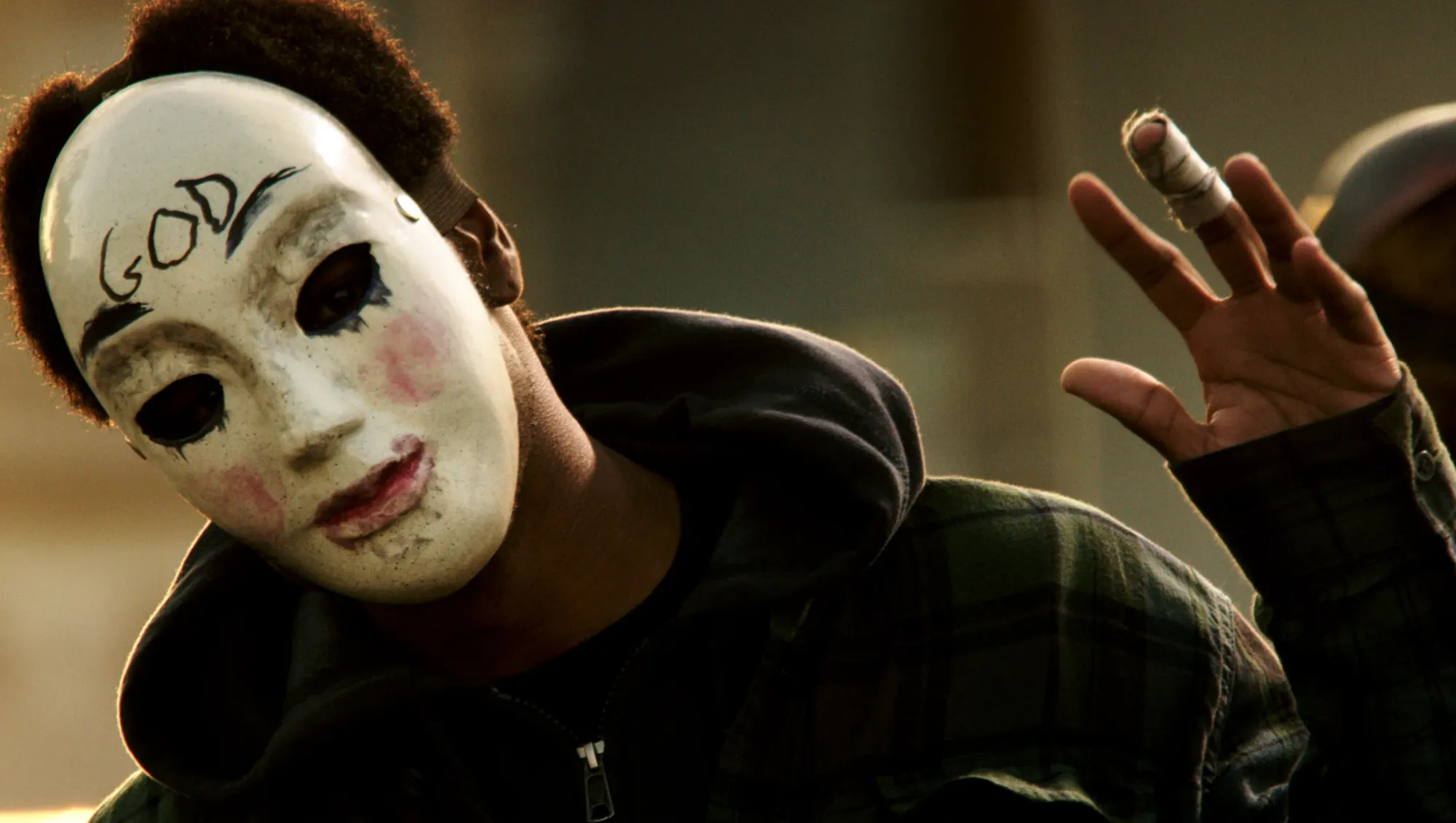
The glimpses of the wider landscape are more fascinating than the protagonists’ struggles. One fleeting Anarchy subplot involves an elderly man who willingly offers himself up to a well-to-do family in return for his own family’s financial security. The climax brings the film’s central characters to a private theater in which kidnap victims are hunted by the wealthy. Yes, we are very much in “I know writers who use subtext and they’re all cowards” territory, but as one piece of news after another confirms that much of the world is run by a handful of powerful people who are, at the very least, willing to look the other way on the sexual exploitation of children and concentration camps, I’m not sure we’re living in an era that demands much subtext.
By the release of The Purge: Election Year in the midst of the 2016 election season, the Purgeverse and our own had started to align even more closely. (Some of the film’s posters used the tagline “Keep America Great.”) Set in 2040, 18 years after the events of the original film, Election Year stars Elizabeth Mitchell as Charlie Roan, a Senator who’s in the process of making an unexpectedly strong presidential run against the incumbent, Eldridge Owens (Kyle Secor), a minister of the NFFA church. Christian nationalism has now become normalized as well, yet Roan is still able to tap into a swelling anti-Purge sentiment. This, of course, will not stand, and much of The Purge: Election Year concerns the attempt to prevent her Purge Night assassination at the hands of the NFFA.

The characters aiding this effort include Joe (Mykelti Williamson), the Black owner of a corner store whose wall art includes famous civil rights leaders; Marcos (Joseph Julian Soria), a Mexican immigrant Joe has more or less adopted as a son; and Laney (Betty Gabriel), a Purge veteran and former gang member who now patrols the streets on Purge Night administering medical aid to those in need. As the series progresses, it brings on an increasingly diverse cast of characters to stand up to foes who become more obviously aligned with white supremacy (or, at the very least, ignore it while taking advantage of Purge Night freedoms or maybe profit from it, like the band of kidnappers led by a LaKeith Stanfield's character in The Purge: Anarchy.) Election Year features swastika-adorned bad guys straight out of Frank Miller’s The Dark Knight Returns. In The First Purge, the Black and Latino residents of a Staten Island neighborhood square off against paramilitary forces (sent by the NFFA to ensure the experiment will be a blood-soaked success) wearing Klan robes and minstrel show-inspired blackface masks. 2021’s The Forever Purge, directed by Everardo Valerio Gout, shifts the action to Texas for a film filled with bad guys echoing our era’s anti-immigration rhetoric.
These shifts made the politics underlying the series clearer, though they had never been far beneath the surface. When The First Purge was released in 2018, I wrote an article praising it for directly referencing contemporary events via unmistakable allusions to Charlottesville and the massacre at Charleston’s Emanuel African Methodist Episcopal Church. (Even less mistakable: one character gets called a “pussy-grabbing motherfucker.”) I also suggested that the series had been too broad and vague up to that point. Looking back, I probably just couldn’t imagine how much the real world would come to resemble its dystopia until the similarities became impossible to ignore.
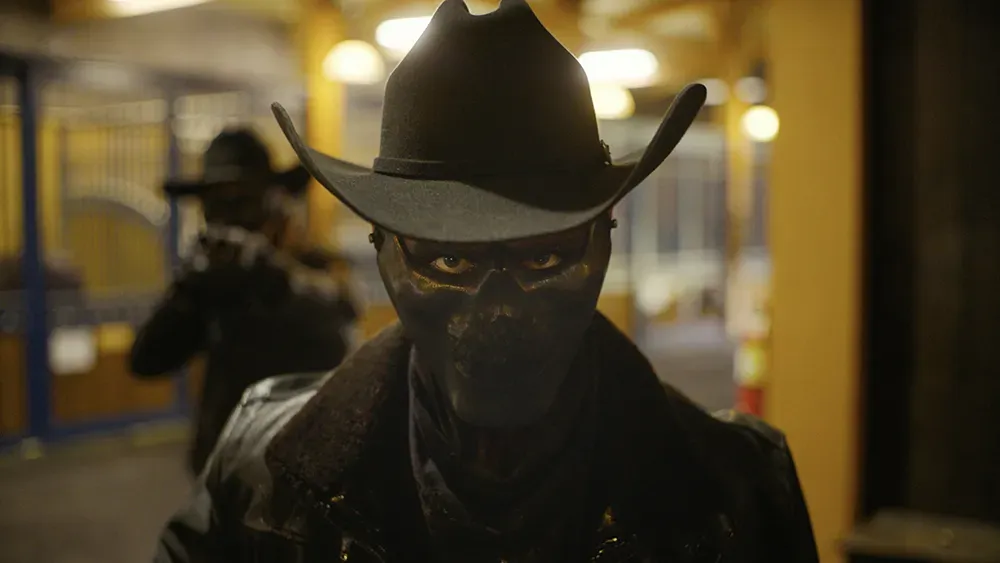
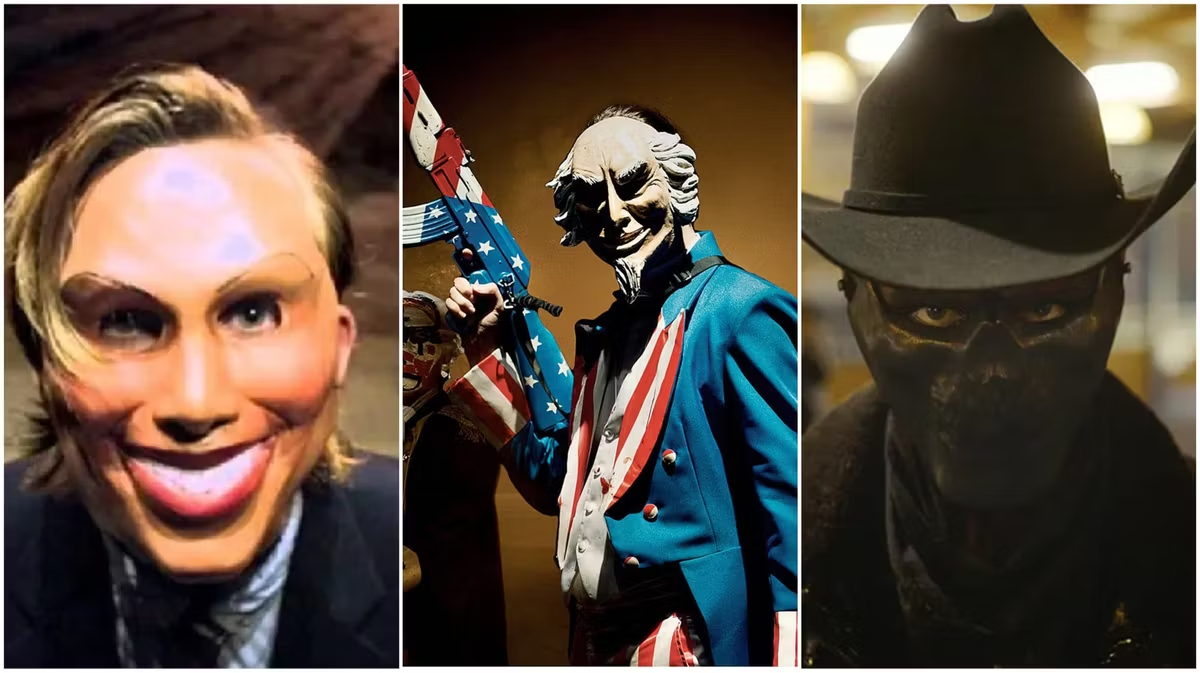
Which brings us to the masks, perhaps the Purge series’ most striking feature and an element I’ve been thinking about a lot in recent weeks. Almost everyone who chooses to participate in Purge Night, which one character dubs “Halloween for grown-ups,” dons scary masks. This, of course, makes for striking horror movie visuals. (I think my favorite are worn by the Election Year Purgers dressed like menacing versions of George Washington, Abraham Lincoln, Uncle Sam, and the Statue of Liberty whose accents reveal them to be European “murder tourists” visiting the States to participate in our national tradition.)
Masks can make those who wear them look threatening, otherworldly, and inhuman. Their anonymity can also give wearers a sense of permission to do whatever they like (and perhaps feel like they’re protected against future prosecution.) They’re a natural fit for the world of The Purge but also for anyone unwilling to take responsibility for their actions. Of course members of ICE, CBP, and other DHS law enforcement branches who’ve spread terror in the streets of American cities want to cling to their masks. Behind them, it must feel like every day is Purge Night. The continuing failure to prosecute even the murderers in their midst, to say nothing of thugs and abusers, only confirms this view. Some have even embraced the chance to remake themselves as monsters.
So where do we go from here? The Purge films*** don’t offer much in the way of solutions. They do offer a lot of pessimism that’s also found echoes in our world. Election Year ends with the NFFA facing a seemingly decisive defeat. Roan wins the election after exposing the party’s attempt to murder her. It’s the sort of humiliation that should kill a political movement forever, an event akin to, say, staging a failed coup. Set eight years later, The Forever Purge takes place in an America that’s reelected the NFFA, which in turn has reinstated The Purge. The film arrived in theaters during the first year of the Biden administration.
Yet even here there are signs of hope, which mostly takes the form of hard choices and local resistance to the NFFA and Purge Night. The first film hinges on the Sandlin family refusing to hand over the stranger in their midst to those participating in the Purge. James, who comes from humble beginnings, was never a true believer, but he saw which way the wind was blowing and has benefitted from going with the flow—until making the last-minute (if ultimately fatal) decision not to go along any further. In the sequels, characters of various backgrounds band together to battle a common foe, chipping away at a monolithic system of oppression wherever they can. A decisive victory might seem forever out of reach but, after a certain point, not fighting back stops being an option.
* Hodge’s character will be the only constant in the first three Purge movies. He shows up as a resistance fighter in both The Purge: Anarchy and The Purge: Election Year, the latter revealing his name: Dante Bishop.
** No, there was no 2014 presidential election in our universe. Just go with it.
*** Yes, there was also a Purge TV series, which ran for two seasons between 2018 and 2019. There’s not enough space to get into it here, but I thought the first season was pretty strong and expanded on the world of the movies in some intriguing ways. I have not gotten around to the second season but probably will one of these days.

Discussion