Alex Gibney, and America, Have Been Telling the Same Story for Over 20 Years
Between 'Enron: The Smartest Guys in the Room' and his new film 'Musk,' director Alex Gibney keeps finding the variations on the same scam to document.

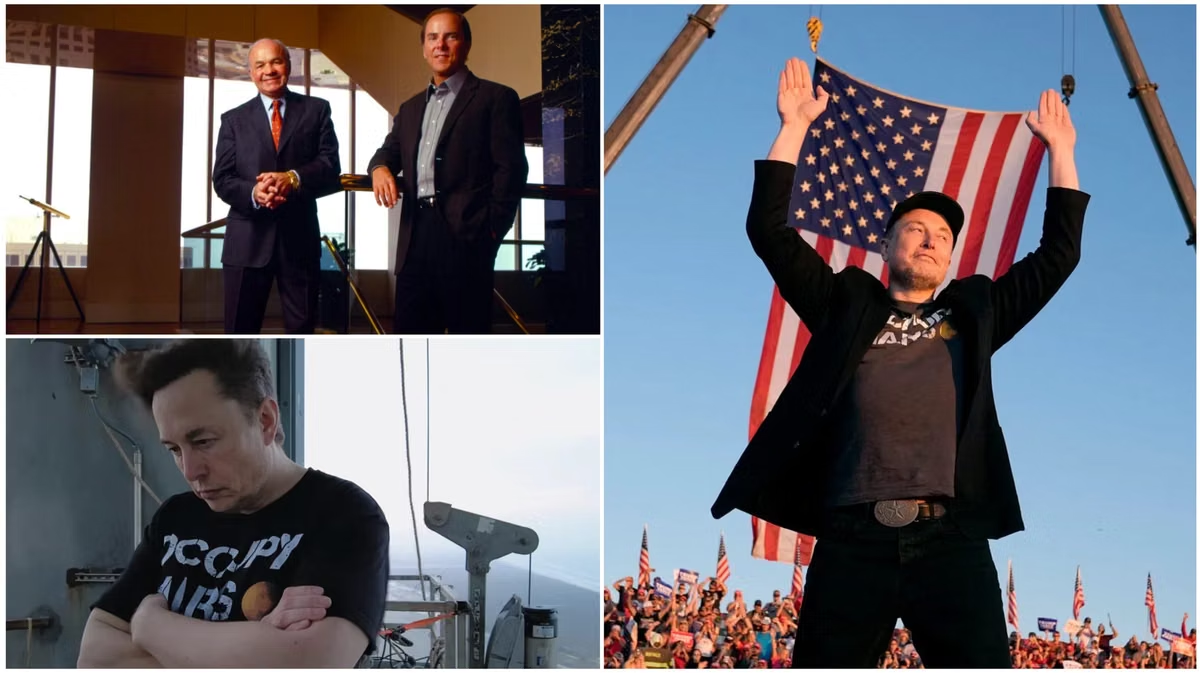
Between his 2005 breakthrough documentary Enron: The Smartest Guys in the Room and his new, four-hour Elon Musk profile, simply titled Musk, director Alex Gibney has become less a brand-name nonfiction auteur than a factory for feature-length newsmagazine pieces, often tilting toward yellow journalism. Beyond the handful of projects explicitly adapted from books—Bethany McLean and Peter Elkind’s Enron, Lawrence Wright’s Going Clear: Scientology and the Prison of Belief and The Looming Tower, and his other 2026 film, Knife: The Attempted Murder of Salmon Rushdie—the Gibney school of digestible news doc has kept turning out films with a Main Title: Subtitle nonfiction formula: Client 9: The Rise and Fall of Eliot Spitzer, Mea Maxima Culpa: Silence in the House of God, We Steal Secrets: The Story of WikiLeaks, and The Inventor: Out for Blood in Silicon Valley. Though his Oscar-winning 2007 documentary Taxi to the Dark Side, about an Afghan taxi driver who was detained and tortured by American soldiers at Bagram air base, opened up the possibility of more artful, ground-level portraiture, it turned out to be an anomaly. Gibney found a successful niche early in his career and has filled it prolifically with films that may be ripped from someone else’s headlines, but are useful summaries of important subjects. That may sound like an insult—and okay, sure, guilty as charged—but with the rise of hacky, threadbare streaming docs like the Netflix series Untold, it’s clear there are levels to this business.
While there’s something deflating about knowing exactly what an Alex Gibney doc about Elon Musk will be like—although he does roll the dice on at least one new conceit, as I’ll explain later—certain patterns have emerged in his work that give them a collective power. Over 20 years separate Enron: The Smartest Guys in the Room and Musk, but in broad strokes, they’re telling the same American story about cults of personality, the unsavory partnerships of corporations and government, and the empty voodoo of capitalism itself, which rewards speculative fantasies that look an awful lot like scams. Gibney’s rogues’ gallery of subjects— from Enron’s Kenneth Lay and Jeffrey Skilling to Theranos founder Elizabeth Holmes to Scientology chief David Miscavige to disgraced cyclist Lance Armstrong (The Armstrong Lie) to now the richest man in human history—are all cut from the same cloth, disrupter-types who brazenly violate the rules while shielding themselves from consequences. Reality has eventually crashed in on a few of them (Lay and Skilling, Holmes, Armstrong), but others still operate with impunity. The fact that Gibney keeps telling the same story is not a knock on him so much as a system that fits neatly into his template of American corruption.
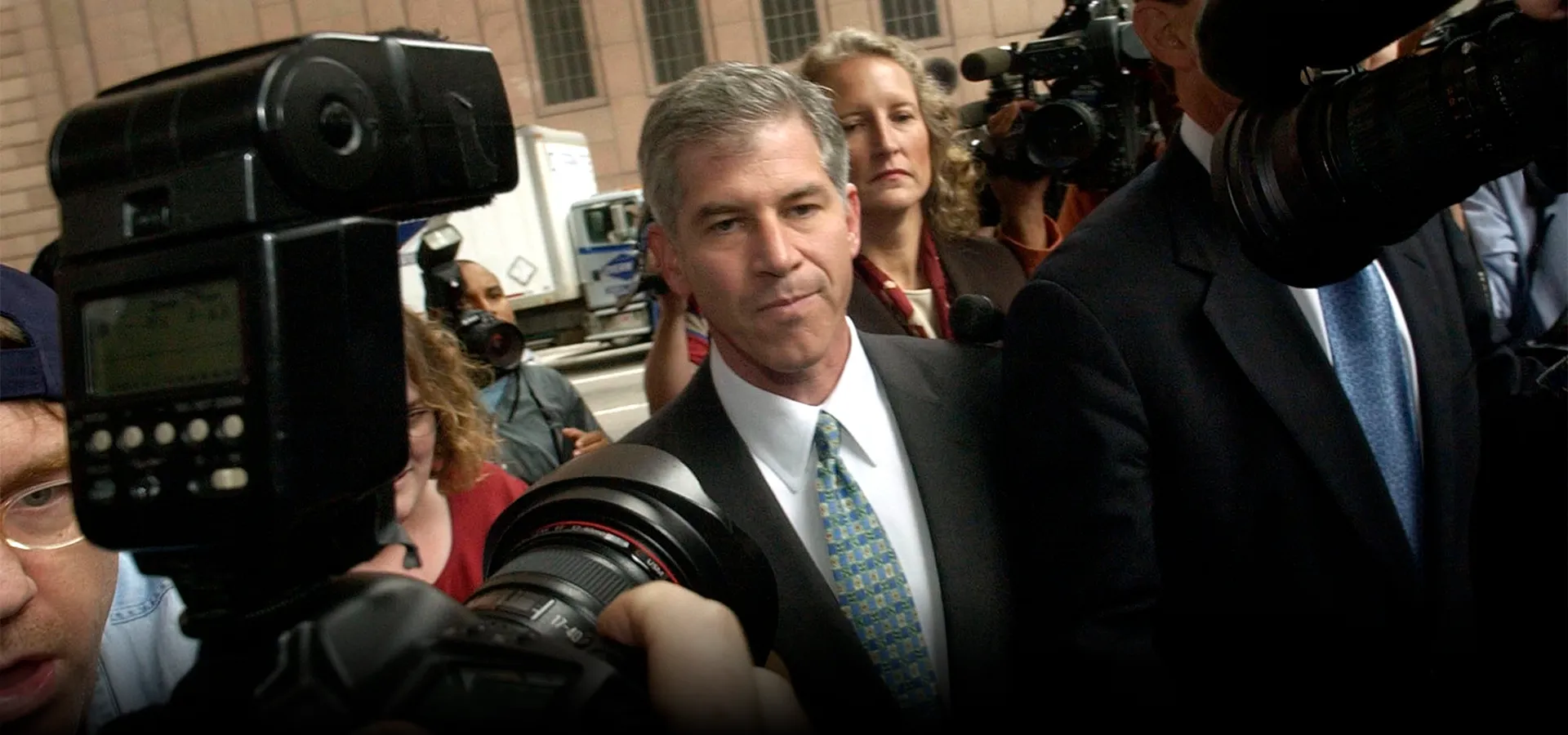
The one specific lesson tying Enron: The Smartest Guys in the Room with Musk: Arnold Schwarzenegger is your dupe of choice.
When Schwarzenegger finally appears in Enron, he’s the grinning beneficiary of a corporate catastrophe that’s swallowed up his predecessor. It seems astonishing in retrospect that the governor of California could be vulnerable to the chicanery of a company based 2,000 miles away from Sacramento, but everything is bigger in Texas, including the seismic corruption of the Enron Corporation. At the turn of the current century, Enron was the seventh largest corporation in America, and it’s a joke of the system that few could tell you what, exactly, this business was producing. Founded by Kenneth Lay in 1985, Enron was ostensibly a natural gas line company before innovating around the more abstract and lucrative business of energy trading, eventually building a sales floor that operated with the Darwinian values of an off-off-Wall-Street pump-and-dump firm. The startling part of this origin story is that the company nearly imploded before it got off the ground due to a couple of oil traders who were tucking conspicuous profits into offshore accounts before auditors caught them. Enron survived bankruptcy by tricking the market long enough to cover its losses.
Though Gibney doesn’t deal in Michael Moore-style agitprop, he comes to stories like Enron’s from a progressive angle, anxious to expose the wrongdoing of the rich, powerful, and connected. With one of the book’s authors, Bethany McLean, as a prominent talking head, Gibney breaks down the Enron story in neat little chapters that are often crudely hammered home by song cues, like Lay getting introduced literally by Dusty Springfield’s “Son of a Preacher Man” or Skilling’s financial schemes rolling out to Marilyn Manson’s cover of “Sweet Dreams.” Gibney also deploys a narrator, Peter Coyote, to piece together a story that Lay, Skilling, and Enron’s executive class made deliberately hard to follow. Even if you can get your head around the idea of a corporation that trades in energy, the particulars will have you gasping for air. How did we end up with a half-built power plant in India? And how could the failure to run California’s electrical grid properly lead to huge financial gains?
The answers to these questions involve diving into the muck of American capitalism, where a phrase like “complex financial instruments” describes innovative forms of flimflammery that ordinary people don’t understand until their retirement accounts are wiped out. Skilling’s high-stakes gambit is called mark-to-market accounting, a numbers game that allowed Enron to book potential profits on contracts before actual profits (or losses) could alter the equation. It was an epic fuck-around-and-find-out situation that allowed Enron to soar on imaginary successes and soaring stock prices before an un-payable bill came due. As Coyote notes near the beginning of the film, “It had taken Enron 16 years to go from 10 billion in assets to about 65 billion in assets and it took them 24 days to go bankrupt.”
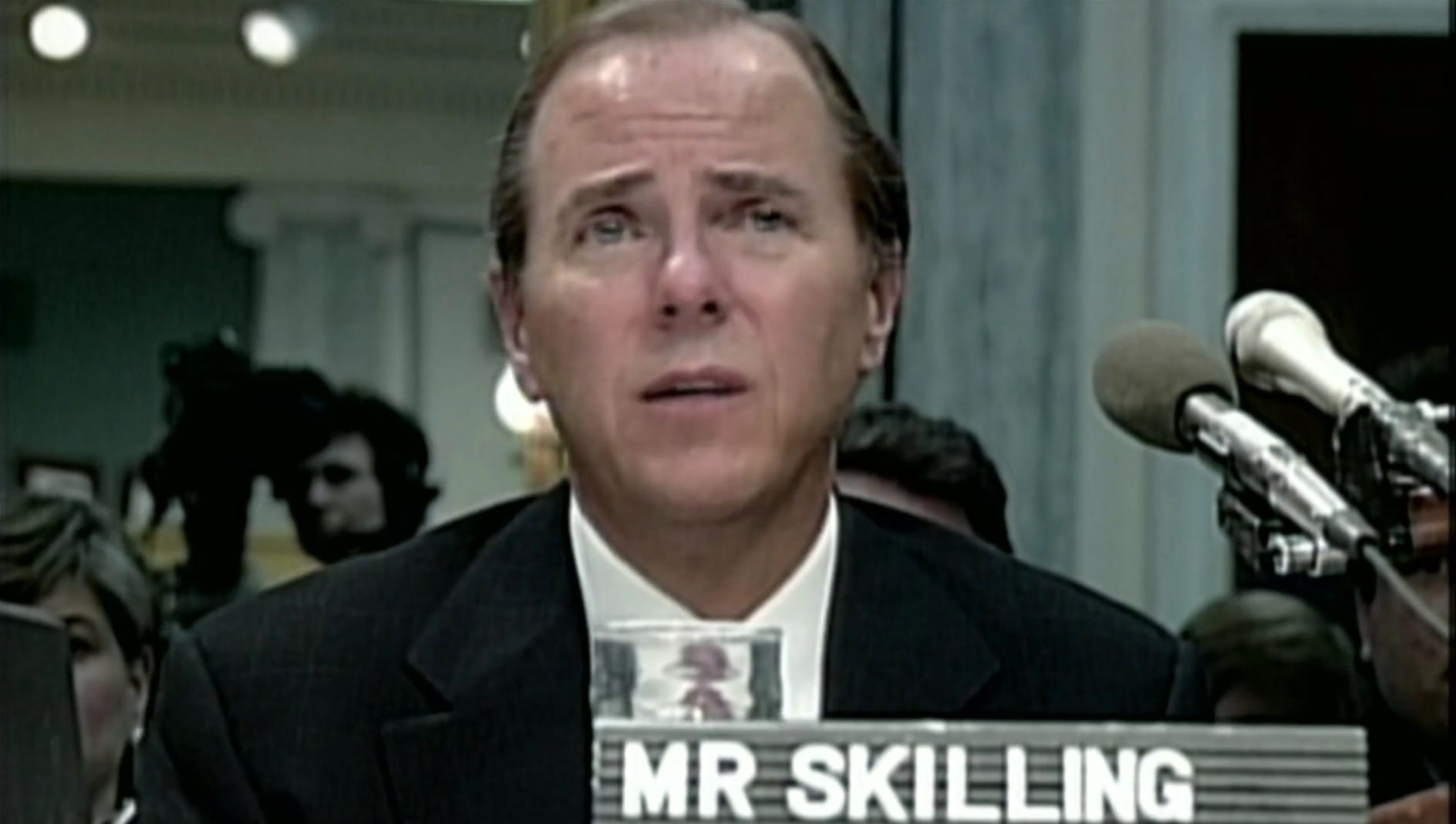
Though it’s hard to wade through the murky soup of Enron’s business model, which also involves book-cooking from the once-revered accounting firm of Arthur Andersen, Gibney does well to pick at the eccentric and reckless personalities involved and nail the political connections that allowed them to operate for as long as they did. With Lay leaning on a longstanding relationship with the Bushes—George W. nicknamed him “Kenny Boy”—Skilling could turn the trading floor into a survival-of-the-fittest that was geared toward goosing stock prices, even while key pieces of the company were face-planting. (One CEO with a zeal for strippers cashed out $250 million in stock before the roof caved in, all for running a failed division.) Given enough support from the government—and a related lack of interest from regulatory bodies—a company like Enron could get by for a shockingly long time on the perception of success, rather than the real thing. You leave the film marveling over how the seventh-largest corporation in America could be built on a smoke-and-mirrors trick.

This post is for paying members only
Sign up now to read the post and get access to the full library of posts for subscribers only.
✦ Sign up