Brian De Palma Goes to War
De Palma's extraordinary Vietnam War movie 'Casualties of War' is not about the Vietnam War.

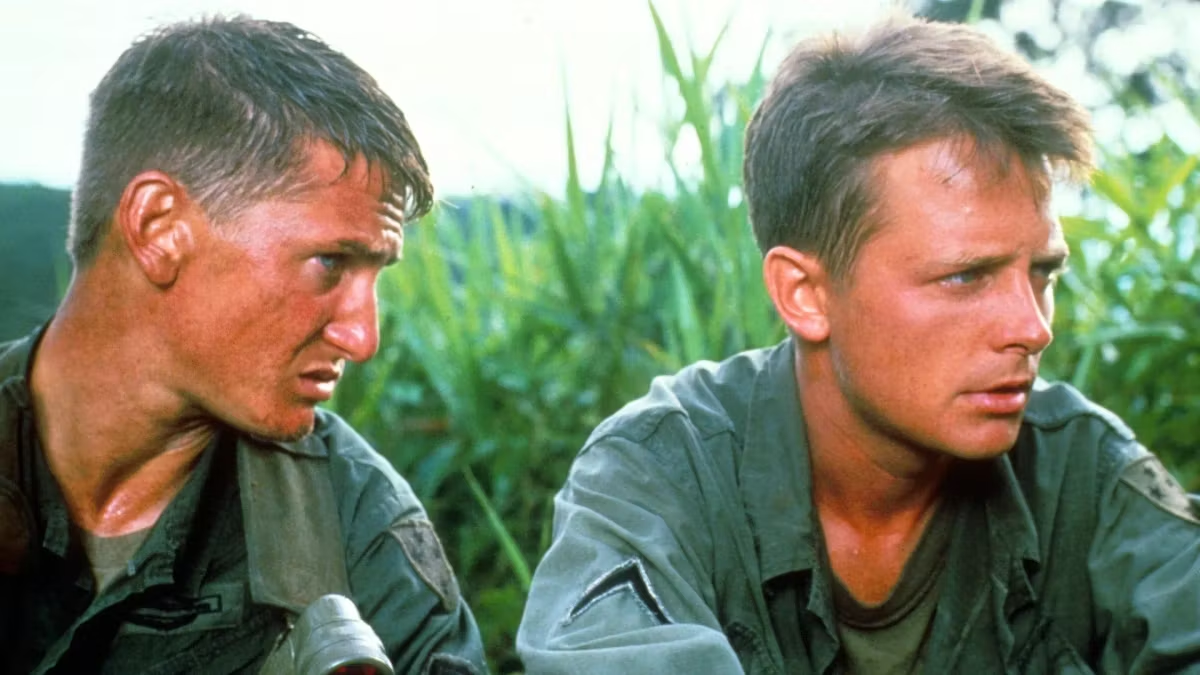
At a press conference at the Cannes Film Festival in 1979, when Apocalypse Now finally debuted after the trade-mag notoriety of production delays and cost overruns, Francis Ford Coppola famously said, “My film is not about Vietnam. It is Vietnam. It’s what it was really like. It was crazy. And the way we made it was very much like the way the Americans were in Vietnam. We were in the jungle. There were too many of us. We had access to too much money, too much equipment. And little by little, we went insane.” The mad genius of Apocalypse Now, which becomes more apparent in the great making-of documentary Hearts of Darkness: A Filmmaker’s Apocalypse, is the degree to which Coppola seemed committed to turning the production process into a journey that mirrors his hero’s nightmarish trip upriver. For it to feel authentic, it needed to have the texture of the Vietnam War, a directionless mélange of surreality and violence, cloaked in a great fog of napalm and pot smoke.
Though I’ve long considered Brian De Palma’s Casualties of War one of the great Vietnam War movies, Coppola’s statement does not apply. It is not about Vietnam. It is merely set in Vietnam. That’s not to say that De Palma and screenwriter David Rabe (Streamers, Hurlyburly), adapting Daniel Lang’s New Yorker article from 1969, are not attuned to the particular context of America’s tragic quagmire and its effect on the psyches and behavior of the men on the ground. But the title says it all: War has an impact on the bodies and souls of everyone it touches, and the images used to propagandize wars are countered by war’s corrosive and destructive realities. That De Palma would take $5 million of Mark Cuban’s money to tell basically the exact same fact-based story of rape and murder—albeit not with the same mastery—nearly 20 years later with the Iraq War drama Redacted affirms his line of thinking. The casualties of war are not specific but universal, a condition that evokes humanity’s worst potential.
Few directors have had a more fraught relationship with Hollywood studios as De Palma—maybe Robert Altman holds the crown—but after spending a decade trying to get Casualties of War off the ground, he earned himself enough commercial capital after 1987’s The Untouchables to finally cash in. We tend to think about studios as having lost their nerve after the 1970s, when the auteur inmates ran the Tinseltown asylum, but Dawn Steel made Casualties of War her first film as production chief at Columbia Pictures. The valorization of military veterans is so often a prerequisite for mainstream war movies of any kind that a break this extreme was an enormous risk, quite apart from the grim nature of gang-rape and murder at the story’s center. American anti-war movies tend to be about how wars affect troops, e.g. The Best Years of Our Lives, but for a film to focus on the despicable acts of soldiers and their enablers up the chain of command is another story. Even at times when war criminals are not treated like aggrieved parties—ahem, ahem, ahem, ahem—there’s a lot of latitude given toward what actions are permissible in that arena. Casualties of War was always an unlikely project. Today it would be unthinkable.
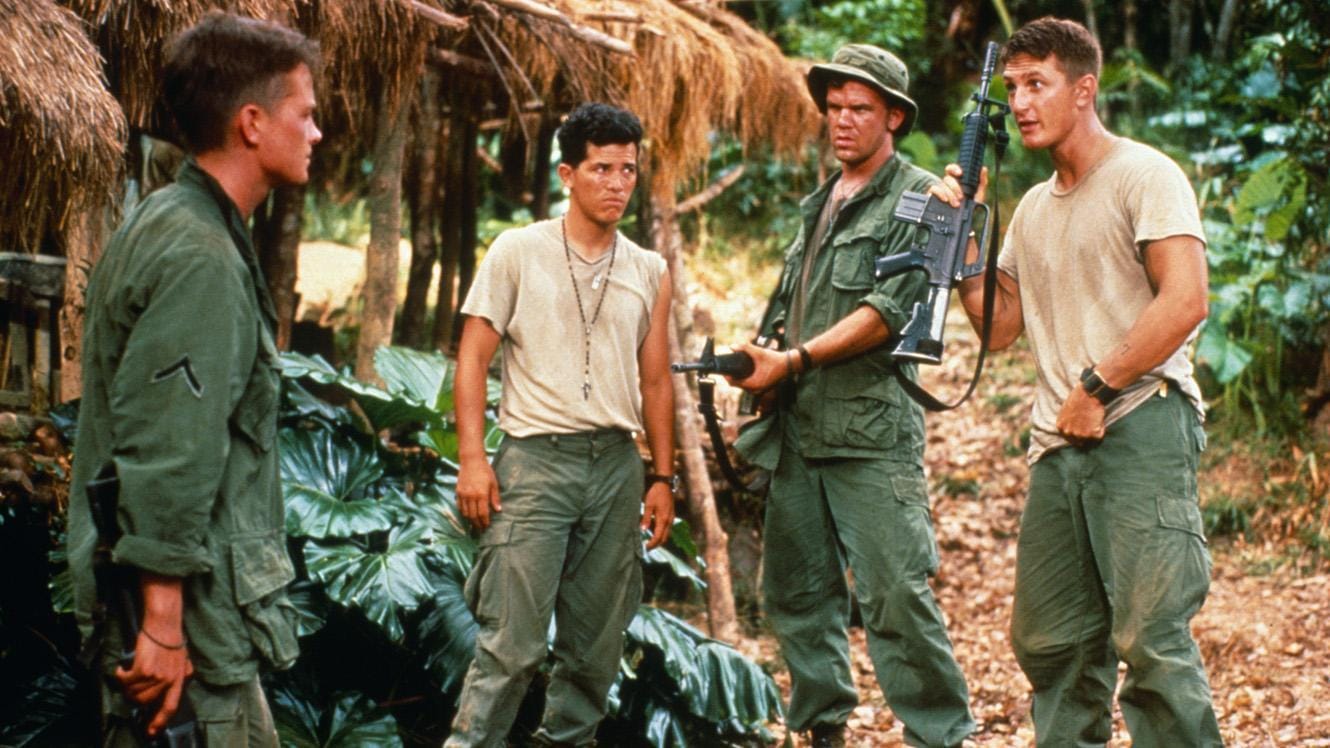
“Unthinkable” is also a word that describes the film’s journey upriver, because the sequence of events takes on a dreadful logic that none of these men could have imagined. The story is told through Max Eriksson (Michael J. Fox), relayed in flashback like a PTSD fever dream as he rides a transit line through San Francisco and spots a young Vietnamese-American student who triggers his imagination. Called a “cherry” due to his inexperience in the field, Eriksson looks thoroughly out of his depth when his platoon gets ambushed by Viet Cong during a night patrol. When Eriksson falls through the ground and gets stuck in a VC tunnel, his feet dangling like bait in the water, it sets up a classic De Palma suspense setpiece where his superior, Sgt. Tony Meserve (Sean Penn), and a VC fighter both respond to his cries for help. Meserve gets to Eriksson first and saves his life, leaving a debt that he will later be asked to pay.
A second ambush sends the platoon hurtling toward a much grimmer destination. While the men are resting in a village in the Central Highlands, they’re ambushed once again by VC and one of Meserve’s closest friends in the platoon dies from a gunshot wound to the neck. Desperate for some kind of reprieve, the men are denied leave to the village because it’s too dangerous, which leads Meserve to believe that the enemy is enjoying the same whorehouse he intended to visit. His fury is incandescent: To his mind, the villagers he’d been sent overseas to protect had set up the ambush and now every Vietnamese person looks like the enemy. That changes the rules of engagement in the field and leads to a plan to “requisition a girl” the next time they’re sent on reconnaissance patrol. “A little portable R-and-R,” he calls it.
Eriksson cannot believe the plan is real until it’s happening, and De Palma immerses us in his feelings of horror, helplessness, and overwhelming guilt. Just as Meserve planned, the platoon slips into a poor farming village late at night, searches through the huts for the right candidate, and kidnaps a young Vietnamese woman, Tran Thi Oanh (Thuy Thu Le), as her mother and sister scream in protest. All Eriksson can offer at this moment is the first in what will become a long series of ineffectual sorries, because he cannot figure out any way to stop what is happening and he will continue to struggle as the lone voice of protest in the group. One of the unsettling effects of Casualties of War is that Eriksson does summon tremendous courage on multiple occasions, but it often seems weak and inadequate, and feels to him like betrayal. Who is he to question the man who saved his life and rat out the others in his unit?

This post is for paying members only
Sign up now to read the post and get access to the full library of posts for subscribers only.
✦ Sign up