Extremely Online: 'Antitrust'
Our new column on films in the internet age looks back at time when Bill Gates was the boogeyman of Silicon Valley.

Extremely Online looks back at films of the internet era, from the 1990s to the present, that tried to grapple with our new and rapidly changing digital world.
Antitrust (2001)
Freaking out about: Tech-bro megalomania, monopolization, mass surveillance, sesame seeds.
Panic level (out of 10): 9. A vision of Big Tech as multi-tentacled source of corruption and lawlessness. Will murder for code.
Reason for optimism: Open source is the future. “Human knowledge belongs to the world!”
Tech gizmo du jour: Wall-mounted digital canvasses that morph into your favorite art when you walk in the room.
Most 2001 things (tie): Legal accountability for the world’s most powerful men. “Man, Clinton’s testimony didn’t get this many hits.” Rachael Leigh Cook.
The original Apple iPod was announced on October 23rd, 2001 and released three weeks later, pitching consumers a 5GB device with “1,000 songs in your pocket” and a $399 price tag. Even as that price would go down while the number of GBs and songs would go up, it was a truly revolutionary gadget that was worth every penny at the time. (As someone who listened to a battery-driven Discman on the bike ride to graduate school, skipping around with each bump on the trail, it was a game changer. If I didn’t work at Onion Inc., brand loyalty might have made me susceptible to the MacBook Wheel gag eight years later.) And while Google was the ascendent search engine at the time, tossing the likes of WebCrawler and AltaVista in the dustbin of the late 20th century, it was by no means a world-beating Silicon Valley behemoth.
Enjoying The Reveal? Now's a great time to become a paid subscriber. You'll get access to everything we publish—from articles to audio commentaries—and help support independent film criticism.
That left one man as the undisputed king of Big Tech: Microsoft founder Bill Gates. The richest human being in the world by far, with $58.7 billion to Warren Buffet’s paltry $32.3 billion. (Gate’s co-revolutionary in personal computer, Paul Allen, was a close third at the time.) If you owned a desktop computer, you were most likely using Windows, Microsoft’s proprietary operating system, and that’s as true today as it was 25 years ago, given that over 60% of desktops worldwide run on Windows. And so if you felt some discomfort with one guy gobbling up such a large share of a tech space that was in the middle of transforming every aspect of modern life, Bill Gates was the gawky, milquetoast super-nerd at the center of the dartboard. While he was protected, as most prominent billionaires are, by flattering media profiles about his luxurious home—in this case, a $130 million interactive “smart house” that continues to evolve outside Seattle—and various philanthropic ventures (which, it should be said, are much more significant than most), there was a prevailing worry that Gates and Microsoft were monopolizing a market with subpar products and aggressive, anticompetitive practices.
On January 12, 2001, MGM seized on all that populist discontent and fired a shot across the bow called Antitrust, which debuted at #12 with a $6.3 million box office return, because populist content of Julia Stiles in the musical-romance Save the Last Dance proved more appealing to younger audiences. (In his review at the time, our own Keith Phipps likened its B-movie fun to “the pleasing odor of extra-sharp cheese.”) Yet the film, like most of post-1995 tech thrillers, holds a time capsule fascination because it reflects the prevailing worries of a culture that hadn’t settled into a future that was still in flux. While change of any kind is likely to be greeted with skepticism, the rapid change associated with technology induces a kind of panic that defines movies like Antitrust and looks fascinating in the rearview mirror. (Hence this new column, Extremely Online.)

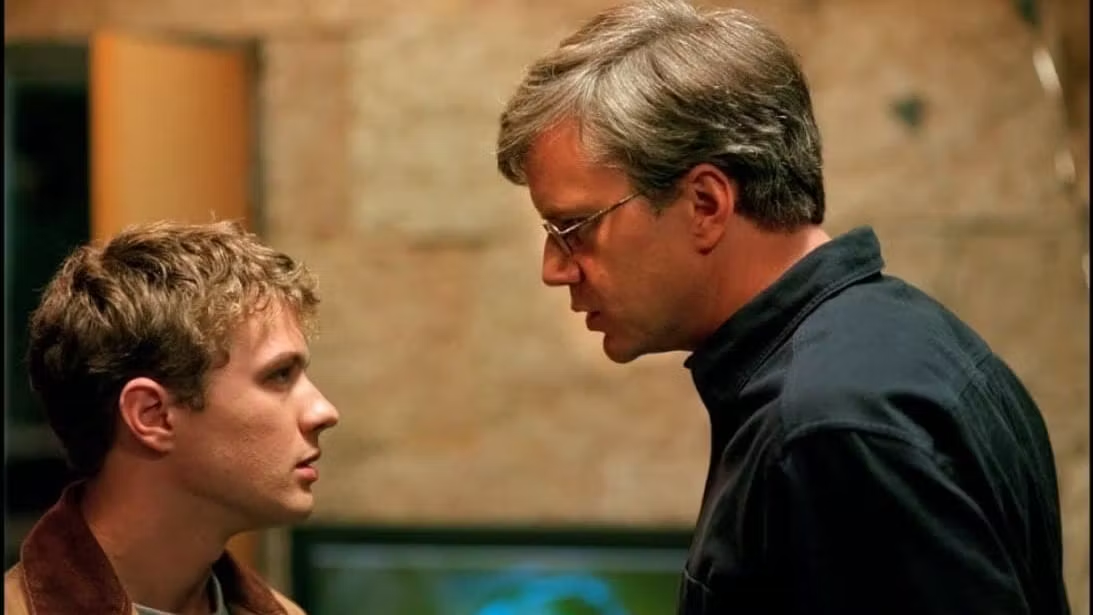
From his first appearance in Antitrust, giving one of those high-toned inspirational lectures that rouse the audience at promotional events or TED talks, Tim Robbins clearly suggests Bill Gates, and he’s got the haircut and glasses to match. Yet there’s at least some piece of “Nuke” LaLoosh, his dim fireballer in Bull Durham, to Robbins’ performance as Gary Winston, the Pringle-munching genius behind a tech company named NURV. (Acronym for “Never Underestimate Radical Vision.”) While Winston’s basic proficiency is never in question, the film suggests his true genius lies in ripping off cutting-edge work, blocking competitors, and cornering the market with mediocre products. These are charges that have been leveled at Gates for decades, but Winston has the edge on the film’s real-life inspiration in at least one respect: He’s willing to murder people to get what he wants.
This raises the stakes for young Milo Hoffman (Ryan Phillippe), a hot-shot Stanford graduate who’s been cooking up revolutionary software with his buddies out of a garage. (Okay, maybe more like a disheveled office, but in Silicon Valley mythos, any independent workspace is considered a “garage.”) Though he and his best friend Teddy (Yee Jee Tso) look at Winston with disdain, it doesn’t take much for Milo to sell out and move to NURV’s Portland headquarters with his girlfriend Alice (Claire Forlani), who refers to herself as “Yoko Ono” and fittingly plays a role in breaking up the band. While Winston and his team sell Milo on the hip corporate campus and a lot of personal attention from the geeked-out boss, the company needs its new recruit to put the finishing touches on Synapse, a world-conquering satellite connectivity system. With only 42 days before the deadline, Winston will stop at nothing to solve some imposing technical problems.
Coming out of a decade where legal thrillers were among the more bankable models in Hollywood, Antitrust is basically a find-and-replace The Firm, with Phillippe in the Tom Cruise role of a brilliant young mind brought into a prestigious corporate outfit that’s run like the mob. (Is it a coincidence that both films take place in mid-sized cities, Memphis and Portland, where the only major pro sports organization is an NBA team? Almost certainly!) Like the nefarious operation in The Firm, NURV devotes much of its resources skirting federal investigators and monitoring its own employees, relying on a security team to guard corporate secrets. Both films also have attractive women on the payroll to manipulate or sexually blackmail our heroes in order to keep them in line. In Antitrust, in fact, those are the only women on the payroll.
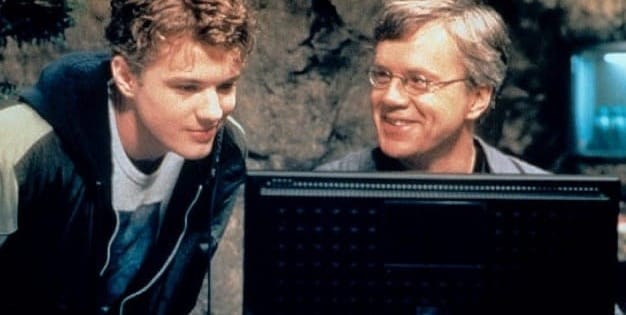
Written by veteran screenwriter Howard Franklin (Quick Change), and directed by Peter Howitt, who’d made Sliding Doors a few years before, Antitrust is a second-rate thriller at best, generic save for a couple of notably ridiculous setpieces. After we discover that Milo is deathly allergic to sesame seeds and that Alice is an ex-con working undercover (and under covers) for Winston, the stage is set for a sequence when Milo finds her secret stash of sesame seeds and scrambles to figure out whether she’s trying to murder him with a home-cooked meal. (She seductively drags her forefinger through the sauce and feeds it to him, which draws from one of the more obscure pages in the foreplay manual.) There’s also the high suspense of Milo typing away at a secret computer terminal as security closes in on him, rendered in a crude keyboard-goon, keyboard-goon editing pattern.
Yet what stands out about Antitrust now is the fury specifically directed toward Bill Gates, who’s so obviously targeted here that the film makes a wink-wink joke about Winston and Gates having the same smart-home features. (“Bill who?,” says Winston, with the cheeky tone of Max Fischer referring to the OR scrubs in Rushmore.) In 2026, it’s perfectly common for people to hold the entire rogue’s gallery of Silicon Valley visionaries in contempt, whether they’re the future subject of movies or TV series (Musk, Peter Thiel, Sam Altman, et al.) or the subject of movies or TV series that have already been produced, like Mark Zuckerberg (The Social Network), Travis Kalanick (Super Pumped: The Battle for Uber), or Elizabeth Holmes (The Dropout). While Antitrust came out just before the iPod ushered in an era of relative good feeling toward the tech world, public hostility wasn’t nearly as elevated in 2001, despite the shared sense that we were in the midst of a transformative moment.
For the Gates figure in Antitrust to rip off code and box out competitors is garden-variety capitalist behavior, in keeping with his oft-repeated mantra in the film: “This business is binary. You’re one or zero, alive or dead.” But to make that last part literal is an inflammatory leap that anticipates the anger that was only just starting to build around our tech overlords. By contrast, the open-source evangelism of young idealists like Teddy seems noble yet quaint, a flicker of independence that’s about to be snuffed by a business of unregulated growth and influence over people’s everyday lives. It’s a little ironic that Gates would turn into a pariah for entirely different reasons decades later, but Antitrust seems more justified in its panic now than it did then. If anything, it lacks the vision to understand Bill Gates as just the tip of the 21st century iceberg.
Next: Startup.com (2001)

Discussion