In Review: ’28 Days Later: The Bone Temple,’ ‘Sound of Falling,’ ‘A Private Life’
Zombies, German generational trauma, and a shrink-turned-detective all await moviegoers this week.


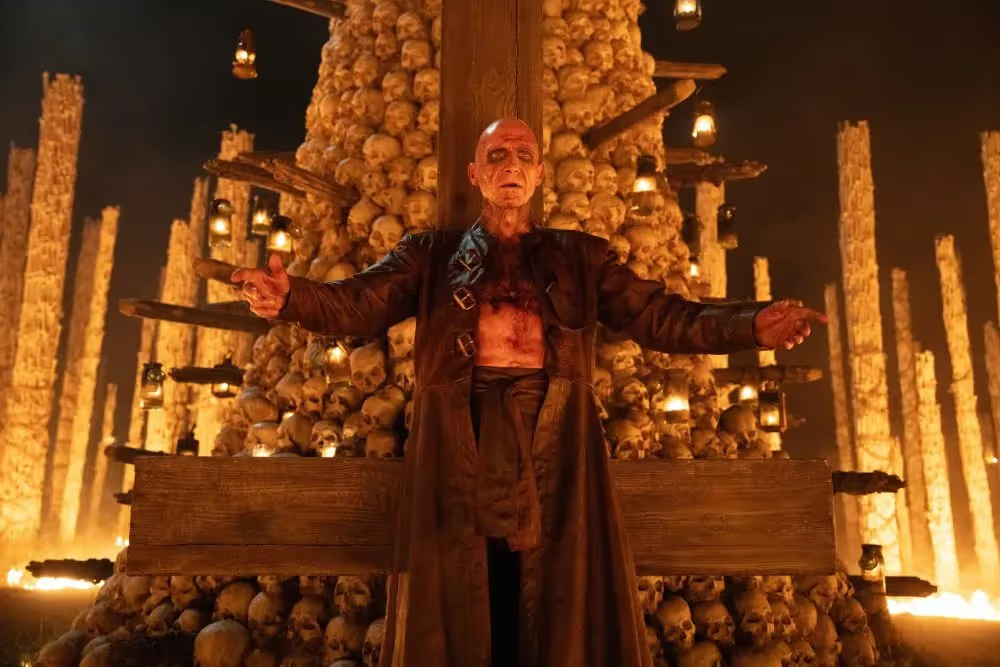
28 Years Later: The Bone Temple
Dir. Nia DaCosta
108 min.
With 2025’s 28 Years Later, director Danny Boyle and writer Alex Garland both returned to the zombie-infested world he introduced in 2002’s 28 Days Later and turned their back on it. Sure, Britain remained filled with victims of the Rage virus that turned them into pitiless killing machines, but those who’d managed to dodge it had kind of moved on. For the survivors, the undead threat had become a fact of life they dealt with while doing their best to create something like a sustainable existence. It was an audacious move and the film felt closer at times to something like Russell Hoban’s classic post-apocalyptic novel Riddley Walker than, say, Return of the Living Dead. Now Nia DaCosta’s sequel 28 Years Later: The Bone Temple goes one step further. Then it just keeps going, offering a weird, bleak, viscerally uncomfortable, and sometimes bitingly funny exploration of the persistence of evil even among those severed from the past. Yes, there are zombies. But the real monstrousness lies elsewhere.
The Reveal is a reader-supported newsletter dedicated to bringing you great essays, reviews and conversation about movies. If you are not paid subscriber, we would love for you to click this button below and join our community.
Picking up where the final scenes of 28 Years Later left off, The Bone Temple opens with that film’s young hero, Spike (Alfie Williams), being held captive by the Jimmys, a roving gang of ruffians who Clockwork Orange their way around the countryside wearing platinum blonde wigs and matching jumpsuits, calling themselves variations on the name “Jimmy” and following the orders of a leader who’s dubbed himself Sir Lord Jimmy Crystal (Sinners’ Jack O’Connell). The good news: Spike survives a do-or-die initiation rite. The bad news: that means he, too, must become a Jimmy.
Meanwhile, not so far away, a pair of other 28 Years Later characters develop a relationship initiated in the preceding film when Dr. Ian Kelson (Ralph Fiennes), the sad-eyed keeper of the ossuary that gives the film its title, discovers that he can soothe the savage breast of the hulking alpha infected he’s dubbed Samson (Chi Lewis-Parry) by using a blowgun to shoot him up with morphine. Soon, in shades of another early Danny Boyle classic, they’re getting high together in the Scottish countryside as Samson starts to manifest signs that his humanity may not have been entirely consumed by the virus.
Scripted by Garland (returning to the world after scripting both the original film and 28 Years Later), the film’s two story strands complement each other before they become entwined. While the kindly Kelson slowly resurfaces Samson’s humanity, the Jimmys embody humanity’s awful potential as the Jimmys line up behind their leader and his brutal approach to survival. When the gang breaks through the modest defenses of a small farming community, DaCosta stages the subsequent torture scenes for maximum discomfort without glorifying the Jimmys’ quest for sadistic edgelord thrills. The loveliness of Kelson, a self-described atheist, and the ugliness of Jimmy’s satanic cult feel locked in battle for Spike’s soul, and the soul of the film, even before they meet.
It’s not a subtle movie, but it’s not a predictable one, either, opening several obvious avenues for its plot to travel down then closing them off and letting the elements collide in less obvious patterns. DaCosta directs with unhurried confidence and it’s hard to imagine an actor as capable of bringing as much heart and dignity to the role of a half (and sometimes fully) naked post-apocalyptic doctor with a fondness for dancing to Duran Duran hits as Fiennes. Or one as capable of making Jimmy Crystal as simultaneously ridiculous and terrifying as O’Connell. DaCosta makes it easy to see how a character like Jimmy Crystal could thrive in a wasteland but also how the virtues Kelson embodies could weather an undead assault and a barbarous aftermath of tribalism and violence. Maybe not all places that descend into darkness have to stay that way forever. —Keith Phipps
28 Days Later: The Bone Temple rages into theaters tonight.

Sound of Falling
Dir. Mascha Schilinski
149 min.
Never let it be said that the Germans don’t have a sense of humor.
While Mascha Schilinski’s conceptually ambitious, century-spanning dirge Sound of Falling chronicles generations of untimely death, incest, and physical and sexual abuse, it’s also full of pranks. In one scene, for example, a few giggling girls in the early 20th century nail a pair of shoes to the floor, so when the maid slips into them, she immediately topples to the hardwood. In another, about six or seven decades later, an older woman emerges from the same house to discover her car has been wedged between two trees—a sight that perplexes her until the whole family rushes out to wish her a happy birthday. She doesn’t seem that amused about her birthday surprise, but then, even the pranks in the film are rooted in hardship and struggle. The laughs seem mean, and any joy unsustainable.
As it slips and slides through multiple timelines, each roughly sketching the lives of four different women, Sound of Falling is perhaps best understood as a haunted house movie not unlike David Lowery’s A Ghost Story, in that the house stays put while the residents get older or change entirely. It takes patience and attention to jibe with Schilinski’s conceit, which can seem like a patchwork of disconnected vignettes from various time periods until the connections between them start to firm up. But while they do ultimately cohere, their diffusion and malleability is crucial to the film’s impact, because Schilinski is attempting to express capital-T Trauma as a unifying theme and it goes a long way toward making that theme seem less didactic than it otherwise would.
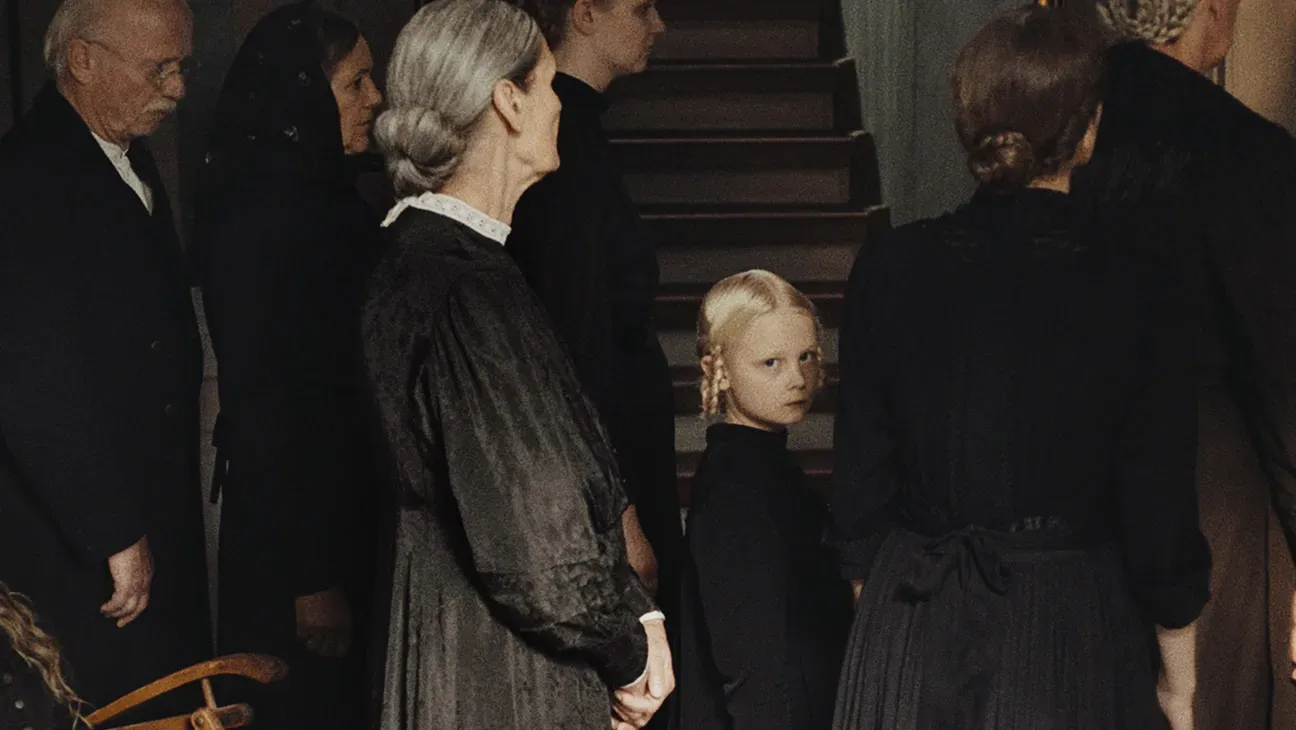
Her commitment to brutal austerity is formidable, however. In the earliest timeline, set before World War I on a farmstead in the Saxony-Anhalt region of Germany, seven-year-old Alma (Hanna Heckt), a pretty little girl with blonde braids, gazes at a girl in a series of photographs placed on the mantle in honor of those who have passed. The dead girl in the picture looks exactly like her, including the black formal dress she’s wearing for the occasion, and she’s told the child’s name is Alma. The women in the family, we learn, have a habit of dying before their time and the photograph seems like a prophecy that sets up many of the horrors to come, including suicides and disappearances, and dark secrets caught through keyholes or slats in the barn door.
Though Schilinski spends time in four different periods—before World War I, the end of World War II, the ’80s in what was then East Germany, and the early 2000s—Sound of Falling isn’t particularly democratic about how much time is spent in each, which is another point in its favor. While a single female character tends to represent each period (and other side characters, always children, grow up to appear as adults later), her most vivid creation is Angelika (Lena Urzendowsky), a teenager in the ’80s whose coming-of-age feels like a Catherine Breillat film in miniature, full of provocation and the wrong kind of sexual attention. Elsewhere, the much younger girls in the earliest two periods, Alma and Erika (Lea Drinda), have an almost spectral quality as they witness some disquieting and lasting events in the family.
There’s a loose, intuitive quality to the way Schilinski jumps around various timelines, as if she’s actively fighting against the programmatic heaviness of her own design. Sound of Falling is all-too-obviously about the mistakes and traumas passed down through generations of women, despite the great shifts in history and progress that have happened along the way. It can be a bit of a slog, frankly, but Schilinski’s command over the look and feel of the film, from the evocative Academy-format images to the unnerving rumble of the soundtrack, sinks into your bones. The more it shimmers with uncanny horror, the better. — Scott Tobias
Sound of Falling opens this week in limited release.

A Private Life
Dir. Rebecca Zlotowski
103 min.
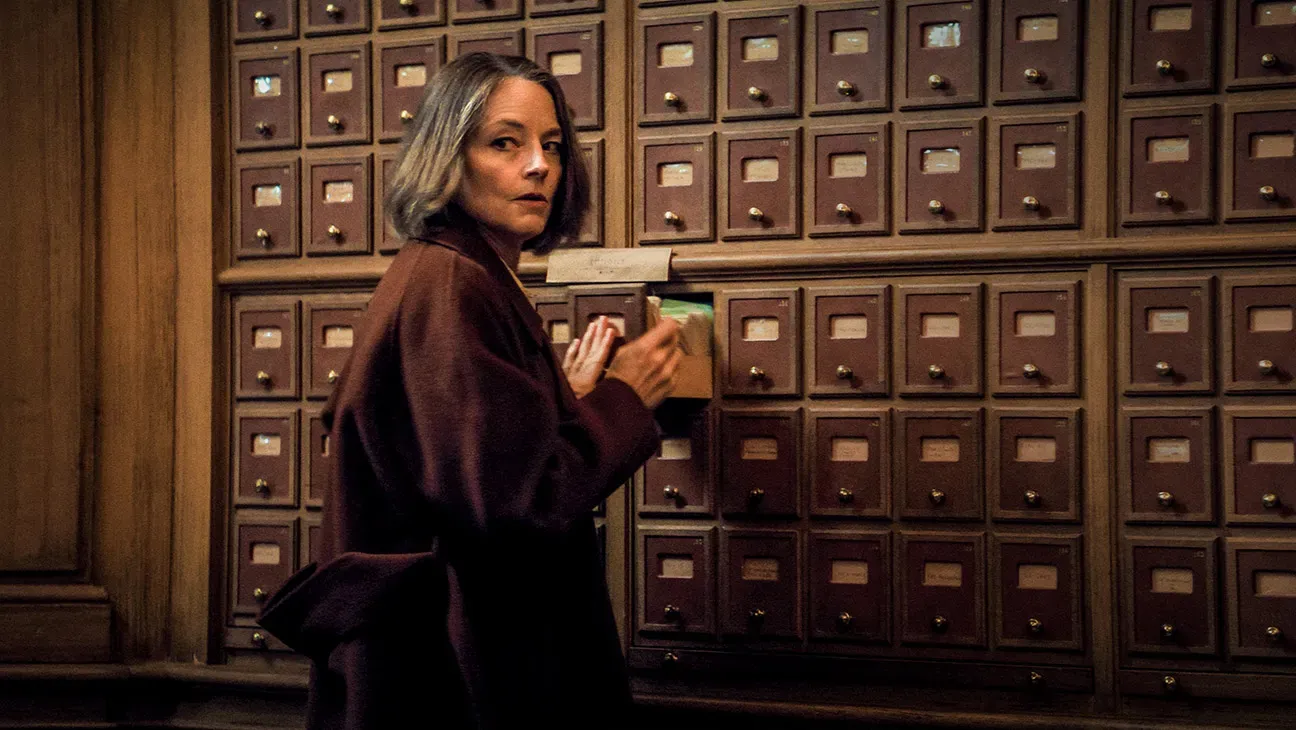
Lillian (Jodie Foster), an American psychiatrist living and working in Paris, has a tendency to hear more than she understands. Early in A Private Life, Lillian visits her upstairs neighbors to tell them to turn down their music then has to look up the insulting phrase one uses to describe her. (That they’re blasting Talking Heads’ “Psycho Killer,” a song partly in French, is a nice touch.) A woman in a seemingly constant state of annoyance, Lillian is aware of her own shortcomings and her resistance to change. She records her clients’ sessions for future reference using MiniDiscs, a format virtually untouched by the rest of the world since the ’90s, ordered by her son Julien (Vincent Lacoste). Her thinking, it seems, is that if she misses anything it will be waiting for her later. But when Paula (Virginie Efira), a longtime patient, unexpectedly dies of an apparent suicide, she realizes she might have missed too much. And that maybe, somewhere in those recordings, she’ll find some evidence that Paula didn’t take her own life after all.
Directed by Rebecca Zlotowski (Other Peoples’ Children), A Private Life is a richly realized if ultimately unsatisfying mystery, built around Foster’s compelling performance as a character awakened to all she doesn’t know or understand by an unexpected loss. A non-observant Jew, she finds herself unable to recite the expected prayers at Paula’s memorial. When Paula’s husband Simon (Mathieu Amalric), blaming Lillian for the loss, throws her out, it only underlines her sense of isolation. Yet while Lillian also finds herself more keenly attuned to possible antiemitic statements after the death, she overlooks an obviously antisemitic gesture that might help clear up her investigation.
That Lillian is not a particularly good detective becomes something of a running gag in the film, one that coincides with the revelation of how much she’s let other aspects of her life descend into mysteries she doesn’t fully understand or seemingly care to investigate. These include the reasons behind the dissolution of her marriage to Gabriel (Daniel Auteuil), the ex-husband for whom she still has feelings, or why she keeps Julien at arms’ length except when she needs to replenish her MiniDisc supply, even though he and his wife are new parents. Zlotowski understands that the real appeal of most mystery movies comes from the characters and the setting more than the plot, but A Private Life’s not-quite-fatal flaw is how little effort it puts into its plot’s central element, padding out the thin investigation with a subplot involving a hypnotist (Sophie Guillemin) and fantasy sequences set during World War II that provide some thematic echoes but ultimately feel like a distraction. Played by Foster with flinty persistence, Lillian is part of the long, great tradition of memorably screwed-up sleuths and A Private Life makes it easy to wish we’d see her again in a sequel in which she pursues a case that’s worth her time and ours. —Keith Phipps
A Private Life opens in select theaters on Friday.


Discussion