In Review: ‘Alpha,’ ‘Kontinental ’25,’ A Magnificent Life’
This week's Euro-heavy new releases include provocative new films from Julia Ducournau and Radu Jude and a fond but flawed animated biography from Sylvain Chomet.



Alpha
Dir. Julia Ducournau
123 min.
It’s hard to go bigger and wilder after making a movie about cannibalism, then following it with one in which a woman becomes pregnant after a sexual encounter with a car. With her third feature, writer-director Julia Ducournau doesn’t really try to top herself, scaling back for a tightly contained story of family and disease. Which isn’t to say that Ducournau has left body horror behind after Raw and the Palme D’or-winning Titane, as Alpha makes clear with an opening that features an extreme close-up of a drug user’s track mark. The film gets grodier from there, too, but it’s a scaled-down sort of grodiness in the service of a story about coming of age in a difficult moment, one in which the appearance of a strange new disease has been met with a panic and disgust that exacerbates preexisting prejudices.
That makes it a hard time to be 13, as Alpha (Mélissa Boros) discovers. Of course, there’s no easy time to be 13, particularly for the daughter of a single mother (Golshifteh Farahani, whose character is never named) descended from Berber immigrants. But Alpha finds it’s harder still when her mother, a doctor, flies into a panic after Alpha returns from a party with an amateur tattoo on her arm that she received while passed out. When Alpha’s unable to detail who gave her the tattoo and what they used, her mother immediately has her tested for the never-named disease that slowly turns the flesh of those who contract it into a smooth, marble-like substance (complete with veining).
Enjoying The Reveal? Now's a great time to become a paid subscriber. You'll get access to everything we publish—from articles to audio commentaries—and help support independent film criticism.
Because it’s too soon to get definitive results, they live in suspense, their fears made worse when Alpha begins bleeding freely wherever her skin has been broken. Amidst this drama, Alpha’s addict uncle Amin (Tahar Rahim, who made himself alarmingly thin for the role) shows up unexpectedly. Flashbacks to eight years earlier reveal his troubled history with Alpha and her mother and Alpha’s mother’s own experiences in the early days of the disease, which spreads disproportionately among IV drug users and gay men. No, AIDS metaphors don’t get much clearer than that.
Alpha is Ducournau’s most restrained film, one short on some of the stylistic bravado of her previous work. But there’s a studied intimacy that mostly works as an effective substitute. The scenes on the later end of the timeline stay close to Alpha, whom Boros plays as a hot-tempered, not always likeable kid prone to making questionable decisions then lashing out when called out for them. She’s a typical 13-year-old kid, in other words, albeit one caught in an extraordinary situation. Ducournau uses images of the disease’s toll sparingly but effectively, and often quite movingly, as when Alpha calls one victim beautiful and later looks on in awe at a club filled with those in various stages of the condition who remain determined to make the most of the life they have left, even as their bodies betray them. All the aspects of Alpha that work makes the film’s final stretch, which brings together the two timelines in a way that makes a lot more sense symbolically than logistically, that much more unfortunate, but no less of a worthwhile effort from a director who understands that shock and horror can sometimes clear space for understanding and empathy. —Keith Phipps
Alpha opens in select cities tonight.

Kontinental ’25
Dir: Radu Jude
109 min.
In the cultural reckoning over police violence in the wake of George Floyd’s murder in 2020, much of the critical ire was directed not toward traditional, heavily watched network cop procedurals but the amiable sitcom Brooklyn Nine-Nine, which to that point had been a largely admired twist on the workplace comedy. (Co-creator Michael Schur had, in fact, been a key writer and occasional performer on The Office.) Four previously filmed episodes for the seventh season were dropped and the eighth season, the show’s last, made an earnest attempt to address the issue head on, opening with news that a major character quit the precinct over her misgivings about the system. Brooklyn Nine-Nine, a progressive show, was a soft target because its creators and cast were susceptible to public shame. Meanwhile, the meat-and-potatoes “copaganda” of primetime continued to grind forward without much self-reflection.
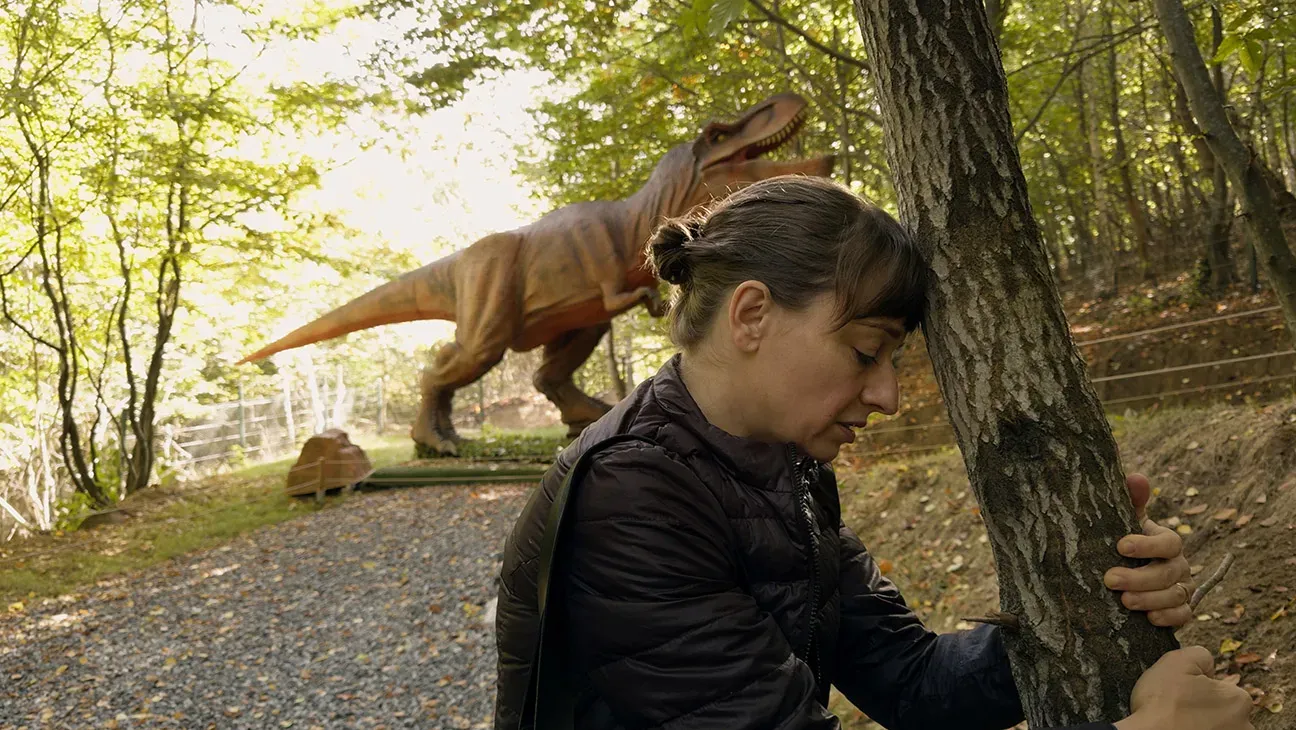
Radu Jude’s new satire Kontinental ’25 flambés just such a soft target, which is an undeniably effective strategy, because it winds up implicating the type of people who might seek out a movie like Kontinental ’25. The secondhand guilt that comes from watching a conscientious woman reckon with her role in an institutional sin is immense and it’s a credit to Jude that he’s so willing to make his audience uncomfortable. Anyone who’s ever tried to salve their troubled consciences through modest donations and earnest social media posts—which is to say me and probably you and perhaps everyone we know—will feel good and rightly zinged here. The more obvious culprits, the ones incapable of shame, will continue to grind forward without much self-reflection.
(It’s at this point that readers who want to see the movie unspoiled will want to exit, because Jude springs a structural surprise in the early going that I can’t keep from revealing.)
Drawing its inspiration (and its title) from Roberto Rossellini’s Europa ’51—the poster for which turns up in the background of a scene at a theater bar—Kontinental ’25 holds off on introducing its central character for the first 15 minutes or so, focusing instead on an unhoused man in the cosmopolitan city of Cluj, Romania. In an ingenious bit of day-in-the-life portraiture, Jude observes the man tucking recyclables into the two plastic bags he has slung over his shoulder and walking through various public spaces, stopping occasionally to solicit café patrons and other pedestrians for loose change. His “home” is the dingy boiler room of an apartment building that’s been bought by real-estate developers who intend to turn it into a boutique hotel. And that’s where Orsolya (Eszter Tompa) comes in.
With masked gendarmes in tow, Orsolya, a bailiff in this rapidly gentrifying city, has finally come to evict the man, though we learn that she’s given him a week’s notice and offered him assistance in reaching out to shelters and handling his possessions. Yet during the additional 20 minutes she gives him to pack up, he hangs himself off the radiator and cannot be revived. (In a typically wry touch, one of the gendarmes advises Orsolya to time her chest compressions to “Stayin’ Alive” as she frantically attempts to administer CPR.) The fallout over the incident is devastating for Orsolya, who blames herself for the man’s death and takes additional heat from internet commenters for doing the job as a Hungarian transplant in Romania.
Much of Kontinental ’25 is given over to long conversations that Orsolya has with people in an attempt to relieve her guilt, whether that’s a boss who brushes away her concerns or a like-minded friend who convinces her to add “homeless Roma in landfills” to a donation schedule that divvies 40 Euros a month to victims in Gaza and Ukraine, and to numerous other liberal causes. Jude does reserve some bile for powerful people who simply don’t give a shit. Orsolya’s boss, after listening to her story, replies that “life is full of unforeseen stuff” and rambles on about a South Korean guy crushed to death by a robot that mistook him for a can. But he doesn’t let her (or the audience) wriggle off the hook so easily, not when she benefits from this unjust system that she serves.
Arriving on the heels Jude’s madcap AI parody Dracula—the cast overlaps significantly between the two films—Kontinental ’25 is an impressive downshift in style, dropping the essayistic looseness of Dracula and Don’t Expect Too Much From the End of the World in favor of a drier, more disciplined approach to social commentary. A little of it goes a long way, but Jude’s attitude about his heroine does get a little more nuanced as her flaws are folded into the context of a changing city. She is not absolved of sin, exactly, but then, who could really cast the first stone? — Scott Tobias
Kontinental '25 opens in New York tomorrow and rolls out to other cities from there.


A Magnificent Life
Dir. Sylvain Chomet
90 min.
The French animator Sylvain Chomet burst onto the scene in 2004 with The Triplets of Belleville, a dizzying and dazzling homage to retro-animation and French comic books that’s littered with references to Jazz Age cartoons and vaudeville, and zips along through a series of anarchic musical setpieces. It’s an extremely difficult film to unpack—unless you’re a Francophile with a strong grasp on century-old cultural history—but a breeze to experience, because Chomet’s warm, oblong, hand-crafted images are such a feast for the eyes. Chomet’s 2010 follow-up, The Illusionist, based on an un-produced Jacques Tati script, dialed back considerably on Belleville’s manic pace, favoring instead a more melancholy and sentimental nod to Tati’s life. (Tati’s family was displeased.)
The Chomet of The Illusionist is the one who turns up for A Magnificent Life, his first feature in the 15 years since, and his distinct, self-evident strengths as an animator are dogged even further by his weakness for drippy nostalgia. The film’s French title is Marcel et Monsieur Pagnol, and the generic English title seems to confess that the subject of Chomet’s affectionate biopic, the playwright, novelist and filmmaker Marcel Pagnol, is more widely known in his home country than abroad. That might explain the storytelling shorthand that Chomet deploys in trying to account for the major events of Pagnol’s life, which the French may be expected to know, but it feels more like the thin, conventional portraiture that sinks other films of its kind. Were it not for Chomet’s impeccable images, A Magnificent Life would be a miserable drag.
Opening in Paris 1956, where a theatrical tribute to him draws a less-than-modest crowd, the film finds a 60-year-old Marcel (voiced in English by Matthew Gravelle) feeling melancholy about his dwindling audience. (“What’s the point of writing things that people no longer wish to read?”) When a magazine offers him the chance to write about his past, Marcel initially worries that he won’t remember anything, but the ghost of younger self pops up to give him a boost and the words start to flow more easily. From there, Chomet turns back the clock to Marcel’s happy youth in Marseille, where he’d write poems for a mother who would die in her mid-30s and flummox a father who was slow to accept his future as a writer. Once he moved to Paris as a young man, however, Marcel’s whimsical comedies and romances, informed by his provincial background, were a hit with audiences on stage and later on screen, when even Hollywood briefly came calling.
A Magnificent Life covers so much ground in Pagnol’s biography—and the historical changes in the country at large—that none of the secondary characters stick, including his girlfriends and wives, and the handful of collaborators that stayed with him. The ghosts of his past self and his mother are the only recurring characters and they’re both clumsy devices to trigger memories or deep-seated emotions. It’s a testament to the beauty of Chomet’s visual style that the picture book images of Paris and Marseille in the mid-20th century are transporting enough to make A Magnificent Life a comfortable sit. But Pagnol deserves better than this limp eulogy. — Scott Tobias
A Magnificent Life opens in select cities tonight.





Discussion