In Review: ‘Backrooms,’ ‘Pressure,’ ‘Power Ballad’
This week's new releases include a spooky horror movie set in a mundane nowhere land, a World War II drama about heroic acts of meteorology, and the latest from 'Once' and 'Sing Street' director John Carney.

Backrooms
Dir. Kane Parsons
110 min.
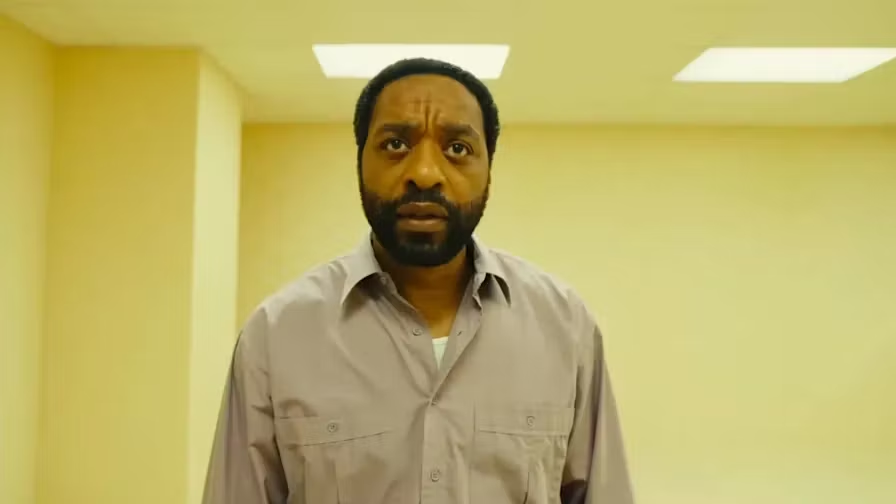
Can a place be so mundane it feels threatening, maybe even evil? Backrooms director Kane Parsons sets most of his feature debut in the sort of familiar-but-unpleasant interiors found in the disused portions of an office complex, or the little-visited lower levels of a school building, or a cleaned-out church basement. But here all the elements that make such spaces—liminal spaces, to use the term that’s come to define them—distasteful are a little too intense. Fluorescent lights hang from drop ceilings and glow with a wearying intensity as they emit a low, ambient hum. The faded beige carpet clashes with the unpleasantly yellow wallpaper. And rather than leading from one more desirable location to another, it goes on forever. Walk around a corner or step through a door and you’ll probably find more of the same. And when you don’t, well, that’s worrisome too.
In Backrooms a barely invisible seam in the basement showroom of Cap’n Clark’s Ottoman Empire—a confusingly named, pirate-themed discount furniture store—provides an entrance to such a space. It’s the film’s equivalent of C.S. Lewis’ magical wardrobe, but when Clark (Chiwetel Ejiofor), the store’s owner and manager, steps through it late one night, he finds Narnia’s polar opposite, a labyrinth so non-descript it circles all the way back to being extraordinary. Yet for all the space’s blandness, the deeper Clark plunges into it, the more threatening it becomes. Why does it feature pieces from his store in slightly altered form? What’s with the cardboard standee of a shaggy man and the stop sign with backwards letters? Why does a recording of a greeting repeated in seemingly every language but English play on a loop? And what’s that noise he keeps hearing in the shadows?
We hope you're enjoying these reviews but The Reveal has much more than reviews to offer. Become a paid subscriber and you'll get access to everything we publish—from articles to lists to audio commentaries—and help support independent film criticism.
That Clark is an architect by training makes a purely functional place constructed with no consideration for beauty seem like a hell designed especially for him, though that doesn’t mean he can’t stop exploring it. In this sense, the backrooms double as a manifestation of his interior life. His therapist Mary (Renate Reinsve) advises him to identify and break away from destructive patterns but he can’t. In time, Mary will also find herself in the space beneath Cap’n Clark’s looking desperately for an exit sign that’s nowhere to be found.
The 20-year-old Parsons got his start online via a YouTube channel where he posts videos under the name “Kane Pixels,” including a series of clips expanded for the film. Backrooms has an online origin that predates Parsons’ videos, one that can be traced back to a single image of a mid-renovation hobby store in Wisconsin that’s accumulated its own mythos via creepypasta. Yet Parsons’ film doesn’t play like an online phenomenon that’s been blown up to the big screen. It’s an intense, disturbing, and disorienting cinematic experience all its own, one that creates a disturbing vibe and then tweaks its frequency to create an unshakeable sense of dread.
It’s also a distinctly analog sort of dread that’s occasionally intensified even further by found-footage horror-inspired stretches that mine scares from the limitations of ’90s camcorder technology. But Backrooms also looks to the future waiting just beyond the era in which it’s set. Scripted by Will Soodik, whose previous credits include episodes of Westworld and Homeland, it takes place in early-’90s California at pretty much the last moment before the world went online. Yet the strange, irrational arrangement of the film’s parallel universe underworld—which contains corridors that loop back on each other, doors with three knobs, and other oddities—suggests the work of a videogame level designed by a madman. The film’s later scenes feature images suggestive of the current moment’s AI grotesquery. Clark slips into a place that sometimes looks like the world we know, but the more time he spends there, the weaker his sense of his own identity becomes. Backrooms feints at explaining what’s happening and why, then backs away. It’s all the better for keeping it a mystery and letting its distorted vision of the recent past provide a dark reflection of our present. —Keith Phipps
You can begin exploring Backrooms in theaters everywhere tonight.


Pressure
Dir. Anthony Maras
100 min.
When Group Captain James Stagg (Andrew Scott), the Scottish meteorologist tasked with predicting the weather for the D-Day invasion of Normandy, is first escorted into the large room at Southwick House in England where his subordinates are gathering data, he casts a weary eye toward a wall full of maps. These maps, we learn, chart the weather patterns of the area from the oft-distant past, with the idea that current conditions might conform to these old models and produce a reliable forecast. It’s a reminder that there wasn’t anything like Doppler radar in 1944, and coming together on an accurate forecast was still a matter of scientific debate that, in this specific instance, had outrageously outsized consequences. If he were wrong, Stagg might be held responsible for a world-altering catastrophe. Being right now puts him at the center of Pressure, a film touted as “the untold true story behind D-Day.”
It seems entirely fitting that Stagg is a relatively obscure figure in World War II history, because Pressure feels like the type of movie that’s destined to follow him, a workmanlike historical fiction that’s content to illuminate a small corner of the war. Yet there’s a meat-and-potatoes quality to the drama that’s highly appealing, mainly because such modest, performance-driven war dramas are not exactly in abundant supply. In the near future, your father-in-law will be happy to insert it into the standard rotation of WWII docs he’s streaming nonstop on his TV in the den.
After a brief scene establishing the Chekhov’s gun of the pregnant wife he’s leaving back home, Pressure follows Stagg to Southwick House, where top Allied decision-makers are readying forces for a D-Day attack on June 5, 1944, when the tides and the moon present optimal conditions for an offense by land and sea. To delay the event any further would risk spoiling the surprise for the Germans, who would have more time to fortify their defenses, but any storm that affects visibility or creates large waves would doom the attack before the boots even hit the beaches. The buck stops at Gen. Dwight D. Eisenhower (Brendan Fraser), who’s haunted by the disastrous results of a D-Day run-through, and Stagg isn’t the only man who has his ear. As Stagg concludes that a massive storm will sweep through the Normandy coast on June 5th, another meteorologist, Irving Krick (Chris Messina), predicts blue skies and some of Eisenhower’s braintrust, like Gen. Montgomery (Damian Lewis), are anxious to push forward.
The battle lines are drawn a bit too broadly here between the introspective Stagg, who operates like a top surgeon with no bedside manner, and gung-ho types like Krick and Montgomery, who look like blithering idiots for clinging to the most optimistic forecast available. But Kerry Condon has a nice supporting role as Eisenhower’s personal secretary, who serves as Stagg’s quiet advocate and intermediary, and there’s something satisfying about a war film that pleads for a measured, rigorous decision-making process. Based on David Haig’s 2014 stage play, Pressure struggles whenever it ventures outside Southwick House, especially in a third act that depicts D-Day through a crude mélange of archival footage and Z-grade Saving Private Ryan theatrics. But the drama leading up to the event is played at the highest of stakes, and Scott’s terrific performance, understated yet firm in its conviction, gives the film the same sturdy backbone that Stagg provided for the good guys. —Scott Tobias
Pressure opens in theaters everywhere tonight, in defiance of all weather forecasts.

Power Ballad
Dir. John Carney
98 min.
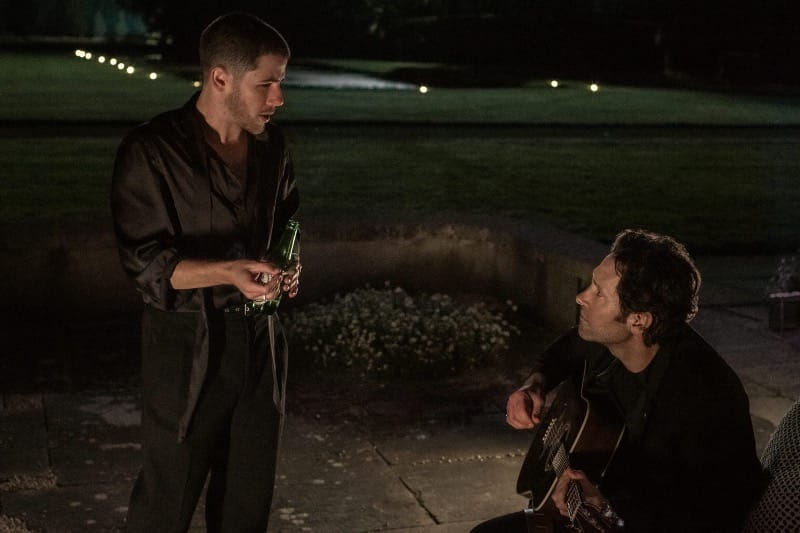
Rick Power (Paul Rudd) has dedicated his life to music but, as Power Ballad opens, it doesn’t seem like music has noticed. A Kansas City native living in the Dublin suburbs, Rick fronts The Bride and Groove, an in-demand wedding band that’s losing its patience with Rick’s habit of closing out the night with original compositions that invariably clear the dancefloor. “We’re human jukeboxes,” one of his bandmates tells him. But Rick—who has called Ireland his home since he fell for Rachel (Marcella Plunkett) while touring with an up-and-coming band years before—wants to be more. He’s got songs of his own and believes others would love them, if they’d just listen. And when a wedding gig leads to a casual but spirited after-hours jam session with the wedding’s special guest Danny Wilson (Nick Jonas), a former boy band star struggling to start a solo career, he finds an unexpectedly appreciative audience of one.
Rick leaves thinking nothing but warm thoughts about the young star until, months later, he hears one of his own songs being performed by Wilson, who’s claimed it as his own. It’s a clear case of plagiarism, or would be if Rick had any proof beyond boozy memories of his all-night jam session. Even his wife and daughter Aja (Beth Fallon) don’t seem entirely convinced. Clearly, something must be done. Yet while Rick’s search for vindication provides the plot for the John Carney-directed Power Ballad, the film’s less interested in whether or not Rick can prove he’s the primary architect of the runaway hit “How to Write a Song Without You”—Danny did come up with the bridge Rick could never get right—than how that search and Danny’s silence might change both men.
Since his 2007 breakthrough Once, Carney has focused on films about music and those who make it, but he’s rarely pushed this far into the thorny territory of what happens when artists’ professional ambitions don't align with their creative accomplishments. Rick knows he’s created something not just successful but meaningful, the sort of song that makes fans remember where they were and who they were with when they heard it for the first time. But hearing it makes him seethe. He’s alienated from his greatest accomplishment and unable to take any joy in his art. Rudd brings the expected easy charm to the part then lets it slip away as Ted’s anger and bitterness overtake it. Rudd’s always good, but Power Ballad reveals dramatic depths he rarely gets to play. Jonas is quite good as well, playing Danny as a not-bad guy whose need for artistic respectability and, more crucially, a hit—he’ll be reality-show-bound without one, his tough-minded manager Mac (Jack Reynor) warns him—compels him to cut Rick out of the process. After all, his memory of who did what that night is pretty fuzzy. There’s no upside to sharing the spotlight and little downside (beyond a nagging sense that he might be a phony).
Carney and co-writer Peter McDonald (who has a fun part as Rick’s bandmate/sidekick Sandy) never oversimplify the situation, alternating between Rick’s slow meltdown in Ireland and Danny’s isolated life in L.A., one largely confined to his life in a hilltop mansion. In some ways, however, they’re living parallel lives united by one song. Rick might be justified in wanting to right an injustice, but it’s a desire that pushes him further and further away from his family. Danny finds the success he’s looking for, but it draws him deeper and deeper into the bubble of pop stardom. They created a song that’s beloved around the world. The central drama of Power Ballad isn’t who deserves credit for that feat but who can survive it with their souls intact. —Keith Phipps
Power Ballad opens in limited release tonight before expanding nationwide next week.




Discussion