In Review: ‘The Odyssey’
Christopher Nolan's adaptation of the epic poem is personal filmmaking on a massive scale.

The Odyssey
Dir. Christopher Nolan
172 min.
The Odyssey is such a foundational piece of literature, the starting point to so many hero’s journeys, that the idea of bringing Homer’s epic poem to the screen feels like adapting the sun. Yet Christopher Nolan’s career as an artist and Hollywood conjurer has somehow made it both inevitable and achievable, with each new film building on the next as his ambitions expand, like a weightlifter doing reps. Here’s a director who deployed the Batman mythos for a three-film survey of post-9/11 anxiety and terror, who conducted large-scale experiments with time and space in movies like Inception, Interstellar, and Tenet, and who captured major historical inflection points through films about the battle of Dunkirk and the God-like conjuring of power that was the Manhattan Project. Who else but Nolan could even conceive of getting a full-scale production of The Odyssey off the ground? Or, more pertinently, who else could have invested it with this much meaning, as a continuum of a brilliant career?
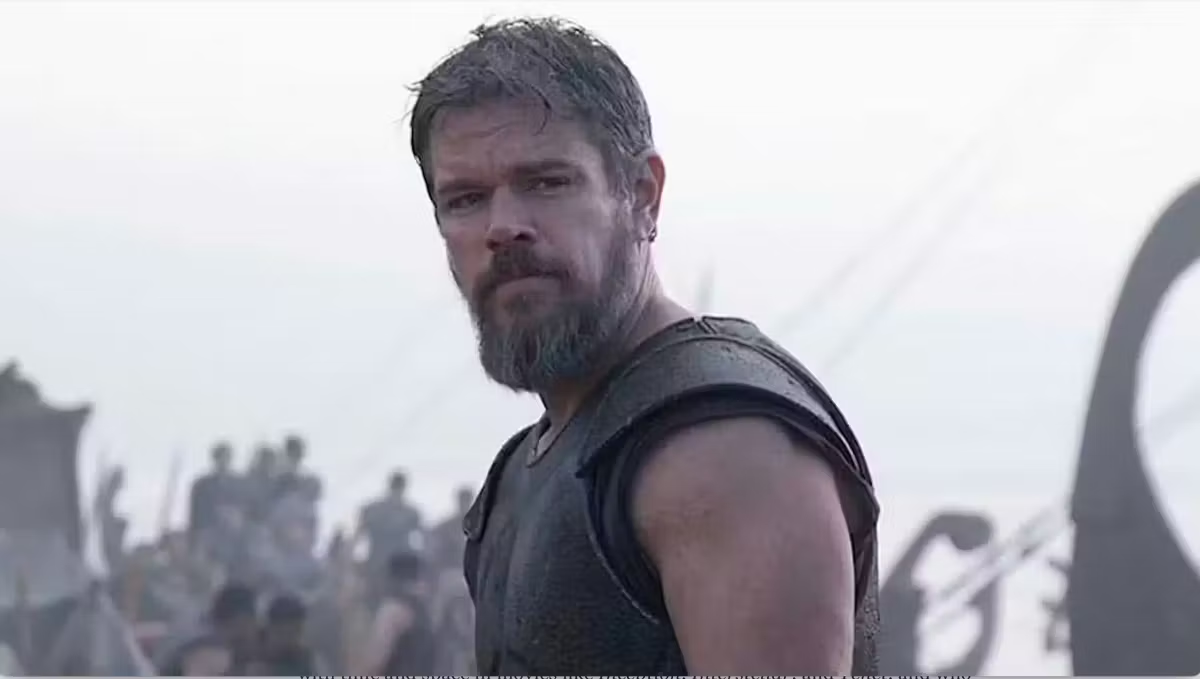
Though the themes of The Odyssey make it a natural follow-up to Oppenheimer, another film about the burdens of leadership and the marshaling of destructive force, Nolan’s obsession with time carries perhaps the biggest weight here. As Odysseus, his intrepid adventurer through various trials of Gods and men, Matt Damon feels like one of the space travelers in Interstellar, desperately plodding forward on a mission that’s urgent yet temporally borderless, with years that pass in minutes and minutes that seem like years. Though Nolan slightly dials back some of the structural trickery of his previous films, the various pieces of this story combine to devastating effect as Odysseus makes his way home from the Trojan War to the island of Ithaca, where his throne sits empty and various scoundrels plot schemes to occupy it. And that’s to say nothing of the load on his conscience, which is made to feel much heavier than his tired legs.
The Odyssey unfolds across multiple planes of action, though Nolan reserves a special place for the siege of Troy, which is elegantly established in a flashback with the Trojan Horse buried in the sand, a totem that will take its own separate and significant journey. The basic outline here is that Odysseus has been missing for two decades after the war, leaving his wife Penelope (Anne Hathaway) and their adult son Telemachus (Tom Holland) waiting in Ithaca for his return, which Penelope steadfastly believes will happen. In the meantime, the castle is overrun by suitors like Antinous (Robert Pattinson) who are vying to take Odysseus’ place next to his wife and seem to spend their days burning through the island’s supply of food and wine. Telemachus’ own claim to the throne puts him in peril, too, especially when he decides to gather up a crew of loyal men and strike out to seek any news he can get about his father.
As for Odysseus, he’s an amnesiac who’s been stranded for an unspecified stretch of time with the nymph Calypso (Charlize Theron), who’s been keeping him on an island, at a distance from humans and his own memories. But we soon learn that Odysseus has, as the kids say, been through some shit, and Nolan starts to go through some of the astounding challenges that he and his surviving force face as they try hopelessly to get home. We witness the men as they encounter Polyphemus (Bill Irwin), a cave-dwelling cyclops who gobbles up intruders like skewers of chicken satay; pay a visit to Circe (Samantha Morton), whose offer to feed them comes with a catch; and navigate their ship past the six-headed monster Scylla and and the giant whirlpool Charybdis.
At these stops and others, Odysseus makes decisions with imperfect outcomes and has to carry the consequences like an eternal load on his back. All of these episodes are ravishingly staged, as you’d hope from a $250 million behemoth, but what makes them particularly special is Nolan’s devotion to shooting on large-format film and flexing an older school of physical production whenever possible. Yet for a story of its scope, the film continues to turn inward as Odysseus keeps having to select from a menu of undesirable options and emerges with whatever tattered integrity he can muster.
The Odyssey is a huge film. It is a small film. It is a great film. —Scott Tobias
The Odyssey opens everywhere today. See it in the largest format possible.



Discussion