In Review: ‘Bitter Christmas,’ ‘How to Rob a Bank,’ ‘Victorian Psycho’
Another busy week concludes with a self-reflective film from an elder statesman and movies about two starkly different sorts of crime.


(Programming note: We've spread a review-packed week across two days. Our reviews of Ebenezer and I Play Rocky published yesterday.)
Bitter Christmas
Dir. Pedro Almodóvar
111 min.
Though it takes a while to get to it, Bitter Christmas features one of the cleverest narrative rug pulls in recent memory. Whether or not it arrives too late to matter will depend on your fondness for the work of writer and director Pedro Almodóvar. This is Almodóvar’s 24th film in a career that’s allowed him to transform gracefully from enfant terrible to elder statesman. The latter phase, which begins around the time of 1997’s Live Flesh, has produced a mix of great to, at worst, pretty good films with little in the way of disappointments (though your mileage may vary on I’m So Excited!, an attempted throwback to the wilder, more comedic films of old). Much of Bitter Christmas plays like one of the pretty good ones until a self-aware scene that throws everything that’s come before it into sharp relief. Exactly how that happens shouldn’t be spoiled, and it’s not like the movie is without its pleasures before that moment.
The story unfolds across two alternating timelines. In 2004, Elsa (Bárbara Lennie) is a filmmaker who’s segued into shooting commercials after making two films that picked up a cult following, albeit not big enough followings to create much demand for a third. There are other hindrances as well. Despite the care of Bonifacio (Patrick Criado), a loving boyfriend she met while casting an underwear ad, Elsa suffers from inexplicable headaches. She also has others in her life, like her sister Patricia (Victoria Luengo) and her friend Natalia (Milena Smit) who need her attention for various crises. Yet, as troubling as they are, these same crises help provide inspiration for a new screenplay.
We hope you're enjoying these reviews but The Reveal has much more than reviews to offer. Become a paid subscriber and you'll get access to everything we publish—from articles to lists to audio commentaries—and help support independent film criticism.
In segments set in 2026, it’s revealed that Elsa’s scenes are all part of a work-in-progress, a screenplay being written by the veteran filmmaker Raúl (Leonardo Sbaraglia). Raúl’s almost as obvious an Almodóvar stand-in as Salvador, the filmmaker played by Antonio Bandera’s in Almodóvar excellent Pain and Glory. But there’s another level to this self-referentiality: Raúl talks about Elsa being a stand-in for himself in a story that draws on his own experiences. And if that weren’t a complex-enough hall of mirrors, both Raúl and Elsa have to reckon with what it means to incorporate elements of their lives, and the lives of others, into their art.
It’s all quite compelling, albeit undoubtedly more compelling for longtime Almodóvar admirers than newcomers. The director brings his usual visual elegance, the cast delivers the expected thoughtful, emotionally layered performances, and not one but two scenes use music—in this case songs by Chavela Vargas—to heartbreaking effect. In other words, it has all the elements of a solid late-period Almodóvar film, albeit one not destined to be mentioned alongside the best Almodóvar films of the era. Then something happens that doesn’t necessarily change that but reveals that the movie you’ve been watching is not quite the movie you thought you’d been watching. It’s at once breathtaking and a little frustrating, shifting Bitter Christmas into an exciting new gear just as it approaches the finish line. Yet all the familiar elements and knowing self-references also make clear that Almodóvar understands his own cult much better than his heroine, even if they serve as set-up for an attempt to break with what’s expected of him. This is one for the true heads, but the true heads will surely love it. —Keith Phipps
Bitter Christmas opens in limited release today.


How to Rob a Bank
Dir. David Leitch
122 min.
When Brian Thompson, the CEO of UnitedHealthcare, was shot and killed outside a hotel in midtown Manhattan, condolences were, let’s say, slower to arrive than expected, especially once the perpetrator was revealed to be Luigi Mangione, a dashing 26-year-old who became a kind of folk hero. The controversy over Mangione’s meme-friendly ascendence left a lot to unpack, but it was plain enough that this daytime murder, reportedly motivated by his severe back pain and the inadequacies of the health care system, tapped into populist anger over corporate greed and its human consequences. This kind of retributive violence is hard to justify, but the point of the “Free Luigi” crowd is that predatory operations like UnitedHealthcare make life-or-death decisions every day. They just don’t make the news.
Produced by the anti-capitalist rabble-rousers at [checks notes] Amazon MGM Studios, David Leitch’s How to Rob a Bank seizes unmistakably on this internet-driven fury, offering a crime spree that the masses can get behind. While it stops well short of murder—these are armed robberies but not assassinations—the basic idea of these vault-raiding content creators is that banks are exploitative businesses and it’s okay to rip them off, because deposits are protected by the FDIC. There are plenty of cinematic precursors to Leitch’s film, from the masked robberies of Point Break to the righteous on-the-lam heroines of Thelma and Louise, but it feels more like a super-charged update on Hell or High Water, Tyler Sheridan’s recession-era crime drama about a series of economically motivated bank jobs. The film’s sincerity is as questionable as its glib, caffeinated, trend-hopping tone, but it’s a fascinating barometer on how people are feeling in 2026.
Shot through with the pace and irreverence of previous Leitch films like The Fall Guy and Bullet Train, How to Rob a Bank stars Nicholas Hoult as Ryan, the ringleader of a Pittsburgh crew that broadcasts its exploits on the YouTube channel of the title. As he and his team, including his partner Emi (Anna Sawai) and Afghanistan vet Vince (Pete Davidson) continue to rob banks and harvest clicks, they start to develop an army of followers that sees them as modern-day Robin Hoods. That presents a special challenge to John West (John C. Reilly), the straight-arrow FBI agent in charge of the case, who has the unenviable task of catching them while facing a PR problem. For help, he turns to a former hacker (Zoë Kravitz) who’s offered relief from house arrest if she can use her technology to fight the crew’s technology.
Leitch and his writer, Mark Bianculli, hold off on revealing Ryan and Emi’s true motivations for their crime, but it’s plain from the start that corporate exploitation is the target and even West has to do his job with stabs of regret. The maximalist style that Leitch brings to his films gives a baseline muscularity to How to Rob a Bank, but he seems incapable of finding another gear, which makes it seem hollow and insincere. The ravaged backdrops of West Texas gave character to a film like Hell or High Water, but here the generalized fury feels more like Joker, with a more cartoonish and abstract relationship to the real world. It’s a content machine, too, trying to find its place in the cultural algorithm. It won’t be standing next to you at the revolution. — Scott Tobias
How to Rob a Bank is now playing in theaters everywhere. That is, if The Man lets you see it!

Victorian Psycho
Dir. Zachary Wigon
102 min.
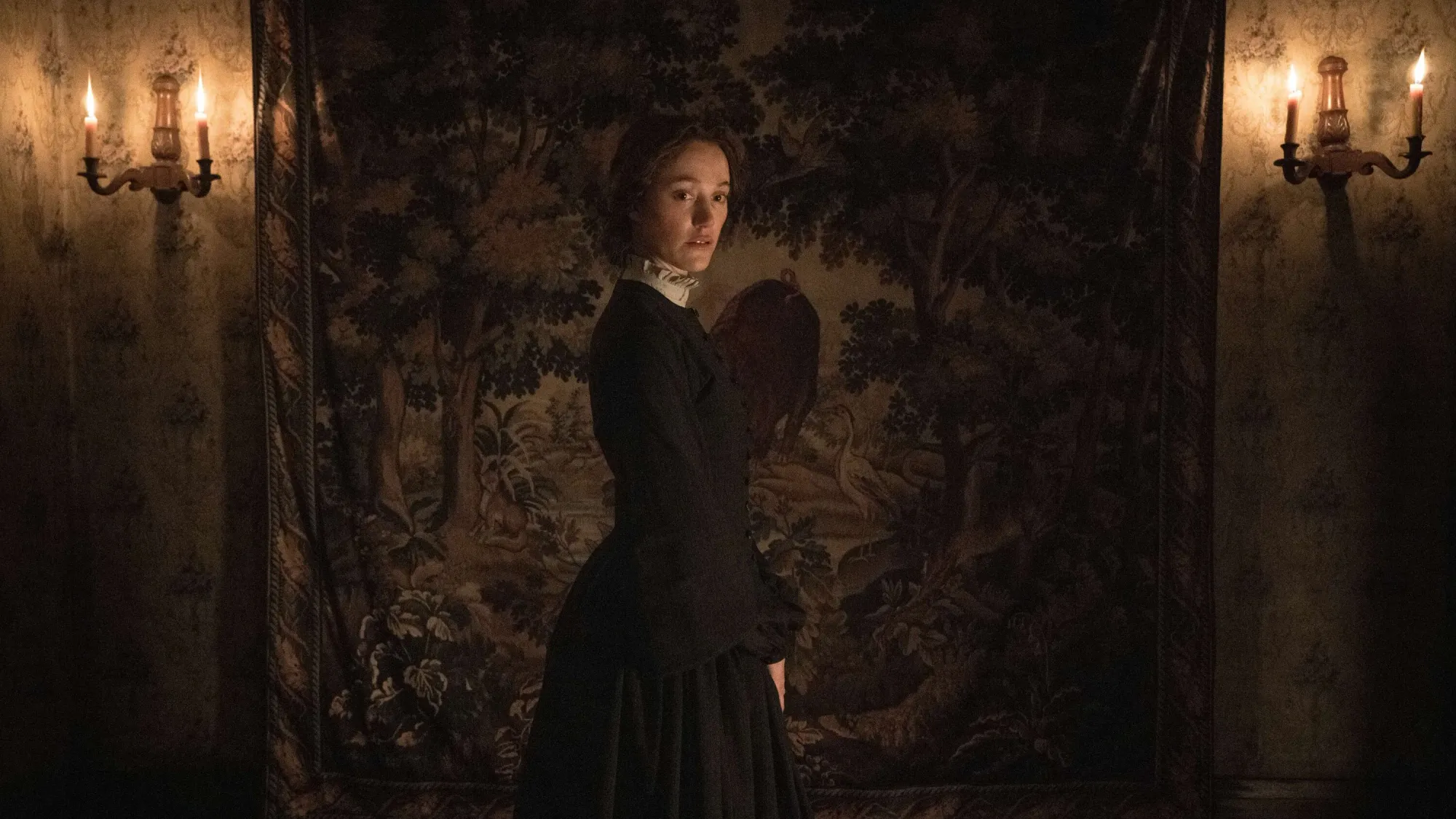
The nods made by Victorian Psycho to American Psycho don’t end with the title. Directed by Zachary Wigon (Sanctuary) from a script by Virginia Feito, adapting her own 2025 novel, it’s the story of an unhinged protagonist who commits one bloody crime after another, taking pleasure in the violence, gore, and mayhem while hiding in plain sight—misdeeds so improbable that it seems at times they must belong to the killer’s imagination. But the resemblance only goes so far. Where Patrick Bateman embodied the worst tendencies of ’80s yuppie culture taken to their homicidal extreme, Winifred Notty (Maika Monroe) is a lowly governess who’s everything Victorian society professes to abhor, despite her unassuming appearance. As the film begins, Winifred has just taken a position as governess for a family living in a cavernous estate somewhere in Yorkshire in the middle of the 19th century. She has some unusual notions about what that job entails.
Her new bosses immediately prove to be demanding or otherwise unpleasant. Mrs. Pounds (Ruth Wilson) treats her with imperious condescension as she instructs her on the importance of shaping young Andrew (Jacobi Jupe) into a young man of substance and, oh yeah, if time permits, she should maybe educate Andrew’s older sister Drusilla (Evie Templeton) while she’s at it. Mr. Pounds (Jason Isaacs) is kinder but may have an agenda of his own. But at least there’s Miss Lamb (Thomasin McKenzie), a fellow servant who’s friendly, if not particularly smart (though that has its advantages). It doesn’t take long for this already tense arrangement to begin unravelling. After Winifred kills a perfectly healthy-looking deer the children discover napping in the forest, she turns it into a lesson. Healthy or not, she was putting it out of its misery because it was in “tremendous pain.” Her reasoning: “all living creatures are.” Before long, she’s putting two-legged creatures out of their misery as well.
From the opening shot of Winifred staring off into the distance with a smirk on her face while claiming in voiceover she’s “the sanest person I’ve ever met,” Monroe gives the performance her all. At once amusing and disturbing, she’s almost enough to save the movie from falling into tedium as the bodies mount and the pace starts to drag. Wigon directs with flair (sometimes too much flair), but it doesn’t take long for Victorian Psycho to develop the same problem as the novel it adapts: It’s built around a single joke—a mousy-seeming mad governess taking apart an outwardly perfect-looking wealthy family. It’s a good one, at least at first, but the joke gets less effective as its various retellings get more intense and the satire is never all that sharp no matter how deep Winifred cuts. —Keith Phipps
Victorian Psycho begins spreading mayhem in theaters today.





Discussion