In Review: ‘Godzilla Minus Zero,’ ‘Mouse’
Of mice and monsters: This week's new releases include a rousing kaiju sequel and a superb American indie drama.


Godzilla Minus Zero
Dir. Takashi Yamazaki
135 min.
Godzilla Minus One—writer/director/effects artist Takashi Yamazaki’s 2023 take on the Godzilla franchise, set in the aftermath of World War II—ends like the 1954 film that started it all: with the big lizard sinking to the bottom of the ocean, presumably never to be seen again. Well, presumably by anyone who’s never seen a Godzilla film before, anyway. After Minus One’s critical and commercial success, a sequel became inevitable. But could any follow-up match the stunning visuals, emotional intensity, and historical resonance of Yamazaki’s first film? Three years later, Godzilla Minus Zero arrives with the answer: Yes! (Mostly.)
Set in 1949, two years after the events of the first film, Godzilla Minus Zero wastes no time confirming that the kaiju remain a clear and present danger to Japan via an opening scene in which a terrifying winged creature lays waste to the city of Matsumoto. Though the monster sports only one head at first, that’s destined to change, revealing the new foe as one familiar to longtime Godzilla fans: King Ghidorah, the biggest asshole in Godzilla’s rogues’ gallery.
We hope you're enjoying these reviews but The Reveal has much more than reviews to offer. Become a paid subscriber and you'll get access to everything we publish—from articles to lists to audio commentaries—and help support independent film criticism.
Standing up to this threat (especially with Godzilla out of the picture) will require the combined efforts of the heroes of the previous film and some new allies. Kenji Noda (Hidetaka Yoshioka) now heads a service dedicated to dealing with such problems, aided by Makoto (Masami Nagasawa), a meteorologist who’s trying to redeem herself from a past disaster only she believes to be her fault. Though the ace pilot Kōichi (Ryunosuke Kamiki) and his wife Noriko (Minami Hamabi) have started a new life with their adopted daughter Akiko (Sae Nagatani) in a Tokyo that’s still recovering from the events of Minus One, they’re eventually drawn into the crisis, too, in part because Noriko’s miraculous recovery has a connection to Godzilla. Also playing a key role: Professor Murakami (Min Tanaka), a survivor of Hiroshima, Godzilla’s attack on Tokyo, and Ghidorah’s recent rampage.
In one of the film’s most telling touches, Yamazaki films flashbacks to Murakami’s experiences in Hiroshima (which took his family) and Tokyo in a style that makes little distinction between the two. Godzilla began as a metaphor for the atomic bomb and Yamazaki’s two Godzilla films have only bound history and the monstrous symbolism it inspired more tightly together. In Minus Zero, that extends to using kaiju as a counterpart to the escalating Cold War of the film’s setting and to a deep ambivalence with Japan’s relationship with the United States, which has come to play the part of ally, protector, and puppetmaster. The end of war doesn’t mean an end to the trauma it created, as Murakami’s alternately poignant and chilling subplot conveys.
Like its predecessor, Minus Zero mixes gripping action scenes with moments of high emotion. The former—massively scaled fight scenes that mount in intensity while revealing surprising twists—top those of the first film. The latter come close enough. Kōichi and Noriko remain appealing characters, but the film gives them a defining dilemma, a choice between defending their country or protecting their new family, that makes their story overwrought and overly sentimental at times. And where Minus One felt self-contained, Minus Zero spends a lot of time laying groundwork for movies to come, almost to the point where it feels incomplete. (Think Spider-Man: Across the Spider-Verse vs. Spider-Man: Into the Spider-Verse.) These are ultimately pretty small problems, however. As a visual stylist and a dramatist, Yamazaki continues to expand the boundaries of what Godzilla movies can be by circling back to how they began and exploring the historical circumstances that shaped them and continue to shape the world. —Keith Phipps
Godzilla Minus Zero begins irradiating theaters tonight.

Mouse
Dir. Kelly O’Sullivan, Alex Thompson
120 min.
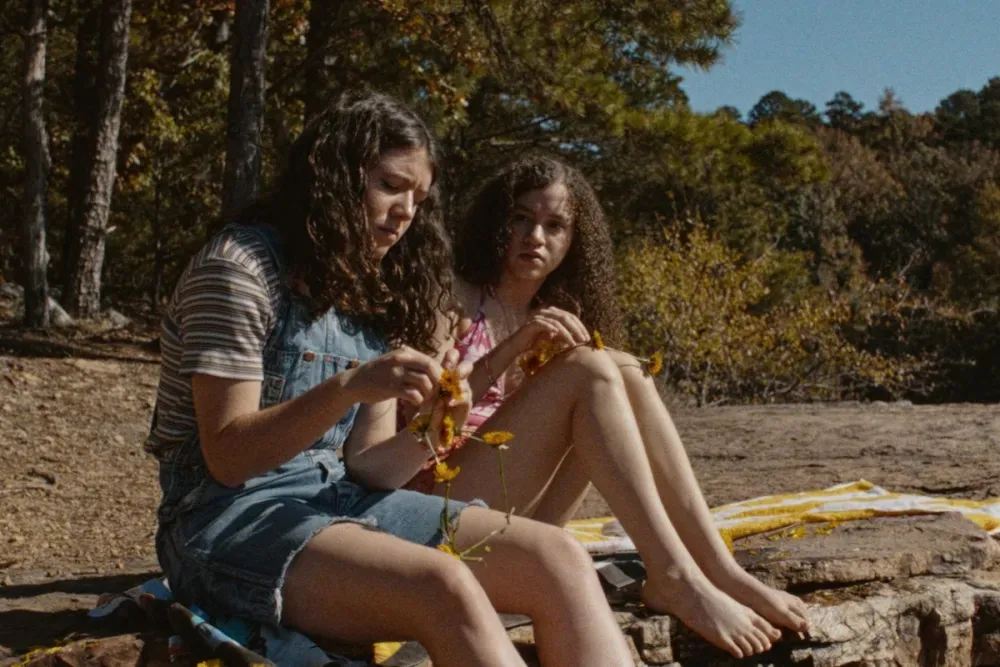
As her junior year draws to a close, 17-year-old Minnie (Katherine Mallen Kupferer) thinks she understands who she is and where she belongs: standing quietly by the side of her longtime best friend, the popular, outgoing Callie (Chloe Coleman). Callie hosts the student news program, while Minnie works the camera. Callie stars in her high school plays. Minnie mostly helps keep them going off stage. Minnie rides shotgun in Callie’s Lexus, a car her mother Barbara (Tara Mullen, Kupferer’s real-life mom) could never afford. This only sounds one-sided, however. Theirs is a true, deep friendship. Callie may surround herself with other popular, well-to-do kids who think she’s their best friend, but Minnie knows she’s the only one who can truly make that claim. And though Callie has made extremely detailed plans for the path she’ll follow to achieve Broadway stardom, Minnie knows Callie will always be in her life. Then, without warning, and before their last summer as high schoolers has even begun, she’s not.
Written by Kelly O’Sullivan and co-directed by O’Sullivan and Alex Thompson (the team behind 2024’s remarkable Ghostlight), Mouse is at once a coming-of-age story and a film about grief with emotional depths as vast as its scope is modest. Set in the Little Rock suburbs in 2002, it follows Minnie as she tries to figure out who she is without Callie. In this, she’s not alone. Before much time has passed, Minnie begins spending long hours with Callie’s mother Helen (Sophio Okonedo), whose marriage to Mark (Christopher Ellis), the American lug she followed to Arkansas in search of family and security, was already disintegrating before they lost their only child. (This, Helen notes, has moved up the timeline.) United by loss, Helen and Minnie fall into roles based on need.
Without her daughter, Helen happily spends time with a girl she already loves. For Minnie, Helen both serves as a connection to Callie and as someone who can succeed in all the ways she sees her own mother failing. Barabara’s overworked and underpaid by the small veterinary practice where she works, a job that’s led her to fill her house with strays—including an abandoned infant who needs attention that Minnie might want for herself. Helen has money, a lovely home, and the ability to provide meals that don’t come from the freezer or Taco Bell. They’re puzzle pieces that almost complete each other. But only almost.
By contrast, just about every element of Mouse fits together perfectly. O’Sullivan and Thompson know and understand the time in which it’s set—a moment when a Christian teenager who’s taken a True Love Waits pledge could still point to Britney Spears as a moral role model—but also the place. One teen mourner tearfully explains that her “mom’s organizing casseroles” mere hours after Callie’s death; later, Helen will note that, after that first wave of casseroles, most people try to avoid her. When Minnie realizes that her new friendship with Kat (Iman Vellani), an outgoing video store clerk, might be more than merely friendly, she’s not sure who she can tell. The film also has an almost miraculous ability to lace what might otherwise be unbearably sad scenes with humor. It’s hard to feel overwhelmed with heaviness, no matter how serious the moment, after a cut to a smiling kid tap-dancing to “Achy Breaky Heart.”
Yet for all the care put into the script and direction via an understated but strong visual sense and careful pacing, this is an actors’ film with two extraordinary performances from Okonedo and Kupferer at its center and a handful of others surrounding them. A marginal presence at first, Barbara emerges as a fully developed character at the same pace it takes Minnie to see her as someone other than an inadequate annoyance. Vellani and David Hyde Pierce, as a drama teacher who played an important role in Callie’s life, are similarly excellent. Mouse doesn’t stray from the few square miles immediately surrounding Helen and Minnie’s homes, but it doesn’t have to. That’s space enough to explore what happens to those who have to put themselves back together after the world they know falls apart. —Keith Phipps
Mouse opens in limited release tomorrow before expanding.





Discussion