In Review: ‘Fjord,’ ‘Everest: The Other Side’
Cristian Mungiu returns with a hot button drama and a documentary chronicles a daring feat gone wrong in this week's reviews.


Fjord
Dir. Cristian Mungiu
146 min.
During a time of relentless politicization, it can be hard to process a film like Fjord, Cristian Mungiu’s provocative new Palme D’Or winner, without wanting to man ideological battle stations. If you were told that Mungiu had made a film about a progressive country’s heavy-handed treatment of conservative Christian family, then you might assume that DailyWire+ had infiltrated cinema’s most elite circles. How could Mungiu, a Romanian New Wave director who chronicled the harrowing ordeal of seeking an abortion under Ceaușescu’s regime in 4 Months, 3 Weeks and 2 Days, turn around and make a film inspired by a case that drew international attention as an example of religious persecution? The answer is right there in the question: Mungiu is keen to abuses of state power and the plight of individuals who are caught up in cruel bureaucracies that defy common sense. Illiberalism is his favorite theme, and he supports it in Fjord with a typically scrupulous docudrama that feels like a noose slowly closing around your neck.
We hope you're enjoying these reviews but The Reveal has much more than reviews to offer. Become a paid subscriber and you'll get access to everything we publish—from articles to lists to audio commentaries—and help support independent film criticism.
Though Mungiu has been careful to deny a direct connection, Fjord is plainly informed by Ruth and Marius Bodnariu, a Romanian couple who moved to Norway and had their five children taken away from them in 2015 due to allegations of corporal punishment, which is strictly forbidden in the country. There are nuances to the case—and nuances to Mungiu’s film, too—but the gist is that many accused Norway’s child protection agency, Barnevernet, of overstepping their bounds. That’s Mungiu’s position, too, but Fjord is remarkably clear-eyed about how such a situation might have unfolded, carefully following each link in a chain of decisions that sparked the controversy. At every turn, common sense falls prey to the machinations of a system that can’t accommodate it, despite its earnest mission to protect children. Once the case gains momentum, it cannot be stopped.
The ambiguities that run through Fjord are epitomized by Sebastian Stan’s slow-burn performance as Mihai Gheorghiu, an evangelical Christian from Romania who moves to an idyllic Norwegian town with his wife Lisbet (Renate Reinsve), a nurse and mother of five who has family in the area. The Gheorghius have an infant at home but the older children attend a local school, where a gym teacher notices that one of them, Elia (Vanessa Ceban), has bruises on her body. Though the headmaster Mats (Markus Tønseth), whose daughter Nora (Henrikke Lund-Olsen) has quickly grown close to Elia, seems reluctant to follow through on it, policy dictates that they summon child protective services to investigate. From there, things escalate quickly. Though there’s evidence for how Elia got bruised, the interview process reveals that the Gheorghius have physically disciplined their kids in the past by spanking. During the investigation, Barnevernet agents remove all the children from their homes and scatter them across various foster families until their safety can be assured. As justice turns against the Gheorghius, however, they turn first to Mats’ wife Mia (Lisa Carlehed) for counsel and later to international Christian activists for support.
It would be simple enough for Fjord to dismiss this oppressive nanny state out of hand, and Mungiu isn’t always subtle on that front, like when Lisbet first meets with a cold Barnevernet official as a giant Norwegian flag flaps outside her window. But he does reveal some unsettling signs on both fronts: When peers warn Mihai and Lisbet against proselytizing—him by playing a few bars of “Amazing Grace” on a keyboard, her in passing Biblical comforts to the bereaved—it raises questions about whether the Gheorghius were getting the benefit of the doubt. On the other hand, there’s an unsettling darkness to Mihai’s seething temper and his eagerness to marshal evangelical fury to their side. Fjord strongly suggests a reasonable solution here, just as 4 Months aligns with women seeking an abortion, but Mungiu is keen to systems of justice that are rigged against ordinary people, regardless of left-right binaries. Now isn’t the easiest time to release a film like Fjord—goodness knows, there are less persuasive cries of Christian persecution out there—but perhaps that makes this the right time, too. — Scott Tobias
Fjord is now playing in limited release. Worth seeing if you can afjord it.

Everest: The Other Side
Dir. Elizabeth Chai Vasarhelyi and Jimmy Chin
115 min.
Part of what allowed Free Solo, directors Elizabeth Chai Vasarhelyi and Jimmy Chin’s 2018 documentary about rock climber Alex Honnold, to remain gripping when it might have turned excruciating was knowing that Honnold survived the improbable and ridiculously dangerous climbing feats he set out to accomplish. Sure, it seemed impossible that anyone could climb to such great heights upon such unforgiving surfaces sans ropes or other pieces of lifesaving gear without falling to their death, but Honnold’s continued existence offered literally living proof that at least one person could. Everest: The Other Side, the team’s latest, offers no such assurances. Years in the making, it began as a film about a daring climbing feat but events forced it to evolve into an account of a tragedy and its aftermath.
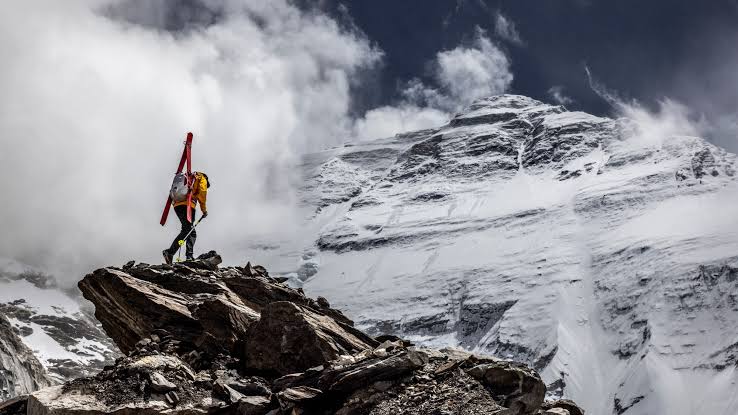
Ski mountaineers Jim Morrison and Hilaree Nelson seem like the sort of couple destined to find one another. After meeting while summiting Mount Everest—an expedition that coincided with the crumbling of Nelson’s marriage—they built a life together around the sport they loved and a dream expedition they hoped to make together. Specifically, they wanted to climb Everest’s forbidding north face—which only a handful of mountaineers had previously been able to do—then ski down it. It’s a dangerous pursuit both felt compelled to follow despite knowing the risks, a choice complicated by the loss it might inflict on Nelson’s two sons, with whom Morrison had formed a tight bond, should either of them not survive. (And while the events covered in the film are a matter of public record, those not wanting to know the specifics of the tragedy at its center should probably stop here.)
What begins as a glowing portrait of a pair of soul mates changes course with shocking swiftness when Nelson, while training for Everest, is swept away in an avalanche as Morrison and the film crew look on helplessly. This leaves Morrison, who’s already survived one tragic loss, to pick up the pieces and decide how to carry on. It also leaves the film shouldering a burden it’s not fully equipped to carry.
Everest: The Other Side allows for a certain amount of soul searching, including some by the filmmakers. At one point Vasarhelyi asks Chin, to whom she was married at the time (they divorced in 2025), how many people who’ve eaten at their dining room table have died. It’s not a question either can answer quickly. And though the film allows considerable space for Morrison’s grief, it’s ultimately better at exploring the “how” of the story than the “why.” Nelson’s sons, central to the early scenes, disappear for much of the film. When they reappear, years have passed and they still don’t seem to understand why their mother would take such a risk, only that there was no stopping her from doing so. It speaks well of the film’s honesty that it would feature such unsettled emotions, but these scenes also introduce questions that sort of trail off into nowhere in favor of a simpler narrative in which Morrison’s decision to carry on becomes a tribute to Nelson.
The “how” of the film is unfailingly spectacular, though. Chin becomes part of Morrison’s climbing team, allowing him a firsthand view of a daring ascent that can only be made in the short window in which the weather remains cooperative. The film complements the up-close shots with astounding scenes of Everest captured by a combination of drones and state-of-the-art lenses. Opening in IMAX, it’s one of those films that should be seen on the biggest screen possible. And Everest: The Other Side should be seen, though it may inspire some queasiness for reasons beyond the dizzying altitudes. —Keith Phipps
Everest: The Other Side opens tonight.



Discussion