In Review: ‘Possible Love,’ ‘Fatherland,’ ‘Wicker’
Today's reviews cover new films by Lee Chang-dong and Pawel Pawlikowski, along with a surprisingly literal wicker man.


(Programming note: This is the third and final installment of this week's review-o-rama. Be sure to check out our previous round-ups of The Only Living Pickpocket in New York and A Talent for Murder here and Wildwood and Clayface here.)
Possible Love
Dir. Lee Chang-dong
164 min.
Originally part of a global project to remake all ten episodes of Dekalog, Krzysztof Kieslowski’s towering riff on the Ten Commandments—the yet-to-be-released Asghar Farhadi drama Parallel Tales is another—Lee Chang-dong’s Possible Love opens with the commandment “Thou shalt not covet” and spends an thoroughly absorbing 164 minutes exploring that sin from multiple angles. In Exodus, the phrase “Thou shalt not covet” is completed by “your neighbor’s house,” “your neighbor’s wife,” and so on, and in Possible Love, that desire takes the expected form of extramarital temptation and the less expected form of documentary ethics, which prove a more insidious force. Though Lee’s class politics are laid out too bluntly at times, the mingling of two couples from vastly different social stations have a mystery to them, too, because the things they covet are not easily reducible and often bound up in competing impulses. They make a mess of things.
We hope you're enjoying these reviews but The Reveal has much more than reviews to offer. Become a paid subscriber and you'll get access to everything we publish—from articles to lists to audio commentaries—and help support independent film criticism.
The mess starts at a memorial service. Two years earlier, massive layoffs at an auto factory sparked a metalworkers strike that failed in traumatic fashion, culminating in a police raid that violently cut through a union barricade. The memorial is for an ex-employee who died by suicide—not the first, we’re led to understand—but Ho-seok (Sul Kyung-gu), a former welder for the company, can barely bring himself to join his wife Mi-ok (Jeon Do-yeon) and their 10-year-old son Cheol (Jung Seop) at the event. Also present at the reception is Ye-ji (Cho Yeo-jeong), a documentary filmmaker who’s securing grant money for an independent doc about the laid-off workers. She hits it off with Mi-ok and works hard to persuade her and the extremely reluctant Ho-seok to become the primary subjects of the film, wining and dining them on the inherited fortune her husband Sang-woo (Zo In-sung) has at his disposal.
The road to hell is paved with good intentions. Ye-ji earnestly wishes to make art about the diminished working class, though it’s telling that she traces the source of her inspiration to a visit to Dubai, a paradise in the desert that she enjoyed while being cognizant of the “invisible” migrants who built and maintain it. Though her husband could peel off the budget for her movie from great gobs of family money—and the investments he manages on his phone as casually as a game of Balatro—she wants her financing to be independent, which girders her integrity and sense of self while a filmmaker of lesser means probably doesn’t get their project made. The way she ingratiates herself to Mi-ok through liquor and “hey, sis” overtures is like a thief greasing a lock, and once she gets through the door, she feels emboldened to shoot whenever she likes. The camera here couldn’t feel more vampiric if it had blood from the lens.
Yet there’s so much more happening in Possible Love that casts these characters in a more complicated light. (All of them save maybe for Sang-woo, whose frictionless existence has turned him into a quietly predatory man-child.) Reuniting with Lee after her breakthrough performance in his 2007 film Secret Sunshine, Jeon Do-yeon is particularly mesmerizing as Mi-ok, a woman who cares deeply about her husband, but can’t penetrate the walled-up despair that has led him to the bottle. Her flirtations with Sang-woo are a fantasy that she indulges right along with her transactional friendship with Ye-ji, leading to a brilliant final act where they all vacation at Sang-woo’s seaside estate and these simmering emotions come rushing to the surface.
Though Possible Love misses some of the eccentric poetry of Lee’s previous film, Burning, the careful sketching of these four characters pays off in tart social commentary and galvanic emotion. Ye-ji’s coveting of a juicy working-class story recalls Anna Paquin’s title character in Margaret, who turns her proximity to a tragic event into a kind of tourism where her understanding and personal growth comes at the expense of people who have experienced real loss. She’s not a villain per se, but the way her camera intervenes in Mi-ok and Ho-seok’s life is often startlingly exploitative, however earnest her intentions. There are lessons here, too, in the feelings people attach to the dignity of work and how external events like job loss and dwindling income can upend a partnership. It’s a sin to covet your neighbor’s life, but it’s human. — Scott Tobias
Possible Love opens in limited release today before coming to Netflix on Nov. 6.

Fatherland
Dir. Pawel Pawlikowski
82 min.
With his last three films—2013’s Ida, 2018’s Cold War, and the new Fatherland—writer-director Pawel Pawlikowski has fashioned an associative trilogy out of short, intimate, black-and-white dramas about characters caught up in the historical currents of post-WWII Europe. Though there’s nothing stopping Pawlikowski from making a fourth or fifth, given the absence of any overlap beyond style and theme, Fatherland feels like a fitting conclusion for a set of films unified by rootlessness and shifting identities. Where Ida is about an orphaned nun who discovers her Jewish family history at a convent in communist Poland of the early 1960s and Cold War whisks a music director and singer through West and East Berlin, Paris and back to Poland, Fatherland is exactly what its title implies, a meditation on home and whether it even exists in some salvageable form anymore.
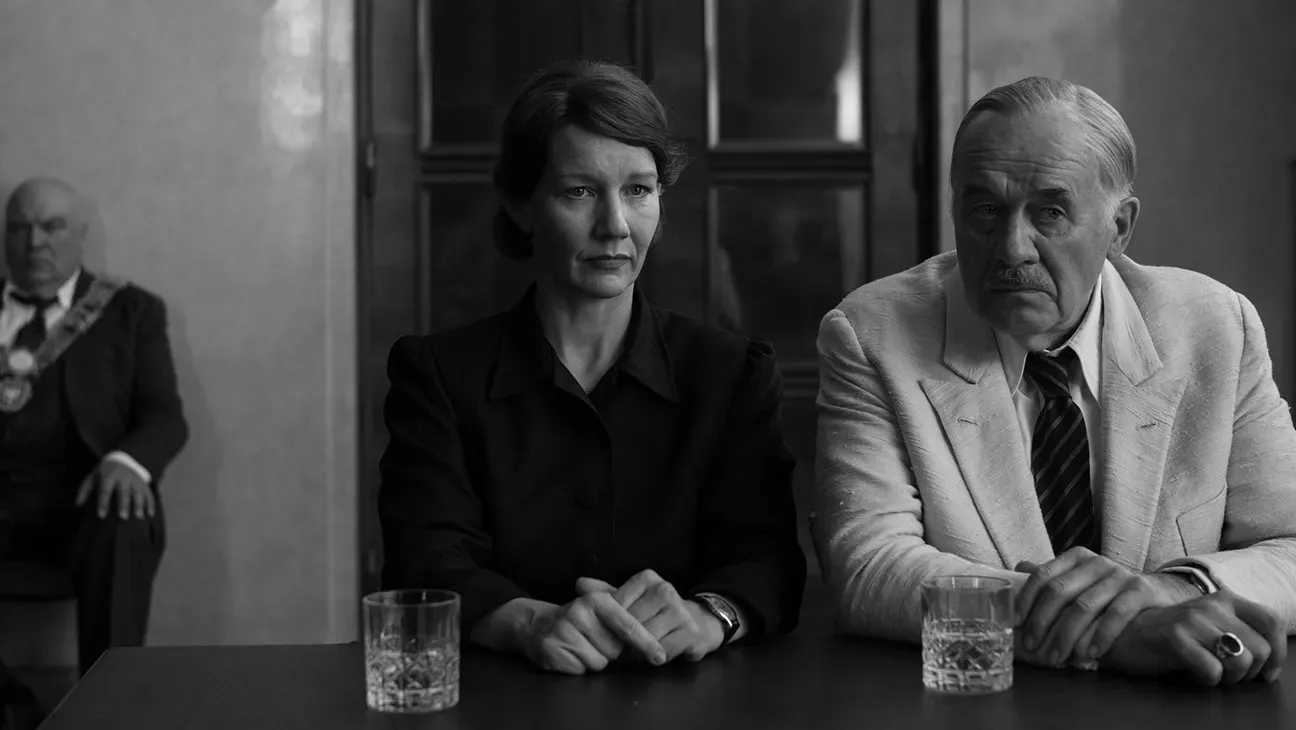
This thematic front-loading makes Fatherland the weakest of three mostly formidable works, lacking anything equivalent to the intimacy and emotional force of Ida and the seductive, perfumed atmosphere and music of Cold War. Yet it’s a fine-hued and perfectly proportioned attempt to understand post-war Germany through the eyes of exiles whose connection to it is enormously complex and personal. While the film technically qualifies as a biopic about Thomas Mann, a Nobel Prize-winning German author who fled the country in 1933, shortly after Adolf Hitler and the Nazi Party assumed power, its scope is admirably narrow. Though Mann (Hanns Zischler) is half of what’s mostly a two-hander, Pawlikowski’s interest drifts primarily to his daughter Erika (Sandra Hüller), a cosmopolitan actress and writer who serves as his driver, interpreter, and companion on a tour through West and East Germany in 1949.
The trip is controversial even within his family. In the brilliant opening scene, Erika talks to her brother Klaus (August Diehl), an anti-fascist author whose 1936 novel Mephisto details an actor who sells his soul to the Nazis to further his career. Holed up in an apartment in Cannes, where there’s evidence of his soon-to-be fatal drug addiction, Klaus loves Erika and listens to her pleas to join them, but he’s estranged from his father and considers Germany “a horrible place with horrible people.” On a tour where Mann will first receive the Goethe Prize in Frankfurt before getting a second Goethe prize in Weimar, East Germany, where he’ll be feted by communist officials, Erika has trouble suppressing her discomfort over her father’s speeches about “The Good Germany,” which are warmly received on both sides of the line.
The tension between father and daughter deepens when news of Klaus’ suicide reaches them and they continue the tour, despite Erika’s special relationship with her brother. But Mann doesn’t necessarily come across as an ogre, either, despite flashes of what Erika calls “cold-blooded narcissism.” Though the family resettled in California during the war, Mann has never felt at home there and there’s some poignancy (and naivety) to him seeking to salvage some common humanity from a divided Germany. The best scenes in Fatherland are a few sharp reminders of how much salt remains on the earth, like when Erika’s ex-husband, the inspiration for Mephisto, tries to explain his behavior to him, or a brave East German who bursts into the Manns’ hotel to reveal how the new regime has repurposed Buchenwald. The country is still broken, just as Klaus had warned, but the bonds within this family are firmer than they often seem on the surface. Home may, in fact, be where the heart is. — Scott Tobias
Fatherland opens in limited release today and expands from there.

Wicker
Dir. Alex Huston Fischer and Eleanor Wilson
105 min.
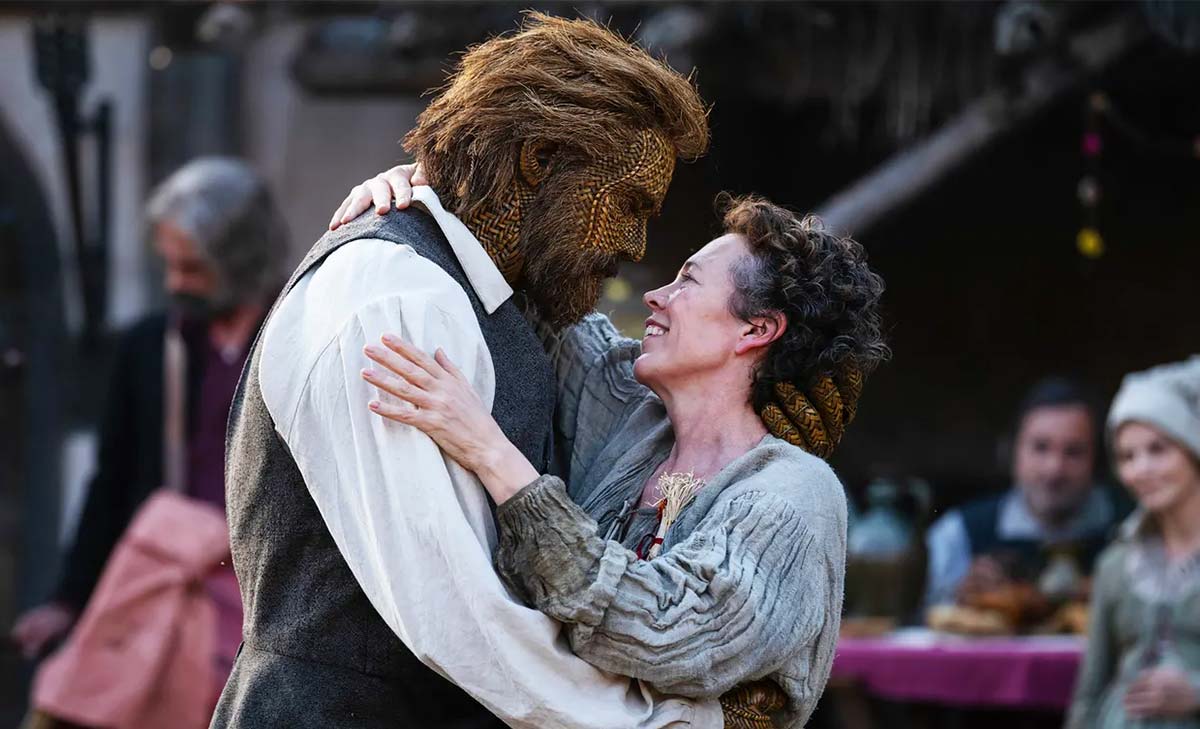
As Wicker opens, the Fisherwoman (Olivia Colman) isn’t even sure she wants a husband. After all, she’s gotten along without one just fine so far. Orphaned in adolescence, she’s lived a solitary life in the woods near a small village she keeps supplied with fish, which her neighbors happily trade for while still making fun of her clothes and fishy smell. If this bothers the Fisherwoman, she doesn’t let it show. Yet when a wedding ritual points to her as the next to wed, it provokes an itch she seemingly has to scratch. To this end, the Fisherwoman turns to the Basket Weaver (Peter Dinklage), one of the few sympathetic locals, to create a bespoke husband made out of wicker. Confident he can pull it off, the Basket Weaver tells her she’ll be able to meet her new husband at the church in one month. And, true to the Basket Weaver’s word, one month later, a Wicker Husband (Alexander Skarsgård), a bespoke creation of the sort you’ll never find on Etsy, makes it to the church on time.
Adapted from Ursula Wills’ short story “The Wicker Husband” by the writing and directing team of Alex Huston Fischer and Eleanor Wilson (Save Yourselves!), Wicker’s title card announces it as a “fable,” which feels apt in ways that work both for and against it. Set in a fantasy version of pre-industrial Britain—one in which Christianity has never supplanted folk rites and magic happenings aren’t common but don’t come as any great surprise—the film creates a colorful world where whimsy and smut live happily side by side. The Wicker Husband’s arrival upsets the other villagers less because he’s made out of wicker than because he quickly settles into a happy, equality-based marriage with the Fisher Woman. She goes off to fish. He does chores around the house. In between they have sex so passionate and athletic that they regularly break the bed. (Fortunately, the Wicker Husband is handy with repairs, too).
The film scores some satirical points by how easily the Wicker Husband rocks the foundation of village life simply by being an attentive, loving, sexually generous spouse. Used to determining what’s acceptable and what’s not, the haughty, less-than-happily married Tailor’s Wife (Elizabeth Debicki, and, yes all the character names follow this convention) becomes annoyed and soon begins scheming against the newlyweds’ marital bliss. And it’s here that the film hits a brick wall (or maybe just one made of tightly woven plant fiber). Despite the efforts of an excellent-as-usual cast (Skarsgård is impressively expressionistic working inside an enveloping costume), Wicker can’t flesh out fable-thin characters that usually suggest only hints of an inner life. When one makes a shocking late-film choice, for instance, it feels like a development dropped in simply because the plot needs to move along rather than an action that makes sense based on anything we’ve seen up to that point. Diverting until it becomes frustrating, Wicker retreats into cutesiness at every moment it threatens to create real drama or deliver a pointed observation. It’s well-constructed and nicely adorned but there’s not much inside it. —Keith Phipps
Wicker is now in limited release.




Discussion