In Review: ‘Is God Is,’ ‘Obsession,’ ‘The Wizard of the Kremlin’
This week's new releases include a daring revenge thriller with theatrical origins, a horror comedy about love gone wrong, and a Russian history lesson.


Is God Is
Dir. Aleesha Harris
99 min.
Aleesha Harris prefaces the printed script of her play Is God Is with a note reading, “This epic takes its cues from the ancient, the modern, the tragic, the Spaghetti Western, hip-hop and Afropunk.” Harris clearly held onto those influences in the years between the first Off-Broadway production of Is God Is in 2018 and this feature film version, which doubles as her directorial debut. Part Greek tragedy, part grimy B-movie, Is God Is is at once provocative and moving, folding an unsparing exploration of the literal and figurative scars left by abuse and misogyny into an adrenaline-fueled road trip through an often hellish-looking vision of the modern American South that begins and ends in fire.
It’s also a story of sisterly love. Kara Young and Mallori Johnson star as, respectively, Racine and Anaia, twentysomething twins who still bear the marks of the night their father (Sterling K. Brown, creepily soft-spoken as a character who’s listed in the credits simply as “Man”) attempted to burn their mother alive. Racine, as the film puts it, “still has some pretty to her,” having been burned mostly on her arms. Anaia can’t hide her scars as easily. They cover her face like candlewax trails and make her reluctant to speak out or meet the eyes of those who speak to her, not that many others try. Racine feels no such reservations, however. She’s quick, even happy, to lash out at anyone who gives her or, especially, Anaia a hard time. And, when they unexpectedly receive a letter from Ruby (Vivica A. Fox), the mother they thought had died in that years-ago fire, she’s just as eager to visit her while they still can. Traveling south, they find her near death as she gives them a simple assignment: “Make your daddy dead.”
We hope you're enjoying these reviews but The Reveal has much more than reviews to offer. Become a paid subscriber and you'll get access to everything we publish—from articles to lists to audio commentaries—and help support independent film criticism.
The “God” of the title most directly refers to the name Racine and Anaia give to their mother as their creator, a choice that immediately invites an allegorical reading of the film. But, like much of Is God Is, there’s a seemingly intentional fuzziness to that metaphor that gets even less clear as the sisters get closer to their final destination. To get there they take a route that first brings them into contact with the woman he paired off with after leaving their mother for dead, a preacher named Divine (Erika Alexander) who leads cult-like gatherings in her living room. Other stops include a visit with their father’s current wife Angie (Janelle Monae), whose abuse at Man’s hands doesn’t stop her from looking down on Racine and Anaia, and his teenaged sons Scotch (Xavier Mills) and Riley (Justen Ross), the latter two a study in contrasts, much like their half-sisters.
It’s hard to know what to feel about the film, or its protagonists, at any given point, particularly once they start to cross one Rubicon of violence after another, but this seems to be much of the point. Harris understands that anyone telling a story of revenge is supposed to pepper it with nods to the importance of grace and forgiveness. She just doesn’t want to. Anaia and Racine are the sort of overlooked and marginalized characters—Black women whom men alternately ignore or treat as objects to exploit—wbo don’t usually get to write their own stories, much less write them in the blood of those who wrong them.
Directing with the assurance of a veteran, Harris pairs the stylized lyricism of her play to a kinetic, sweat-drenched grindhouse aesthetic that’s at once gripping and repellent without overwhelming the complicated, conflicting emotions that drive the sisters to do what they do. Anyone looking for a comforting message about how the past belongs to the past, how anger destroys souls, and how those who commit grievous wrongs should be given a chance to change should look elsewhere. There are plenty of examples out there, and most of them don’t ring as true as Is God Is. —Keith Phipps
Is God Is opens nationwide tonight.

Obsession
Dir. Curry Barker
109 min.
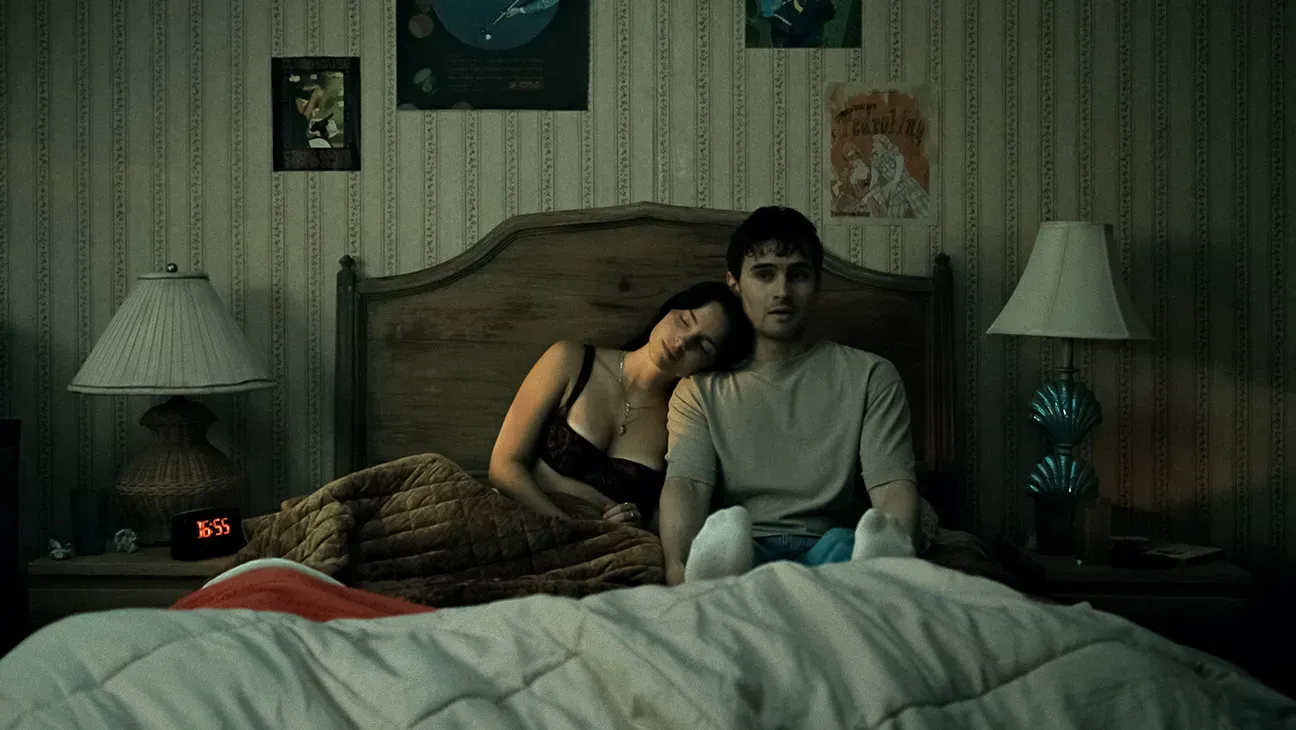
Bear (Michael Johnston), a music store employee who lives in the house he inherited from his grandmother, loves Nikki (Inde Navarrette), an old friend who works in the same store. But does Nikki share these feelings? In the opening scenes of Curry Barker’s Obsession, Bear comes this close to finding out by asking her directly, a talk the two have clearly needed to have for a long time. It’s obvious that both care for one another, but less obvious what that means for Nikki, who could be sending signals that she wants to take their relationship to the next step or preparing to put up a wall that will define it as purely platonic. Either way, both keep dancing around what needs to be said, and dancing so well that it seems like it will take a truly dramatic, maybe even supernatural, development to end the stalemate.
The ambiguity-filled opening turns out to be the best stretch of this ultimately frustrating horror-comedy. After stopping at a new age store to pick up a present for Nikki, Bear opts for a One Wish Willow, a seemingly vintage novelty item that grants users, as its name suggests, a single wish. But instead of giving the gift to Nikki at the end of a frustrating night, Bear decides to use it himself to wish her into loving him. The bad news: it works. Soon Nikki makes herself inseparable from Bear, much to the bafflement of their closest friends Ian (Cooper Tomlinson) and Sarah (Megan Lawless), both employees of the same music store and members of the same trivia team who didn’t see this new relationship coming and don’t know what make of it now that it’s here.
There’s an obvious direction in which Barker, who got his start making videos for YouTube (Tomlinson is his partner in a duo called “that’s a bad idea”), could have taken this premise, turning Nikki into a possessive, psychotic, misogynistic cliche. Obsession thankfully doesn’t go in that direction, but then it doesn’t really go in any direction. Navarrette’s quite good playing Nikki in both her pre- and post-wish incarnations—some of the film’s freakiest moments involve flashes of Nikki’s real personality coming to the surface beneath—but rather than using the situation to explore the implications of what love and free will mean, Obsession just turns the character into psychopath who reliably does the weirdest, most destructive thing in any given situation.
If Obsession was supposed to be about anything, that must have gotten lost in the process of making the movie. Barker keeps the tone ominous and the action bloody (and the cinematography frustratingly murky), but the film only really comes to life in the moments when it remembers the comedy half of the horror-comedy equation late in the film. Yet by then the action around those moments has turned so grim that the laughs feel out of place. Some of Obsession works, but it’s ultimately only good enough to make it easy to wish it was much better. —Keith Phipps
If you've been wishing for a new horror comedy, your wish has come true. Obsession opens tonight.


The Wizard of the Kremlin
Dir. Olivier Assayas
136 min.
One of the tragic falsehoods of Western capitalism—advanced by Gorbachev, glasnost, and the fall of the Soviet Union—is the idea that an authoritarian empire could be dismantled by blue jeans and rock music when, in fact, it’s the autocrats who are consistently successful in bending foreign companies to their will. For one heady stretch of The Wizard of the Kremlin, an awkward and ungainly historical fiction about Vladimir Putin’s spin doctor, there’s a brief moment under Boris Yeltsin where new freedoms do take hold of Moscow and the film looks like it was directed by Olivier Assayas, specifically the Assayas who staged a 30-minute party sequence in his 1994 breakthrough Cold Water. Assayas doesn’t treat this bacchanal with undue nostalgia, since the money flowing through this “new Russia” would funnel into the oligarchy, but it’s a reminder of his dexterity and hipness as a director, which isn’t as easy to spot during the rest of the film. As the curtains come down over the country, his style seems to contract in kind.
Adapting Giuliano da Empoli’s novel of the same name, Assayas and his co-writer, Emmanuel Carrère, bite off a too-large chunk of recent Russian history, roughly late Yeltsin to 2019, to try to explain how the country arrived at Putin and bent to his omnipresent power. Yet it wisely takes a side door into history by following Vadim Baranov (Paul Dano), a gifted strategist and propagandist who’s conceived as a fictionalized version of Vladislav Surkov, the adviser who refers to his own machinations as “Putinism.” Yet The Wizard of the Kremlin is not above a few clunky devices, including a flashback structure in which Baranov, now retired and living in a snowy forest estate outside Moscow, tells his story to an American journalist (Jeffrey Wright) who’d called him “the new Rasputin” in a magazine piece.
Speaking in a pained whisper that toggles between a Russian accent and his normal voice, Dano makes for a mannered, distant protagonist as Baranov, though it may be Assayas’ point that his opportunism scrubs away his soul. Baranov recalls an exciting time in a cosmopolitan Moscow where young adults were coming into “a world they felt strong enough to conquer” and he was thriving as an avant-garde theater director with a glamorous girlfriend (Alicia Vikander). But his life takes a turn when his friend, oligarch-to-be Dimitri Sidorov, runs off with his partner and Baranov lands a job as a TV producer, where his cynicism seems to align with public taste. From there, his media savvy puts him in the sphere of Putin (Jude Law), whose understanding of power, gleaned from his time heading the FSB spy agency, helps turn him into Yeltsin’s permanent successor as prime minister.
Though Law doesn’t even bother to affect an accent other than his own, his imposing, dead-eyed Putin gives The Wizard of the Kremlin most of its juice, playing a leader who combines tactical certainty with a winner-take-all ruthlessness. As much as Baranov’s experience makes him an effective partner to the leader he calls “the tsar,” it’s clear that Putin is the driving force in their relationship, rather than a creation of some media Svengali. Yet the effect, in dramatic terms, is to expose Dano’s Baranov as too weak a character to hold the center of Assayas’ ambling, talky account of recent Russian history. There are some good lessons here about how a country can slip past oligarchy into full-on Orwellian autocracy, but Assayas cannot find the right packaging for it. — Scott Tobias
If you want to contribute to the Paul Dano discourse, The Wizard of the Kremlin will give you that opportunity in select cities this weekend.




Discussion