In Review: ‘Merrily We Roll Along,’ ‘Reflection in a Dead Diamond’
This week's new releases include a Eurospy throwback and the preservation of an acclaimed Sondheim production.


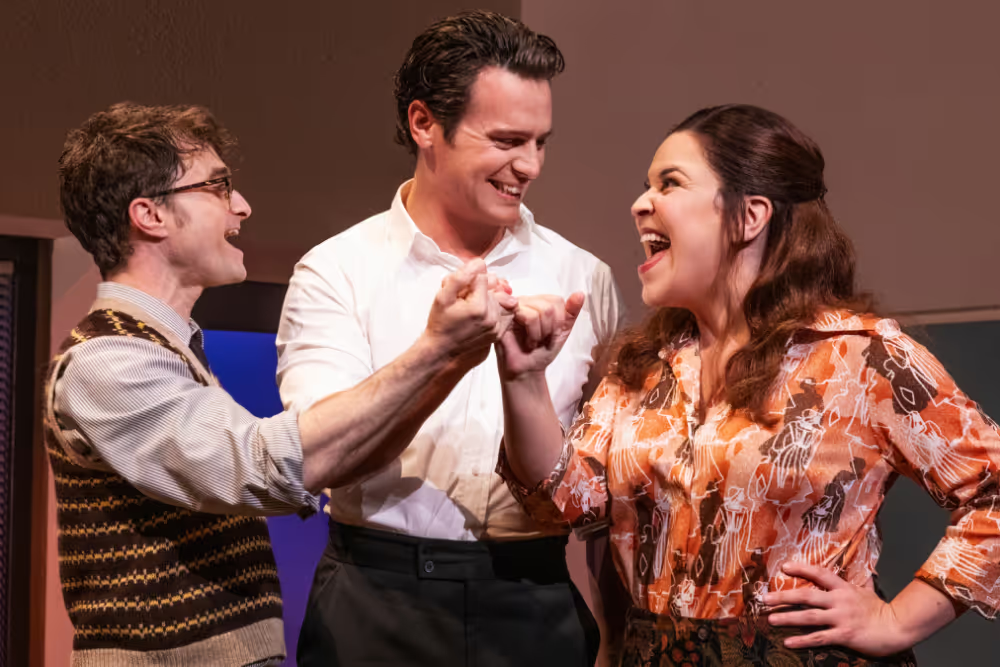
Merrily We Roll Along
Dir. Maria Friedman
150 min.
Maybe it’s fitting that Stephen Sondheim’s Merrily We Roll Along should have a kind of backwards existence. Like the George S. Kaufman and Moss Hart play it adapts, Sondheim’s musical unfolds in reverse chronological order. The story of three close friends, Merrily opens at a moment when they’ve grown semi-estranged and battered around by life, then works backwards to a moment of youthful idealism two decades earlier. The musical’s production flopped, lasting just 16 performances past its 1981 Broadway debut. But a string of revivals over the years has rehabilitated its reputation and confirmed it as one of Sondheim’s major works, a process crowned by an acclaimed 2022 staging directed by Maria Friedman starring Daniel Radcliffe, Jonathan Groff, and Lindsay Mendez. Hit musicals tend to begin their lives with splashy debuts. Merrily has reversed the process.
Directed by Friedman and produced by some of those responsible for the filmed version of Hamilton, this new film preserves that acclaimed production for posterity. As with Hamilton, Merrily We Roll Along doesn’t have any ambitions beyond providing those who missed the show with a chance to catch it via another medium, or a souvenir for those lucky enough to catch it live. Drawn from a handful of live performances and some audience-free sessions in June 2024, the film doesn’t offer much in the way of cinematic touches apart from a few titles announcing the changing date. The lighting often feels decidedly uncinematic and many of the performers’ expressions and gestures have clearly been calibrated for a theatrical audience, not those watching on television or movie screens.
The Reveal is a reader-supported newsletter dedicated to bringing you great essays, reviews and conversation about movies. If you are not paid subscriber, we would love for you to click this button below and join our community.
All that only rarely gets in Merrily’s way, however. In short, the film confirms that Friedman’s production and its stars’ performances are as good as you’ve heard. Time might have helped this, too. Opening in 1977 then winding back to 1957, its characters’ stories of lost innocence often intersects with key moments in American history, like the end of the war in Vietnam and the Camelot spirit of Kennedy’s presidency. This was always part of Sondheim’s design, but it seems even more poignant in 2025 than it must have looked in 1981. These are scenes from a closed chapter, moments in the life of a generation that’s already had its say. We know how their story ends.
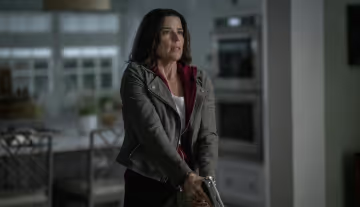
Merrily opens in California, where Franklin (Groff) has transitioned from a successful career as a composer to even more profitable work as a producer. But all is not quite what it seems as his old friend Mary (Mendez) drunkenly reminds him. Subsequent chapters depict the fraying of their friendship and of the relationship between Franklin and Charley (Radcliffe), the playwright and lyricist who served as Franklin’s writing partner in years both lean and bountiful.
All three are excellent, meeting the demands of an emotionally tricky work without clear villains. Franklin might look the part in the early scenes, but at its heart, Merrily is the story of how time erodes even the purest of intentions and love has a tendency to sour rather than just disappear. Richard Linklater’s in-the-works film adaptation—which he’s shooting across several decades—may create a truly cinematic version of Merrily We Roll Along. (We’ll find out some time in the late 2030s or early 2040s if the production goes as planned.) As the record of a landmark staging of a great play, however, this Merrily feels like a gift to all those who wish they could have been there, or want to return. —Keith Phipps
Merrily We Roll Along merrily rolls along into select theaters this Friday.

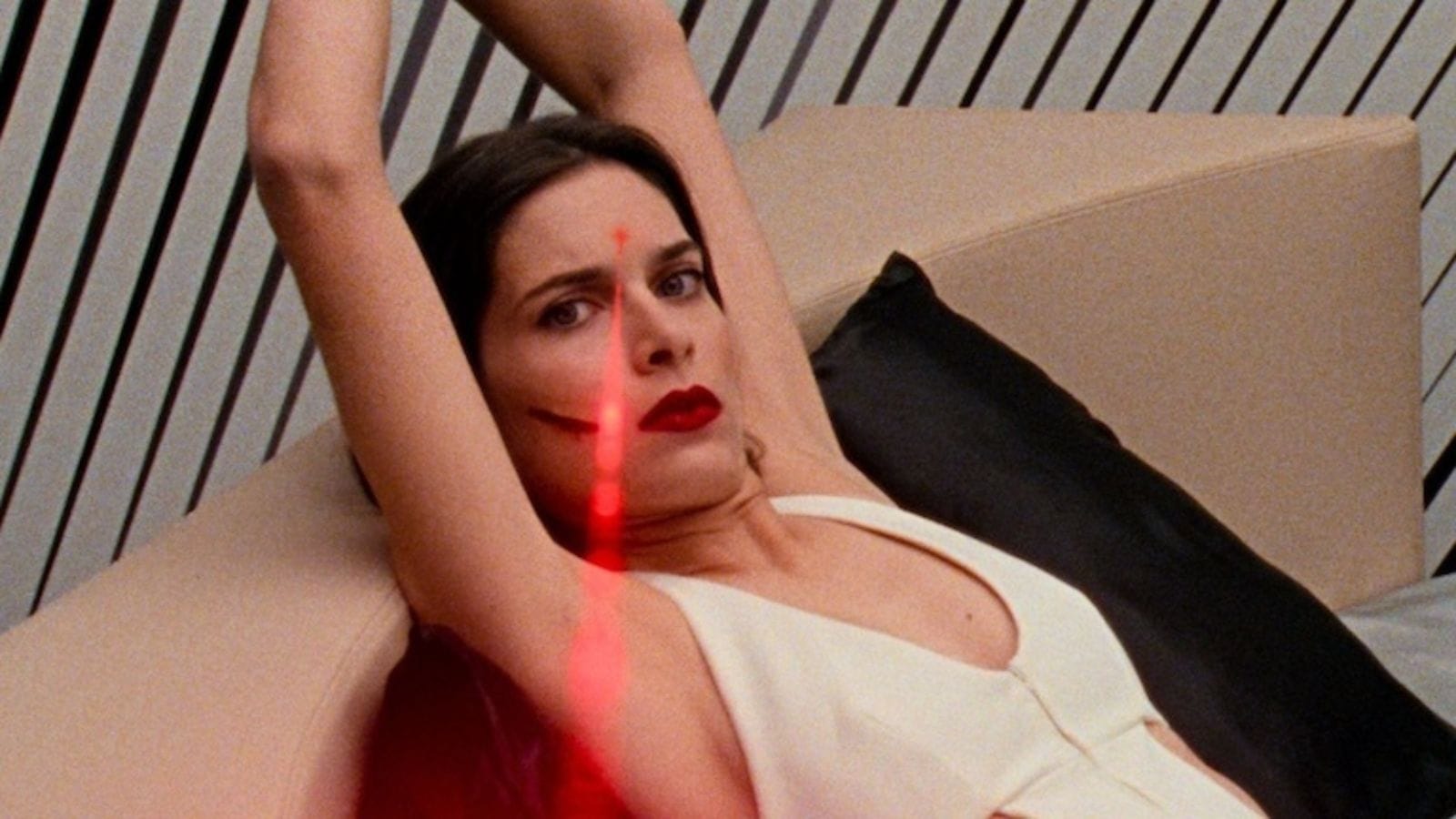
Reflection in a Dead Diamond
Dir. Hélène Cattet and Bruno Forzani
87 min.
If you were to ask a modern cinephile—at least one who’s schooled in avant-garde retro genre pastiches—to guess who directed a film called Reflection in a Dead Diamond, he or she would surely know that the answer is Hélène Cattet and Bruno Forzani, the Belgian duo responsible for such playful exercises in style as Let the Corpses Tan and The Strange Colour of Your Body’s Tears. These titles perfectly evoke the experience of the films themselves: Mysterious, ornately beautiful, drifting around the fuzzy borders of comprehensibility. The basic idea of a Cattet/Forzani film is to focus on a subgenre already known for its stylization and intensify it to the nth degree, like scientists extracting their aesthetic essence in the lab. Their 2009 breakthrough Amer and The Strange Colour of Your Body’s Tears tackled giallo with great bursts of bloody eroticism while Let the Corpses Tan felt like the unearthing of Spaghetti Western considered too bizarre for distribution.
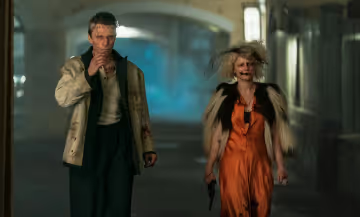
With their new film, Reflection in a Dead Diamond, the husband-wife team tackle the Eurospy thrillers of the ’60s and ’70s, which sought to capitalize on the success of the 007 series through modest, easily recouped budgets and an amped-up sexuality. Mario Bava’s 1968 cult favorite Danger: Diabolik seems like a primary source here, given the presence of a deadly criminal in a form-fitting black body suit, but there’s no doubt that Cattet and Forzani’s reference list runs quite a bit deeper and more esoteric. Set in an underpopulated corner of the French Riviera, Reflection starts with John Diman (Fabio Testi), a retired septuagenarian spy, obsessing over the disappearance of a guest at the hotel where he’s taken up residence. (That the hotel’s management keeps harassing him over unpaid rent suggests that the glamor and riches of the international spy game are more finite than we might assume.)
Yet this disappearance is merely the starting point for a film that radically collapses the timeline between Diman’s sleuthing as an old man and the activities of his younger self (Yannick Renier), who becomes enmeshed in various cases, particularly a deadly figure named Serpentik who sneaks around in a sexy black catsuit and likes to poison victims with a ring she sinks into the back of their necks. Cattet and Forzani do not come close to clarifying Serpentik’s motives or even the effort to bring her to justice, but plotting has never been their priority. Instead, a film like Reflection in a Dead Diamond dazzles with colorful images and montages that fiddle with spy-movie conventions, like the gizmos Diman uses to do his work (machine-gun headlights, a remote-detonator watch, an X-ray vision ring) or his high-concept adversaries. Among young Diman’s elusive perps is “Kinetik,” a screen-masked killer who hypnotizes his victims to believe they’re in a film. “They lose all notion of reality,” Diman’s boss tells him, until the words ‘The End’ appear, which sounds the death knell.”
A little of this stuff goes a long way with Cattet and Forzani, who have always seemed more immersed in image-making than in the tedious business of telling a story with a mind toward pace and characterization. To experience their films is to toggle between exhilaration and enervation, and hope the balance tips the right way in the end, which it ultimately does with Reflection in a Dead Diamond. Here’s a film where a dress with silver mirrored sequins can function as a discotheque turn-on, a hallucinogenic series of screens, or a weapon that launches porcupine-like blades at the push of a button. What’s not to love about that? — Scott Tobias
Reflection in a Dead Diamond starts streaming exclusively on Shudder tomorrow.

Discussion