In Review: ‘No Other Choice,’ ‘The Testament of Ann Lee,’ ‘The Plague,’ ‘Song Sung Blue’
A week of reviews of new holiday season releases concludes with stories of revenge, religion, sports, and Neil Diamond.


End-of-Year Programming Note: We're focusing on reviews during this shortened holiday week. Yesterday we published our reviews of Marty Supreme, Father Mother Sister Brother, and Anaconda. Next week we'll be back with a discussion of The 400 Blows as part of our survey Sight & Sound's 100 best films. Then look for our best of 2025 lists when we return to our regular newsletter schedule in January.
No Other Choice
Dir. Park Chan-wook
139 min.
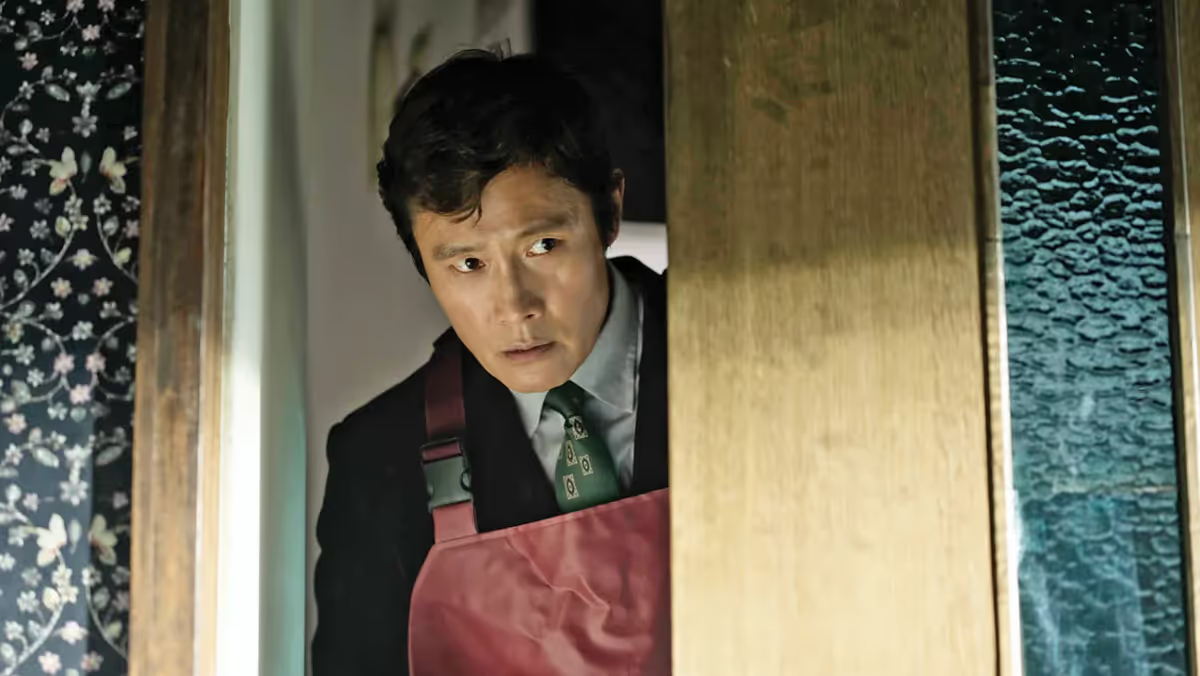
How perfect is Yoo Man-su’s (Lee Byung-hun) life in the opening moments of No Other Choice? Even the sun seems to shine on cue as he and his wife Mi-ri (Son Yee-jin) and their two children (one a stepson from Miri’s previous marriage) enjoy an outdoor barbecue. A veteran at the firm of Solar Paper, Man-su lives in the childhood home his good fortune has allowed him to reacquire, which he’s since outfitted with matching doghouses for the family’s dogs. “Know what I’m feeling now?,” he tells his family as they embrace in a group hug. “I’ve got it all.”
He’s not a man who fears dramatic irony, but that won’t keep it at bay. After being told the American company that’s purchased Solar Paper has no other choice but to let him and many others go in an attempt to streamline and modernize the operation, Man-su finds himself adrift. All he knows is paper, but the same contraction that’s taken his job—the combined result of downsizing, automation, and artificial intelligence—has made positions within the industry vanishingly rare. As time passes, Man-su and Mi-ri have to consider some hard choices of their own, sending the dogs away to live with Mi-ri’s parents and putting their house on the market then watching as their obnoxious neighbors consider buying it from them. Then another possibility occurs to Man-su: If he could just eliminate some of the competition, maybe he’d have better luck. Maybe he, too, has no other choice.
The Reveal is a reader-supported newsletter dedicated to bringing you great essays, reviews and conversation about movies. If you are not paid subscriber, we would love for you to click this button below and join our community.
Though adapted from a 1997 novel by Donald Westlake that was previously filmed under that name by Costa-Gavras in 2005, No Other Choice feels crafted for this specific moment, when seismic changes in countless industries have left so many out in the cold. People like Man-su have worked hard and done everything asked of them, only to find themselves deemed unnecessary for the future. Of course, such changes haven’t made everyone contemplate murder, but some of the charge of Park’s film comes from a sense of wish fulfillment. Yet there’s more at work here. Every twist in Park’s film reveals the path Man-su has started to follow as one that pits him against others in the same situation, not against the system at the heart of the problem.
Park’s working in a comedic mode that keeps descending deeper into darkness as Man-su and Mi-ri’s actions grow more desperate. Though the film’s long middle section starts to feel a little repetitive, Park’s filmmaking remains unfailingly sharp and the performances perfectly calibrated to the increasingly absurd, and carnage-filled, situations in which they find themselves. Yet a sense of exhaustion feels appropriate to the material and the film’s final moments provide a grim, perfectly crafted punchline to everything that’s preceded them. It’s a film that could have been tailor-made for 2025 and, even more chillingly, for seemingly every year in the foreseeable future. —Keith Phipps
No Other Choice opens in limited release on December 24th.

The Testament of Ann Lee
Dir. Mona Fastvold
137 min.
Amanda Seyfried is an extravagantly talented human being. She can cover Joni Mitchell on the dulcimer. She can do magic tricks. She can carry big-ticket musicals like Mamma Mia, play a possessed Elizabeth Holmes in the miniseries The Dropout, slip off to make movies with Atom Egoyan, and go toe-to-toe with actors like Ethan Hawke and Gary Oldman in First Reformed and Mank, respectively. It would be hard for any one project to serve as a repository for all Seyfried can do, but The Testament of Ann Lee, an audacious musical-drama about idealism and faith in the New World, ticks more than a few boxes. As a woman whose religious conviction sends her on a journey from Manchester, England to upstate New York in the lead-up to the Revolutionary War, Seyfried sets her Disney-heroine eyes to the heavens and the spirit possesses her to full and moving effect. To play a character of mad, unwavering courage, she gives all of herself.
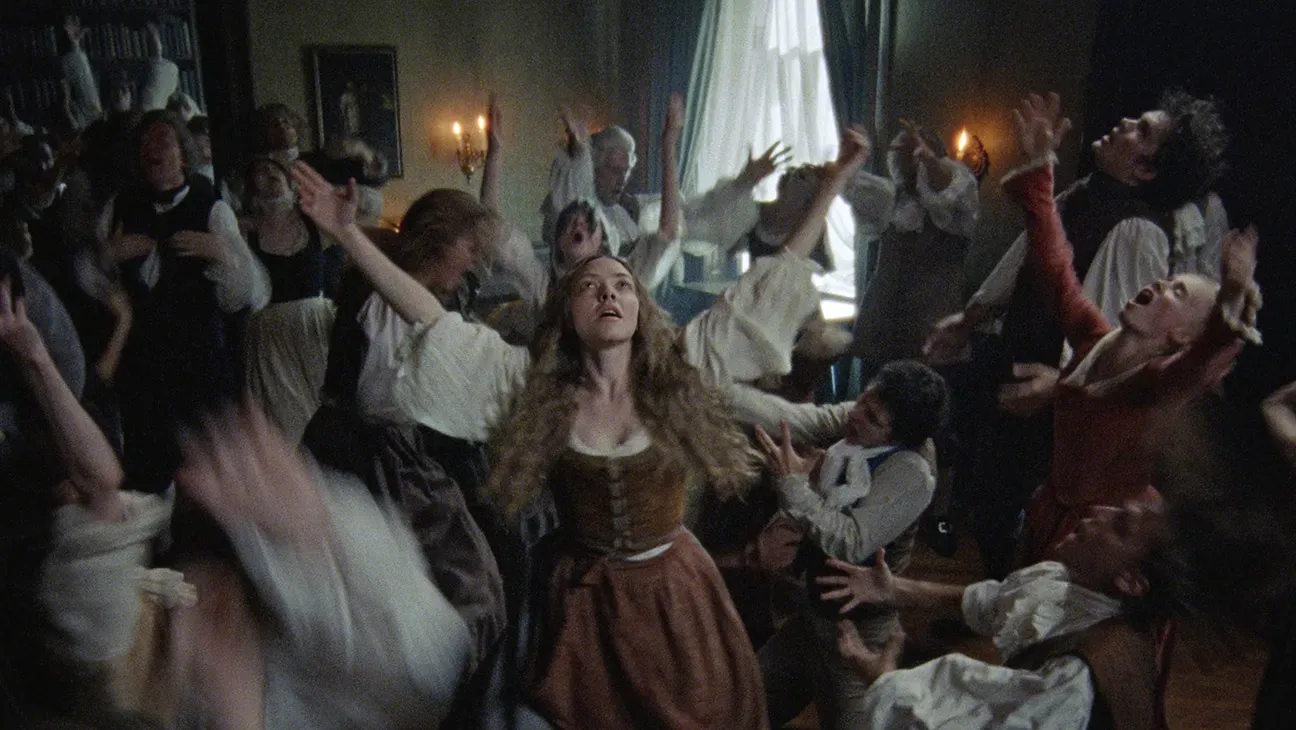
Director Mona Fastvold co-wrote The Testament of Ann Lee with her partner, Brady Corbet, a reversal of roles from last year’s The Brutalist, which they wrote together for Corbet to direct. The two films form a fascinating partnership, each about immigrants and iconoclasts who realize their vision in America, only to find that the country isn’t as accommodating to individualism as it promised to be. With her loyal disciple Mary (Thomasin McKenzie) connecting the pieces of Fastvold’s episodic story in voiceover narration, Ann Lee opens in Manchester in the mid-1700s, when young Ann (Seyfried), one of many siblings in an extensive family, seeks answers for her spiritual restlessness. Looking for answers outside the Church of England, Ann and her devoted brother William (Lewis Pullman) slip into a revival meeting where men and women share equal footing and faith is expressed through dancing and wailing in ecstasy. To Ann, it’s a revelation.
As the leader of a small Quaker sect called the Shakers, Ann comes to the role through a combination of personal trauma and spiritual epiphany, but Fastvold smartly doesn’t try to untangle one from the other. Her rejection of “fleshly cohabitation” owes to the formative revulsion of witnessing her parents have sex in close quarters and later losing all four of the children she had with her husband Abraham (Christopher Abbott), who’s not as inclined to abstinence. After her religious activity leads to imprisonment, Ann experiences a transcendent vision, but that could be owed to the delusions of a woman withering away from hunger. No matter. Once freed, Ann and her followers secure enough money from a well-to-do old acolyte (Jamie Bogyo) and set sail to America, where they hope to worship free of persecution.
The Testament of Ann Lee suggests a bigger story than Fastvold has the time or resources to tell, but it stays close to Seyfried’s hip and allows the purity of Ann’s vision to carry the day. Drawn from original Shaker hymns, Daniel Blumberg’s songs alternate between wordless, rhythmic thrusts of wailing, stomping and chest-pounding, and heartfelt odes to God and the natural world. For as much chaos and misery that swirls around the Shakers, these sequences are like a blissful reprieve where they can connect to a higher power while insulating themselves from hostile outsiders. Ann’s foundational belief in equality between genders and races—she’s barely set foot in America before screaming “shame” at slave auctioneers—exists apart from where she and the Shakers call home. She is independent and sticks to her values. That appears to be Fastvold and Corbet’s credo, too. —Scott Tobias
The Testament of Ann Lee opens in limited release on December 24th.

The Plague
Dir. Charlie Polinger
95 min.
Water polo is like if drowning were a sport. On the surface, spectators can surely see how exhausting it must be for athletes to paddle back and forth (and in place) in a field of play comparable to lacrosse, hockey or any other sport where the object is to slip a ball into a guarded net. But below the surface, the jostling for position leads to all sorts of nasty jabs and kicks that the referees don’t catch, and it’s not uncommon for players to get dragged underwater. What we see in the stands or during a telecast is literally half the action. A much darker game is happening in the deep.
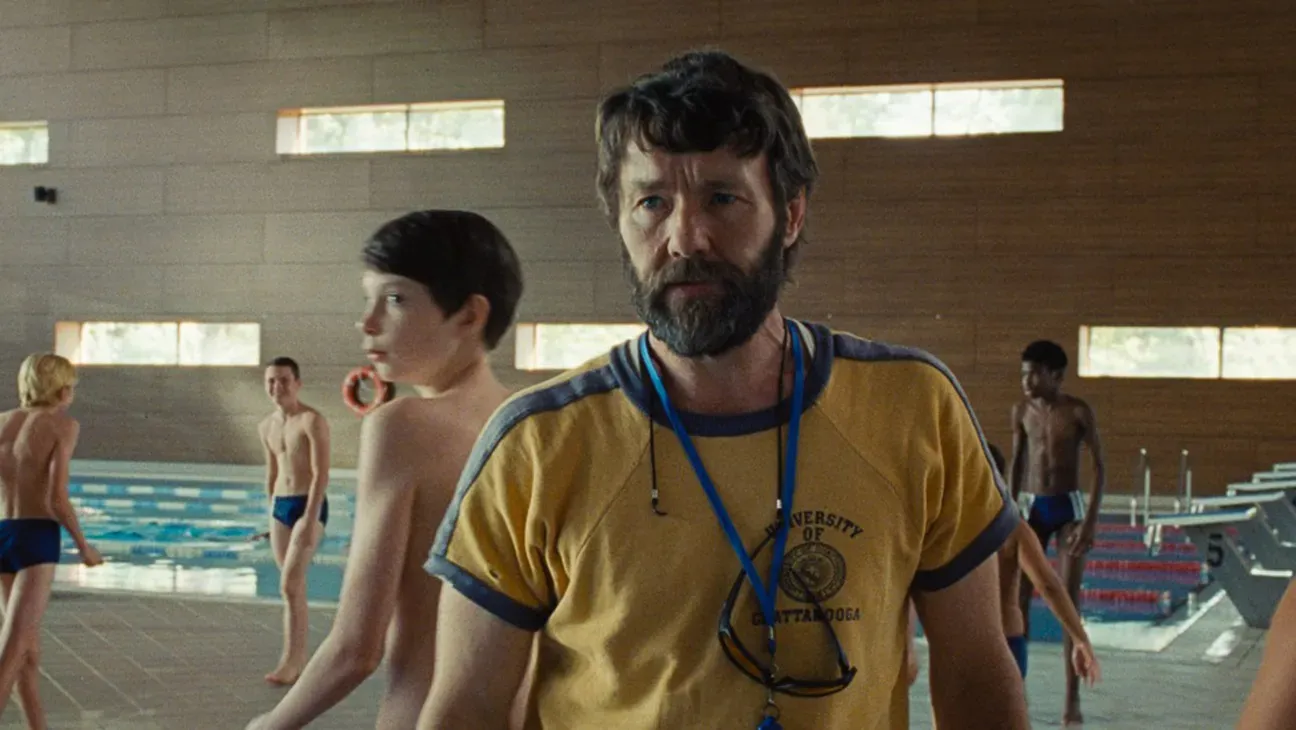
In other words, water polo is the perfect sport for a certain type of coming-of-age picture. Charlie Polinger’s assured and exceptionally unnerving debut feature The Plague opens on an underwater shot of 12-year-old boys plunging into the pool at a water polo training camp in 2003. In another context, it might be a bunch of boys having summer fun, but Polinger sets a more ominous mood, as those flailing legs are at once a force of collective power and a potential battering ram for any kid who doesn’t fit in with the team. It’s a running joke that “Daddy Wags” (Joel Edgerton), the upbeat coach and supervisor of the camp, brushes off the physicality as typical roughhousing while missing a dynamic more in line with Lord of the Flies.
The ritualistic bullying in The Plague starts with the tribalist prank of the title, when the majority of the kids choose an outcast to assign with “the plague” and ostracize him until they find another boy to harass. (It’s like a more virulent form of cooties, where the sickness gets passed along if you touch the afflicted.) The film’s shy, runty young hero Ben (Everett Blunck) doesn’t come into camp with any allies, so it’s not long until he becomes the prime target. The sadistic ringleader here is Jake (Kayo Martin), a sinister little bastard who isn’t much bigger than Ben, but who carries himself with supreme self-confidence. Size doesn’t matter when you have a band of minions under your control.
Polinger tracks the escalation of danger and violence with startling intensity—the first third of Full Metal Jacket also appears to be an influence—but there’s nuance to the way Ben chooses to handle this situation. It’s an easier path for Ben to submit to Jake’s sphere of influence along with the other kids, even if that means adopting a cruelty that isn’t in his nature. Grown-ups may talk about standing up to bullies, but the consequences of nonconformity are steep. The water polo metaphor is clean and effective—the harmless “fun” adults above water, shielding the brutality under it—but this camp scenario also seems like a trial run for more mature forms of toxic masculinity and groupthink to come later in life. The Jakes of the world don’t disappear. They just have more weapons at their disposal. — Scott Tobias
The Plague opens in limited release on December 24th.


Song Sung Blue
Dir. Craig Brewer
132 min.
Mike Sardina (Hugh Jackman) would never call himself a Neil Diamond impersonator. Instead, Mike would call himself a “Neil Diamond interpreter.” But as Song Sung Blue opens, he wouldn’t even call himself that. Diamond’s music—which has seen Mike through some dark times and helped him stay sober for two decades—means too much to Mike for him to perform it, even though he makes his living paying tribute to rock and roll legends for appreciative Milwaukee-area crowds under the name “Lightning.” But, beyond the voice, Mike’s has the hair and the spirit to be a great Diamond, um, interpreter. And after he meets Claire (Kate Hudson), a single mom who does a killer Patsy Cline impression, she pushes him toward the inevitable, joining him on stage as Thunder. Together find love and (small-scale) success, amassing enough of a cult following as the Diamond tribute act Lightning & Thunder that no less than Pearl Jam asks them to perform as an opening act when they pass through town. What could possibly go wrong?
A lot, as it turns out. Based on Greg Kohs’ documentary of the same name, Song Sung Blue begins as a sweet love story between two people looking for a second chance before segueing into a triumph over adversity tale in which every triumph proves short-lived. Written and directed by Craig Brewer, the film feels more assured as the former than the latter. Jackman plays Mike as a charismatic but sincere cheeseball who’s learned to embrace a quieter life when not on stage. Claire wants only for the rest of the world to see what she sees and treats Mike’s embrace of his inner Diamond as the best way to make this possible. They’re fun together, with Hudson even pulling off a credible Midwestern accent (albeit one that sounds more akin to the world of Fargo than Milwaukee).
Happy love stories, even happy love stories interrupted by the occasional spirited performance of “Brother Love’s Traveling Salvation Show,” don’t make for compelling viewing, yet Brewer’s film only starts to feel a little aimless when dealing with Mike and Claire’s medical crises, which dominate the film’s second half. Beyond touching on but not engaging deeply with bigger issues—insurance costs, prescription drug addiction, mental illness—the more dramatic stretches of Song Sung Blue convey less of a sense of who Mike and Claire are, both on their own and with each other. That’s not really Jackman or Hudson’s fault. They remain winning throughout the film, and get able support from, among others, Michael Imperioli, Jim Belushi, Mustafa Shakir, and Fisher Stevens (as Lightning & Thunder’s extended line-up and management team) and Ella Anderson and King Princess (as, respectively, Claire and Mike’s daughters from previous marriages). It evens out to an engaging-enough biopic, but if Song Sung Blue had found a way to interpret their bittersweet love story with a Lightning & Thunder-like intensity, it could have been even more. —Keith Phipps
Song Sung Blue opens everywhere December 24th.

More Recent Releases:
Anaconda
Avatar: Fire and Ash
Ella McCay
Father Mother Sister Brother
Hamnet
Is Thing Thing On?
Jay Kelly
Marty Supreme
Merrily We Roll Along
Reflection in a Dead Diamond
The Secret Agent
Sentimental Value
Silent Night, Deadly Night
Wake Up Dead Man: A Knives Out Mystery
Wicked: For Good
Zodiac Killer Project
Zootopia 2


Discussion