In Review: ‘Teenage Sex and Death at Camp Miasma,’ ‘Tony,’ ‘One Night Only’
This week's new releases include an ultra-meta horror movie, a portrait of Anthony Bourdain as a young man, and an accidentally dystopian high concept rom-com.


Teenage Sex and Death at Camp Miasma
Dir. Jane Schoenbrun
112 min.
Kris (Hannah Einbinder) fully understands why she’s been eyed to reboot Camp Miasma. Having enjoyed critical acclaim, if not much commercial success, with her first feature—an artistic horror film that can at least be partly described as a queer riff on Psycho “from the perspective of the shower curtain”—she seems like the ideal choice to breathe new life into a piece of “zombie IP” with even more problematic elements than the typical ’80s slasher movie franchise. Her agent (Sarah Sherman) has used terms like “elevated” and “woke” as selling points that will land Kris the gig while allowing the studio to rebuild a tentpole and earn some positive PR in the process. Kris understands that she’s an opportunistic choice. She also doesn’t care. Camp Miasma might be misogynistic and it’s definitely transphobic (any resemblance to Sleepaway Camp, which gets a direct reference, is not accidental). But it’s also seared itself into Kris’ psyche in ways she can’t fully understand.
We hope you're enjoying these reviews but The Reveal has much more than reviews to offer. Become a paid subscriber and you'll get access to everything we publish—from articles to lists to audio commentaries—and help support independent film criticism.
In Teenage Sex and Death at Camp Miasma, their third feature, writer and director Jane Schoenbrun essentially gives Kris a whole movie to attempt to figure it out. As a first step, she travels to a remote corner of the Pacific Northwest that’s home to the former summer camp where the first film and at least one back-to-basics sequel were filmed. The camp’s not entirely abandoned, however. It’s now home to Billy Presley (Gillian Anderson), an actress who’s led a reclusive existence since starring in the first Camp Miasma film. She’s nonetheless agreed to meet with Kris, which Kris takes as a sign she might be able to lure her out of retirement. Upon arrival, however, it becomes clear that Billy might have other reasons to play host to the filmmaker.
Schoenbrun’s even more tuned into where their film falls in the horror landscape than their protagonist. Teenage Sex and Death at Camp Miasma’s opening credits roll against a collection of objects and press clippings that trace the history of Camp Miasma, a breakout slasher hit that spawned a string of diminishing returns sequels (alongside trading cards, an arcade games, and more), ran out of gas before the end of the 20th century, then lived on in the 21st via critical reassessments that attempted to sort out its often fucked up mixed signals about death and sexuality. Of particular consideration: Little Death (Jack Haven), the series’ killer, a spear-wielding psycho in a mask that looks like an air conditioning vent who returns to exact revenge on each new generation of visitors to the camp, where they died at the hands of a bunch of transphobic bullies confused by Little Death’s habit of alternating between girls’ and boys’ bunks, and girls’ and boys’ clothes. But Teenage Sex and Death at Camp Miasma has an agenda that goes beyond an attempt to unpack the cultural undercurrents of the slasher film, territory cleared out by Scream 30 years ago, toward an attempt to understand why the dark, retrograde images of the past can still have so much power. Schoenbrun’s film unfolds within a space where film references double as portals into its protagonist’s soul.
Or, if not Kris’ soul, her libido. By all indications the least enthusiastic triangle point of a polyamorous throuple made up of Kris’ girlfriend Mari (Jasmin Savoy Brown) and a hipster named Thor (Aren Buchholz), Kris finds that her time with Billy stirs memories of an early sexual awakening tied to one of Billy’s key Camp Miasma scenes. She also finds that her host is receptive to exploring this connection with her, though this, too, might not be quite what it seems. Who is it that Billy talks to at night? Why does all her art look like Little Death’s mask?
Schoenbrun isn’t interested in providing answers so much as letting viewers sink into the layers of a film that becomes less interested in remaining grounded in any kind of reality as it goes along. When Billy screens her own print of Camp Miasma for Kris, for instance, what begins as a dead-on parody of an ’80s slasher film eventually slips loose from the bounds of time with a sequence that would have been impossible to make in the pre-digital era, accompanied by an anachronistic song. As in Schoenbrun’s last film, I Saw the TV Glow, even art can be distorted by memory and the desires we bring to it.
Yet as heady as Teenage Sex’s explorations can get—even its self-awareness has self-awareness—it’s also looser, funnier, and ultimately more joyful than anything Schoenbrun has made to date, both in its freewheeling style and its performances. Einbinder is winning as a woman beginning to realize how much pleasure her neuroses have denied her. Anderson plays Billy as a kind of alluring cross between Norma Desmond (who’s explicitly referenced) and Dolly Parton (who’s not), mixing a welcoming, honeyed demeanor with undertones that might be erotic or sinister or some horror-movie mix of the two—the perfect foil for a character for whom films have long served as a lens through which to view reality. “I think I saw too many movies as a kid and it messed me up real bad,” Kris tells Billy at one point. Teenage Sex and Death at Camp Miasma is one for anyone who might nod their head at that line, but it’s also there to suggest that this might be as good a way of understanding the world as any. —Keith Phipps
Teenage Sex and Death at Camp Miasma opens in limited release this week before expanding in subsequent weeks.

Tony
Dir. Matt Johnson
106 min.
It’s possible for someone to see and enjoy Tony, a biopic about a formative summer in the life of celebrity chef, author, and TV personality Anthony Bourdain, without knowing a single thing about him. But the target audience likely knows and adores Bourdain from some combination of his lively 2000 memoir, Kitchen Confidential: Adventures in the Culinary Underbelly, his appearances on cooking shows like Top Chef, and his first-rate documentary series No Reservations and Parts Unknown, which showcased his infectious curiosity about global cuisine and the cultures around it. Until his death in 2018, Bourdain was arguably America’s best export, a tourist who treated his hosts with humility and respect, and emerged with insights beyond whatever exotic delicacies happened to slide down his gullet.
Those memories of Bourdain as a public figure are not included in Matt Johnson’s evocative and often hilarious coming-of-age story, but they’re like the hidden ingredient that enhances and completes a dish. Knowing the person that Bourdain would become helps forgive the irrepressible shit that he was as a pretentious, skirt-chasing 19-year-old who improvised his way through a chaotic few months in mid-’70s Provincetown, Massachusetts. He was hardly a finished product by the end of that single summer, and one of the chief pleasures of Tony is that Bourdain isn’t magically cured of being a fuck-up, despite the insight he gains about himself. We know that he had years of hard-living and drug addiction ahead of him, but the film doesn’t have the tidiness of a typical biopic. It’s about the seedling that suggests the tree.
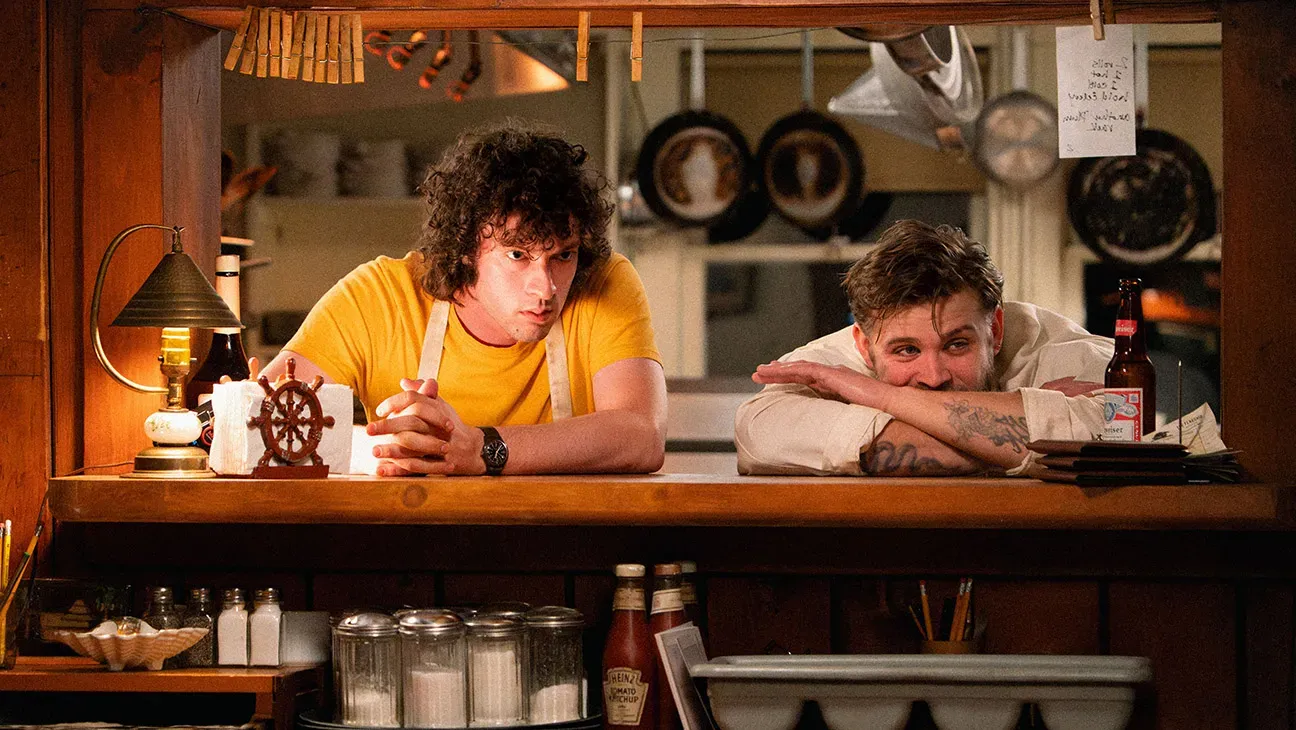
Carved from a small section of Kitchen Confidential, the film introduces 19-year-old Tony (Dominic Sessa) as a bullshit artist of the first order, confidently pitching a novel to a three-professor panel at Vassar College that he feels certain will score him a fellowship for the summer. When the fellowship falls through, his Plan B is to pull the cash from his father’s wallet and follow Nancy (Emilia Jones), the young woman he fancies, to Provincetown, where she’s serving tourists at a by-the-slice pizza oven for the summer. A series of scrapes later, Tony stumbles into a dishwashing job at the Flagship, a shabby seafood joint whose Brazilian chef (Antonio Banderas) provides him with a hammock and a little running-around money. The rowdy kitchen culture proves intoxicating to the chef’s young charge, but his maturity isn’t nurtured quite as effectively as his passion.
The Bourdain of Tony never actually stops being an indulgent little scoundrel, and the film is smart about how the work-hard/play-hard ethos of kitchen culture can encourage bad behavior off the clock. It takes a long time, for example, for the impressionable Tony to stop admiring a co-worker (Leo Woodall) whose ease with women and expertise on hard drugs are a more persuasive model for living than his boss, a quiet, wizened mentor who’s lost some of his ambition. Carrying over much of his underdog charisma from The Holdovers, Sessa has the authentic shagginess to keep Bourdain looking like a work in progress, even when a concise descriptor like “asshole” would seem to apply.
Before Nirvanna the Band the Show the Movie, the ingenious musical-comedy he made with Jay McCarrol (who provides the film’s scorescores here), Johnson had already mastered the biopic with 2023’s Blackberry, which featured its own memorable shitheel in Glenn Howerton’s hard-charging tech CEO. But there are small, revelatory moments where the kitchen speaks to Tony’s better angels, particularly in relationship with Banderas’ chef, who sees enough talent in his young charge to withstand his constant errors in judgement. More crucial still is Johnson’s sense of place, which draws deeply from Bourdain’s own appreciation of the connection between food and the communities forged around it. It’s not a tasteful film so much as a film that appeals to taste. — Scott Tobias
Tony will be on the menu in select theaters this weekend.

One Night Only
Dir: Will Gluck
102 min.
Imagine for even a minute the implications of a near-future—one impossible to distinguish from the present, honestly—where a “celibacy mandate” has been passed by the U.S. government and single adults are only allowed to have sex once a year, during a 12-hour window. The law is enforced by a biometric sensor that triggers the authorities to any impermissible shagging, though gay sex is fine (because the schoolmarms are okay with it somehow?) and so is masturbation. Okay, is the minute over? Are you imagining a rom-com? Or are you imagining a totalitarian state not unlike the one in The Purge, where a similar mandate around crime has completely reordered society and turned this night of “freedom” into an affirmation of fascist power?
One Night Only is almost shockingly unprepared to answer any of the questions its premise raises, to the point where it yadda-yaddas past them as swiftly as possible. Aside from a couple of news clips and conversations about how the “mandate” works and graffitied evidence that it’s unpopular in New York City, the film treats it as a basic high-concept rom-com conceit, something to add a little horny-on-main urgency to a relationship stalled by miscues and revived by serendipity. But there’s a difference between, say, a rom-com where the heroine has been a bridesmaid 27 times and one where the social backdrop is unremittingly bleak—or would be if the filmmakers weren’t so desperate to sanitize it. Even a silly comic detail, like a run on condoms so extreme that one bodega is offering one for $200, triggers disquieting thoughts about how such a shortage is possible. (Are condoms still being manufactured by private companies? Are they using false “scarcity” to drive up prices, like diamonds? Are outside organizations forbidden from distributing birth control and STD protection? Etc.)
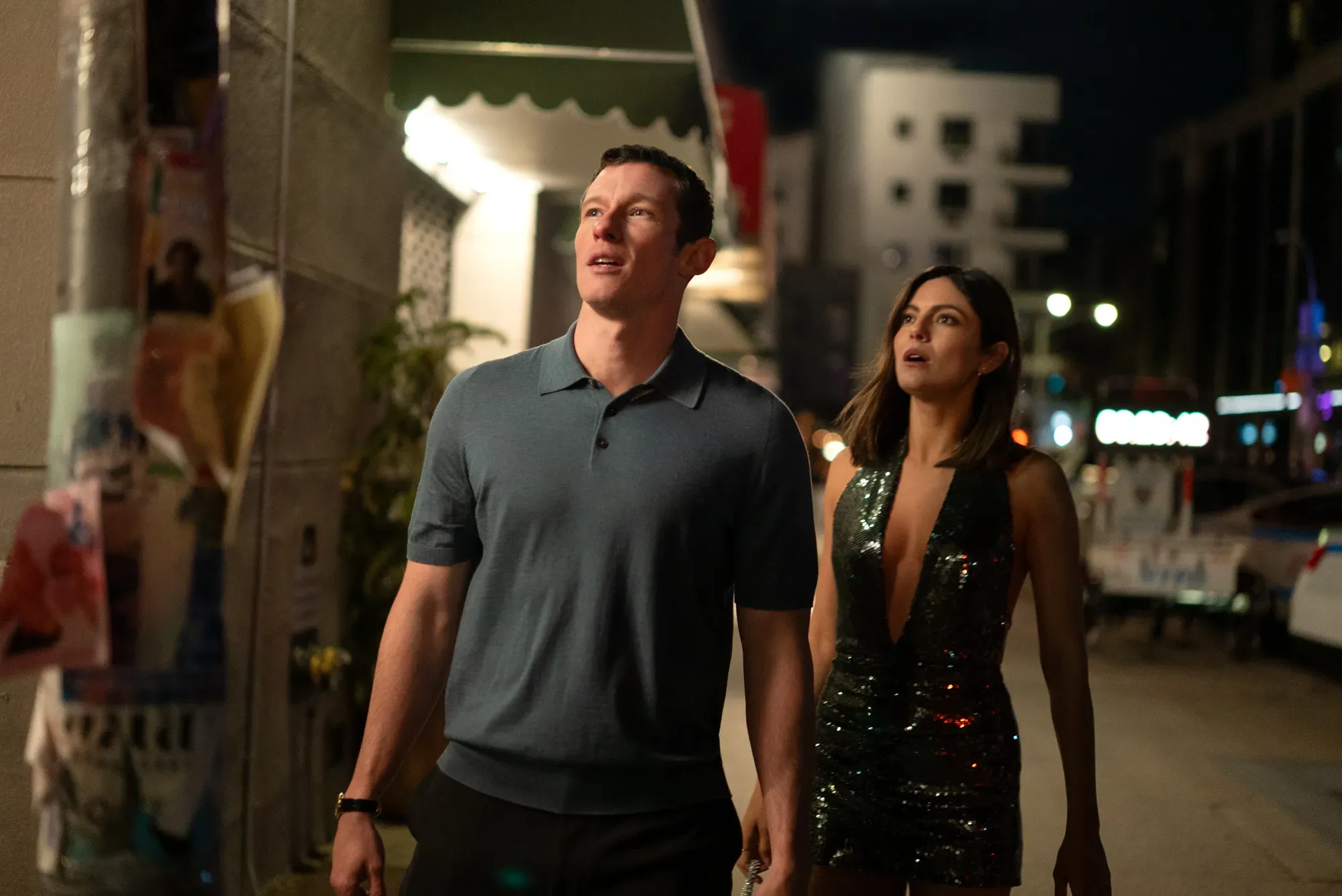
Putting all that aside for a moment—it’s not possible, but in the spirit of the film, let’s endeavor to try anyway—One Night Only attempts to be a more user-friendly After Hours, sending two sex-seekers through a nocturnal Manhattan that seems cosmically determined to defy their wishes. Callum Turner stars as Owen, a pizza shop owner who intends to sleep with his girlfriend (Maya Hawke), only to be told over a swanky omakase dinner that she wants to bonk their building superintendent instead. Meanwhile, Allie (Monica Barbaro), a singer who specializes in commercial jingles, ventures out with a friend with the intention of forging a more substantive connection with a sexual partner, but when the friend hooks up with a random guy immediately, she’s in a slinky party dress with nowhere to go. Owen and Allie meet and have great chemistry together, but something invariably happens to split them apart. Fate treats them like a cat with a ball of yarn.
Director Will Gluck knows his way around a rom-com, as evidenced by the will-they-or-won’t-they chemistry between Mila Kunis and Justin Timberlake in Friends With Benefits and, more recently, between Sydney Sweeney and Glen Powell in Anyone but You. Barbaro and Turner look hot together, too, but One Night Only pours cold water on them at every turn, which at first seems like the silly delays built into most rom-coms but later reflects a sex-negativity that’s at the heart of his insidious film. Though Gluck and his screenwriter, Travis Braun, are ostensibly aligned with the New Yorkers taking full advantage of their 12-hour window, the film bends toward a prudish, heteronormative attitude about casual hook-ups that is unmistakably pro-mandate. One Night Only is certainly one for the time capsule, reflecting a period of rising authoritarianism and cooling libidos, but for now, premarital sex takes the L. — Scott Tobias
One Night Only will start violating mandates (and man-dates) at theaters everywhere tonight.




Discussion