In Review: ‘The Christophers,’ ‘Faces of Death,’ ‘You, Me & Tuscany,’ ‘Exit 8’
Steven Soderbergh's two-person drama about art, life, and fraud leads a busy week that also includes a picturesque rom-com and a pair of unusual horror movies.


The Christophers
Dir. Steven Soderbergh
100 min.
No one appreciates the art of the steal more than Steven Soderbergh, who conquered Hollywood with the elegant, slight-of-hand seductiveness of Out of Sight and Ocean’s Eleven and who keeps returning to stories, like Side Effects and Logan Lucky and No Sudden Move and Black Bag, that are built around deception. Even Soderbergh’s style, cool and distant, can feel like a professional thief casually casing the next job without drawing attention to himself. Yet deception is just the beginning of his terrific new film The Christophers, which hums with the tension of two crafty characters trying to outmaneuver each other but develops into a work of genuine emotional depth. Soderbergh lures you into believing he’s making another heist picture and then pulls the rug out. The trick is that this film about art, commerce, and personal connection is not entirely a trick at all.
Enjoying The Reveal? Now's a great time to become a paid subscriber. You'll get access to everything we publish—from articles to audio commentaries—and help support independent film criticism.
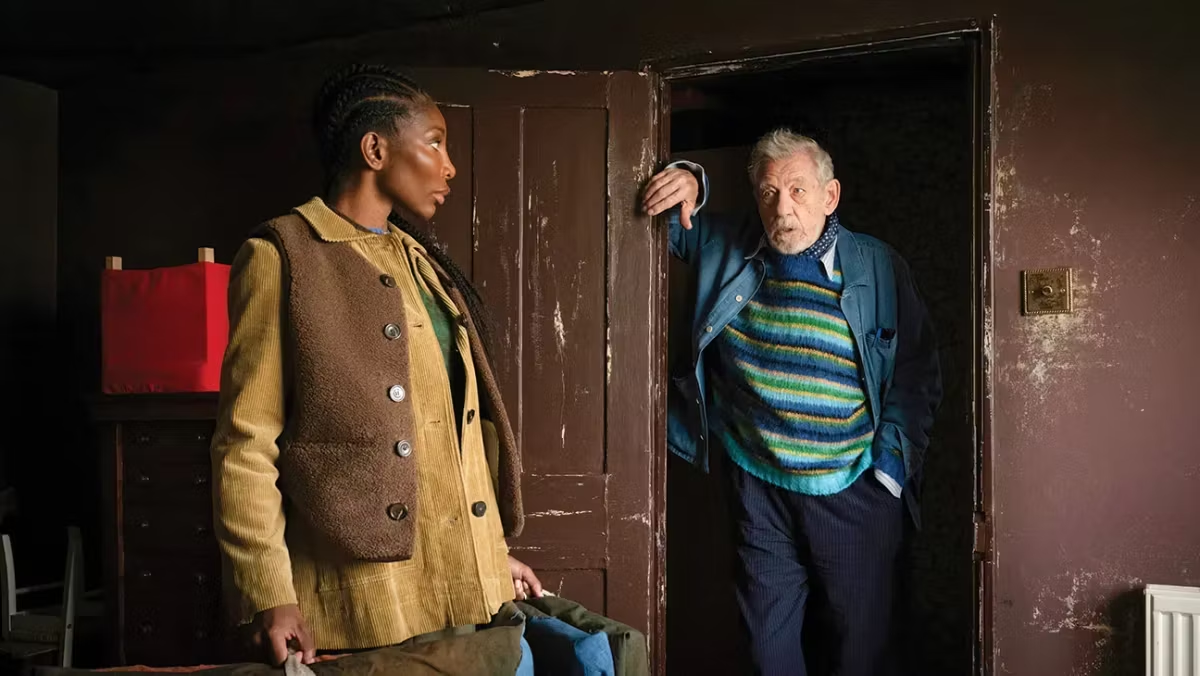
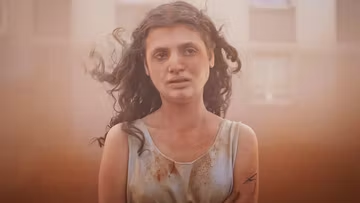
Carrying the same enigmatic force that made her HBO series I May Destroy You feel so wonderfully destabilizing, Michaela Coel stars as Lori Butler, a London art restorer who excels at replicating an artist’s work through a combination of scrupulous research and the technical minutiae of palette-mixing and brushstrokes. As she struggles to make ends meet, Lori gets a tempting proposal from Sallie (Jessica Gunning), an untalented acquaintance from her art school days, and Sallie’s brother Barnaby (James Corden), who offer a percentage of a get-rich-quick scam. Sallie and Barnaby ask Lori to con her way into an archivist/caretaker job for their father Julian Sklar (Ian McKellen), a once-revered painter who had parlayed his fame into a gig as a Simon Cowell-type judge on a British reality competition show for aspiring artists. The siblings want Lori to use her access to nab a series of abandoned paintings called “The Christophers” from his attic and complete them in Sklar’s style. When the old man finally kicks the bucket, the logic goes, this amazing “discovery” should fetch a bundle at auction.
It’s not an easy heist for Lori on any level. Part of the fun of The Christophers is that Julian is less addled than he seems and proves highly capable of sniffing out any ulterior motives, real or perceived, that his new assistant might be carrying. Then there’s the larger issue of completing Julian’s work, which isn’t a paint-by-numbers affair for Lord, but more akin to a Method actor trailing a subject to get a part exactly right, picking up all the relevant gestures and emotions. It’s here where The Christophers grows into a multi-layered excavation project, as Lori tries to immerse herself in Julian’s past and naturally gets to know him more intimately in the process. At the same time, Lori herself has her share of secrets and Julian is intrigued enough by her to start interrogating her more closely, too, and getting a keener sense of her motives.
Scripted by Ed Solomon (Men in Black), Soderbergh’s writer on No Sudden Move and the experimental TV series Mosaic, The Christophers is a slippery customer, an ingenious and twisty two-hander that shifts in tone as Lori and Julian get their hooks into each other. Coel and McKellen prove to be a combustible pair, two actors of contrasting generations, genders, and race who parry in darkly funny sessions that morph in complexity as their characters continue to try to outflank each other. While their common irascibility gives The Christophers a comedic pop, the film is serious about exploring the mysteries of the artistic impulse and the relationship artists have with the ugly, necessary business of monetizing their work. Old hands like Soderbergh and McKellen have been around long enough to know what it’s like. — Scott Tobias
The Christophers opens in limited release this weekend.

Faces of Death
Dir. Daniel Goldhaber
98 min.
The original Faces of Death didn’t make much of an impression when it was released in 1978. In fact, it’s hard even to find records of theaters playing the film. But that would change once the film found its way into video stores, where it became a kind of rite of passage for ’80s and ’90s sickos looking for gross kicks. Directed by “Alan Black,” a pseudonym for John Alan Schwarz, a moonlighting TV editor, the film mixes clips of real-life accidents, slaughterhouse scenes, war atrocities, and other disturbing footage with staged moments, like a graphic electrocution death and gourmands dining on monkey brains after first bashing in the monkey’s head. Presented as a documentary taken from the collection of a pathologist named Francis B. Gröss (sure), it both brought the mondo genre to its natural, bloody conclusion and became a viral video long before the term had any meaning.
Both its word-of-mouth success and darkness makes the original Faces of Death (and its sequels and knock-offs) look now like a precursor for the current era of online horrors, a connection that serves as the spark for this new film directed by Daniel Goldhaber and written by Goldhaber and Isa Mazzei. (The two previously collaborated, in various capacities, on CAM and How to Blow Up a Pipeline and the opening credits gives them a shared “a film by” credit.) Rather than doing a remake, whatever that might look like, Goldhaber and Mazzei attempt to connect the dots between an older sort of morbid voyeurism and a world in which video horrors are always just a click away. It’s a smart idea that’s unfortunately a little undernourished by the film itself.
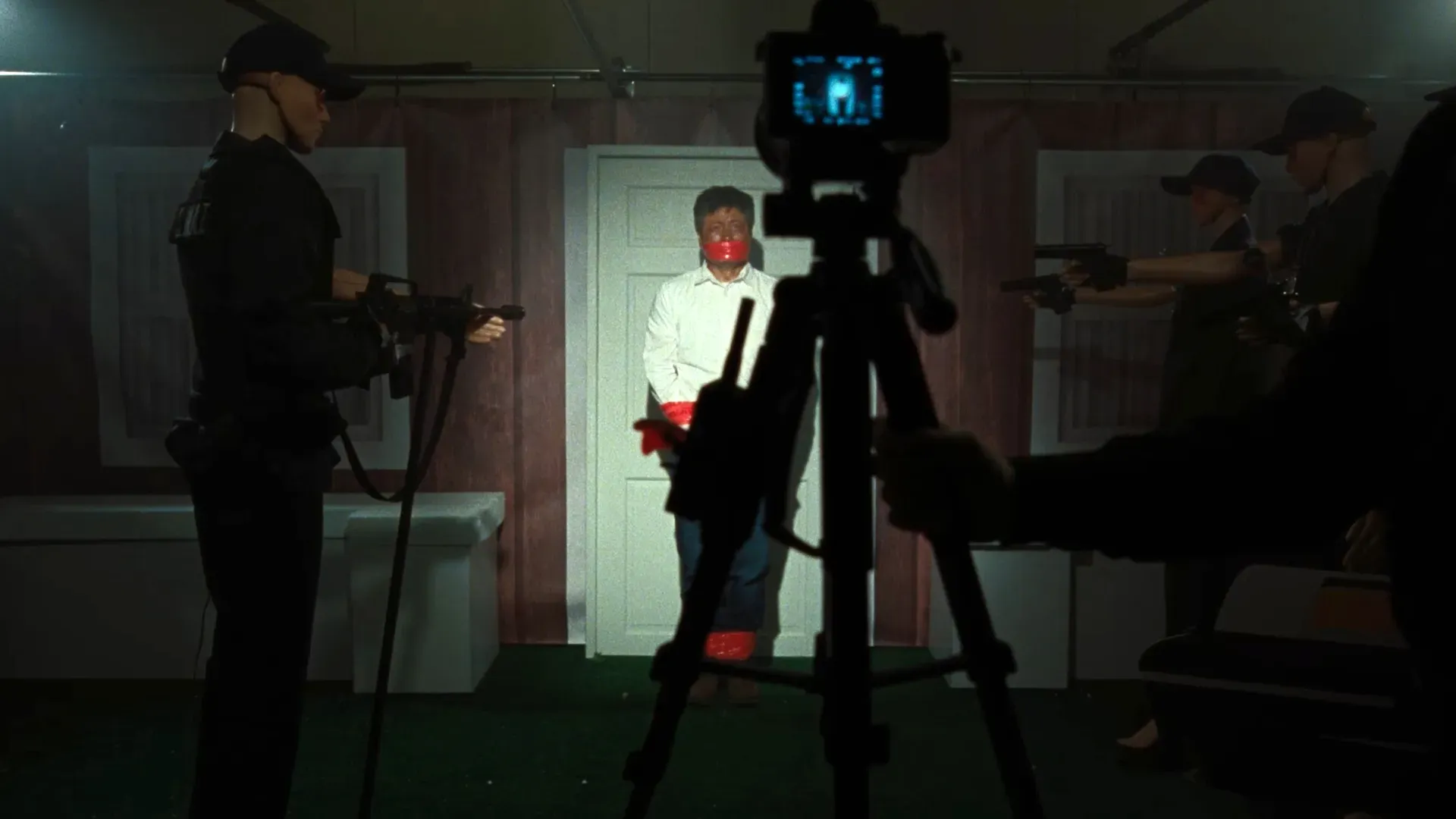
A semi-recluse after her own captured-on-video tragedy went viral, Margot (Barbie Ferreira) spends her nights at home and her days working for a YouTube-like video service where she specializes in content moderation. This means making snap decisions about the appropriateness of videos for the site. (Violence: probably fine. Tips on safe sex and for counteracting overdoses: verboten.) Margot mostly seems to have hardened herself to the task, though that changes when she’s asked to assess a video featuring mannequins, an apparent execution, and an authoritative-sounding voiceover ruminating on the nature of death. Then another and another. With the help of her horror fan roommate Ryan (Aaron Holliday), Margot comes to realize that someone is recreating scenes from the 1978 film Faces of Death, only this time with real deaths.
It’s a rich set-up and the behind-the-scenes look at how online video gets moderated (inspired in part by Goldhaber’s own experiences) is darkly fascinating. Yet it doesn’t take long for the new Faces to largely abandon its novel premise in favor of a grimy-looking (and grimy-feeling) giallo riff in which Arthur (Dacre Montgomery), a loner revealed as the Faces-obsessed serial killer early in the film, and Margot play a cat-and-mouse game while Margot’s life falls apart around her. It’s not badly executed, but there’s nothing scary or clever enough to set it apart from similar films beyond the Faces of Death connection, a throwback meta cloak wrapped around a merely good-enough modern horror movie. —Keith Phipps
Faces of Death opens in theaters tonight. (The original can be found under the counter at your nearest video store. You must be 18 or older to rent.)

You, Me & Tuscany
Dir. Kat Coiro
105 min.
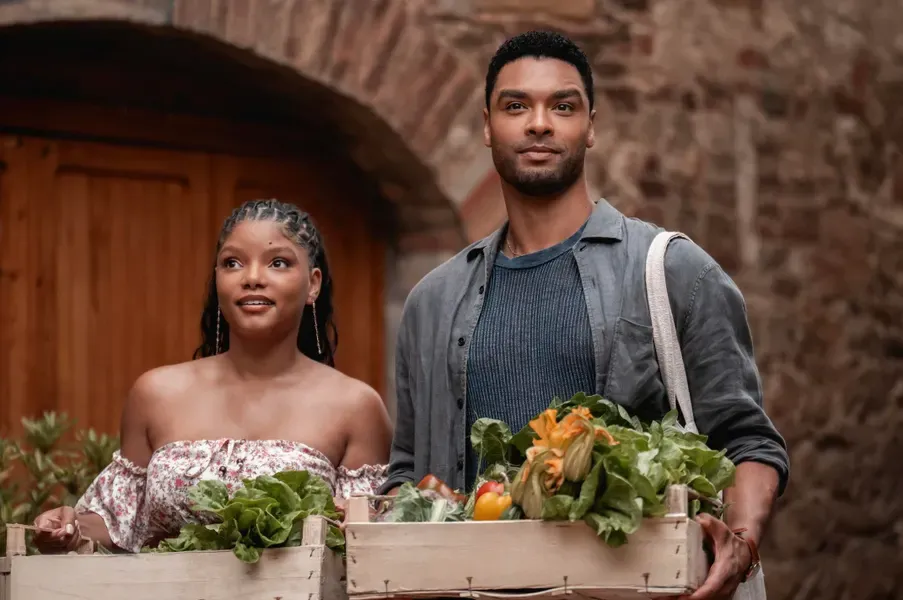
In the rom-com You, Me & Tuscany, a young house-sitter from New York flies to an idyllic village in Tuscany, squats at a villa she knows to be unoccupied, and then pretends to be the owner’s fiancée to keep his family from having her arrested. That’s the short version of the story. The long version is much more tortured, because the filmmakers seem absolutely terrified that audiences will reject its heroine as a freeloading criminal monster, even though she’s played by Halle Bailey, an actress so pop-off-the-screen effervescent that she was cast as Ariel in the live-action version of The Little Mermaid. If there were any animals or fish around, they’d talk to her.
And so there’s an exhausting list of reasons why Anna (Bailey) has broken into another person’s home in Italy: She doesn’t have much money because she dropped out of culinary school to take care of her dying mother. She impulsively uses the plane ticket for a trip she had planned for her mother, inspired by Matteo (Lorenzo de Moor), a friendly stranger who shares smart-phone pictures of his villa. Plus, she happens to arrive during a big annual food and wine festival that has left no vacancies in the town, so she opts to slip into Matteo’s place for the night.
But that only kicks off another series of deceptions (and justifications) involving the engagement ring that Anna happens to slip on her finger or the early flight home that’s far more expensive than the $500 she has to her name. So she plays the part of Matteo’s fiancée to his family, who instantly adore her and thank her for curbing his global wanderlust, and winds up falling for his cousin Michael (Regé-Jean Page), a local winemaker with values as firm as his abs. There may have been some way to convert these complications into screwball plotting, but You, Me & Tuscany is geared more toward the colorful ethnic comedy of My Big Fat Greek Wedding, tipping its cap early by casting Nia Vardalos in a bit part. Between that and a shoutout to Diane Lane in Under the Tuscan Sun, it’s like a trip back to the peak rom-com era of the early 2000s.
Any nostalgia for that era is extinguished quickly, however, because You, Me & Tuscany is a reminder of how silly rom-com gimmicks often spoiled the “rom” without giving back much in “com.” The sword of Damocles that hangs over Anna’s head throughout most of the film creates a tension that dampens the dream of her living in this sun-kissed paradise, which is full of amiable Italian stereotypes. Stripped away of all this nonsense, there’s real potential in the chemistry that Bailey and Page are able to drum up together, along with the intoxicating food-and-wine fantasy of Anna realizing her culinary ambitions. It’s a piece of escapism that can’t escape from itself. — Scott Tobias (2/5)
You, Me & Tuscany opens in theaters everywhere tonight.

Exit 8
Dir. Genki Kawamura
95 min.
The Lost Man (Kazunari Ninomiya) thinks he knows where he wants to go. He just doesn’t know how to get there. Riding the subway at rush hour, he just wants to keep his head down, listen to Ravel’s “Bolero,” and make his way to his job. It’s not going to be that easy, however. Even his noise-cancelling headphones can’t drown out the sound of an asshole yelling at a mom with a crying infant. Then there are the phone calls he keeps getting from The Woman (Nana Komatsu), an ex for whom he obviously still has feelings. But The Lost Man’s not sure what to do with her revelation that she’s pregnant, calling from a hospital, and wanting to know if he wants her to keep the baby. Is he ready to be a father if he can’t even tell off the jerk a few passengers away from him?
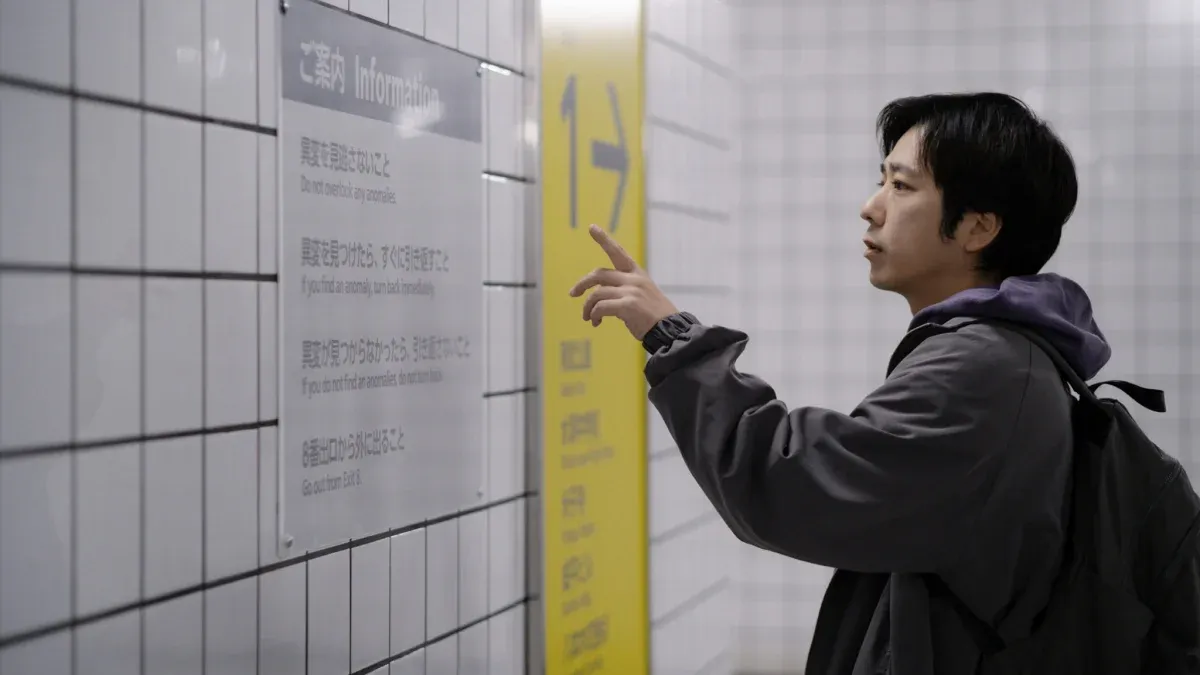
Soon all of this won’t matter. Or at least it won’t seem to matter. Not long after exiting the train, The Lost Man finds himself walking down a seemingly ordinary passageway, one lined with posters on his left and maintenance doors on his right. As he follows an overhead sign labeled “Exit 8,” another man (Yamato Kochi) passes him on his right. After a few more twists, The Lost Man finds himself in an identical corridor lined with the same posters where he walks by the same man. Or is it identical? After a few weird moments, The Lost Man finds a sign telling him to watch for “anomalies.” Should he encounter them, he needs to turn back. And, as nonsensical as this sounds, it works. Both passing through an anomaly-free corridor and spotting a difference, be it subtle or bizarre, and turning back, cause the numbers on the exit signs to work their way closer to the “8” that will allow him to exit. But that doesn’t mean getting out will be easy. (What’s an “8” turned on its side, after all?)
Directed by Genki Kawamura, Exit 8 adapts a 2023 indie game that teases out the disquieting, uncanny qualities beneath the surface of the sort of bland, functional, everyday spaces that most of us pass through without thinking—or looking at twice—all the time. Kawamura, a screenwriter and novelist directing his second feature, recreates the game’s sense of dread and couples it to The Lost Man’s mounting panic each time the counter resets and he realizes he must have missed something. After an opening stretch that retains the film’s first-person perspective, Kawamura skillfully uses long, fluid takes and compositions that create a sense of unease about what might be just out of frame. But Exit 8 only fully commits to horror in a few select scenes. Mostly, it turns up a familiar sense of anxiety stemming from the unshakable feeling that we’ve somehow gotten off the path we were supposed to be on—and might never be able to get back to where we belong. Working with co-writer Kentaro Hirase, Kawamura uses the game’s scenario as a physical manifestation of The Lost Man’s worries about fatherhood. That pairing occasionally feels forced but ultimately works, thanks in large part to Ninomiya’s persuasive performance as a man who has reached a point in life that requires him to do a lot of fretful circling before he can push forward. —Keith Phipps
Exit 8 twists its way into theaters tonight.

Discussion