In Review: ‘“Wuthering Heights”,’ ‘Pillion,’ ‘Good Luck, Have Fun, Don’t Die,’ ‘Crime 101’
A big week at the movies includes an unconventional Emily Brontë adaptation, an unconventional love story, a tale about the end of the world, and a meat-and-potatoes crime thriller.


“Wuthering Heights”
Dir. Emerald Fennell
136 min.
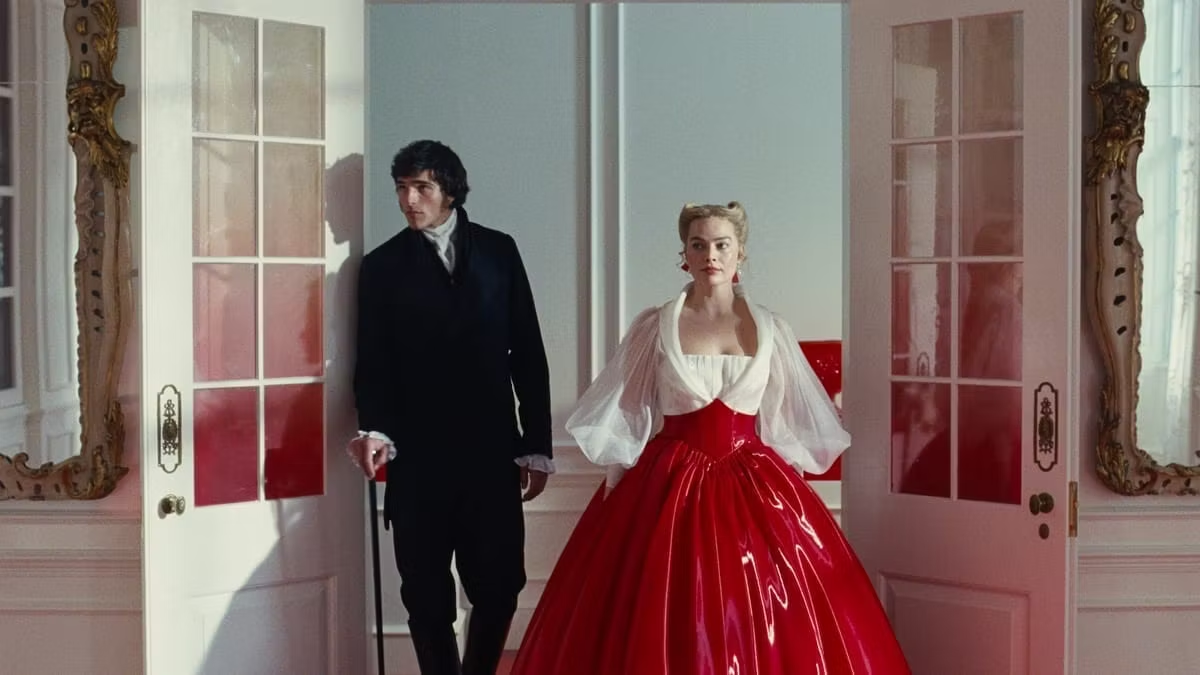
“Wuthering Heights” writer and director Emerald Fennell has said those quotation marks should be considered part of the title and it’s easy to see why. You can still find the original Wuthering Heights on bookshelves across the globe, but this is “Wuthering Heights,” a film that couldn’t exist without Emily Brontë’s novel yet one that’s not beholden to the source material, or really any idea of what a Wuthering Heights adaptation might look like. Quotation marks can buy an awful lot of creative leeway. In fact, it’s probably best to think of Emerald Fennell’s “Wuthering Heights” less as an adaptation of Emily Brontë’s 1847 novel than a gut rehab. The structure remains recognizable from the outside and some of the key interior details have been left intact as a nod to tradition. But the insides have otherwise been torn out and reworked to the taste of the new owner.
That’s a healthy approach to adaptation, but what if the inside was filled with rooms that seemed to belong in different houses? Fennell’s “Wuthering Heights” alternately plays as an homage to soundstage-bound studio-era filmmaking, a grandiose epic filled with sweeping Yorkshire vistas, a racy video seen in the early days of MTV, a straightforward tragedy, soft-focus erotica, and a goof on the very idea of making a Wuthering Heights movie. “Wuthering Heights” looks great and it’s fun to wander around in it for a while, but it’s hard to shake the thought that Fennell’s film has been thrown together without much consideration for how all the rooms might fit together. It’s the cinematic equivalent of The House on the Rock.
The Reveal is a reader-supported newsletter dedicated to bringing you great essays, reviews and conversation about movies. If you are not paid subscriber, we would love for you to click this button below and join our community.
One theme does unite the whole film no matter what tone it’s trying on at any given moment: the connection between sex and death, which Fennell establishes with a fake-out opening scene in which what sounds like lovemaking is revealed to be the agonized groans of a man being hung. To drive the point home, a young member of the crowd gathered for the public execution points out that the condemned has died with “a stiffy.” And, in case you missed the point, Fennell throws in a shot of that, too. This, the opening makes clear, ain’t your granny’s Wuthering Heights.
Which isn’t to say that it is entirely removed from the novel. Soon, Mr. Earnshaw (Martin Clunes) is bringing a young ruffian who will be named Heathcliff (played by Owen Cooper as a child and Jacob Elordi as an adult) home to Wuthering Heights, his venerable Yorkshire estate. Earnshaw’s daughter Cathy (Charlotte Mellington as a child, Margot Robbie as an adult) is delighted to have a new companion, then confused as they age and their feelings for each other grow more complicated. Their love seems impossible. They’re too different from each other in the eyes of the world and, practically speaking, Cathy needs to marry up if she has any hopes of paying off her father’s bills, as Cathy’s servant companion Nelly (Vy Nguyen then Hong Chau) is quick to remind her. Enter Edgar Linton (Shazad Latif), a wealthy neighbor who arrives with his ward Isabella (Alison Oliver) and begins courting Cathy, a development that sends Heathcliff off to parts unknown, at least for a while.
At times, “Wuthering Heights” brings to mind Roland Joffe’s little-loved, overheated 1995 adaptation of The Scarlet Letter, which peppered another literary classic with all the sex Nathaniel Hawthorne must have forgotten to include. In one sequence, Cathy spies on a pair of servants having a kinky encounter when she’s unexpectedly joined by Heathcliff, whose attempt to shield her eyes and stifle her voice leaves her so hot and bothered she has to take to the moors the next day to masturbate. (Heathcliff shows up for that too.) Fennell has a stronger grasp on the material, however, and a gift for provocative sex scenes that was very much in evidence in her previous film, Saltburn. The film often feels polymorphously perverse, making even broken eggs and the flesh of a plucked chicken suggestive and, later, placing Cathy in a room painted to resemble her own flesh, complete with beauty marks and veins.
At the heart of it all is, of course, the self-destructive relationship between Cathy and Heathcliff, a love that cannot be denied no matter how toxic it becomes to the lovers and those around them. (In that sense, it is still your granny’s Wuthering Heights.) Robbie and Elordi play it well and undeniably look the parts of irresistible objects of desire. But, apart from the increasingly perverse spite relationship formed between Heathcliff and Isabel (Oliver has a lot of fun playing Isabel as kind of eternal teenager who leans into bad, horniness-inspired decisions, consequences be damned), a mopey predictability overtakes the film as Cathy and Heathcliff’s love enters its inevitable, and protracted, death spiral. After trying on an array of possibilities, “Wuthering Heights” eventually settles on one. Unfortunately, it’s one of the duller options. —Keith Phipps
"Wuthering Heights" strides lustily into theaters tonight.

Pillion
Dir. Harry Lighton
107 min.
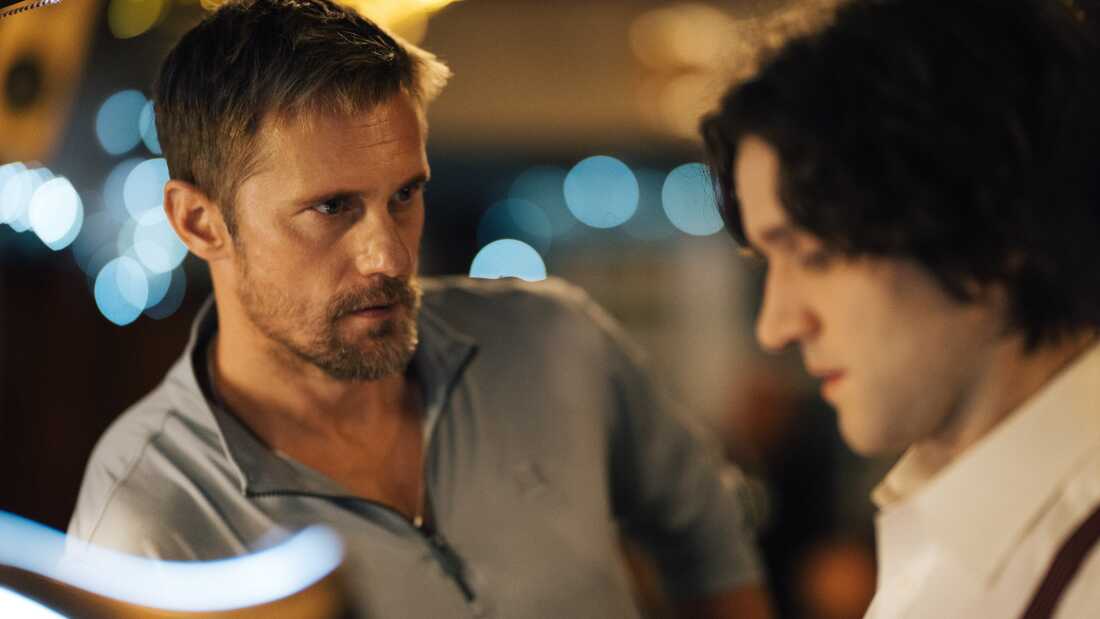
Peggy (Lesley Sharp) and Pete (Douglas Hodge) want the best for their sweet, introverted son Colin (Henry Melling), who still lives in their modest home in Greater London, logging time as as traffic warden while occasionally lending his voice to a barbershop quartet that busks at a local pub. They have accepted that Colin is queer and, as the compassionate and loving parents of an only child, have a keen, almost adorably overeager interest in his love life. When Colin meets a conspicuously beautiful biker at the bar and strikes out for a mysterious late-night rendezvous, Peggy and Pete are hilariously excited about it, treating a casual gay hook-up as if their son was meeting his prospective sweetheart at the ice cream parlor.
Of course, the relationship between Colin and Ray, a taciturn adonis played by Alexander Skarsgård, isn’t quite what they had in mind. They’re angling toward a more conventional path toward happiness for Colin without recognizing what turns him on and what he might like for himself, which is information that he doesn’t want to share with his parents and that they would rather not know. A dominant-submissive partnership like the one Colin and Ray develop in Pillion, writer-director Harry Lighton’s winning debut feature, is way too in the weeds for them, which turns their support into a millstone around his neck. Colin already feels overwhelmed by Ray and the discomfiting (though arousing) terms of their BDSM dynamic, and doesn’t need to feel the weight of his parents’ expectations, either.
And yet Pillion is a film made for people like Peggy and Pete, so that the Colins and the Rays of the world might be understood a little better. Based on Alex Mars-Jones’ novel Box Hill, it feels like the A24 version of a movie that Miramax might have produced during its heyday, when it courted older audiences with cute British comedies with a slight touch of naughtiness. That may seem like a glib description of a movie that’s willing to get this explicit about the ins-and-outs, so to speak, of BDSM culture, but Pillion does bend toward convention and seems intent on bringing viewers like Colin’s parents along for the ride. It’s odd to see a romance that commences with rough trade in an alleyway end up feeling like a spiritual descendent of Bend It Like Beckham.
Melling and Skarsgård do make a wonderful odd couple as Colin and Ray, whose relationship makes sense precisely because Ray has so much inherent power over his overmatched, woefully inexperienced mate. After that brief, nearly wordless tryst in an alley, Colin eventually spends the weekend at Ray’s apartment and accepts the terms that are brusquely dictated for him. In exchange for whatever sexual attention Ray opts to give him, Colin must submit to conditions as benign as cooking for him and as onerous as sleeping on the rug at the foot of his bed. (If he snores or gets up in the middle of the night, Ray says, he’d have to sleep in the hallway instead.) To be clear, these degradations are not at all off-putting to Colin, who loves to be a submissive, but inevitably, the terms of their relationship start to feel too emotionally limiting.
Pillion has to tread a delicate line between questioning the long-term viability of Colin and Ray’s arrangement while stopping short of kink-shaming. Lighton does not quite transcend the clichéd notion of Ray’s inflexibility as a dominant revealing a dysfunction that prevents him from truly caring for a man like Colin. But Pillion does succeed as a first-time love story for Colin, who needs to figure out how submissives, too, can negotiate their own terms. It’s an immensely appealing film that Peggy and Pete would have been happy to see at the local cinema, even if they might mask their faces a little during the sex stuff. — Scott Tobias
Pillion continues to roll out in limited release this week. It opens nationwide next Friday.

Good Luck, Have Fun, Don’t Die
Dir. Gore Verbinski
134 min.
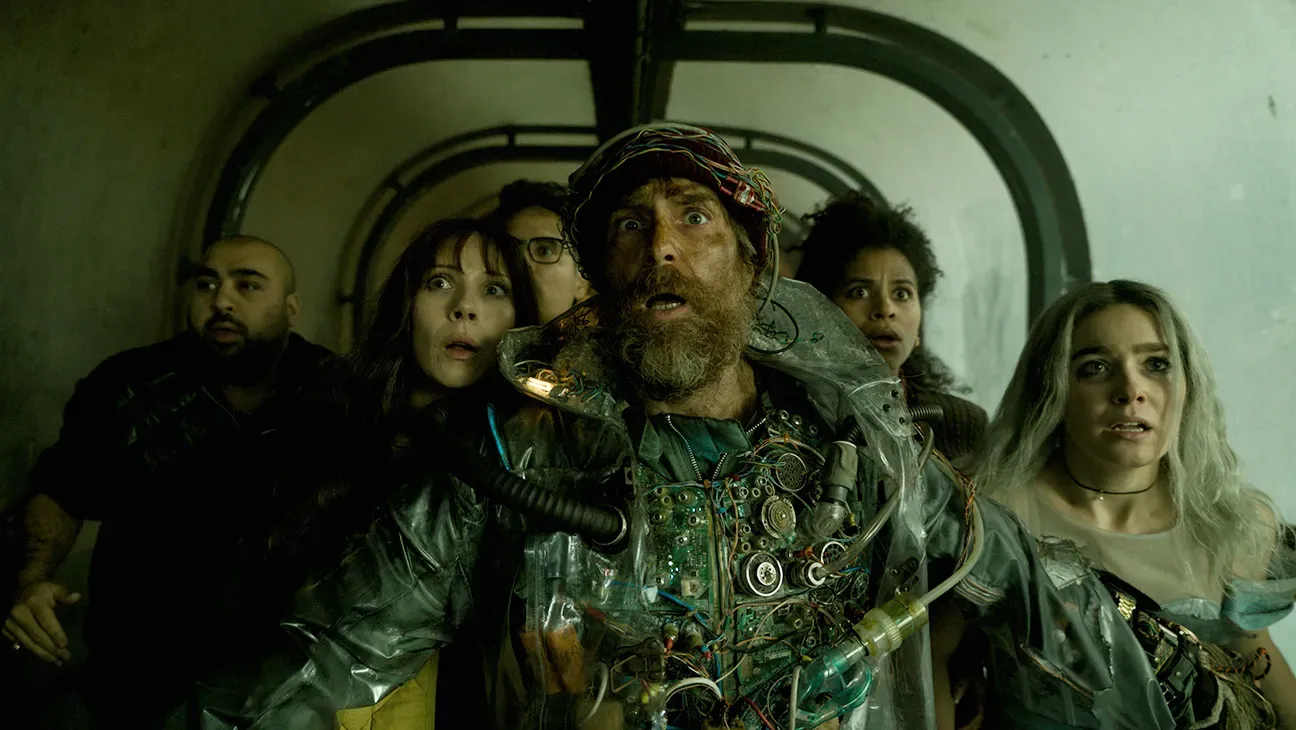
The world’s about to begin an irreversible slide toward the apocalypse, but don’t worry: a crazy-seeming bearded man wearing a raincoat covered in wires (Sam Rockwell, playing a character billed as “The Man From the Future”) is on the case. In fact, The Man claims as he barges into a crowded L.A. diner late one evening, he has everything he needs to prevent the end of the world, provided he assembles just the right crew from the diner’s patrons. Sure he’s tried before. In fact, he’s tried and failed to find the right combination 117 times. But he’s pretty sure he’ll crack the code eventually and maybe this time is the one in which he stops the malevolent artificial intelligence from coming online. It could be his, and thus humanity’s, lucky night. Who knows?
If you’re already thinking that it sounds like Good Luck, Have Fun, Don’t Die borrows conspicuously from a few other movies, that’s okay: you’re supposed to. Early on, The Man admits that what he’s describing resembles the plot of Groundhog Day. Other sources of inspiration—from 12 Monkeys to The Matrix to Ghostbusters to Night of the Living Dead—don’t get mentioned by name, but their influence is too obvious to ignore. It’s a meta touch fitting for a film with an AI foe in which it’s sometimes unclear what lines viewers should be drawing between reality, simulation, and delusion.
Directed by Gore Verbinski from a script by Matthew Robinson, Good Luck, Have Fun, Don’t Die is driven by a soul-deep wariness about where technology is taking us, and where it’s landed us already. When The Man enters the diner, virtually every customer is already staring at their phones. It takes threats to get their attention. After The Man assembles his crew, the film then provides flashbacks filling in the stories that brought each character there. For teachers Mark (Michael Peña) and Janet (Zazie Beetz), it’s a student body whose phone fixations have turned them into menacing zombies. For Susan (Juno Temple), it’s a clone that’s proven inadequately close to the son she lost in a school shooting, an event that’s become so commonplace that a whole industry has risen up to provide simulated offspring for grieving parents. Sure, the replacement kids are expensive, but the government covers part of the cost and you can save some cash if you opt for the version with ads.
Susan has the grimmest of Good Luck’s subplots, but not by that much. Once it’s fully revealed, the backstory of another party member, a woman in a knock-off Disney princess costume named Ingrid (Haley Lu Richardson), rivals hers. But, really, the whole world Verbinski creates feels pretty dystopian, even as the crew struggles to stop the AI destined to really mess things up from coming online. Even Rockwell’s manic hero (or “hero?”) feels worse for wear and a little tired of going through the same routine, however determined he remains to beat the machine.
This is Verbinski’s first film since A Cure for Wellness in 2016 and, as with its predecessor, Good Luck sometimes threatens to topple under the weight of its unruly ambitions. Verbinski’s technical skills and gift for constructing set pieces remain very much intact, even when the story seems to be going in several directions at once and the tone shifts between dark comedy to the darkest comedy imaginable. (See the joke about the advertising tier for revived children above.) Good Luck feels raggedly put together at times, however precise Verbinski’s filmmaking might be within each scene, but as the story unfolds and the full scope of the threat emerges, a winning sincerity overtakes the film. The Man from the Future has seen what it looks like when human imagination first gets coopted then squeezed into nonexistence and realizes it’s worth fighting no matter how many times he has to start over. Whether there’s a way out of that loop is another question. —Keith Phipps
Good Luck, Have Fun, Don't Die opens nationwide tonight.


Crime 101
Dir. Bart Layton
140 min.
Among the many life lessons that veteran minor-league catcher Crash Davis imparts on the young, dim fireballer Nuke LaLoosh in Bull Durham is to avoid trying to hammer the opposition with fastballs. “Strikeouts are boring,” he says. “Besides that, they’re fascist. Throw some ground balls. It’s more democratic.” In an IP-addicted Hollywood that hurls nonstop heaters like Nuke LaLoosh, there’s room for an off-speed pitch like Crime 101, which is down-the-middle in a way that would be less notable were it not so rare. Based on a novel by Don Winslow, who’s an expert at propulsive thrillers about dirty cops and vicious cartels, the film lives up to its generic title in that it’s a shameless facsimile of Michael Mann’s Heat, right down to its glittering Los Angeles backdrop. Yet it’s so rare to see studios bother with a well-plotted, crisply orchestrated crime picture that it feels like a gift. It’s little wonder that some of the best actors in the business have fluttered to it like moths to flame.
As the Robert De Niro and Al Pacino in the film’s cat-and-mouse game, Chris Hemsworth stars as a professional thief and Mark Ruffalo as the obsessive detective pursuing him, though both operate under a code of honor that often eludes others of their kind. The “101” of the title is not merely a signal of the meat-and-potatoes quality of the story, but part of the thief’s pattern of behavior, because he likes to choose spots with easy access to Highway 101. At least that’s the theory Ruffalo’s Detective Lou Lubesnick applies to Mike Davis (Hemsworth) as he tries to make connections between various robberies while frustrating his bosses, who want him to close more cases. Halle Berry stars as the connecting piece between the two men, an insurance broker for ultra-wealthy clients who Mike tries to recruit for the big jewel heist that could set him up for life.
The Waingro in this Heat scenario is Ormon (Barry Keoghan), a reckless and violent criminal who prowls Mike’s terrain on his motorcycle.here are parallels, too, in the Amy Brenneman-like love interest (Monica Barbaro) that Mike takes on despite his lone-wolf reputation and in the Jon Voight-like fence (Nick Nolte) who sets up his jobs. That there’s no Heat equivalent to Berry’s character may account for why she’s the most compelling figure in Crime 101, a dedicated professional who’s caught between sleazy clients and misogynist bosses who refuse to make good on their promises. She’s not temperamentally inclined to cross the line, but she’s so tired of getting steamrolled that she can’t be blamed for sniffing out a good opportunity.
Writer-director Bart Layton proves a fine match for the material, having already directed two incisive films about unusual criminal schemes: the 2012 documentary The Imposter, about a con artist who pretended to be the long-lost member of a Texas family, and 2018’s American Animals, an underrated fact-based thriller about a rare book heist at Transylvania University in Kentucky. Crime 101 represents a massive scale-up in budget, but Layton is a confident storyteller and the various subplots in Winslow’s pulpy scenario converge elegantly, even if they’re a bit secondhand. Jennifer Jason Leigh turns up for one scene, as if to offer her blessing to the project. Good movies are worth making. — Scott Tobias
Crime 101 opens tonight in theaters everywhere.





Discussion