Pairing Off at the 2026 True/False Film Festival
At this year's True/False Film Festival, films about grief, politics and the environment were in conversation with each other.


Before the first public screening of his heartbreaking new film Remake, which had its North American premiere at the True/False Film Festival last weekend, director Ross McElwee gave the audience permission to laugh. In the past, we would not have needed permission at all, because the laughs rolled out freely and generously, tried to gentle deadpan wit that was so often attached to McElwee’s autobiographical work, which would start with an inquiry into one topic or another but inevitably digress into the bemusing minutiae of life itself. Almost exactly 40 years ago, McElwee’s Sherman’s March not only raised the bar on first-person, essayistic non-fiction filmmaking, it was also one of the funniest films ever made, an ostensible history of William Tecumseh Sherman’s Civil War campaign through Georgia and the Carolinas that turns into a document of McElwee’s own romantic path of destruction. The film’s full title says it all: Sherman’s March: A Meditation on the Possibility of Romantic Love In the South During an Era of Nuclear Weapons Proliferation.
One underrated aspect of Sherman’s March is that it does, in fact, have some compelling things to say about Sherman’s fascinating contradictions and the imprint of his campaign on Southern identity. But it’s in McElwee’s nature to act as a memoirist, too, which has given his filmography a continuity that could be likened to Michael Apted’s Up movies but more loosey-goosey, since McElwee isn’t following through on a social experiment in nonfiction filmmaking. Each new film feels like a visit from an old friend who’s wrapping his mind around some fresh obsession, but who has updates to share about his friends and family, like the infant daughter, Mariah, that he and his wife adopted from the bureaucratic tangle of Latin America (2008’s In Paraguay), or the fractured relationship that he had with his son Adrian (2011’s Photographic Memory).

The brutal irony of Remake is that it’s arguably McElwee’s most whimsical idea for a documentary but the digressive force here is tragedy, not comedy. And yet, it’s hard not to laugh along with McElwee when Hollywood comes calling with the idea of remaking Sherman’s March as a fiction feature and presents him with a contract to sign over the rights to it. McElwee agreesThe , under the stipulation that he would be allowed to shoot a “making-of” documentary about the production, which keeps changing shape without ever quite coming to fruition. Yet several years into the project, Adrian died of a fentanyl overdose at age 27, cutting short a young adulthood troubled by drug abuse and mental health issues. Adrian’s life had been a well-documented part of McElwee’s ongoing story, too, and his own aspirations as a filmmaker add another layer of autobiography to Remake. At one point, father and son are each filming the other having a conversation in the kitchen as dad makes an omelette with a GoPro affixed to his ball cap.
The Reveal is a reader-supported newsletter dedicated to bringing you great essays, reviews and conversation about movies. If you are not paid subscriber, we would love for you to click this button below and join our community.
With a restored version of Sherman’s March playing at True/False, too, as part of the festival’s “True Vision Award” program, it pierces the heart to see where fate has taken McElwee, who once pinballed through the lives of beautiful women, from an aspiring actress with a mesmerizing thigh-exercise regimen to a hippie linguist given to sunning herself on an uninhabited island. Where McElwee once seemed capable of going anywhere with a camera attached to his shoulder, including approaching Burt Reynolds on the set of Cannonball Run II, no one in his family wants to be filmed for Remake, including his wife, who divorces him before their son’s death. McElwee squares up to these low moments in Remake while sifting through remnants of the past, like a cache of Adrian’s own video footage, which are a window into his frustrated aspirations and his impulse to drift off the common path.
Yet Remake is more bittersweet than you’d expect—or, least, more bittersweet than you’d expect if you hadn’t seen other Ross McElwee films. When he gave the True/False audience permission to laugh during the film, he meant it sincerely. For one, the film brings back scene-stealer Charleen Swansea, the gregarious poet and teacher from North Carolina that he’d been following as far back as the 1977 doc Charleen and who spent her time in Sherman’s March roasting him for his pitiful attempts at “passion.” Checking in with Charleen again is hard for McElwee (and for us) because dementia has diminished her memories of their collaboration, but her buoyancy and irreverent sense of humor remains intact. There is certainly loss in Remake, but nothing is altogether lost. Our old friend carries on.

One of the exciting aspects of going to any festival, especially one as well-curated as True/False, is that films inevitably enter into conversation with each other. Immediately after seeing Remake, for example, I slipped into Closure, the new documentary from Michał Marczak, a Polish filmmaker who’d made a strong impression a decade ago with All These Sleepless Nights, a docu-fiction hybrid about young pleasure-seekers in Warsaw. While Marczak insists that Closure is more purely non-fiction, his flair for the cinematic comes through in his dynamic compositions and a score that feels like the tremulous underbedding of a Trent Reznor/Atticus Ross collaboration. Much like Remake, the film is about a father coping with the loss of his son, in this case a teenager whose disappearance near the Vistula River vexes him. Was it suicide? Is he really gone for good? The answer to both questions appears to be “yes,” but Marczak follows the father as he scours the banks of the Vistula relentlessly, trying to reach some definitive conclusion to a mystery that he may never solve.

Another inadvertent double feature over the weekend confronted me with two angles on Israel’s scorched-earth response to the Hamas attack on October 7th, 2023, which has leveled much of the Gaza Strip and killed an estimated 70,000 Palestinians and counting—around 80% of them civilians, and 30% children. I doubt there will be a more vital and necessary film to see in 2026 than Poh Si Teng’s American Doctor, which addresses the devastation head on, from the perspective of three doctors willing to risk their lives to provide life-saving care in Gaza. Just to witness an up-close, unblinking look at the conditions on the ground is a bracing reminder of how few of these images seep through mainstream news coverage, where it might rattle the consciences of those who might recoil at the reckless disregard for the lives of non-combatants.
But then, “reckless” is too generous a word to describe what we see in American Doctor. A more fitting word is “deliberate,” given the relentless targeting of not only civilians, but of hospitals, journalists, and health care workers, who are among the scores of casualties. One interesting wrinkle to American Doctor is that the one white doctor of the three, a Jewish orthopedic surgeon from North Carolina named Mark Perlmutter, is the most strident in cable-news hits and other public appearances. His colleagues, a Palestinian and a Zoroastrian, share his passion but are much more diplomatic, because they better understand the sensitivities around the conflict and are inclined to try more gentle forms of persuasion. (That said, a scene where the most stoic of the three rebuts the absurd lie that Hamas was operating in tunnels underneath bombed hospitals drips with enough contempt to melt iron.)
Though American Doctor does not yet have distribution, its accessibility gives it tremendous power as a cultural event. While politicians and pundits have made a habit of yadda-yadda-ing the violent targeting of children here and abroad—from Sandy Hook to the recent leveling of a girl’s school in Tehran, which killed as many as 170 people—it’s hard to question the scale of the tragedy depicted in the film and the motives of doctors who face extraordinary danger in trying to mitigate it. No doubt American Doctor will be questioned anyway, but engaging in a moral argument over what’s happened (and happening) in Gaza is better than the complicity of silence.
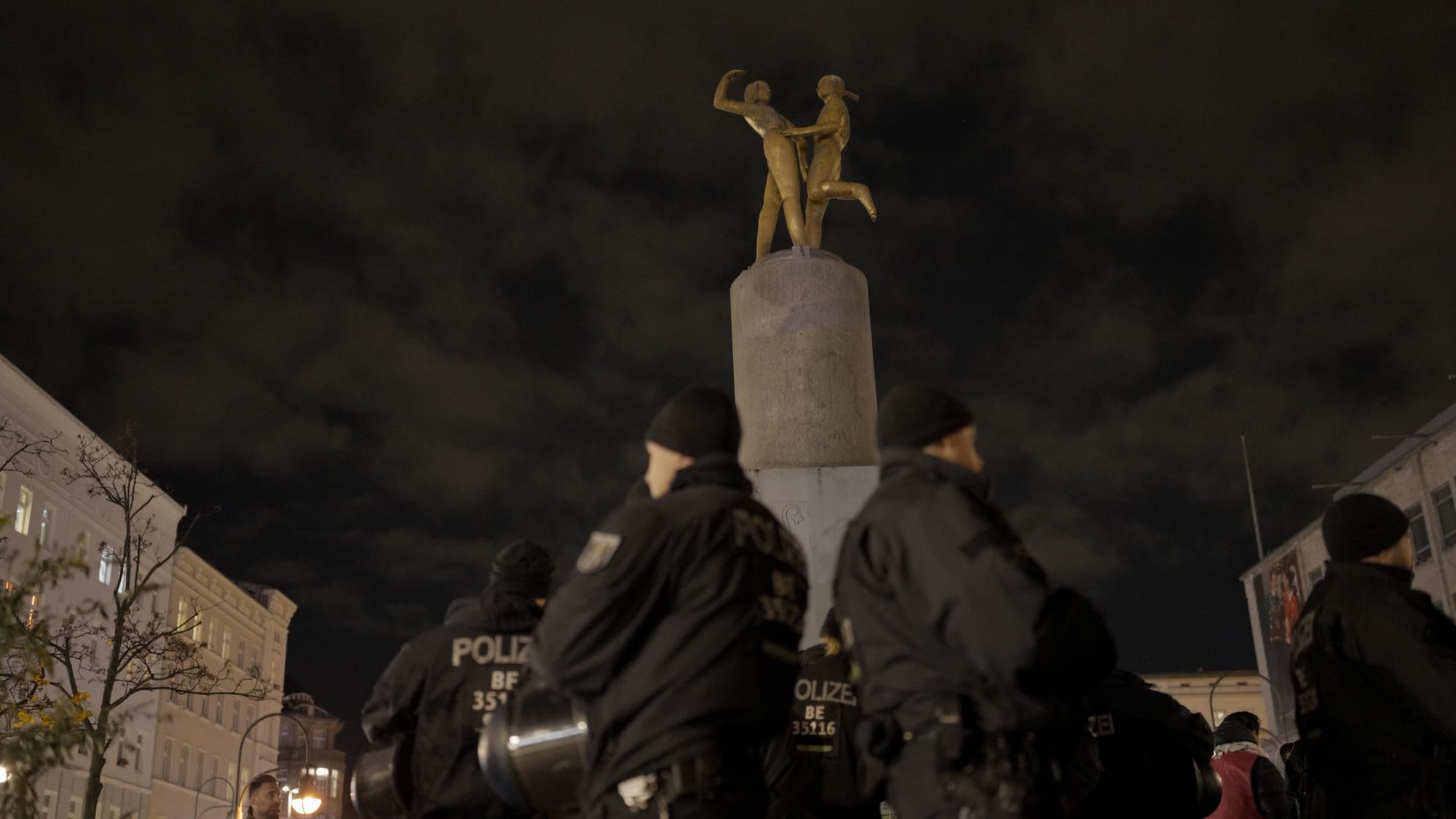
It’s also better than the outright suppression of dissent that director Leah Galant witnesses in her essay-film Landscapes of Memory, an unfortunately stodgy title for a documentary that pulses with anger and humanity. A young Jewish-American whose father—a sweet, rascally presence whenever he’s on screen—has been diagnosed with ALS, Galant heads to Germany to explore the idea of “collective memory,” specifically as it relates to the country’s efforts to remember the Holocaust and prevent any future spikes in antisemitism. Yet Galant and the activists she profiles are appalled by the hypocrisy of German authorities who use collective memory to crack down on pro-Palestinian sentiment while allowing the far-right AfD (Alternative for Germany) party to push blood-and-soil nationalism into the mainstream. Through her lens, collective memory looks more like selective memory.

Politics also seeped into two prominent eco-documentaries to turn up at True/False after debuting to great fanfare at Sundance earlier in the year. Nuisance Bear and Time and Water are about two environmental catastrophes that appear past the point of no return. With Nuisance Bear, directors Jack Weisman and Gabriela Osio Vanden do their best to monitor a single, troublesome polar bear as it barrels its way through Churchill, Manitoba, a city that’s touted as “the Polar Bear Capital of the World” and has the tourists to prove it. Beyond the gross spectacle of visitors on safari, snapping pictures out of bus windows, there is a sincere effort to manage and sustain the polar bear population. But just the reality of bears living in proximity to humans makes life impossible for both parties, locking them into a never-ending cycle of “nuisance bear” incursions and the graceless necessity of shooing them away.
With Time and Water, her follow-up to the popular Sundance-winner Fire of Love, Sara Dosa again takes a personal approach to the geological phenomenon, but it’s a little drier this time around. She leans heavily on Andri Snær Magnason, an acclaimed writer from Iceland who has a personal attachment to the country’s glaciers, which have functioned as a vital source of memory for both his extended family and for the country at large. As climate change has led to the rapid winnowing of the glaciers—and the outright “death” of the smallest one on the island, for which Magnason is chosen to write an official epitaph—the obvious environmental loss is coupled here by the more abstract loss of the country’s identity. Dosa and Magnason ruminate on this latter point quite a lot, to the point where Time and Water feels like it has as many potential endings as The Return of the King. But it’s worth thinking about climate change as something more expansive than the altering of the present and future. It can destroy the past, too.
Other notes from the festival:

Phenomena joins Closure as the most non-traditional, experiential documentary I saw in this year’s slate, demonstrating basic scientific principles (Light, Matter, Energy, etc.) through experiments and tricks of photography (and a superb score by Nils Frahm) that bring them to cinematic life. Though his father is a physicist, Josef Gatti comes at the material as a filmmaker hellbent on visual and aural stimulation. To put it in the most sophisticated language possible, the film makes you feel like you’re tripping balls.
The Great Experiment is an audacious attempt to summarize the political turmoil of Donald Trump’s first term in office by surveying American unrest and “polarization” in a rough, intuitive chronology. I found it mostly rudderless and marred by an unintended both-sides-ism in depicting the divisions within the country (which are, frankly, the fault of the side that ultimately tried to overthrow the government). But the black-and-white images include a lot of good, original, ground-level images and it’s certainly one for the time capsule.
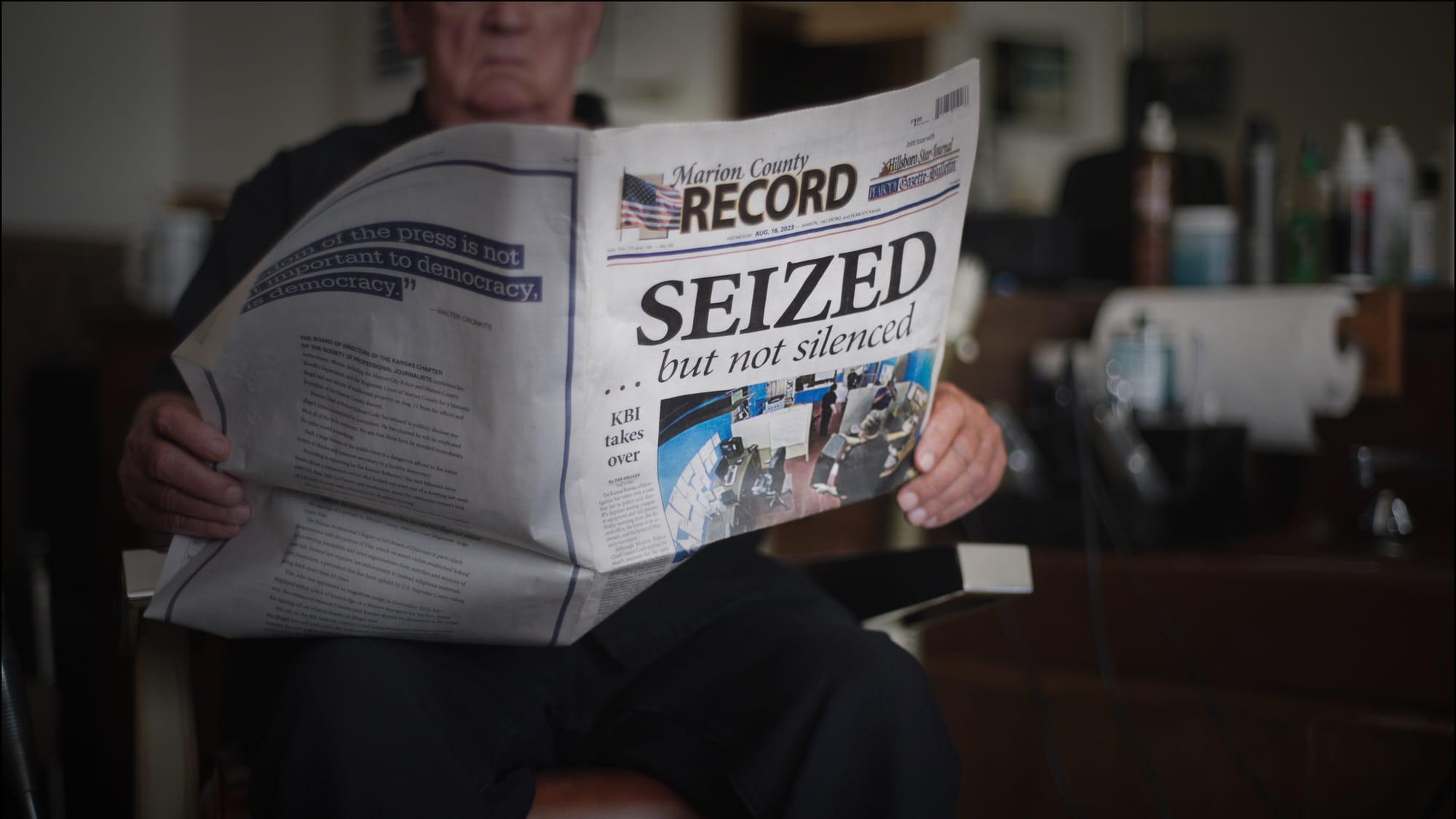
A couple of other political docs go the more conventional route: Seized digs into the appalling, ham-handed raid on a Marion, Kansas newspaper that made national headlines for its violation of First and Fourth Amendment rights. Director Sharon Liese feints at an annoying “balance” by noting the sometimes-petty articles that the paper’s longtime editor would write about local officials, which created tension within a town of less than 2,000 residents. But he’s ultimately on the side of the angels, and the film makes a strong point about how the weakening of local news sources across the country allows institutional abuse to go unchecked. Meanwhile, Who Moves America tracks the lead-up to a massive UPS strike that never ultimately comes to pass, which gives a conventional union doc an anticlimactic ending. (Points off, too, for lionizing Teamsters boss Sean O’Brien, who’s since sold out the labor movement to Donald Trump and the Republican Party.)
One more note to my fellow Revealers: Please consider coming out to a future festival! True/False is such a unique and important festival, and it’s unusually accessible and affordable to members of the public. There’s also enough time between screenings for a meet-up to happen, so let’s socialize next year!
Discussion