Pee-wee's America
With 'Pee-wee's Big Adventure,' Paul Reubens' whimsical creation conquered America. The sequels proved how hard it was to do it.

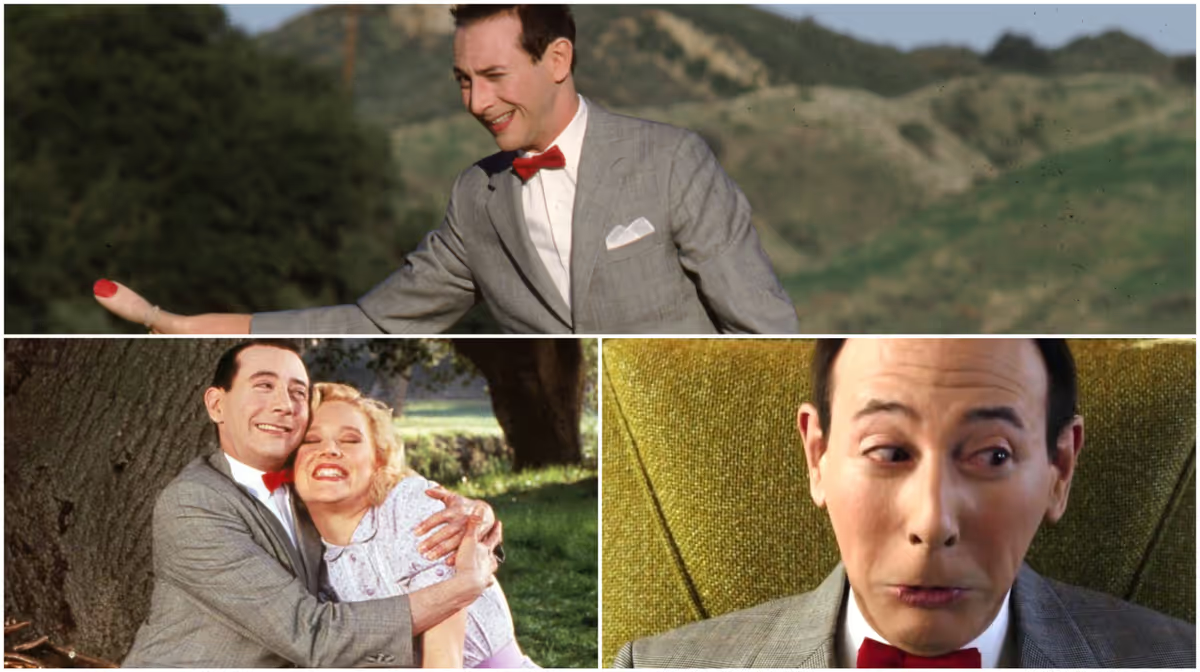
Things are not going well for Pee-wee Herman when he stumbles into the Apache Bar, a roadside dive that happens to be a private club for a motorcycle gang that calls itself “The Satan’s Helpers.” After a long and eventful journey to San Antonio, Texas—riding shotgun with an escaped convict, hitching a lift from an ominous Big Rig driver known as “Large Marge,” sharing a boxcar with a folk song-screeching hobo—Pee-wee has discovered that his beloved bicycle, a red Schwinn tricked out with design flourishes and James Bond gizmos, is not in the basement at the Alamo, as a fortune teller suggested. In fact, there’s no basement in the Alamo at all, a notion that made him the laughingstock of the best group his gum-chomping tour guide (Jan Hooks) had ever had. Now he’s back to square one, broke and untold hundreds of miles from home. He needs to make a call, but can’t hear above the din.
“Shhhhh…,” he hisses at the roughnecks. “I’m trying to use the phone!”
So begins the most famous sequence in Tim Burton’s debut feature Pee-wee’s Big Adventure, a modest hit in 1985 that’s finally gotten the Criterion treatment, an honor befitting one of the greatest comedies ever made. To the extent that the film penetrated the culture during the summer of Rambo: First Blood Part II, The Goonies, Cocoon, and Back to the Future, audiences would remember Pee-wee’s last request from the Satan’s Helpers, who didn’t take kindly to being shushed and certainly didn’t take kindly to this man-child in the gray suit and red bowtie accidentally knocking their parked motorcycles over like dominos. Pee-wee drops a quarter in the jukebox, borrows a pair of white platform shoes, and opts to spend his final moments on earth on top of the bar, dancing to the 1958 Latin-inspired instrumental “Tequila” by The Champs.
It is a quintessential moment for Pee-wee, the character first developed by Paul Reubens for the L.A. improv troupe The Groundlings in the late ’70s and cycled through appearances on The Dating Game, late-night talk shows, HBO specials, three feature films, and a Saturday morning variety show. The formula is simple enough: Pee-wee has to take a bar full of people who want to kill him (or rather, stomp him, then tattoo him, then hang him, then kill him) and turn them around. And it’s a special kind of magic that he’ll do it mostly by being himself, though he does smash a few glasses to play to the crowd. We’ve seen the model of The Satan’s Helpers in movies before, specifically the Roger Corman biker pictures that popped up in the mid- to late-‘60s. But in Pee-wee’s hands, these snarling hooligans are quickly and utterly disarmed, as if converts to the Church of Whimsy.
That’s the power of Pee-wee Herman and that’s the magic of Pee-wee’s Big Adventure, a road movie that transforms the American road into a cartoon landscape of his own imagination. For Reubens, playing Pee-wee must have felt like a career-long metafiction in which he constantly faced Satan’s Helpers types and labored to turn them around, to varying degrees of success. Pee-wee was certainly a challenge to traditional notions of masculinity and adulthood—and, let’s face it, sexuality—and there was never a time in which he would be in fashion, at least as an imitable figure in pop culture. And so Reubens had to slip on those platform shoes, crank up the jukebox and hope that another in a long line of tough crowds might come around to his way of seeing things. Whatever melancholy he must have felt having to do it is never once betrayed by PW: He is optimism personified.
This post is for paying members only
Sign up now to read the post and get access to the full library of posts for subscribers only.
✦ Sign up