‘Straight Talk’ and the Burdens of Being Dolly
In this rom-com about a small-town Southern gal who becomes a talk-radio star, Dolly Parton told a meta-narrative about her public image.

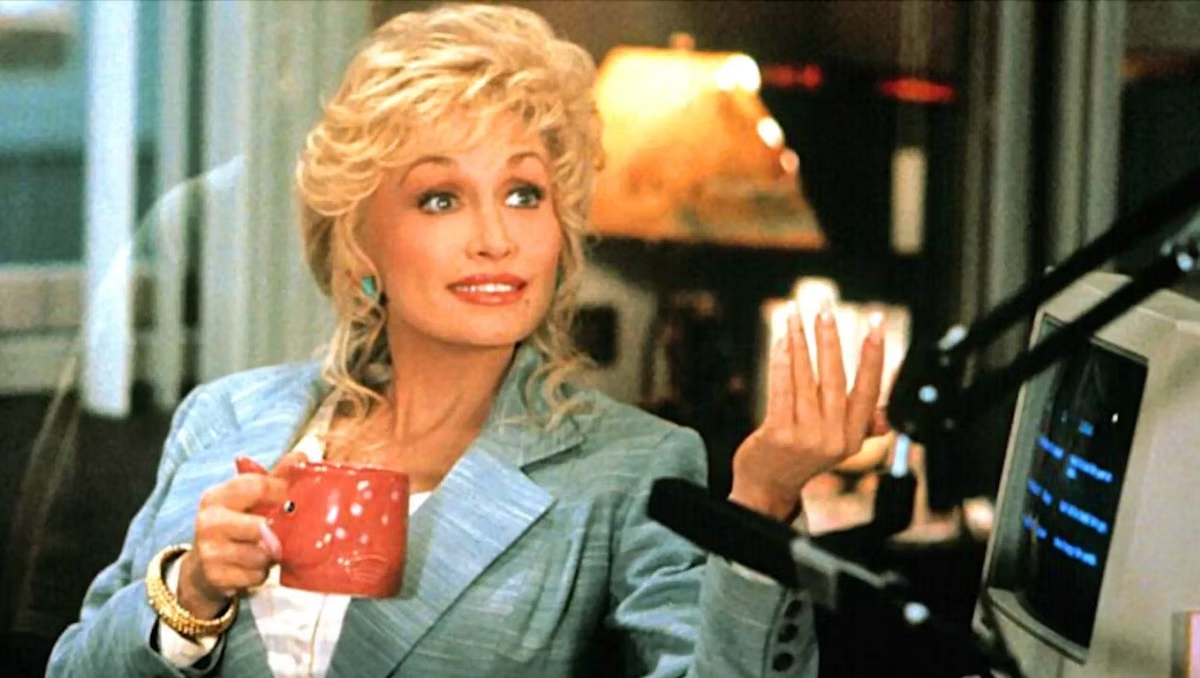
To say that authenticity was Dolly Parton’s brand sounds cynical and contradictory on its face, because the word “brand” suggests a level of commercial calculation that makes authenticity impossible. Yet fame itself has a way of forcing a person’s hand. Ordinary people may give plenty of thought to their values and how they want to be understood by others, but when you live your life in the spotlight—which Parton did from an early age, as she emerged from poverty in rural Tennessee and grew into a songwriter and multi-hyphenate country star—you have a public image that must be cultivated and controlled. And no one proved better at it than Parton, who died as an icon so universally beloved that even President Trump wrote something normal about her, despite her association with initiatives (education and literacy, scientific research and vaccines, a steadfast support for the gay and trans community) that are anathema to him. (The normalcy was short-lived.) Now that she’s gone and the skeletons are free to emerge from the closet, we’re mostly discovering that she was secretly more wonderful than we even imagined her to be.
The “Dolly” persona may well have aligned with the person she truly was, but it limited her as a movie star, because there wasn’t a lot of room to paint outside the lines. Though she’s fondly remembered for a run of features in the ’80s—starting with perhaps her most charming turn as a brassy receptionist in the workplace comedy 9 to 5, and continuing with marquee roles in The Best Little Whorehouse in Texas, Rhinestone and Steel Magnolias—Parton was not a character actress but an actress playing variations on a character, one with a strict set of parameters that could only be pushed so far. It’s hard to guess what kinds of performances she might have given had she rebelled against her public image, but then again, could Dolly Parton ever have disappeared into a role? Would it have meant for her to have lost control?
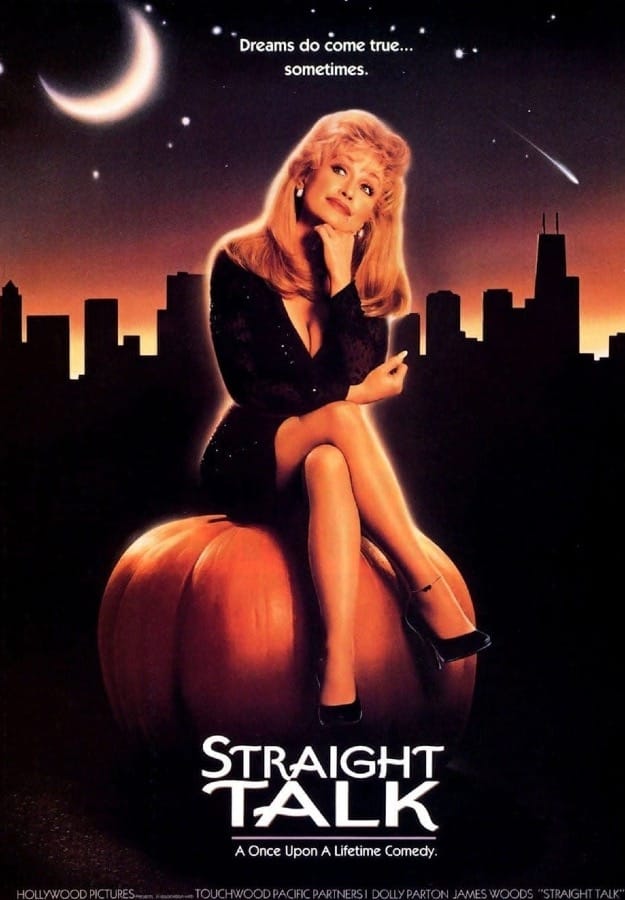
That meta-narrative plays out in the 1992 romantic comedy Straight Talk, the last and least-noted of Parton’s star vehicles, which opened to middling reviews and box office and quietly curbed her Tinseltown ambitions, at least as a bankable lead. During that stretch in the early ’90s, Disney was flooding theaters with modestly budgeted mainstream films through its Touchstone and Hollywood Pictures production labels, betting that the occasional hit like Sister Act could redeem the many low-stakes mediocrities that slipped quietly onto video store shelves. It was a radical strategy at the time and an absolutely unthinkable one now, when solid base hits up the middle are not a priority for studios that almost exclusively swing for the fences. Straight Talk turned out to be one of those low-stakes mediocrities, a reasonable fate for a contrived and visually indifferent film that’s no more than pleasant. It’s not less than pleasant, either: Parton is her disarming and lovable self, and there’s 91 minutes of her.
This post is for paying members only
Sign up now to read the post and get access to the full library of posts for subscribers only.
✦ Sign up