The New Cult Canon: ‘Confess Fletch’
Greg Mottola and Jon Hamm gave audiences the Fletch they apparently didn't deserve.

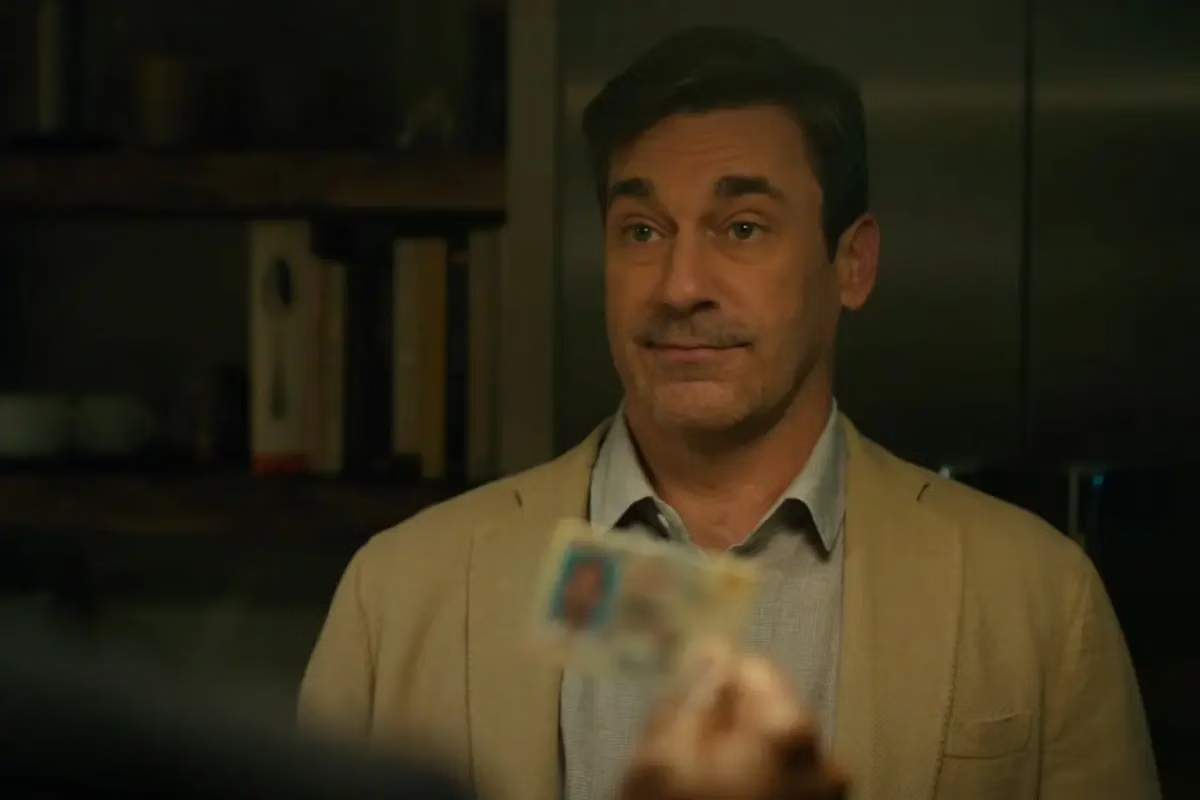
“I just love listening to podcasts in my car. This is a particularly interesting one on pigs. Did you know they don’t sweat? And they have the longest orgasms of any mammal.” — Fletch, Confess, Fletch
In one of the funniest scenes of the current century, Irwin Maurice “Fletch” Fletcher (Jon Hamm), a freelance writer and former investigative reporter (“of some repute,” he’ll make sure to tell you), visits Eve (Annie Mumolo), a single woman who owns a cluttered condo next to the luxury Boston townhouse where Fletch is staying. Fletch is curious to hear about Eve’s relationship to the condo’s owner, Owen, because when he walked into the place, he was greeted by a friendly note, a complimentary bottle of wine, and the body of a dead barista named Laurel Goodwin. Though he handles that last revelation with his signature breezy aplomb, the police are unimpressed by his story and hostile to his attempts to offer himself as the unofficial third detective on a case where he is the prime suspect. Nevertheless, he learns that Eve has a key to Owen’s place, because she feeds his fish when he’s out of town and she seems perfectly happy to have the company. That’s one thing she and Fletch have in common: They don’t have the shiftiness of murderers.
Enjoying this free Fletch-related content on The Reveal? Now's a great time to become a paid subscriber. You'll get access to everything we publish—from articles to audio commentaries—and help support independent film criticism.
The sequence that follows is a masterclass in low-key slapstick and a perfect illustration of why Greg Mottola’s Confess, Fletch, an adaptation of Gregory Mcdonald’s second novel built around the character, is such a rare pleasure, especially at a time when a new Fletch comedy might be sold as a potentially lucrative franchise revival. The foreground/background dynamic in the kitchen has Fletch ostensibly asking questions of Eve, but she doesn’t need much prompting to launch into a dizzying stream-of-consciousness while tending to her yippy dog Mignon and whipping up leftovers for dinner. Among the facts Fletch learns about Eve:
1. Mignon pees when he’s hungry, which is why he’s currently peeing on the floor. (She covers it up loosely with a dish towel.)
2. Eve gets around the “no pets” rule instituted by her rich neighbors because Mignon was grandfathered in and she keeps buying dogs that look like Mignon (this is her third) to replace him, and they seem to believe she has a 25-year-old dog.
3. She considers herself Owen’s “quasi-shrink” because he would come over to smoke weed and cry. She hates Owen’s ex, a “lifestyle curator” named Tatiana (Lucy Punch). And when Fletch seems to deduce that she has feelings for Owen, Eve asks, “What is this? Woodbird and Bernstein?”
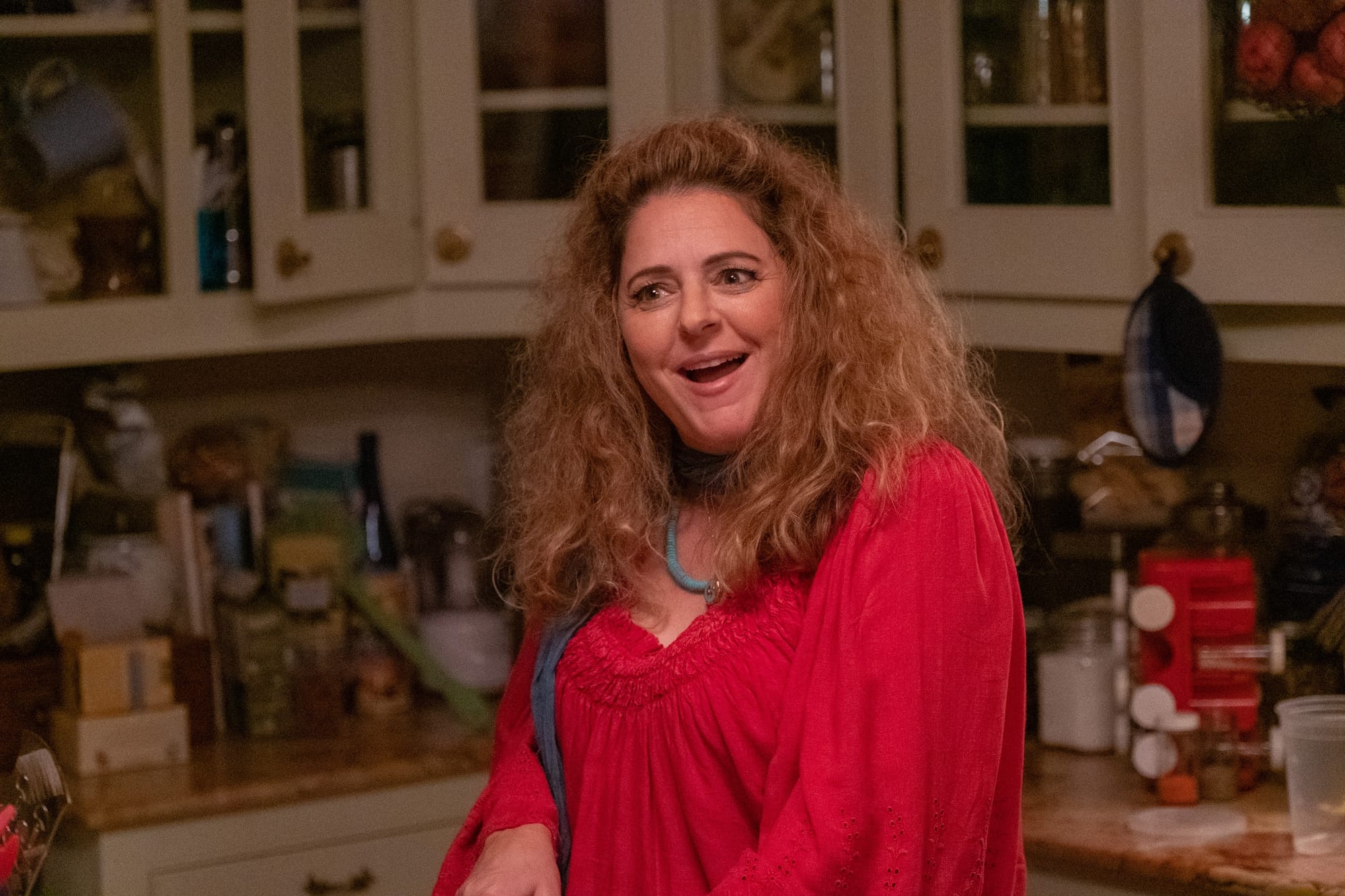
That’s the foreground. In the background, Eve mutilates her hand with a large knife on the chopping block, sets her skirt on fire with the gas stove, and triggers another flare-up by generously drizzling an ocean of olive oil into (and around) a stainless steel saucepan. (Did I mention she’s reheating matzoh ball soup?) This might sound like the nervous behavior of a murder suspect, but there’s every indication that this is just what Eve is like, which is why she treats her blaring smoke alarm as an annoying malfunction. Hamm hits all the right comic beats with his reaction shots—and the subtle underlay of the Buzzcocks’ single “Oh Shit!” is a nice touch—but the scene belongs to Mumolo, who plays Eve as an amiable shambles who doesn’t seem to notice the chaos she leaves in her wake.
With respect to Chevy Chase’s Fletch—and let’s be kind and pretend there was just one, in 1985, that Michael Ritchie directed and that Area Insurance Salesmen of a certain generation quoted frequently through the late 20th century and beyond—a scene like that would have never happened. For better or worse, the 1985 film’s cartoonier take on Fletch, only loosely inspired by Mcdonald’s 1974 novel, would have never been so democratic a comedy. Chase, with his silly schtick and multiple personae, is the one who got to make the jokes while the rest of the cast played it straight, which made Fletch more of a vehicle for Chase, with the mystery plotting and supporting players mostly turned into grist for the mill. Again, it’s not a bad idea for a movie, given that Chase was at the top of his game at the time, but there was room for another take on the character.
Enter Mottola, whose gift for ensemble comedy was immediately apparent in his 1996 indie debut feature The Daytrippers and later affirmed by 2007’s Superbad and 2009’s Adventureland, which even at their raunchiest felt grounded in lived experiences and attuned to the specific strengths of his performers. He and Hamm had intended to make Confess, Fletch the first in a new franchise, but the film was released in September 2022, just as theaters were reawakening after the pandemic, and it was treated as such an afterthought theatrically that it was shuffled to Showtime a little over a month later. It may be a fanciful notion that a mystery/comedy series as pleasurably low-stakes as a Mottola and Hamm’s take on Fletch ever stood much of a chance in any era, but it has streamed its way into becoming a niche classic. Doing Fletch right is not some tried-and-true formula for mainstream success.
The more obvious cinematic model for Confess, Fletch isn’t the Chase comedy but a shaggy-dog tale more in the spirit of Robert Altman’s classic The Long Goodbye, which cast Elliott Gould as a marble-mouthed Philip Marlowe who bluffed his way through the libertine, post-hippie world of early ’70s Los Angeles. The one minor flaw to Mottola’s film is that it’s not nearly as evocative of its Boston milieu, but Hamm’s Fletch has the same knockabout quality as Gould’s Marlowe and both mysteries are casually byzantine in that there’s no special urgency for them to get unknotted. The purposefully convoluted mess all gets sorted out eventually—and turns out to be more carefully plotted than you’d imagined—but the point is to meet people like Eve and puzzle over their motives and delightful eccentricities.
Before Fletch even got to Boston, he’d been buzzing a Vespa through the streets of Rome, where a wealthy count had hired him to investigate his missing art collection. While bedding the count’s daughter Angela (Lorenza Izzo), Fletch learns that her father has been kidnapped and the culprits want one of his missing Picassos in lieu of a cash ransom. That adds extra motivation for Fletch to fly to Boston and visit Roland Horan (Kyle MacLachlan), a shady art dealer and college professor who also has a passion for EDM. But the discovery of Laurel Goodwin’s body in Fletch’s townhouse rental has the effect of sidetracking his art investigation without killing it entirely. As he dodges inquiries from the chief detective, Morris Monroe (Roy Wood Jr.), and Monroe’s green prodigy Griz (Ayden Mayeri), Fletch works to exonerate himself without simultaneously looking for the missing paintings. Unsurprisingly, his frame-up and the art scheme are connected.
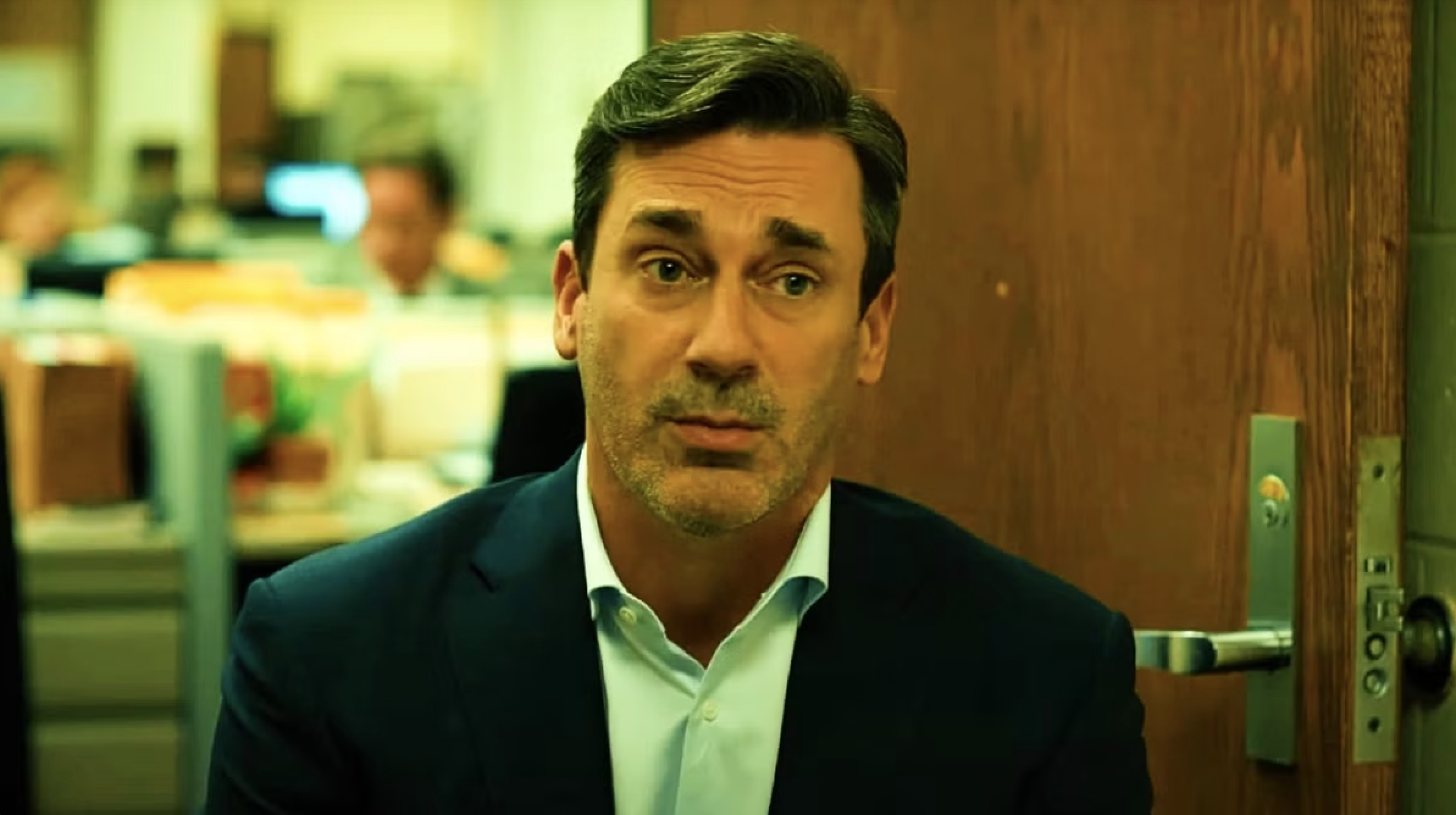
One of the funny ironies of Confess, Fletch is that Fletch, for all his clever evasiveness and keen investigative instincts, doesn’t solve the case or save anyone so much as be present for situations where the case can be solved and someone else can do the saving. While Hamm holds steady as the eye of this particular hurricane, Mottola most often puts him in a position where the other actors are given equal opportunity to make an impression. Small comic details pay off all the way down the line: Wood does well as Fletch’s exasperated foil on the force, but to make his Detective Monroe a new father opens up hilarious asides about hassles like sleep training a baby. (“Oh are you Ferberizing? Is that why you’re tired?”) These behavioral quirks extend to the goofy spectacle of MacLachlan’s buttoned-down Horan privately gyrating to EDM, Marcia Gay Harden making a meal of her horny Italian countess, or Eugene Mirman appearing in a bit part as a marina security guard without thoughts on the J. Geils Band.
Mottola follows Mcdonald’s plot carefully, but one of the pleasures of his script is how he’s able to update the characters to the modern world without compromising the voice. Some of the funniest moments in the film reference things that did not exist in 1976, when Mcdonald’s novel was published, like Horan’s EDM obsession, the pretentious fake-job of “lifestyle curator,” or Fletch’s interest in podcast facts about pig orgasms and hummingbird metabolism. There’s also a great running joke here about Fletch shouting “five stars” to the various rideshare drivers he uses to give the police the slip. (When Monroe finally gets him in the back of his car, Fletch is notably more critical: “'Four stars.’ Your back seat’s filthy.”) While Mottola seeks to wrest the character away from Chevy Chase’s interpretation and closer to Mcdonald’s novels, he pulls off the trickier task of making his original touches sound like something the author might have written.
As for Hamm, the Fletch role encapsulates a series of post-Mad Men turns as a comic actor that make a joke out of the confidence and self-possession that Don Draper flashed so effectively in pitch meetings. 30 Rock mocked that persona brilliantly in an episode where he discovers that his dashing looks have led society to forgive his ineptitude, and while Confess, Fletch doesn’t go nearly that far, he plays a character who never for a second worries about his fate, despite being framed for murder and possibly marked for it, too. Everything’s going to work out just fine for I.M. Fletcher, which has the effect of removing the suspense from this “wrong man” scenario and replacing it with curiosity and fun, a goofy variation on the gentleman sleuths who solve whodunits in the parlor.
In a better world, Mottola and Hamm seemed prepared to knock these out indefinitely. Our dystopia has limited us to one.
Next: Hundreds of Beavers


Discussion