The Sum of All (Cape) Fears
With a limited series coming to Apple TV next month, here's a look back on the era-specific terrors of Cape Fear.

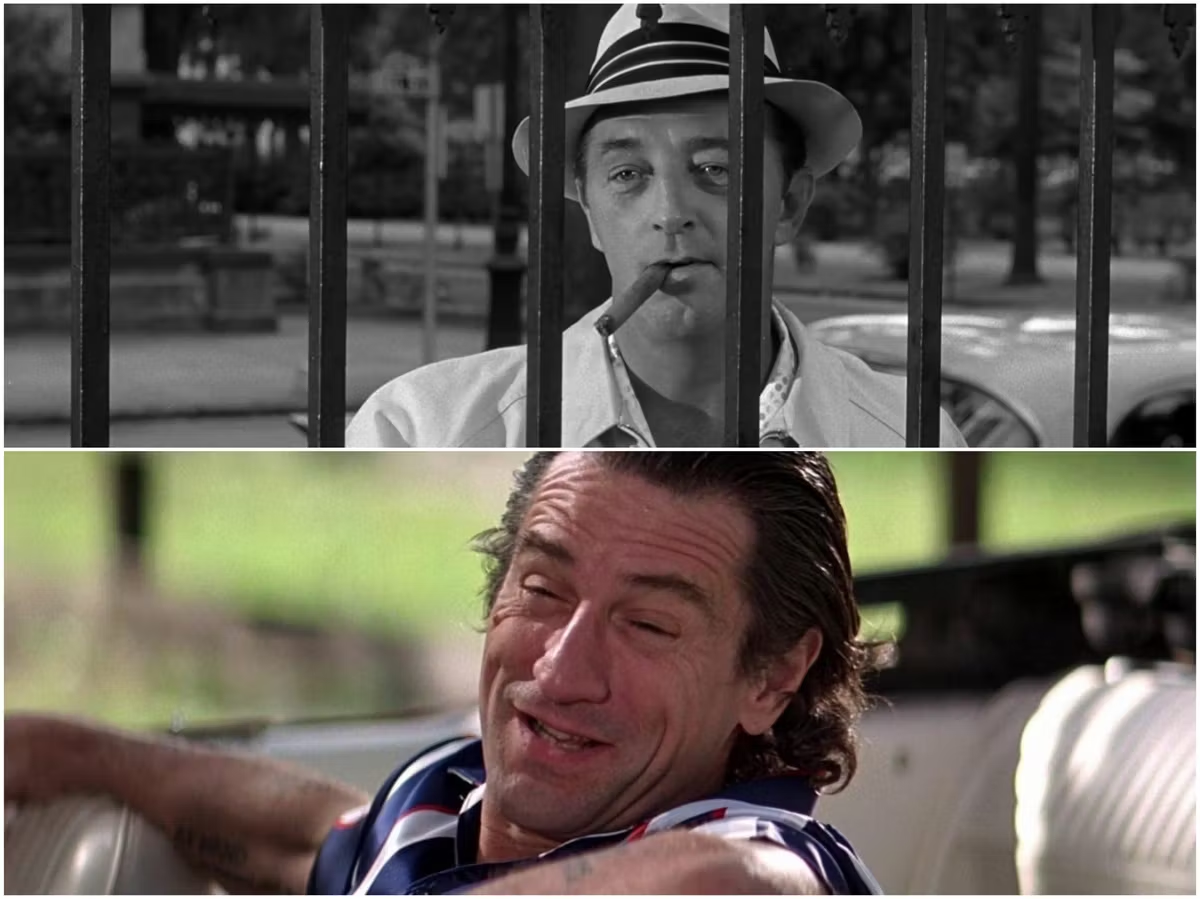
“Don’t mind me, counselor. I’m just getting a gander at the rest of your family.”
That’s Robert Mitchum as Max Cady in the original 1962 Cape Fear, a gripping noir-inflected adaptation of John D. MacDonald’s suspense novel The Executioners, about an ex-con taking revenge on the family man he blames for putting him in the clink. The word “gander” stands out, especially as Mitchum reads it, with a gentle drawl that sounds sinister without him needing to put any English on it. Strolling through the Southern idyll of New Essex with a stogie and a Panama hat, Mitchum’s Cady operates like a lion on the savannah, cooly assessing his options for hurting local attorney Sam Bowden (Gregory Peck) the most while satisfying an unmistakable lust. So he’s getting a gander at Sam’s wife Peggy (Polly Bergen) while peering a bit more closely at Sam’s 14-year-old daughter Nancy (Lori Martin), who’s still too young to comprehend herself as the subject of predatory lust.
Nearly three decades later, director Martin Scorsese would direct a remake of Cape Fear with Robert De Niro in the Cady role, and now, after another three decades plus, Apple TV is releasing a miniseries version of Cape Fear on June 5th with Javier Bardem playing Cady. It’s hard to say yet what a difference this most recent 30 years has made—I have yet to watch the new series, which is under currently review embargo anyway—but it’s fascinating to look at the 1962 and 1991 versions side-by-side as a measure of where movie culture (and culture culture) was in each period and how each approached the same material as an exercise in pulp filmmaking and a provocation on the law, revenge, and sexual violence. In every era, it’s a nasty bit of business.
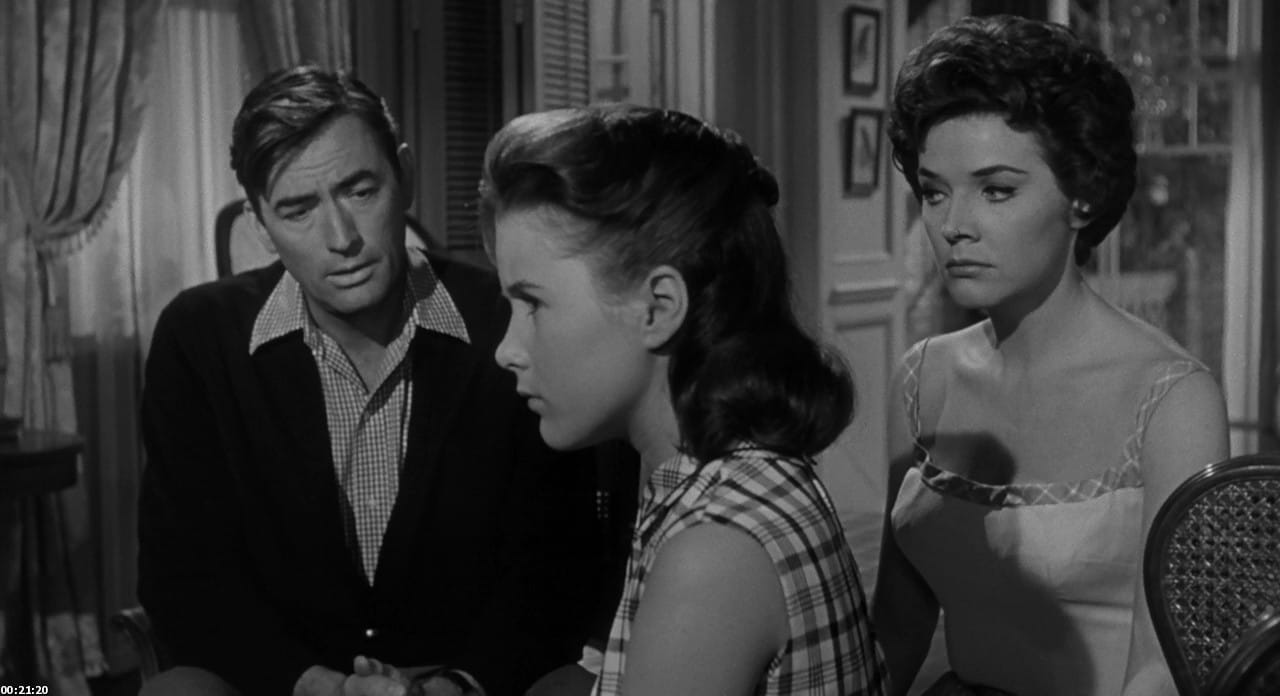
Opening to the resounding horns of Bernard Herrmann’s score—which Scorsese wisely retained, with additional Elmer Bernstein flourishes, for the remake—the 1962 Cape Fear, directed by genre specialist J. Lee Thompson (The Guns of Navarone), emerged unmistakably from the shadows of Alfred Hitchcock’s Psycho two years earlier. On top of Herrmann’s contribution, the film was also shot in noir-inflected black-and-white and aimed to shock audiences with an irrepressible, lustful monster in human form. Though Scorsese’s remake would introduce all sorts of ambiguities to the story, the contrast between good and evil in Thompson’s film—as stark, really, as the “Love” and “Hate” tattooed on Mitchum’s fingers in the 1955 noir classic The Night of the Hunter—doesn’t limit the film’s subtle, insinuating edge. It’s evidence that a crime thriller can be stark and determined to rattle its audience without being overly aggressive about it. It ganders when you might expect it to leer.
While Wesley Strick’s script for Scorsese’s film would make significant and meaningful tweaks to the material, screenwriter James R. Webb (How the West Was Won), another old genre hand, hews more closely to MacDonald’s premise, even if both films would embellish a third act in the waterway of the title. Cady arrives in New Essex after serving an eight-year sentence for a rape that he was 100% guilty of committing, but he nonetheless holds a grudge against the man whose testimony landed him in prison. At the time, Sam was doing the decent thing, providing an eyewitness account of a horrific crime. Given his position as a lawyer and a pillar of the community, it’s hard not to see Sam as someone whose character more or less reflects the common decency of Atticus Finch, another small-town Southern lawyer that Peck would play the same year in To Kill a Mockingbird. He is the hero of the story, without question, and we’re asked to consider what we would do in Sam’s situation.
But that’s where the ’62 Cape Fear gets a bit knottier than it first appears, because Sam’s avenues for self-defense lead him into morally compromised territory. It’s part of the longstanding, often reactionary nature of pulp fiction that the law is often inadequate in protecting innocent citizens from harm. Yet even while we might root for Sam to repel this terrible threat to his family, his soul is nonetheless coarsened by the fight. Though Cady was put in prison as a functional illiterate, he resurfaces in New Essex with a keen sense of how to torment the Bowdens without landing himself back in the clink. It is not illegal, for example, for Cady to stare at Nancy at the bowling alley and while it’s definitely illegal to poison the Bowdens’ family dog—a sequence that plays out, chillingly, with loud offscreen barks that turn to whimpers—Sam cannot prove that he was even trespassing. And Sam’s attempts to exploit his friendly relationship with the local police chief, played by Martin Balsam, result in a series of petty charges that are eventually leveraged against him.

This post is for paying members only
Sign up now to read the post and get access to the full library of posts for subscribers only.
✦ Sign up