‘Waterloo’: The Film That (Maybe) Defeated Stanley Kubrick’s ‘Napoleon’
Stanley Kubrick really wanted to make a biopic of Napoleon Bonaparte as his follow-up to '2001: A Space Odyssey.' And he might have gotten away with it if it weren't for this meddling film.

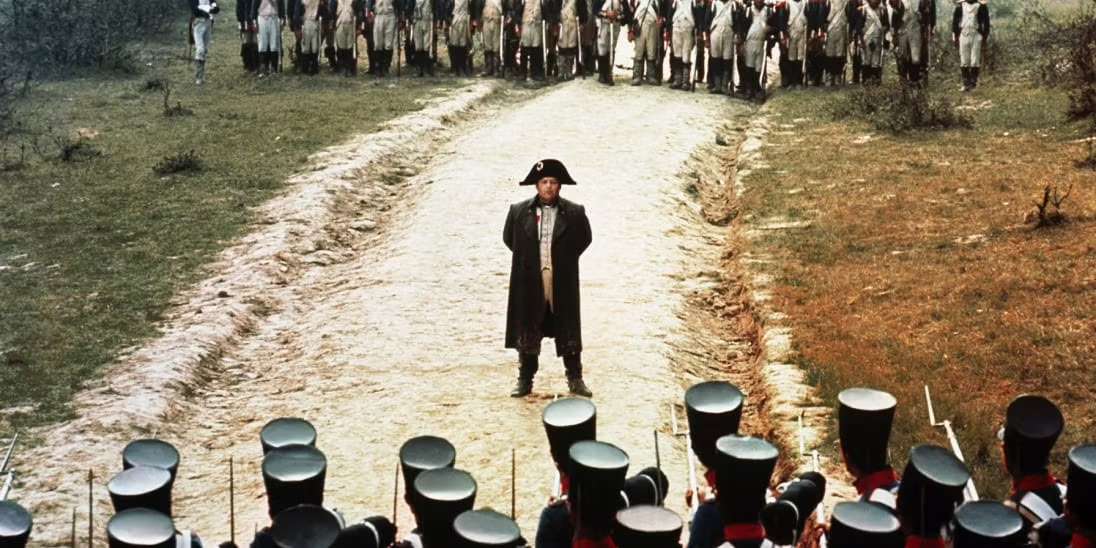
In another timeline, Stanley Kubrick’s Barry Lyndon wouldn’t exist because Waterloo never got made. The theoretical butterfly effect goes something like this: For whatever reason, producer Dino De Laurentiis never hires the Russian director Sergei Bondarchuk to helm a massively scaled movie about the battle that decisively ended the career of Napoleon Bonaparte. Said film never met the scorn of critics and indifference of moviegoers when released in the fall of 1970 and spring of 1971, which made making a movie about Napoleon, particularly an expensive movie about Napoleon, look like a bad investment. Stanley Kubrick proceeds with Napoleon, his planned follow-up to 2001: A Space Odyssey, instead of pivoting to A Clockwork Orange and then making Barry Lyndon, a film set shortly before Bonaparte’s rise but heavily informed by the extensive research Kubrick conducted for Napoleon.
But that didn’t happen. Waterloo does exist. And just as a muddy battleground that made it impossible for Napoleon to maneuver his cannons into place at the real Waterloo changed the course of European history on June 18, 1815, the image of Rod Steiger grunting and scowling in the middle of a cinematic recreation of the same battle redirected the course of Kubrick’s career.
Maybe. Kubrick began pre-production on Napoleon in 1967 and MGM announced it as the director’s follow-up to 2001 in July 1968, while Kubrick’s science fiction epic still lingered in theaters. By the end of 1971, however, MGM had changed its mind and a subsequent attempt to revive the project at United Artists, possibly with Jack Nicholson, stalled out as well. (Others previously considered for the lead: David Hemmings and Ian Holm. Audrey Hepburn, Kubrick’s choice for Josephine, declined the role in a polite letter.) It’s possible that Kubrick’s ambition would have made Napoleon financially unfeasible under any circumstances, and even less likely to get a greenlight in the early 1970s, when cash problems sent studios into a panic and, as a 1971 San Francisco Examiner article about Kubrick put it, “low budget films made by the young appeared to be in vogue.” It’s also possible Kubrick might have moved on anyway. The director’s many unrealized projects have their own Wikipedia page. But if any cause can be singled out, if the film had its own Waterloo, it’s Waterloo.

This post is for paying members only
Sign up now to read the post and get access to the full library of posts for subscribers only.
✦ Sign up