#45 (tie): ‘Barry Lyndon’: The Reveal discusses all 100 of Sight & Sound’s Greatest Films of All Time
A journey through Sight and Sound's 100 best movies of all time arrives at Stanley Kubrick's story of a rascal's rise and fall, set in the heart of the 18th century .


On December 1st, 2022, Sight & Sound magazine published “The Greatest Films of All Time,” a poll that’s been updated every 10 years since Bicycle Thieves topped the list in 1952. It is the closest thing movies have to a canon, with each edition reflecting the evolving taste of critics and changes in the culture at large. It’s also a nice checklist of essential cinema. Over the course of many weeks, months, and (likely) years, we’re running through the ranked list in reverse order and digging into the films as deep as we can. We hope you will take this journey with us.
Barry Lyndon (1975)
Dir. Stanley Kubrick
Ranking: #48 (tie)
Previous ranking: #59 (tie) (2012); #27 (tie, 2002).
Premise: Redmond Barry (Ryan O’Neal), the teenaged son of an esteemed Irish Protestant family that’s fallen on hard times in the middle years of the 18th century, begins a peripatetic life after he flees his provincial home believing he’s killed a rival for his cousin’s affections in a duel. Robbed by highwaymen on his way to Dublin, Barry enlists in the British army and travels to the continent to fight in the Seven Years’ War. After deserting, he’s pressed into the service of Prussian forces, setting into motion a chain of events that will lead to him joining forces with the Chevalier de Balibari (Patrick Magee), a con artist and fellow Irishman. Together, they amass a fortune that allows Barry to marry the widowed Lady Lyndon (Marisa Berenson), a dramatic rise that sets Barry up for an equally dramatic fall.
Keith: As with every film Stanley Kubrick made after Dr. Strangelove, Barry Lyndon had to pass through a gauntlet of distaste and suspicion on its way to becoming widely acknowledged as a masterpiece. As I often do, I turned to newspapers.com to see how the film was received at the time. The first review I found was a positive Chicago Tribune review from Gene Siskel that gave the film three-and-a-half stars out of four but opened not with praise but a defense:
There’s been a lot of bad-mouthing of Stanley Kubrick’s Barry Lyndon, a three-hour Victorian novel of a movie. Friends who have seen it have found it tedious and presumptuous. They’ve acknowledged its beauty while cursing its emptiness.
I wonder if I saw the same film.
In some ways, Siskel was overstating his case. The film was far from universally reviled. I found plenty of raves for Barry Lyndon, but also reviews with headlines like “Barry Lyndon: frightfully high-toned boredom” (Toronto Globe and Mail), “And a long time was had by all” (New York Daily News) and “Barry Lyndon is pretty… boring” (Newark Star-Ledger). (Sick burn!) I also know critics who still feel like there’s one ruinous element to the film despite its virtues. (We’ll get to that later, I’m sure.)
I guess maybe some context helps. Barry Lyndon was Kubrick’s follow-up to A Clockwork Orange, which was divisive for other reasons. On the face of it, it couldn’t be more different. Instead of a grim and grimy near-future, we visit a past that—once the film’s protagonist reaches a certain level of wealth—is all neat order and gleaming surfaces. A Clockwork Orange has its own, deliberate rhythm, but Barry Lyndon feels genuinely languid, on a scene-by-scene basis. (Which isn’t to say it’s poorly paced. The movie always feels shorter than its 3+ hours to me.) Barry Lyndon inspired comparisons to Tony Richardson’s Tom Jones, an adaptation of another novel about an 18th century rascal, in part because it has none of the puckish energy of Richardson’s film. And it easily could. Thackeray’s novel, particularly its early chapters, would easily lend themselves to that sort of treatment. Instead it’s filled with compositions and lighting inspired by 18th century art and long, observational takes, many of which sloooooooowly zoom out to put the first images we see in a scene in a broader context.
Enjoying The Reveal? Now's a great time to become a paid subscriber. You'll get access to everything we publish—from articles to audio commentaries—and help support independent film criticism.
In other words, Barry Lyndon doesn’t behave like a normal movie. But I think it’s all the better for it. Take, for instance, the first battle scene we see, in which ranks of soldiers advance on the enemy, then thin with each volley of bullets aimed at them. It’s not staged for excitement. We just watch as dozens of soldiers fall in the line of fire and others take their place then, when Barry flees, we see the dead and even greater number of writhing wounded left behind. And, we’re told, all this is part of a skirmish that no history book will remember. It’s one of those scenes you can point to in order to refute accusations that Kubrick was merely cold and clinical. He’s not pushing viewers to feel one thing or another, but I’d be distrustful of anyone who saw anything but the absurdity and grim toll of war in that scene.
There’s a lot to talk about here and I’ve gone on for a bit. So let me start by asking you why it took a while for this film’s reputation to reach its current point? And, oh yeah, that casting question: What do you make of Ryan O’Neal as Barry, the element often pointed to as a weakness of the film. I have mixed feelings, honestly. I can’t help but imagine that another actor might have brought more to the role (at the least better accent work) but also that maybe that wouldn’t have made the film better. O’Neal’s screen persona, at least at this point, was that of a dopey charmer prone to get into trouble. Maybe he’s perfectly cast?
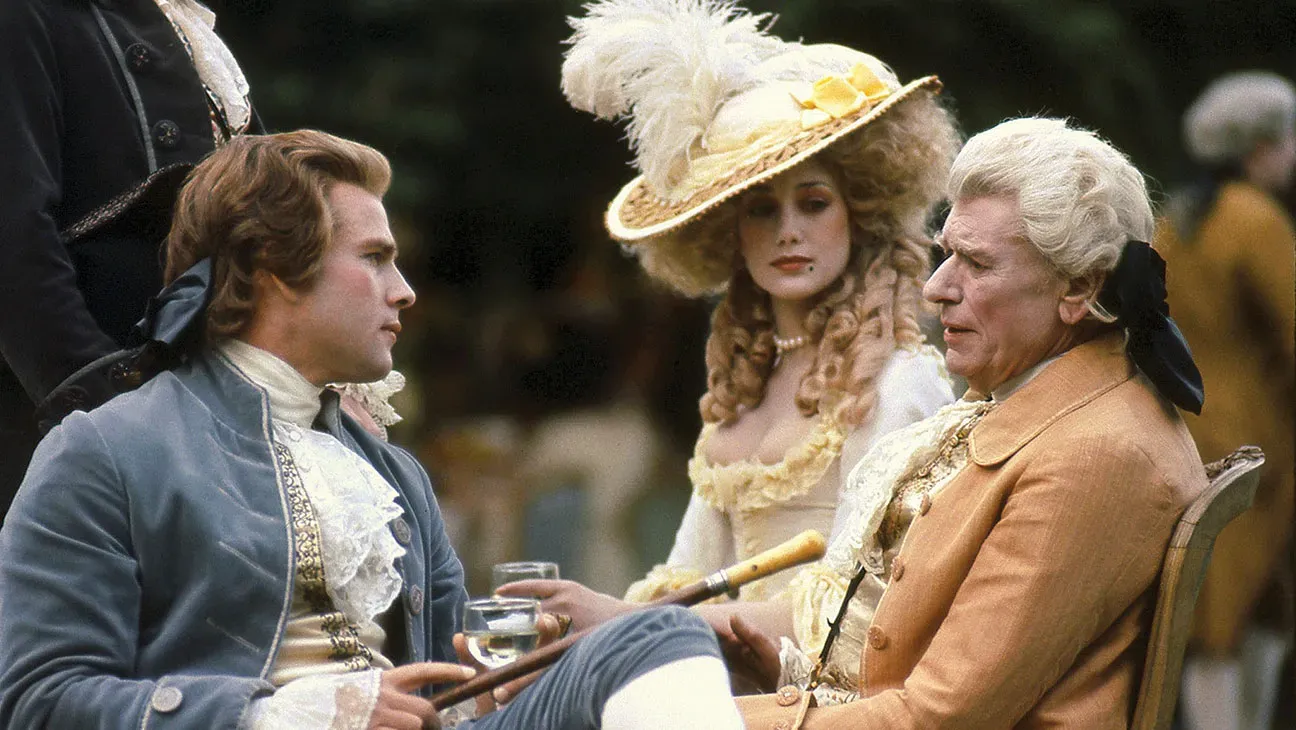
Scott: I hate to start on this sour note, because I think Barry Lyndon is one of the greatest films from one of our greatest filmmakers, but perhaps it’s best to rip the Ryan O’Neal question off like a Band-Aid before moving on to the rest of the movie. I think it’s worth noting that Kubrick’s casting—or more specifically, his treatment of actors—has come under a lot of scrutiny over the years, certainly for more films than Barry Lyndon. You always heard stories about his exacting nature and how doing dozens of takes naturally sucked the life out of performers who were surely feeling enervated by the experience. At a Hollywood Reporter roundtable in 2010, the late Robert Duvall made headlines by saying that Kubrick’s films had “the worst performances I’ve ever seen in movies,” tying it to his unusual process.
If you step back and take a broader look at Kubrick’s filmography, I think you can identify many career-defining lead performances (e.g. Malcolm McDowell in A Clockwork Orange, Kirk Douglas in Paths of Glory, Nicole Kidman in Eyes Wide Shut, and—sorry, haters—Jack Nicholson in The Shining) and others, like Keir Dullea in 2001: A Space Odyssey or Matthew Modine in Full Metal Jacket, that are oddly self-effacing, because they’re folded into Kubrick’s larger design. That’s how I tend to see Ryan O’Neal in Barry Lyndon. Could Kubrick have found a more persuasive actor to play a conniving 18th century Irishman of common stock? Most certainly. But your description of O’Neal’s image as “a dopey charmer prone to get into trouble” gives the casting a certain logic, and I think it’s important with Kubrick to think about acting more holistically, as part of his vision rather than in relation to the way other productions use actors.
It’s funny that the Sight and Sound list has helped inform my thinking on this, because Kubrick reminds me so much of Carl Dreyer, whose 1955 masterpiece Ordet we just talked about a few entries ago. Dreyer’s work was so singular and so out-of-step with his contemporaries that critics were often slow to recognize his greatness, because there were few points of comparison and little connection at all to the present. (God, remember how much grief Eyes Wide Shut got for its studio set not resembling New York City enough?) In Barry Lyndon, we’re given a hero who drifts like a piece of flotsam through history, constantly whipped along by the machinations of fate. And while it’s fair to see how his behavior affects (and ultimately seals) his fate, such is the nature of the picaresque that Kubrick has made here. I don’t think a more commanding or assertive performance would really serve a movie like Barry Lyndon that well, because he is, in Roger Ebert’s words, “a man to whom things happen.”
In any case, I’m happy that Barry Lyndon is firmly part of the critical trajectory of late-period Kubrick films, which have all shaken the mixed reception they initially received. (The bounce from not appearing in the ‘92 poll at all to hitting #27 in the ‘02 poll is quite resounding, and it strikes me as a stable bet for the future. Our pal Bilge Ebiri at Vulture not only notched it at #1 on his ranked Kubrick list last year, he considers it the greatest film ever made.) As you noted, there were some complaints about the film’s pacing at the time, but if we’re going to compare ’70s period classics, I don’t think Barry Lyndon is all that different from the two Godfather movies, which also string together episodes that an immersive, languorous quality, even if there’s a pulpiness to gangster stories that’s absent in our hero’s misadventures through European high society.
Also, come on, the pace is such an asset! You mentioned that extraordinary sequence during the Seven Years’ War, when the English army marches straight into enemy fire, with some soldiers dropping in lines and others continuing forward while the rifles are being reloaded. But I’m also wowed by the formality of the duels, where third parties are tasked with loading the pistols and refereeing the gunfight, adding this air of gentlemanly fairness to a ritual of savage and often unnecessary violence. (We’re told in the opening sequence that Barry’s father was shot dead due to a “conflict that arose over the purchase of some horses.”) That final duel in the film between Barry and Lord Bullington (played as an adult by Leon Vitali) is protracted in a way that both emphasizes the absurd formalities of it and draws out this painful expression of resentment between an abusive stepfather and his bruised, prideful stepson. Who would want to “tighten up” a sequence like that one?
But maybe we should get into what this film is about, right? Because for as much Barry is “a man to whom things happen,” there’s a trajectory to his life that’s worth some reflection. The young man we meet in the beginning of the film, who’s wooing his cousin Nora (Gay Hamilton), has an innocence to him that’s quickly coarsened by experience. His conflict with the much older Army captain John Quin (Leonard Rossiter) offers a quick, painless lesson in the way the world works and the money and power he must acquire to gain leverage over other people. That turns him into a scoundrel and a cheat, but Barry also learns that loyalty from those in power, whether they’re military men or the societal elite, is usually conditional.
We see that so often in Kubrick’s films, right? You think about the French military brass who make an example out of “cowardly” grunts in Paths of Glory or the War Room occupants in Dr. Strangelove or the elites at the orgy in Eyes Wide Shut. Kubrick is keen to the special class of people who run the world, and the distance between their vaunted status and the oft-vicious ways they wield power. How do you see Barry Lyndon fitting into the big Kubrick puzzle, Keith? And how does this film resonate for you?
Keith: The most immediate connection that comes to mind is one you bring up. There’s a lot going on in Eyes Wide Shut, including the story of a man who thinks he’s part of the elite class only to realize that there’s another level he can see but never join—and might be undone by even the attempt to join. Whatever Barry thinks of himself, he knows he’s an outsider even after he marries Lady Lyndon. The estate belongs to her and Bullington will inherit it all upon her death, leaving both Barry and Bryan (David Morley) at Bullington’s mercy, unless he can acquire a title of his own. It feels like Barry’s making real progress toward that goal when Bullington humiliates him at a concert. Then—as demonstrated by a long, painful scene in which one of the aristocrats toward whom he’s been attempting to ingratiate himself, politely but decisively declines his company for lunch—Barry’s out, and all the money he’s spent trying to curry the favor of those who could make him the aristocratic equivalent of a made man, has been for nothing. No matter how close he got, there’s now nowhere to go but down.
I don’t think the connections end there. The absurdity and horror of war connects the film to Paths of Glory, Spartacus, Dr. Strangelove and Full Metal Jacket. An interest in the codes and behaviors of closed-off groups run through his work, too, in everything from the gangland ethos of The Killing though the bored, ritualized interactions of the 2001 astronauts and on to Eyes Wide Shut.
And the style, of course, is unmistakably Kubrick, with hall-of-fame-level assistance from cinematographer John Alcott. The closing credits contain a special note for the lenses developed to shoot by candlelight, but I’m just as astounded by the images of light pouring through windows into shadowy rooms. It’s almost a cliché to call Barry Lyndon “painterly,” particularly since the art of the period he’s depicting so obviously informs the visuals. But no other word really captures the look of the film or that way Kubrick’s lingering shots gives viewers more time than most movies to consider the positioning of each character in the frame and how they relate to each other. In one extreme example, a shot of Lady Lyndon in the bathtub, Berenson keeps her face frozen, further blurring the line between moving images created by 20th century photography and the tableaux created by oil and canvas two hundred years before.
In Geoffrey O’Brien’s liner notes for the Criterion Collection edition of the film, he writes “one of the many mysterious things about Barry Lyndon is why Kubrick chose to film that particular work.” I think, and I suspect O’Brien would agree, that the film provides its own answer. It’s a bleakly funny, haunting rise-and-fall story so committed to recreating not just the look but the attitudes and mores of Ireland, Britain, and continental Europe in the latter half of the 18th century that it has an almost anthropological quality. But Thackeray’s 1853 The Luck of Barry Lyndon wasn’t exactly an English Lit 101 staple then or now.
Though a rival to Dickens in his day, Thackeray’s now mostly known for Vanity Fair (which Kubrick also apparently considered filming) and Barry Lyndon, the latter largely because of Kubrick. Reading the novel, it’s very much a case of an adaptor making the material his own. Thackeray’s literary efforts include a stint as an anti-Irish humorist for Punch and there’s a lot of, well, punching down about all things Irish in the novel. (Kubrick had also invested a lot of time in a project set a few years after the events of Barry Lyndon, a film about Napoleon that was canceled after the failure of the movie Waterloo. More on the latter tomorrow.)
Both book and film go toward the same dark place, but take different routes to get there. (The film’s stunning epilogue, the one with the lines, “good or bad, handsome or ugly, rich or poor, they are all equal now” even appears as a virtual throwaway passage toward the beginning of the novel.) I don’t want to get too hung up in comparing the novel and its source, but there’s one change worth considering. While the Barry of the film is a cad, cheat, flatterer, and philanderer, the Barry of the novel is a scoundrel who beats and imprisons Lady Lyndon after extorting her into marrying him. He is incorrigible and irredeemable whereas the Barry of the film never seems evil, just prone to vice. In that, he more closely resembles the protagonist of one of the film’s other inspirations, “The Rake’s Progress,” a series of paintings and engravings by William Hogarth tracing one young man’s pursuit of pleasure and descent into ruin.
The Barry 0f the novel is an unreliable narrator, a villain who thinks he’s a hero. (Which sounds a bit like the source material for another Kubrick film, Lolita) But, like Hogarth’s rake, a kind of worst-case-scenario everyman, it’s not that hard to see Barry’s weakness and temptations and flaws as ones we might succumb to or possess. So I’ll send this back to you with a question: What do you think of Barry? Does his one act of mercy in the duel, which also proves to be his final undoing, suggest he’s not a bad guy at heart? Is Barry Lyndon primarily a cautionary tale? Or is he a victim of circumstance?
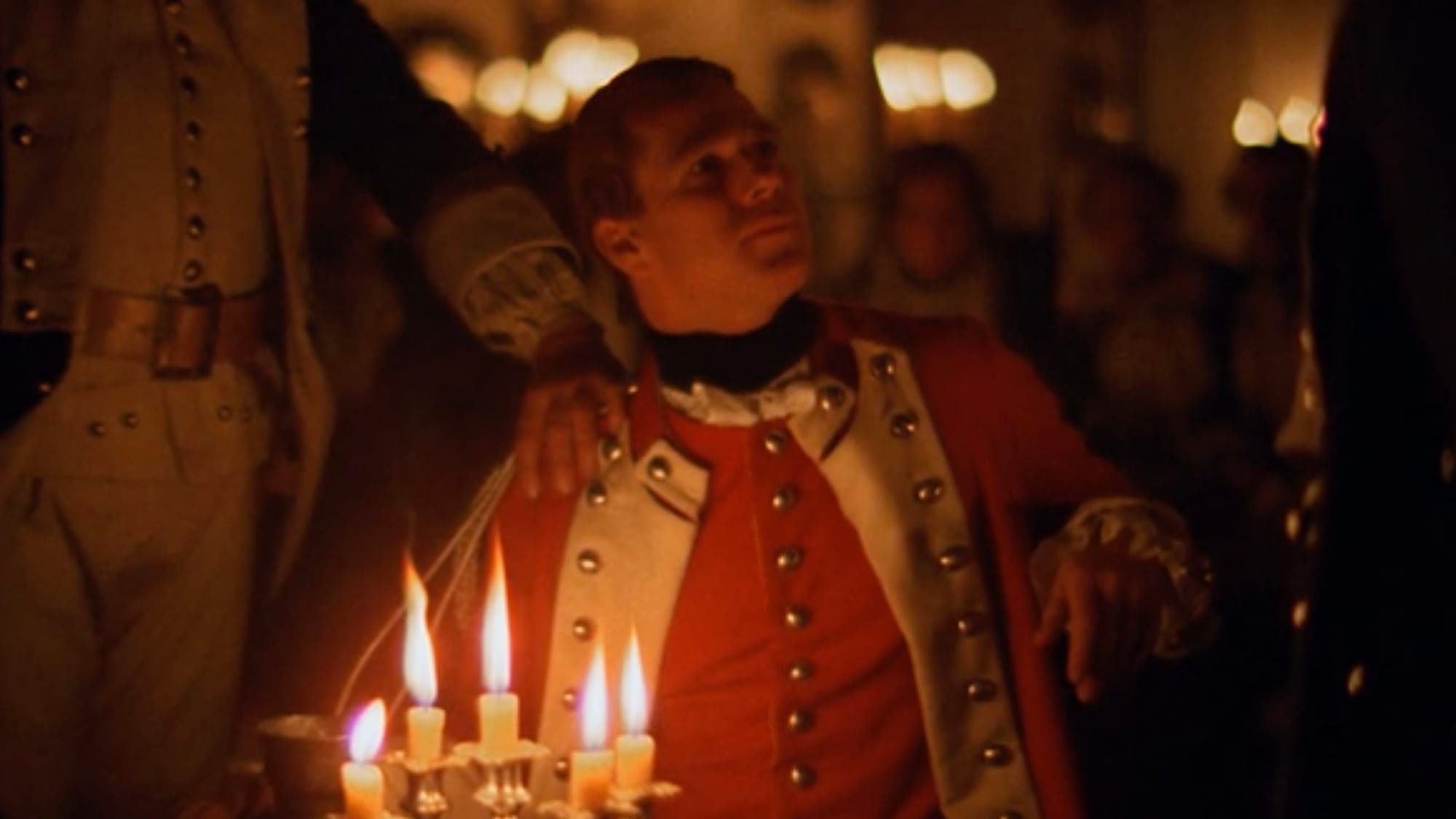
Scott: Now you have me wishing that Ryan O’Neal’s performance was stronger, Keith, because I’m struggling to sort through Barry’s contradictions and maybe a more assured lead would offer a clearer take on the character. I am convinced to a large degree that Barry Lyndon, as it whisks its passive eponymous character through the battlefields and parlors of 18th century Europe, is more interested in the corrupting nature of the world than the corruptability of man. That said, Barry does make decisions throughout the film that set what turns out to be a largely disastrous course for his life. Some of those decisions are made out of jealousy and wounded pride, like his (rigged) duel with Captain Quin; some are made out of cowardice and rank opportunism, like his desertion of the English army during the Seven Years’ War; and some reveal a genuine (if foolish) affection, like the tragic indulgence of buying a grown-up horse for the not-grown-up Bryan or his decision to shoot his pistol into the ground after Bullingdon accidentally misfires in their duel.
Barry’s relationship with Bullingdon is a fascinating piece of Barry Lyndon’s second half, and I’d give a lot of credit for that to Leon Vitali, who was Igor to Kubrick’s Dr. Frankenstein* for the second half of his career but stepped out from behind the scenes to play the older Bullingdon. (Incidentally, I had the privilege of profiling Vitali for Rolling Stone when the documentary Filmmaker came out and no one understood Kubrick’s moods and genius better.) What’s so mystifying about Barry’s behavior in this part of the movie is that he surely knows the power Bullingdon will have over Lady Lyndon’s estate but he beats and humiliates the boy (and young man) at every opportunity. The best explanation I can muster is that Barry is impulsive and lives entirely by the seat of his pants, which is what brought him to this rarefied space among the elite, even if he’s incapable of realizing how precarious his situation is. Barry can be shrewd and conniving, but he runs hot emotionally and he can’t control his behavior for political reasons. He can’t stop himself from unleashing that final, shocking assault on Bullingdon in front of all his societal betters and his life nosedives from there.
(* Fun fact: Vitali actually played Dr. Frankenstein himself in the 1977 film Terror of Frankenstein.)
The look of the film is, of course, as stunning as you describe. People who describe Barry Lyndon as the most beautiful film ever made won’t get any argument from me, despite the abundance of contenders for that prize. (Days of Heaven would come along a few years later. Just saying.) I’ll confess to being a little late to appreciate the film’s pristine beauty because I first saw it on the big screen in the early ’90s, when the 35mm prints in circulation were often dogged by the colors fading into pink and purple, which obviously left the wrong impression, and VHS didn’t have the resolution to correct it enough. Now, I think the film’s “painterly” qualities are part of its commentary on the upper-class at that time. When you go to a museum, you often encounter the beautiful, flattering portraits that society’s elite class would commission from the era’s great artists. Kubrick gives us images of that quality while underlining the vanity and decadence of people who could afford to be the subject of such master painters. However you feel about Barry, Kubrick reserves more contempt for the men who actually hold authentic power in this world, which is a consistent theme in his work. (We haven’t even mentioned The Shining, a movie set in a hotel haunted by the genocidal sins of its past, monied guests.)
Kubrick’s attitude about the events of Barry Lyndon comes through strongest in the omniscient voiceover (provided by Michael Hordern), which is marked by a dry, scabrous, ironic wit. With regard to the above point about the target of Kubrick’s ire, there’s this great bit of narration about an obscure and needlessly destructive war: “Gentlemen may talk of the age of chivalry, but remember the ploughmen, poachers and pickpockets whom they lead. It is with these sad instruments that your great warriors and kings have been doing their murderous work in the world.” And then there’s this concise summary of Barry’s transactional relationship with Lady Lyndon: “Lady Lyndon was soon destined to occupy a place in Barry's life not very much more important than the elegant carpets and pictures which would form the pleasant background of his existence.” You could grouse that Kubrick doesn’t show much interest in Lady Lyndon’s sad trajectory—in fact, he regards her almost as coldly as Barry does—but the voiceover does a lot to establish her as an accessory in this patriarchal environment. She’s just as vulnerable to fate as he is, despite her apparent wealth.
Barry Lyndon is one of the jewels of ’70s filmmaking, but we’re not done with the decade yet by a long shot. Up next are two more Sight and Sound list-makers from the ‘70s, locked in a tie for #43, but we’ll shift to a much humbler production next with Charles Burnett’s Killer of Sheep, a low-budget independent film that uses Italian neo-realist technique to illuminate the invisible lives of the Black community in Watts. That Burnett submitted as his UCLA film-school thesis project was, as the kids say, a flex.
Previously:
#95 (tie): Get Out
#95 (tie): The General
#95 (tie): Black Girl
#95 (tie): Tropical Malady
#95 (tie): Once Upon a Time in the West
#95 (tie): A Man Escaped
#90 (tie): Yi Yi
#90 (tie): Ugetsu
#90 (tie): The Earrings of Madame De…
#90 (tie): Parasite
#90 (tie): The Leopard
#88 (tie): The Shining
#88 (tie): Chungking Express
#85 (tie): Pierrot le Fou
#85 (tie): Blue Velvet
#85 (tie): The Spirit of the Beehive
#78 (tie): Histoire(s) du Cinéma
#78 (tie): A Matter of Life and Death
#78 (tie): Celine and Julie Go Boating
#78 (tie): Modern Times
#78 (tie): A Brighter Summer Day
#78 (tie): Sunset Boulevard
#78 (tie): Sátántangó
#75 (tie): Imitation of Life
#75 (tie): Spirited Away
#75 (tie): Sansho the Bailiff
#72 (tie): L’Avventura
#72 (tie): My Neighbor Totoro
#72 (tie): Journey to Italy
#67 (tie): Andrei Rublev
#67 (tie): The Gleaners and I
#67 (tie): The Red Shoes
#67 (tie): Metropolis
#67 (tie): La Jetée
#66: Touki Bouki
#63 (tie): The Third Man
#63 (tie): Goodfellas
#63 (tie): Casablanca
#60 (tie): Moonlight
#60 (tie): La Dolce Vita
#60 (tie): Daughters of the Dust
#59: Sans Soleil
#54 (tie): The Apartment
#54 (tie): Battleship Potemkin
#54 (tie): Blade Runner
#54 (tie): Sherlock Jr.
#52 (tie): Contempt
#52 (tie): Ali: Fear Eats the Soul
#50 (tie): The Piano
#50 (tie): The 400 Blows
#48 (tie): Wanda
#48 (tie): Ordet
#45 (tie): North by Northwest
#45 (tie): The Battle of Algiers
You might also like
#38 (tie): ‘Rear Window’: The Reveal discusses all 100 of Sight & Sound’s Greatest Films of All Time
#38 (tie): ‘Breathless’: The Reveal discusses all 100 of Sight & Sound’s Greatest Films of All Time
Discussion