Death and Dishonor in Stanley Kubrick’s ‘Paths of Glory’
How Kubrick’s caustic anti-war film took up a career-long fight against the elites.


(Programming note: Since the recent release of the Criterion Collection’s The Complete Kubrick has brought the work of Stanley Kubrick back into the conversation (not that it ever really left), we’ve opted to make this week’s features Kubrick-focused. Don't miss Keith's piece yesterday about the fullness of Full Metal Jacket.)
“The life of one of those soldiers means more to me than all the stars and decorations and honors in France” — General Paul Mireau, Paths of Glory
“There are few things more fundamentally encouraging and stimulating than seeing someone else die.” — General Broulard, Paths of Glory
It is the eve of an execution. Three French soldiers have been court-martialed for “cowardice in the face of the enemy” and are slated to die by firing squad the next morning. As it happens, limiting the number of condemned soldiers to three is the compromise solution, part of a face-saving measure for the generals who asked them to do the impossible and were humiliated by their inevitable failure. At this point in World War I, the opening narration in Stanley Kubrick’s Paths of Glory informs us, the French and the Germans have spent two years mired in trench warfare, where “successful attacks were measured in hundreds of yards and paid for in lives by hundreds of thousands.” For leadership to believe that one such impasse could be broken by a French attack on the “Ant Hill”— a heavily fortified German position across a “no man’s land” of craters, barbed wire, and mutilated bodies—was always a fanciful notion, and those who survived the first wave retreated when it became obvious. That’s the “cowardice” for which these three men have been arbitrarily selected to die.
Their commanding officer, Colonel Dax (Kirk Douglas), is profoundly shaken by what has occurred. When his immediate superior, General Paul Mireau (George Macready), had ordered the attack, blithely estimating that Dax would lose the majority of his men to take the Ant Hill, Dax objected as firmly as he could, but he ultimately had to follow orders. (Mireau’s cool rationale for mass sacrifice parallels George C. Scott likening the deaths of millions of Americans to getting “our hair mussed” in Kubrick’s Dr. Strangelove.) Then, when the mission failed and these three men were singled out, Dax volunteered to defend them in front of a court martial that was hastily rigged to condemn them. So now, Dax is alone with his thoughts in an elegant military library when Mireau’s superior, General Georges Broulard (Adolphe Menjou), enters the room and we hear the sound of music wafting from below.
We're keeping our Kubrick week content free to all readers but we hope you'll become a paid subscriber. Paid subscriptions unlock everything we do at The Reveal (and other perks) and allow us to keep this independent movies newsletter going.
Broulard apologizes to Dax. There’s a General Officers dance happening that night and the colonel didn’t have a high enough rank to get an invitation. It is a small moment in a film full of much bigger outrages, but for Stanley Kubrick, life is a party with a limited guest list. The General Officers dance is the spectral 4th of July ball in The Shining. It is the infamous orgy that Tom Cruise’s doctor gets in trouble for crashing in Eyes Wide Shut. It is an exclusive space where the elites gather for boozy soirees without any thought to the troubled world they’re responsible for creating. Though these parties are only literal in a handful of Kubrick productions, they speak to his long-standing convictions about power and the callousness of those who make the most consequential decisions and are shielded from accountability. They haunt the halls of the Overlook Hotel, discuss hypothetical death counts in Dr. Strangelove, and funnel scores of men through the crucible of war and trauma in Spartacus, Full Metal Jacket, and Paths of Glory. As Dax suffers in silence over the fate of his men, the music that swells as Broulard enters is the sound of important people who aren’t giving it a second thought.
Based on Humphrey Cobb’s 1935 novel, Paths of Glory was produced a year after Kubrick’s first truly great film, the 1956 noir The Killing, and continued his collaboration with the novelist Jim Thompson, who wrote dialogue for The Killing and gets screenplay credit here alongside Kubrick and Calder Willingham, another novelist who’d amass some major credits in film. (He co-wrote The Graduate with Buck Henry and Thieves Like Us with Robert Altman and Joan Tewkesbury.) Paths of Glory is not a satire like Dr. Strangelove, which would sprinkle absurdist jokes around a doomsday scenario so plausible that another movie, Sidney Lumet’s superb Fail Safe, would play it straight the same year for the same studio. Yet the film’s cynicism about the arrogance and callousness of the leadership class runs so deep that it borders satire, with lines that cut like razor wire. Even the title is a bitter joke: The only paths to glory here lead up through the chain of command, and the scoundrels who take them step over bodies to get there.
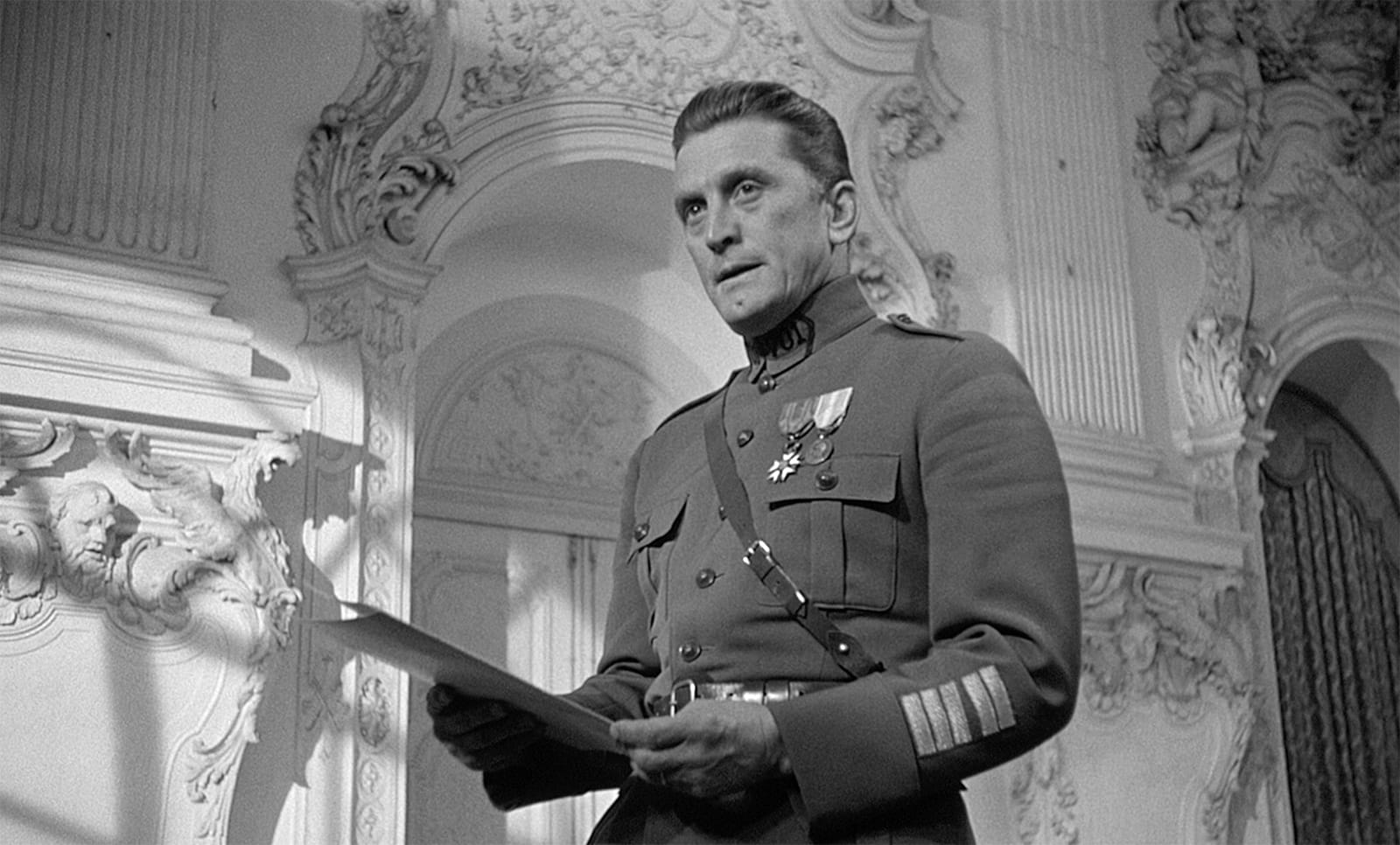
There’s a specific futility to World War I that gives Paths of Glory its power, too, given the endless hell of soldiers fighting for yards in a conflict that no one seemed capable of rationalizing. The 1930 adaptation of All Quiet on the Western Front—still as powerful an anti-war film as I’ve ever seen—depicted it as a meat-grinder for young Germans duped in service, and by the time Kubrick catches up with Colonel Dax and the 701st Infantry Regiment, they’re trading philosophies over the most optimal ways to die. (When a pair of soldiers agree that it’s better to go by machine gun than bayonet, another claims that what they’re really afraid of is pain, not death.) But as much as Dax strenuously objects to Mireau’s plan to sacrifice a vast swath of his men to a daylight attack on the Ant Hill, he’s committed enough to protocol to follow orders. When the morning comes, it’s Dax who’s first out of the trenches with his whistle to lead the charge, though the initial wave falls so short of its goal that a second wave never materializes. This leads to a shocking order from Mireau for the artillery commander to fire on their own position to force them onto the battlefield. The commander refuses to do it without written confirmation and the attack ends there.
What happens next is a farce of accountability. Mireau, the man who earlier proclaimed that the life of a single soldier meant more to him than “all the stars and decorations and honors in France,” wants to court-martial 100 men for cowardice, declaring that if “they won’t face German bullets, they will face French ones.” When Broulard talks him down to three representatives, the selection process is either arbitrary or sinister: One is chosen to cover up a friendly fire incident on a reconnaissance mission, another is a heavily decorated soldier who drew lots, and a third just appears to be the guy who annoyed his commander the most. Staged from stem-to-stern in only a handful of minutes, the court-martial scene is a brilliant model of economy, as Dax futilely attempts to argue against the foregone conclusion that these three men must pay for their master’s sins. (When it’s revealed that one of the men couldn’t have advanced on the Germans because he was knocked unconscious, the large gash on his forehead is treated with skepticism. “That could have been self-inflicted later,” notes the prosecutor.)
As Keith noted in yesterday’s piece about Full Metal Jacket, “Kubrick saw war as an essentially unchanging pursuit, however much the details might vary between conflicts,” which is true and also makes the rationale behind any given war beside the point. For as well as Paths of Glory evokes the specific conditions of trench warfare, Kubrick is focused more on the hypocrisy and arrogance of leaders who are utterly detached from the shell-shocked grunts they’re asking to dash headlong into enemy fire. Time and again, Kubrick cuts between the constant shelling on the trenches or battlefields and the opulent spaces where the fates of the many are decided upon by the heavily decorated few. These spaces cannot be penetrated by the grim realities outside of them, which is how quagmires like World War I (or Vietnam or most other modern war you can name) start and how can persist when they’re unwinnable. The party never stops.
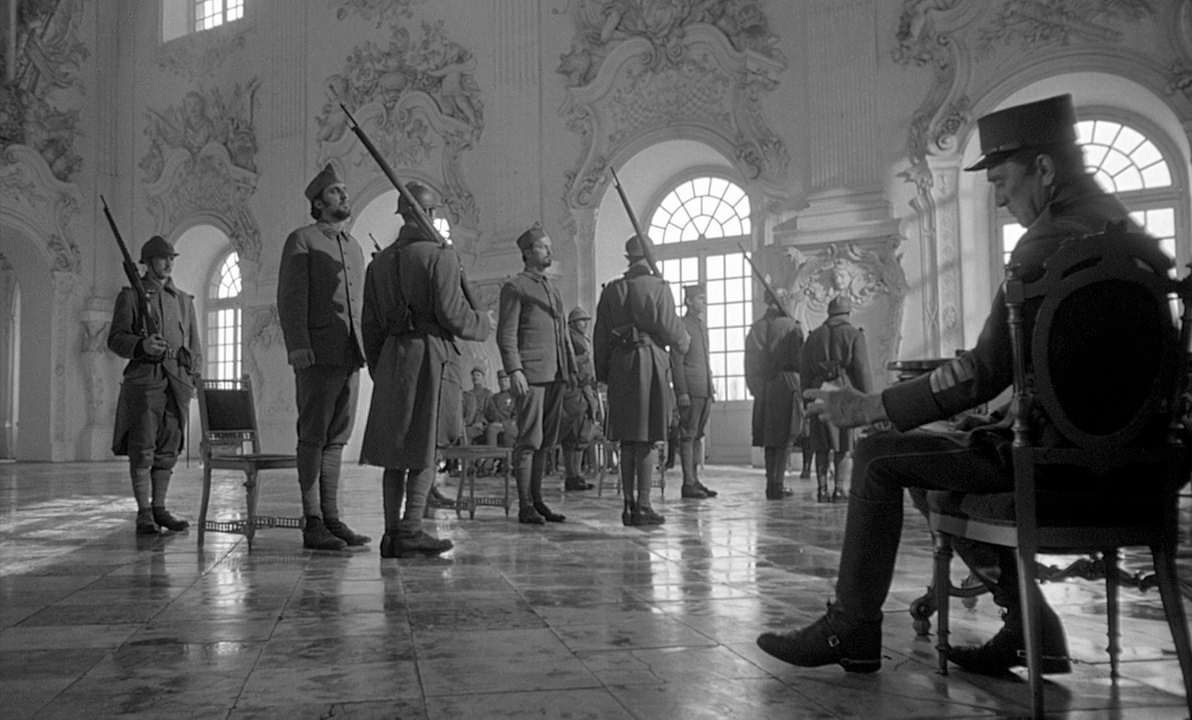
There are a plethora of nasty little twists and barbs in Paths of Glory, leading up to a whopper of a conclusion where Broulard is shocked to learn that Dax has been acting in good faith, rather than scheming to get Mireau’s job. (Brouland finds Dax’s “idealism” revolting, to be sure, and disqualifying for any military promotion. Dax uses the opportunity to call him a degenerate sadist.) Yet there’s one turn of the plot that stands out to me: Shortly before his execution, the most decorated of the three condemned soldiers gets in a fight over the chaplain and suffers a skull fracture that knocks him cold, but doesn’t affect his fate. The catch is that the general demands that he remain conscious for the firing squad, and the sergeant in charge of the execution is given instructions on how to revive him by pinching his cheeks when the time comes. And so there’s this absurd spectacle where the man is walked out to the firing line on a stretcher, propped up against a post, and pinched awake, only for the lights to go out on him seconds later.
“The men died wonderfully,” says Mireau afterwards, and Broulard extends the compliment to Dax, believing that it’ll be good for discipline and morale after this whole unfortunate ordeal. Their incompetence is spun as a win.
The end of Paths of Glory turns so sharply from the film’s caustic tone that it took me several viewings to come around on it. Dehumanization is such a common theme in Kubrick’s work—an aspect that often got derided by his critics as “cold”—that a sequence where Dax’s surviving men are treated to a performance by a young German woman (Kubrick’s future wife Christiane Harlan, credited as Susanne Christian) who’s been bullied into a singing a folk song. Their hostility melts under her quivering voice, and there’s a feeling of both relief from the horrors of war and a sense of solidarity with another human, from the other side of the conflict, being forced to the front. For Kubrick to offer this redemptive moment of warmth and shared anguish is a gear shift in an otherwise pitiless anti-war film. Then again, Dax can only bargain for a few extra minutes before sending all of them back to the trenches again.

Discussion