Drive-In ’76: ‘The Missouri Breaks,’ ‘Grizzly,’ ‘The Stranger and the Gunfighter,’ ‘Don’t Open the Window’
A check-in at the drive-in fare of 50 years ago finds an abundance of rustlers, martial artists, giant bears, and zombies.

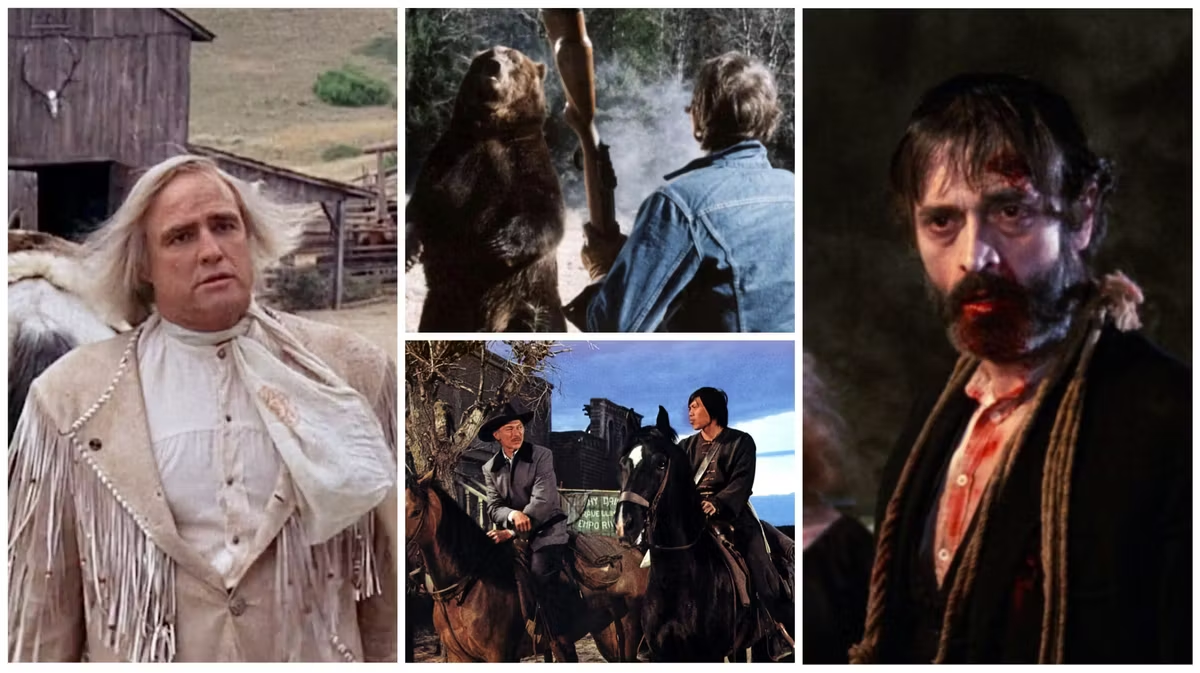
Each month, from April through September, Drive-In ’76 revisits the drive-in fare fifty years past, from big Hollywood releases to low-budget exploitation movies that played in the wee hours of the night. Stock up at the concession stand because we’ve got a quadruple feature lined up for May.
Feature One: The Missouri Breaks (released May 26, 1976)
The night kicks off with a major motion picture.
For his follow-up to Night Moves, Arthur Penn chose to make a movie demythologizing the Old West. It might have been more successful if other movies, including some of Penn’s own, hadn’t already so effectively performed the same task. Penn’s 1958 debut The Left Handed Gun cast Paul Newman as a Billy the Kid driven more by his own neuroses than a desire to be the baddest gun in town. His Little Big Man recast the story of the Old West as a tale of genocidal expansion filled with scenes designed to bring to mind the war in Vietnam. Scripted by novelist Thomas McGuane, The Missouri Breaks similarly, if less memorably, attempts to connect the dots between America’s past and present. Echoing Nixon and others, land baron David Braxton (John McLiam) wraps himself in a call for “law and order” in an attempt to consolidate his hold over a stretch of the Montana frontier, no matter how many outlaws he has to kill in the process. His reasoning, located just beneath the veneer of drawing a line between right and wrong: they eat into his bottom line too much.
It’s a rich set-up made even richer by Braxton’s chief opponents: a colorful gang of rustlers, led by Tom Logan (Jack Nicholson), who make it their mission to harass and undermine Braxton after he hangs one of their own. Nicholson’s in typically fine ’70s form here in his first role since One Flew Over the Cuckoo’s Nest and it’s a pleasure to watch him work opposite Frederic Forrest, Harry Dean Stanton, and his Last Detail co-star Randy Quaid, who play the other members of the gang. The film has an agreeable, picturesque looseness, highlighted by an early-film bank robbery that goes wrong, but not that wrong.
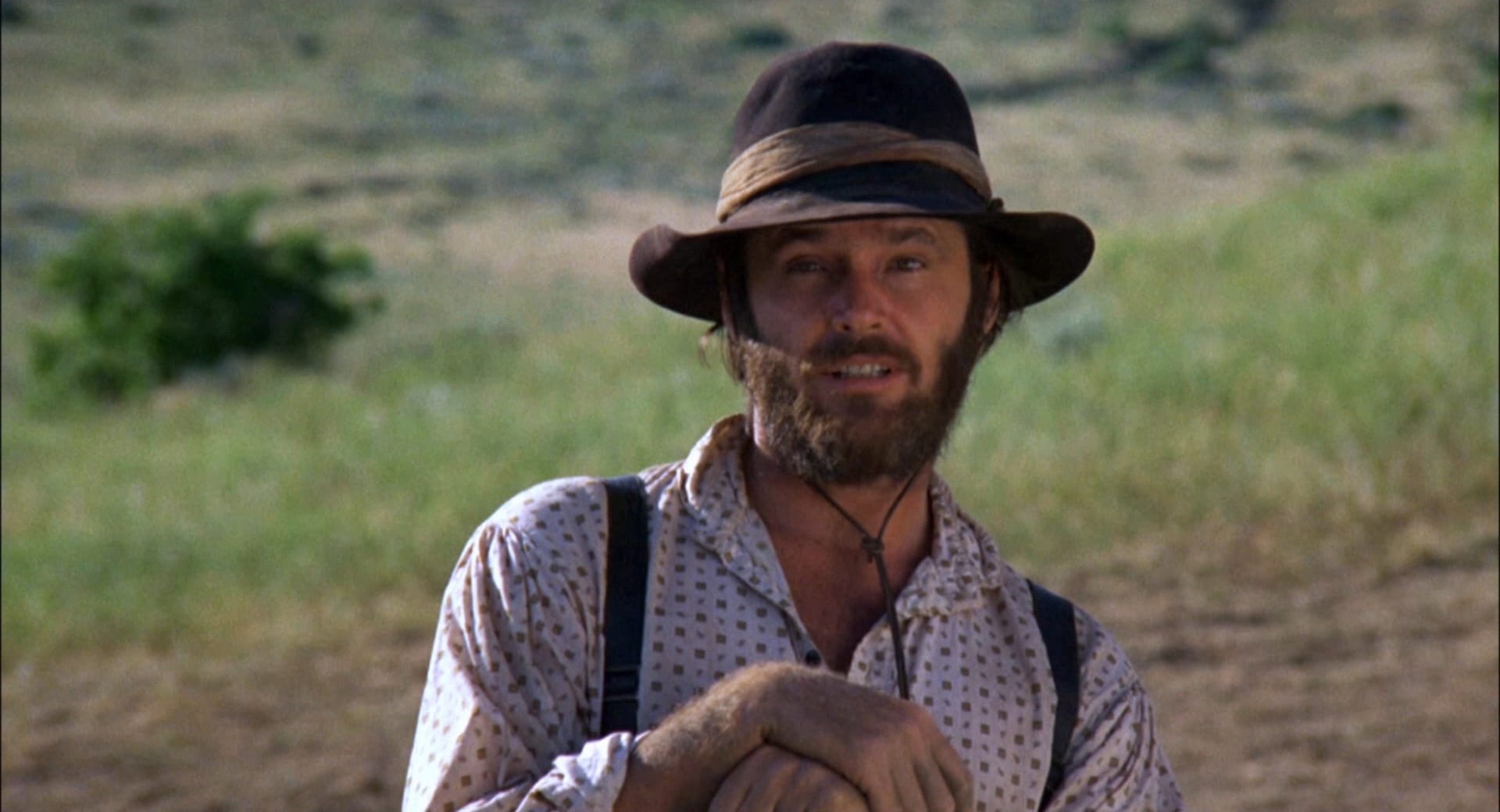
That The Missouri Breaks feels minor in comparison to Penn’s past films and similar then-recent efforts like Bad Company and McCabe and Mrs. Miller is The Missouri Breaks’ second biggest problem.* Its biggest problem is Marlon Brando, who plays the jovial but pitiless hired gun “regulator” Robert E. Lee Clayton with a twinkle in his eye and a thick, unconvincing Irish accent that makes the character seem more silly than threatening. And, unfortunately, since Lee is also a self-styled master of disguise, it’s just one of a few accents Brando tries on. This was Brando’s first role since a 1972 comeback that included both The Godfather and Last Tango in Paris. It was as if he spent the years between trying to turn into Peter Sellers.
[* A United Artists release, it also brings to mind Heaven’s Gate, which tells a similar story in a far grander style. Tales of The Missouri Breaks’ chaotic-sounding production suggests no lessons were learned in the years between.]
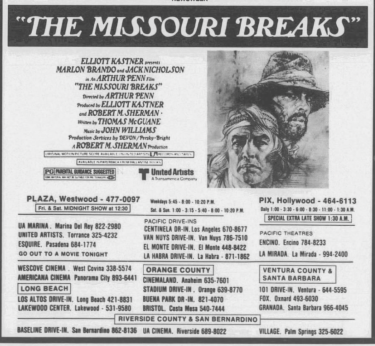
The Missouri Breaks was the big-deal release at the end of May 1976. It performed respectably enough, topping the box office for three weeks in a row. Still, despite the talent involved, it’s never spoken of in the first breath when anyone talks about Penn, Nicholson, or Brando. That combination suggests it should have been an all-timer instead of a second-tier addition to ’70s movies depicting the Old West in the midst of a long sunset. And despite a happy-ish ending that rings false, it’s a little too downbeat for the Summer of ‘76 drive-in crowd. Fortunately, they had other options.
Feature Two: Grizzly (released May 19, 1976)
Stick around: There’s a killer bear on the loose!
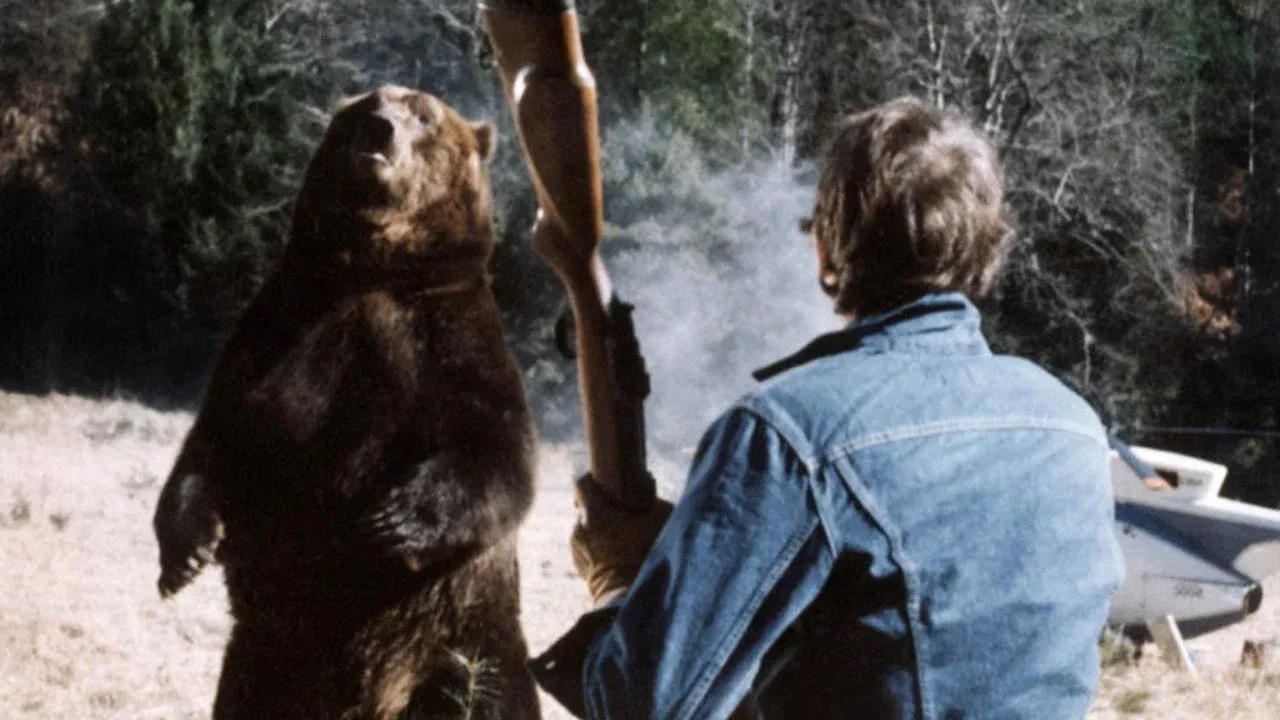
The success of Jaws left audiences, for want of a better word, ravenous for killer animal movies. That, and little else, explains the success of the Grizzly, which aims to be Jaws-but-in-the-woods-instead-of-on-the-beach-and-with-a-bear-instead-of-a-shark and succeeds just well enough to underscore what makes Jaws exceptional. Michael (Christopher George), Don (Andrew Prine), and Arthur (Richard Jaeckel), the three main characters, slot pretty neatly into the same types played by Roy Schneider, Robert Shaw, and Richard Dreyfuss in Jaws, but they have no depth individually and no chemistry together. The biggest problem, though, is the grizzly itself. The early scenes that offer only glimpses of slashing claws are pretty effective but, as in Jaws, you eventually have to show the monster. The editing of footage of a semi-fearsome real bear with screams and reaction shots just doesn’t cut it.
Which doesn’t mean Grizzly isn’t fun in spite of, and sometimes because of, its shortcomings. Audiences—again, for want of a better phrase and, again, I’m sorry—ate it up. Grizzly might not have been Jaws but Spielberg’s hit created an environment in which seemingly any half-competent killer animal movie could thrive. (Of course, not all such movies rose to the “half-competent” threshold. Other 1976 releases included: Dogs, Mako: The Jaws of Death, Squirm, and Shark Kill.)
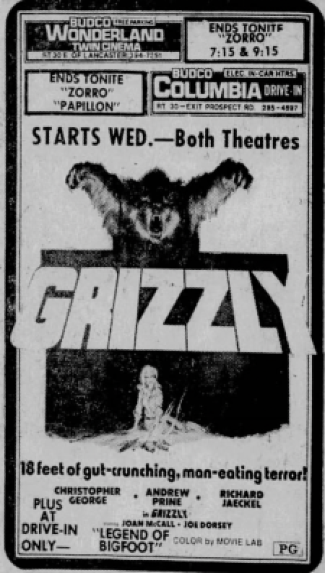
It’s also hard not to admire Kentucky-born director William Girdler’s timing, marketing savvy, and work ethic. Girdler started out in horror then segued into blaxploitation via a stretch of films that included the Exorcist-inspired Abby. He followed Grizzly with another animals-gone-amok film, Day of the Animals, before returning to horror for his ninth film, The Manitou. That film was weeks away from its 1978 release when Girdler died in a helicopter crash in the Philippines while scouting locations for a movie about international drug smuggling at the age of 30. The ’80s could have used a filmmaker with his B-movie enthusiasm.
Feature Three: The Stranger and the Gunfighter (released May 5, 1976)
East meets West via an Italian / Hong Kong co-production about a lost fortune and an unusual treasure hunt.
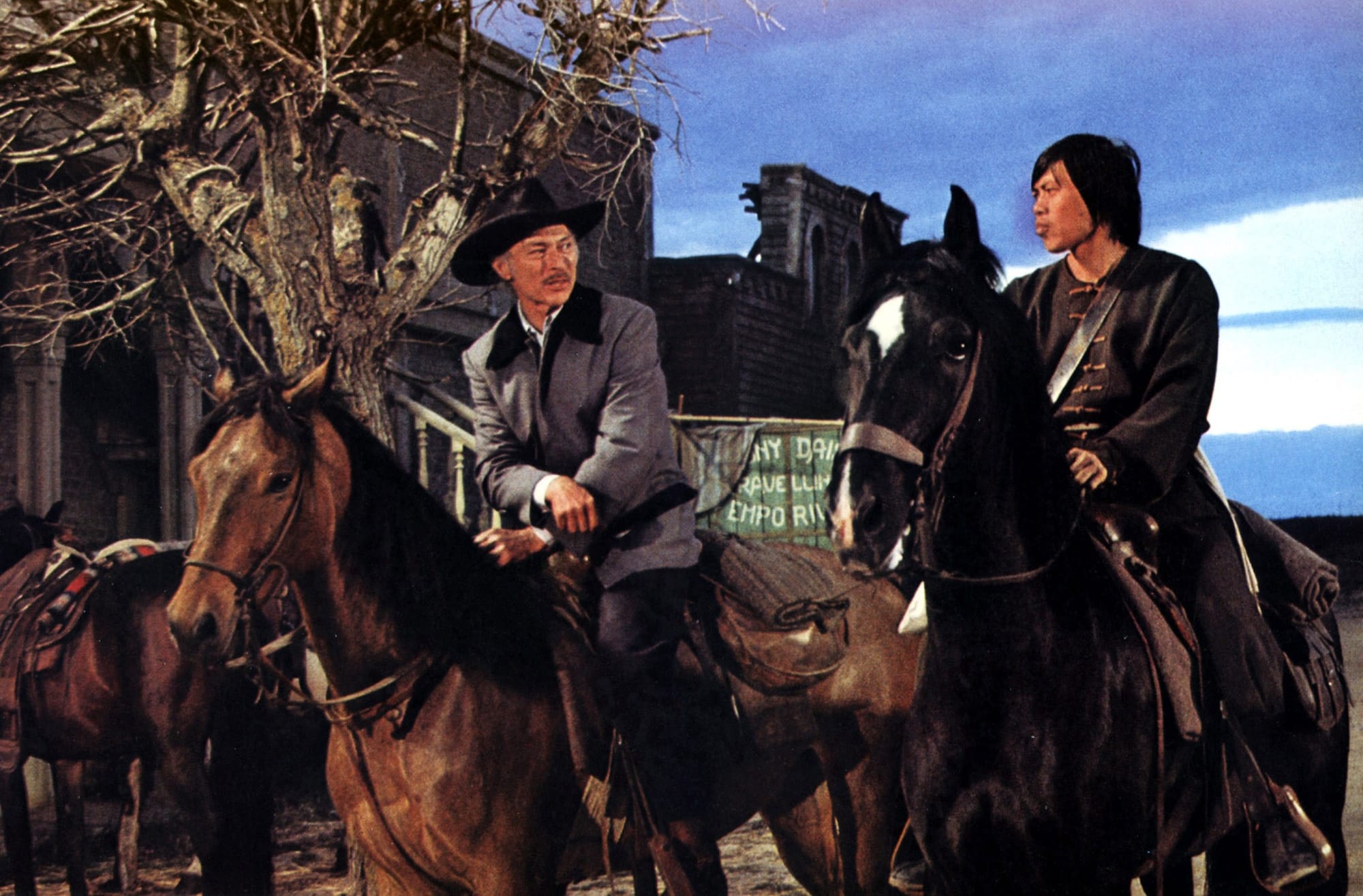
Alternately known as El Kárate, el Colt y el Impostor and Blood Money (that’s the title you’ll find it under on Tubi and other services), this late spaghetti Western effort tries to inject new life into the subgenre via an infusion of outside influences. Co-produced by Carlo Ponti and Shaw Brothers Studio, The Stranger and the Gunfighter pairs Lee Van Cleef with Lo Lieh, a Shaw Brothers fixture who’d later turn up in films like Police Story 3: Super Cop and Sex and Zen. A struggling Hammer Studios tried something similar around the same time, resulting in The Legend of the 7 Golden Vampires, which sets Peter Cushing’s Van Helsing loose against some Chinese vampires and somehow neatly splits the difference between two distinct cinematic worlds. Not so The Stranger and the Gunfighter, which apart from some bookending scenes set and filmed in China, is essentially a lighthearted Euro-Western buddy comedy in which one half happens to be a skilled martial artist.
It’s familiar but mostly fun, thanks in part to a truly goofy plot. Van Cleef plays Dakota, a scoundrel who, while visiting Monterey, accidentally blows up the wealthy Mr. Wang (Ching Miao) in the process of breaking into his safe. But instead of finding treasure, Dakota finds only photos of four women in various states of undress. Meanwhile, in China, Wang’s nephew Ho Chiang (Lo) is compelled to travel to America in search of Wang’s fortune by a powerful warlord who threatens his family. Eventually, Dakota and Ho team up and come to the realization that Wang has tattooed clues to his fortune’s location on the buttocks of four beautiful women. Together, they ride out. In search of butts.
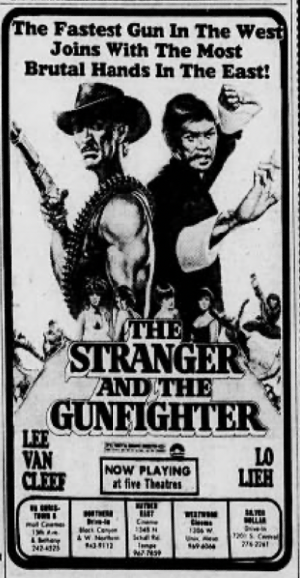
Ass-centric premise aside, there’s nothing here you haven’t seen before and better. But journeyman director Antonio Marghetti (or Anthony Dawson, as the American poster would have you believe), whose filmography includes everything from the Dean Jones-starring comedy Mr. Superinvisible to the capable ‘80s fixture Yor, the Hunter from the Future, provides steady if uninspired direction, Van Cleef and Lo are fun together, and the cringe factor of the culture clash is surprisingly low. You could do better but you could also do worse. It’s getting pretty late so your standards are probably a bit lower than usual anyway.
Feature Four: Don’t Open the Window (Released May 26, 1976)
But wait. There’s more. And this one’s a weird one.
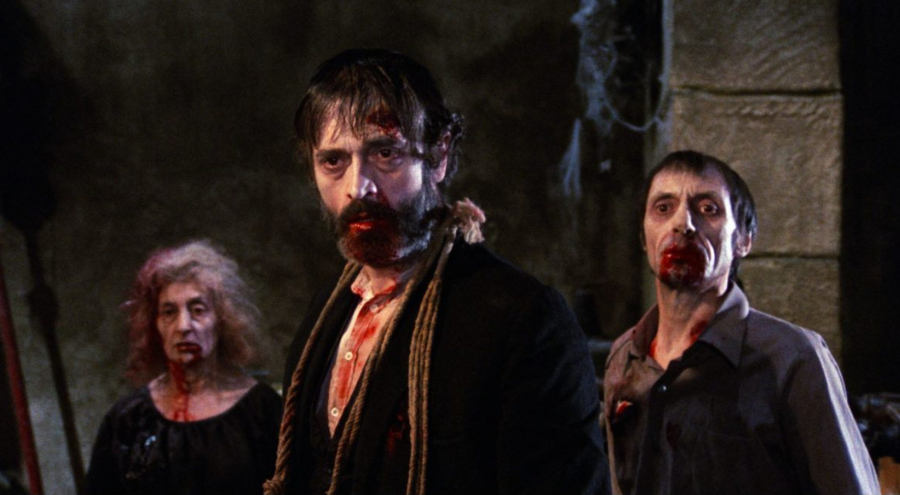
That makes it the perfect time to watch a film like Don’t Open the Window, now better known by its British title, The Living Dead at Manchester Morgue, though it also played under the name Let Sleeping Corpses Lie. (I kind of wish they’d gone with a more straightforward translation of the Spanish title: No Profanar el Sueño de los Muertos (“Do Not Profane the Sleep of the Dead”) For the record, no scene in the film involves the opening or closing of windows ). Set in England, directed by Spanish filmmaker Jorge Grau, and scripted by the Italian team of Marcello Coscia (Yeti: Giant of the 20th Century) and the prolific Sandro Continenza (Agent 077: From the Orient with Fury), the film plays like a displaced giallo thanks to a lurid tone and overstuffed cast of characters. Until, that is, the zombies show up.
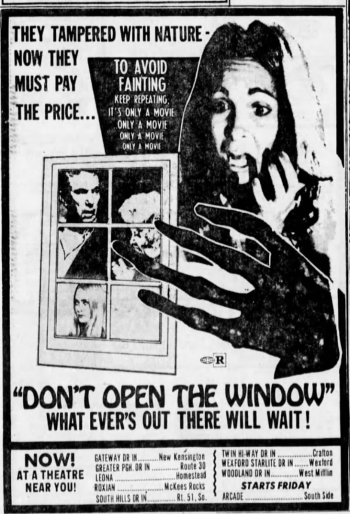
Cristina Galbó and Ray Lovelock play George and Edna, visitors to the north of England who reluctantly begin traveling together after a car accident. Despite the title, they never make it to Manchester, but do make it to a small town where they immediately attract the suspicion of a dimwitted police inspector (Arthur Kennedy) after the death of Edna’s brother-in-law. (George does have long hair, like a hippie, and there have been reports of satanists in the area.) Could the real culprits be the walking dead? And could all this have something to do with a piece of experimental farm equipment that uses an ultrasonic frequency to kill parasites?
Yes and yes! Don’t Open the Window begins as a curious twist on Night of the Living Dead with an unusual setting—Grau makes great use of the misty, hilly English countryside—then slowly transforms into a woozily delirious experience all its own as one odd detail, like feral infants seemingly on loan from It’s Alive, gets piled atop another and characters who behave as if they’ve recently experienced sharp blows to the head somehow manage to evade death. It’s the sort of film that makes you feel like you might have fallen asleep and imagined it. And at this hour, maybe you have. Or maybe that distinction doesn’t matter anymore.
Sun’s coming up. Time to go home.
Discussion