In Review: 'Disclosure Day'
Steven Spielberg once again considers the possibility of extraterrestrial beings on Earth. The question is: Can we handle it?

Disclosure Day
Dir. Steven Spielberg
145 min.
The question of whether we’re alone in the universe is one that Steven Spielberg has answered multiple times, with an emphatic “no,” turning instead to the more interesting question of what the interaction between humans and aliens might actually be like. With the notable (okay, extremely notable) exception of War of the Worlds, Spielberg has been a radical optimist since Close Encounters of the Third Kind and E.T. the Extra Terrestrial, imagining creatures of intelligence and vulnerability that are rooted in his own experience of childhood. The thornier philosophical debate—and the one that’s swirled about popular conspiracy theories about Area 51—is whether humanity itself could process the actual reality of aliens crash-landing on earth. It’s one thing for a sweet 10-year-old boy like Elliot to forge a profound bond with an extra-terrestrial, but E.T. is also about scientists in hazmat suits nearly poking our visitor to death.
We hope you're enjoying these reviews but The Reveal has much more than reviews to offer. Become a paid subscriber and you'll get access to everything we publish—from articles to lists to audio commentaries—and help support independent film criticism.
In his mostly crackerjack new sci-fi thriller Disclosure Day, Spielberg and screenwriter David Koepp (Jurassic Park, War of the Worlds) allows the debate to spill out into the open, with each side frantically attempting to outwit the other. Though the film does get to a place where Spielberg and Koepp can start to suggest how billions of people might handle the most staggering revelation of their lives, they’re more interested in presenting the scenario than resolving it. Just as a film like E.T. feels keenly attuned to the suburban expansion and domestic complications of the 1980s, Disclosure Day speaks unmistakably to our own fractured society, which seems in no place to agree on anything, much less the presence of non-humans on earth. At the same time, there could be no greater litmus test than all of us coming to terms with something larger than ourselves.
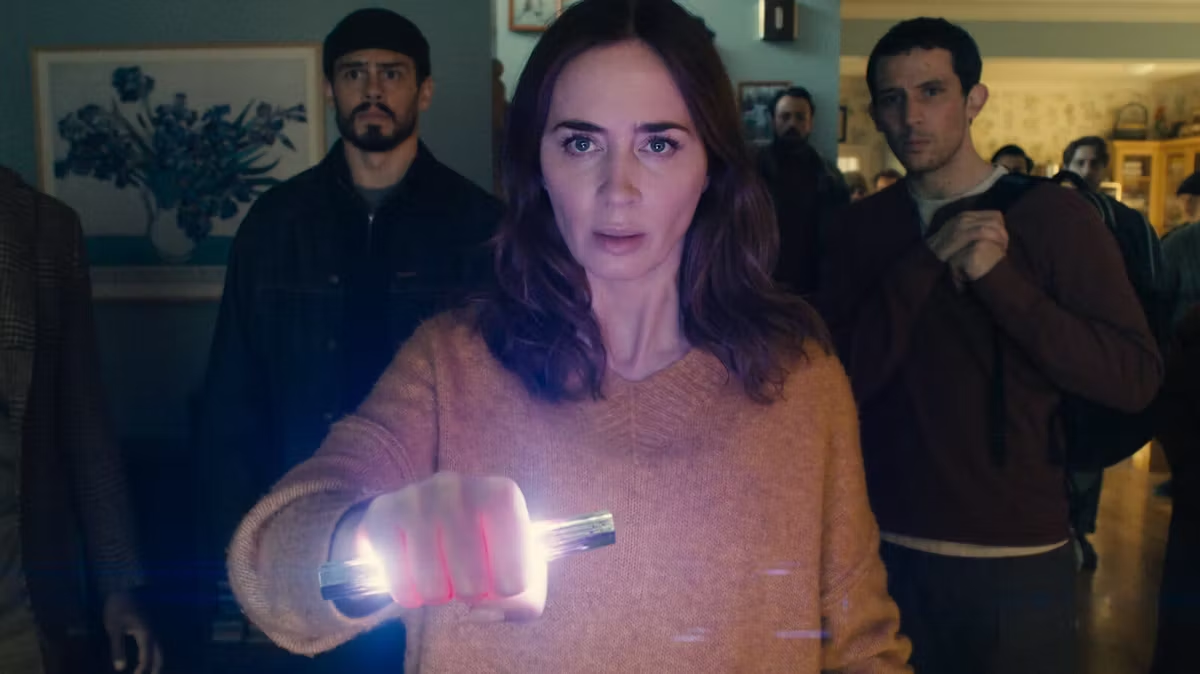
Though it links more firmly with Close Encounters and E.T. thematically, Disclosure Day operates with a pedal-to-the-metal urgency that feels closer to Spielberg’s two Tom Cruise movies, Minority Report and War of the Worlds, speeding forward and filling in the story gaps later. The opening sequence slams the camera to the mat quite literally as whistleblower Daniel Kellner (Josh O’Connor) anxiously negotiates the exchange of sensitive government secrets at a backwater pro-wrestling event. He and his girlfriend Jane (Eve Hewson) manage to escape the clutches of Noah Scanlon (Colin Firth), the head of a cybersecurity operation, who wants to stop Daniel from allowing information about aliens to go public. Meanwhile, at a local broadcast news station in Kansas City, meteorologist Margaret Fairchild (Emily Blunt) enters into a kind of fugue state where she knows multiple languages, possesses extrasensory perception, and can speak in a clicking alien voice.
Daniel and Margaret obviously have a lot to talk about, but getting them on the right path together, away from Noah and his tech-aided minions, proves to be a difficult task, orchestrated mostly by Hugo Wakefield (Colman Domingo), another defector from Scanlon’s company. Disclosure Day introduces a powerful alien widget—a figurative narrative device—that adds some metaphysical and mesmeric threat to the mix, but it’s mostly an extended cat-and-mouse game that spills out into middle America. As one of the greatest entertainers in film history, Spielberg can still string together bravura action pieces as few directors can, and his offhand wit is in evidence, too, especially as Margaret surprises herself by Jedi-mindtricking her way through the Heartland. Age hasn’t dulled his instincts.
And yet age has shaped his perspective, which has deepened in the latter half (or two-thirds) of his career, since he followed Jurassic Park with Schindler’s List in the same year. The politics of Disclosure Day are allusive at best, but Spielberg and Koepp are strongly aware that they’re making a film at a polarizing time, when human qualities as basic as empathy and openness are not something we can expect everyone to possess. Spielberg isn’t the type to succumb to cynicism, even now, but Disclosure Day turns uncertainty into its own level of tension, right through the emotional final moments of the film. All anyone can do in 2026 is appeal to our better angels and hope for the best. — Scott Tobias
The secrets of Disclosure Day will be revealed everywhere, well, today. Unless Colin Firth succeeds in stopping it.



Discussion