In Review: ‘Whalefall,’ ‘Sense and Sensibility’
This week's narrative reviews go inside the bellies of a whale and late 18th century English society.

(Programming note: This is the second installment of today's reviews. Where this batch focuses on narrative films—both of which we thought were pretty good—the earlier installment covered two excellent new documentaries, You Can See Everything and Once Upon a Time in Harlem.)
Whalefall
Dir. Brian Duffield
105 min.
It seems callous at first that Jay (Austin Abrams) would decline to accompany his mother Zara (Elisabeth Shue) to visit the grave of his father Mitt (Josh Brolin) but, as the film will soon reveal, he has his reasons. Jay had a complicated relationship with Mitt, but he also knows the grave isn’t his dad’s final resting place and the casket it contains is empty. Rather than enduring a slow death by mesothelioma in a hospital bed, Mitt, a local legend among scuba enthusiasts, chose to end his life by throwing himself into the ocean he loved for one last dive. What Jay doesn’t tell his family after he returns to their Central Coast California home while on a break from college is that he has his own act of remembrance planned: he plans to make a dive in search of his father’s bones. This will not go according to plan.
Based on Daniel Kraus' 2023 novel, Whalefall follows Jay as he attempts to escape a seemingly certain catastrophic fate. Shortly after beginning his dive, he observes first a giant squid then the predator chasing it: a mammoth sperm whale. The squid proves to be no match for the whale, despite the famous diorama that has them forever fighting to a draw. Nor does Jay, who’s swallowed alongside the squid. Jay’s limited air supply gives him a limited time to make an already difficult escape attempt. The film’s flashback structure makes Jay’s depleting tank double as a ticking clock for his attempts to make peace with his father’s memory. Neither will be easy. Mitt is revealed as a passionate but quick-tempered father whose attempts to pass on his love of diving and concern about the ocean to his son could be overbearing (to put it kindly). And whales, it turns out, don’t like to surrender their prey.
We hope you're enjoying these reviews but The Reveal has much more than reviews to offer. Become a paid subscriber and you'll get access to everything we publish—from articles to lists to audio commentaries—and help support independent film criticism.
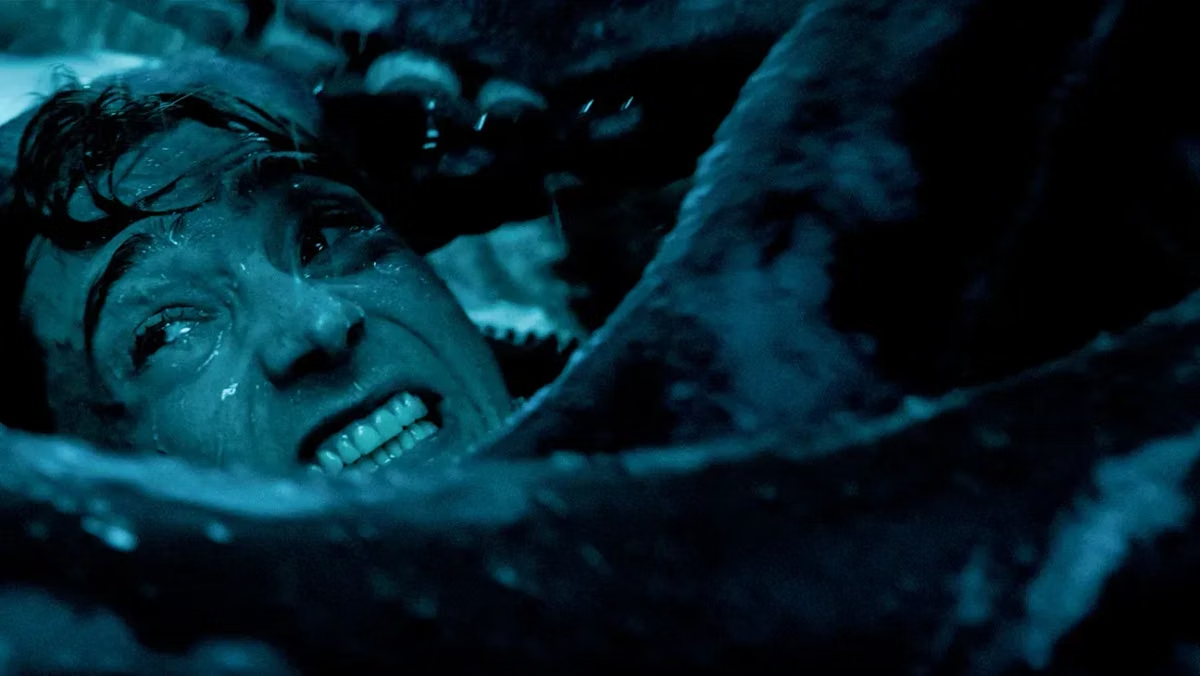
After some expansive underwater images and a scary scene that establishes the whale’s vast size and Jay’s helplessness before it, Whalefall largely takes place inside the whale’s digestive system. This might seem like the set-up for an extremely limited survival thriller, and it sort of is, just one that largely takes advantage of those limitations. Director Brian Duffield, who co-scripted the film with Kraus, treats the inside of the whale as a claustrophobic, almost unearthly environment in which one deadly threat gives way to the next. (If the angry squid doesn’t get Jay, it seems like the toxic gas and acidic digestive fluids will.)
Often resembling an oceanic twist on Gravity that subs in the belly of a whale for outer space, Duffield’s film similarly uses each new twist in Jay’s survival to rhyme with past losses he has not yet resolved. While the father/son material is a bit underdeveloped, Abrams and Brolin play it with an intensity and believability that makes their scenes together feel immediate even before the border between the past and present fully collapses. As the crisis mounts, Jay’s memories start to blur together with his worsening circumstances, as nitrogen narcosis introduces confusion and hallucinations into his ordeal.
Whalefall is a daring film on several levels, betting that it can make Jay’s struggles within his tight surroundings feel exciting while also using them to serve a metaphor as big and inescapable as, well, a whale. The dares largely pay off. Duffield’s direction and Abrams’ performance create a sense of mounting tension, both physical and emotional, that could take a crushing turn at any moment. Though its story of a son trying to make peace with a father he could never please, and whose legacy he might not be able to escape, often feels familiar, the film gives it a novel, moving variation. In its best moments, Whalefall is almost as overwhelming and inescapable as Jay’s leviathan captor. —Keith Phipps
Whalefall arrives in theaters tonight.


Sense and Sensibility
Dir. Georgia Oakley
132 min.
It’s been 30 years since the last major screen adaptation of Jane Austen’s Sense and Sensibility, and, well, here’s another one, distinguished mainly by being handsome and new. There’s virtually no tale-of-the-tape comparison that would give this version the edge over Ang Lee’s 1995 standard, which brought a young Kate Winslet into a cast of once and future British legends like Emma Thompson, Hugh Grant, and Alan Rickman. Yet director Georgia Oakley, who’d made a striking debut a few years ago with indie drama Blue Jean, strikes nearly all the right notes, however familiar they may sound. With production values that align closely with the 2005 Pride & Prejudice—sleek and sweeping yet connected to the grimy realities of a family peering into the class abyss—Oakley’s Sense and Sensibility leans on an excellent cast to bring Austen’s themes and emotions across. As adaptation, it mostly paints within the lines.
As they nervously congregate around their late father’s will, the three Dashwood sisters learn that his estate has been passed along to their half-brother John (Tom Brooke) and his arrogant wife Fanny (Stacy Martin), who’s all too happy to toss them to the winds of fate. The two older Dashwoods, the even-tempered Elinor (Daisy Edgar-Jones) and her more volatile younger sister Marianne (Esmé Creed-Miles), are of marrying age but still in search of viable prospects. Much to Fanny’s irritation, Elinor develops an instant chemistry with her older brother Edward Ferrars (George MacKay), whose reciprocal feelings are bound up in other complications. For her part, Marianne yawns her way through a meeting with the earnest Colonel Brandon (Herbert Nordrum), but she swoons for John Willoughby (Frank Dillane), whose dashing personality masks his less admirable qualities. Questions of love and money complicate all of these relationships.
As the Dashwoods fall into financial uncertainty, Sense and Sensibility adds a welcome layer of bawdy comedy as Fiona Shaw turns up to steal scenes as Mrs. Jennings, a distant Dashwood relative who relocates them to a rustic cottage in Devonshire and meddles in their affairs with a crude but well-meaning elan. Turlough Convery complements Shaw, too, as the blustery local who owns the cottage and loves to supply the Dashwoods with fresh kills from his hunts, as if he were an eager-to-please sporting dog. The Devonshire backdrop nicely underscores both the Dashwoods’ tumble down the social ladder and the down-to-earth nobility and dignity that makes them worthy of better lives. With so many practical worries about the future, their values make them especially vulnerable.
Though their romantic travails are the engine that drives Sense and Sensibility, the bond between sisters is the soul of Oakley’s adaptation, and she does well to develop the hot-and-cold dynamic between Elinor and Marianne. Edgar-Jones plays the taciturn Elinor with a reserve that occasionally cracks with emotions, but it’s Creed-Miles who gets the showier role as Marianne, a live wire whose lust for life defies convention and opens her up to more wounding setbacks. There’s one conspicuously silly tweak to the final act that’s meant to separate Willoughby and Brandon as Marianne’s suitors, but Sense and Sensibility mostly plays the material down the line and well. It could just stand to borrow a little more of Marianne’s out-of-pocket spontaneity. — Scott Tobias
Sense and Sensibility opens in theaters everywhere tonight.




Discussion