In Review: ‘The Dog Stars,’ ‘Coyote Vs. Acme,’ ‘Buddy’
This week's no releases include an unexpectedly reflective take on the post-apocalyptic world from Ridley Scott, a long-delayed legal thriller featuring Wile E. Coyote, and a horror movie that's definitely not for kids.


The Dog Stars
Dir. Ridley Scott
118 min.
It is hard to guess what anyone was thinking when they made The Dog Stars, the 30th feature directed by Ridley Scott and without question one of his strangest. That’s not intended as a slight on Scott’s craftsmanship behind the camera, which remains steady and occasionally eye-catching, and also not to say that this post-apocalyptic sci-fi/romance/whatsit isn’t compelling or occasionally surprising, even when it dramatically missteps. But there’s some fundamental purpose that’s missing from The Dog Stars, no evident reason—much less urgency—to explain what this rudderless film is trying to say about grief, humanity, and how we might relate to each other at the end of the world. In that respect, it’s a little like its survivalist heroes, who struggle to stay alive and defend their lonely corner of the world, but can’t seem to articulate why they fight for an uncertain future while carrying the weight of the past.
Set after a flu pandemic has wiped out most of humanity, the film opens on a blighted airstrip in rural Colorado, where Hig (Jacob Elordi), a mechanic who lost his wife to the virus, puts his skills as a mechanic to use fixing broken machines and maintaining a rusted Cessna that’s still in operable condition. He has a mostly friendly relationship with Bangley (Josh Brolin), a former Marine who also lives on the property, and they have the military arsenal to beat back the hordes of armed, near-feral humans who occasionally cross onto the property. After losing his beloved dog, Hig works up the nerve to fly the Cessna to Grand Junction, where he hopes to find another pocket of humanity, but an oil leak causes him to crash-land near a mountain ranch. There he meets another pair of survivors, the grizzled ex-Navy SEAL “Pops” (Guy Pearce) and his daughter Cima (Margaret Qualley), who was a big-city medical resident in her former life.
A crazy-quilt patchwork of tones and ideas, The Dog Stars can feel like several films competing for attention, though all of them hold some fascination, as if Scott were looking to prove his dexterity in managing a gauzy, slow-burn romance in one episode and a bloody, Black Hawk Down-like siege in another. Though we’re meant to believe that Hig and Cima are separately grappling with the pain of losing their partners, the tentativeness of their chemistry together is almost perverse, as if two of the last people on a ravaged Earth—played by the two of the most beautiful people on a fully stocked, pre-apocalyptic Earth—have barely given a thought to hooking up. Perhaps there’s some worry about building toward a future that’s fraught at best, but most of the film’s feelings are tabled in favor of a low-hum ambient angst.
The dynamic between Hig, Cima and Pops at the ranch gobble up the largest chunk of running time, which lulls you to sleep before a sequence in Grand Junction that’s such a bizarre, startling turn it feels like a cold splash of water to the face. Though it doesn’t seem to fit in The Dog Stars, this brief interlude holds the rest of Scott’s somnambulant exercise in sharp relief, but the film otherwise seems reluctant to imagine a more robust version of its post-apocalyptic scenario. A word like “tender” applies to some of it, but more often the operative word is “dull.” — Scott Tobias
The Dog Stars twinkle in theaters nationwide tonight.

Coyote Vs. Acme
Dir. Dave Green
103 min.
When asked by NPR’s Terry Gross in a 1990 interview why the classic Warner Bros. cartoons were filled with animals, animator Chuck Jones replied, “It’s easier to humanize animals than it is to humanize humans.” Amongst Jones’s many creations, there are few more relatably human characters than Wile E. Coyote, the “Carnivorous vulgaris” (to use one of the character’s many “Latin” names) who never sinks in despair no matter how many of his attempts to catch and eat the Road Runner (“Accelerati incredibillis”) end in failure and humiliation (which is all of them). He’s at once the embodiment of the sense that sometimes the universe itself seems determined to thwart our plans and rob us of our dignity and our habit of carrying on anyway. If Jones didn’t dream him up, Samuel Beckett might have. That Coyote’s attempts are almost always aided by products from the Acme Corporation that end up backfiring, literally or otherwise, on their user doesn’t help, even if he never seems to notice a pattern.
We hope you're enjoying these reviews but The Reveal has much more than reviews to offer. Become a paid subscriber and you'll get access to everything we publish—from articles to lists to audio commentaries—and help support independent film criticism.
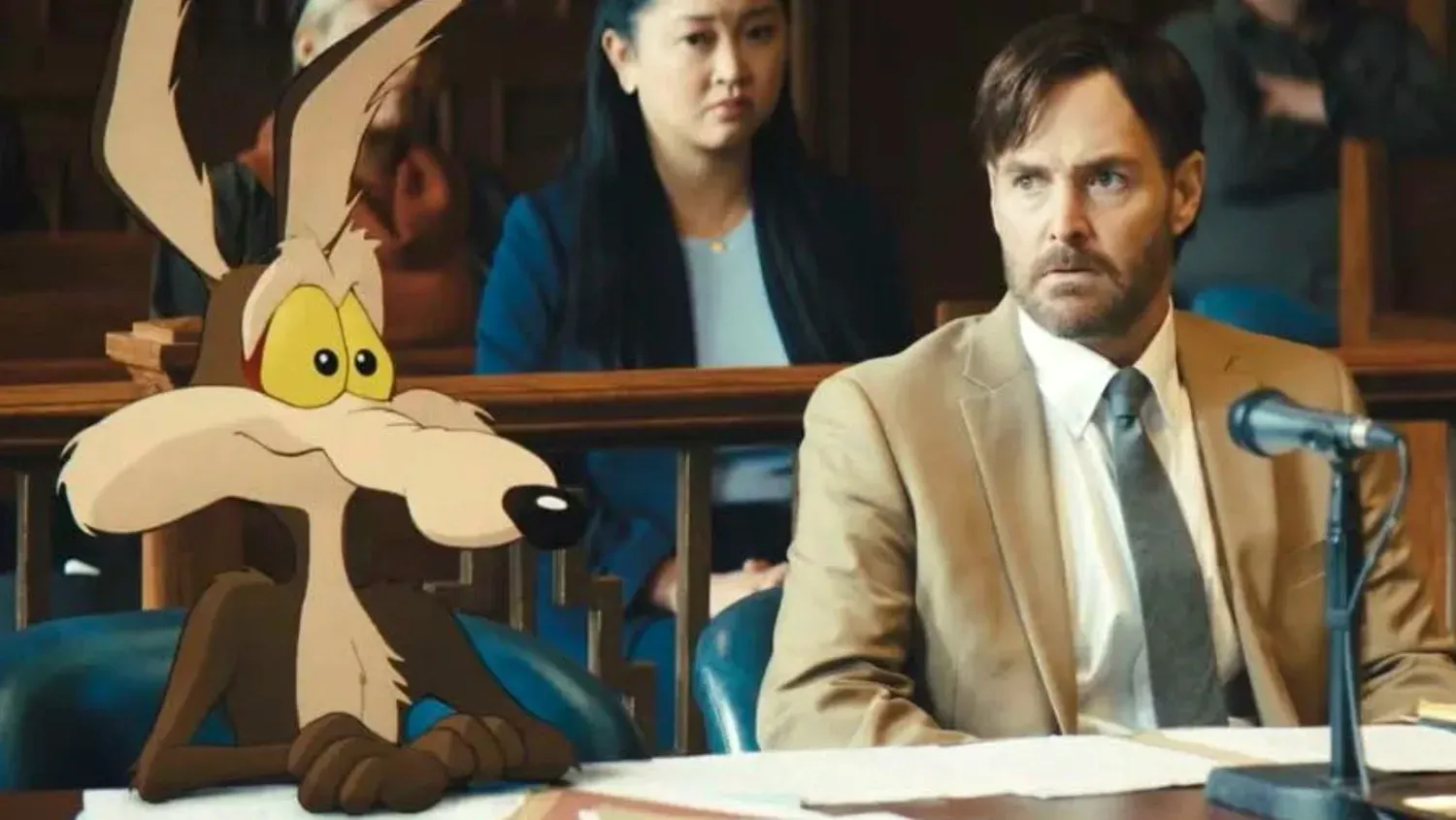
But what if he did? That’s the premise of Ian Frazier’s 1990 New Yorker piece “Coyote v. Acme,” which takes the form of a legal document laying out the many ways Acme has failed the author’s client over the years. That might not seem like a substantial enough premise on which to base a feature film, but Coyote Vs. Acme proves otherwise. Directed by Dave Green from a script by Samy Burch (May December, Late Fame), Coyote Vs. Acme reworks the idea as a John Grisham-inspired legal thriller in which a scrappy underdog takes on a corporate behemoth at the risk of their career and maybe their health (though the effects of cartoon TNT and other perils tends to be fairly short-lived).
While recuperating from his latest attempt, Wile E. Coyote (who communicates only with pantomime and signs on planks) catches a TV ad in which Kevin Avery (Will Forte), a partner in the budget-friendly firm of Avery, Jones & Maltese, encourages potential plaintiffs to seek justice. This sends Coyote to nearby Albuquerque (home of a famous annual Carrot Festival), where he discovers Kevin’s mostly interested in settling small potatoes claims for a few hundred dollars, not the sort of massive lawsuit Coyote wants to pursue. But a mishap and the enthusiasm of Kevin’s upbeat niece/intern (Lana Condor) combine to lead them to file one anyway. That development forces a reluctant Kevin to square off against Acme’s ace lawyer Buddy Crane (John Cena), who also happens to be an old law school rival.
Cleverly combining live-action and animation to create a world in which humans and animated characters (including quite a few familiar Looney Tunes faces) live side-by-side, Coyote Vs. Acme stays true to its animated inspirations by stacking one gag on top of another, a healthy mix of everything from over-the-top cartoon violence to sly details like the book Coyote reads as he hangs out in Kevin’s strip mall office: How to Wait Around Dramatically. Between jokes, the film finds room both to build a nice buddy-movie partnership between Coyote and Kevin while adding some real-world resonance via the story of a little guy going up against a corporation. Acme might have begun as a humble, well-intentioned anvil factory but its size, drive and questionable ethics now make it a part of everyone’s lives whether they want it there or not. That this winning film, which was shot in 2022, was itself almost sent to the trashbin by one such corporation before being rescued by a much smaller distributor only deepens that resonance. Surrounded by Acmes, we’re all Wile E. Coyote now. But its belated release suggests we can still eke out the occasional win. —Keith Phipps
Coyote vs. Acme (finally) arrives in theaters tonight.

Buddy
Dir. Casper Kelly
96 min.
Back in 2014, late-night viewers of Cartoon Network’s Adult Swim line-up encountered a short film so bizarre it stood out even in the context of the usual fare the network aired at the bleary-eyed hour of 4 a.m. Casper Kelly’s “Too Many Cooks” begins as a dead-on parody of an early-’90s sitcom credits sequence complete with an earwormy theme song. Then it just keeps going, unveiling a telegenic cast big enough to fill a Cecil B. DeMille epic before shifting genres from comedy to crime drama to cheapo kiddie animation to nighttime soap to horror and so on until it all starts to blur together and the underlying reality breaks down. It’s ingenious but also weirdly thought-provoking. Kelly explores how easily one insipid form of entertainment melts into the next and how quickly the familiar becomes uncanny with small changes (and, sure, some big changes too, like the addition of a smirking slasher killer).
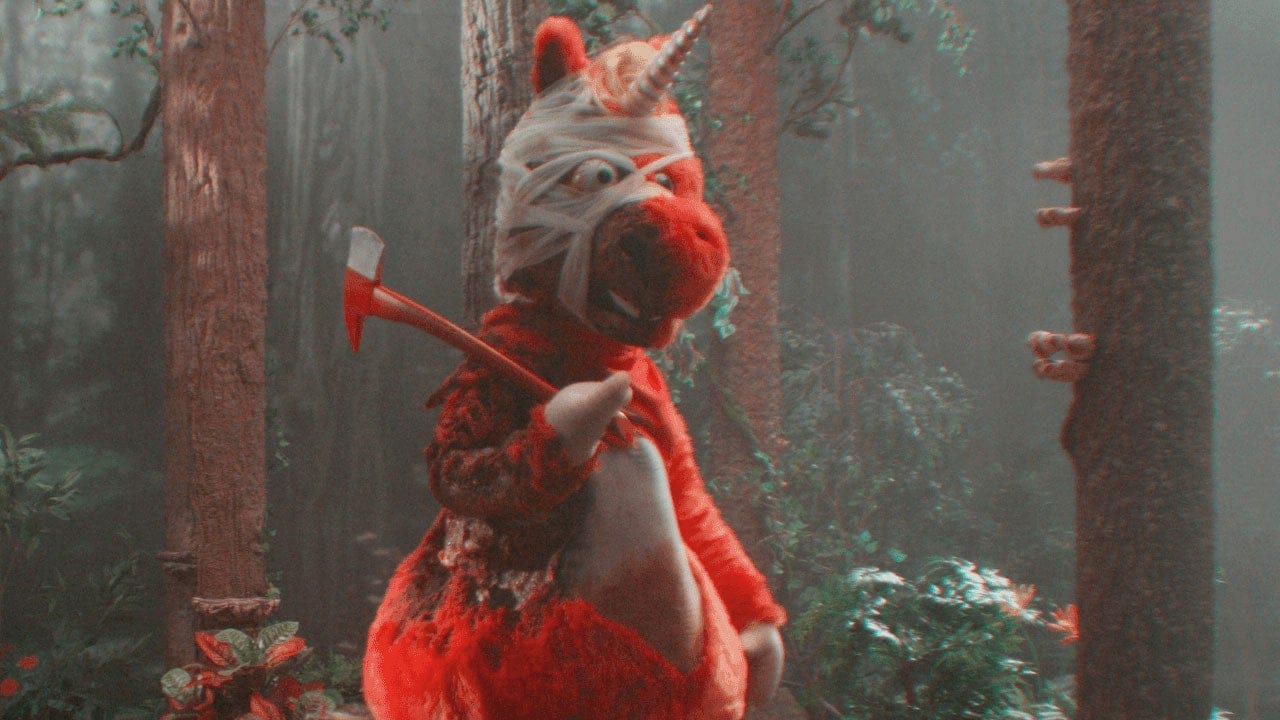
Some of the ideas explored in “Too Many Cooks” evidently still haunt Kelly, based on Buddy, his feature debut, which begins as a seemingly unremarkable episode of a 1990s kid show called It’s Buddy. Presided over by a merry, huggable unicorn named Buddy (voiced by Keegan Michael Key) and filled with anthropomorphic objects like a friendly backpack named Strappy (voiced by Patton Oswalt), It’s Buddy plays like a near-exact cross between Barney and Friends and Pee-wee’s Playhouse, complete with a cast of kids who hang on Buddy’s every word and seemingly exist solely to have fun and listen to the occasional lesson.
But when one of those kids declines to partake in the mandatory merriment and one of his playmates, a girl named Freddy (Delaney Quinn), notices his subsequent disappearance, Buddy’s world takes a darker turn, and the seams holding it together start to stretch and break with each subsequent “episode.” Then, when the show starts to get truly grim, Buddy shifts to a contemporary suburban home where Grace (Cristin Miloti) slowly starts to suspect that her family of four was once a family of five, even though neither her husband (Topher Grace) nor her two sons remember there being another member of the family.
In its best moments, Buddy raises questions about what makes certain types of children’s entertainment attractive to kids and repulsive to the grown-ups in their lives. Did Barney stir up so much hate at least partly because of his free declaration of love? Buddy considers the dark side of the bond between kids and their TV friends as it shifts from parody to horror and how shows like It’s Buddy demand viewers not ask too many questions. It’s clever and shocking but ultimately a little disappointing because it’s rarely more than clever and shocking. Once Grace’s investigation leads her to Buddy’s world, the film never finds another twist or deeper thematic territory to explore. Still, there’s a lot to admire here—from Key’s increasingly menacing performance to the remarkable production design—and it’s as midnight-friendly as movies can be. Or maybe it’s best saved for 4 a.m., which might be the ideal time to watch Kelly’s work. —Keith Phipps
Buddy begins accepting hugs in theaters tonight.




Discussion