In Review: ‘Supergirl,’ ‘The Invite’
Supergirl takes the spotlight and a dinner party takes an uncomfortable turn in this week's new releases.



Supergirl
Dir. Craig Gillespie
108 min.
Last summer, James Gunn’s Superman offered a fresh spin on the increasingly weary superhero movie by reviving DC’s flagship superhero as a beacon of optimism in the midst of story that, if not exactly ripped from the headlines, felt more connected to the real world than, say, movies about adventures in the quantum realm or hulked-out presidents driven by rage and diminished intellectual abilities. (Wait a minute. Maybe that last one was kind of timely.) Supergirl suggests it’s taken exactly one year to lower the project’s ambitions. Which isn’t to say it’s a bad movie. Supergirl is a perfectly serviceable space adventure film that sometimes plays like a slightly better Star Wars movie than The Mandalorian and Grogu. But while it’s set far away from the Metropolis of its predecessor, Supergirl still sometimes seems to be working from a checklist, from its righteous heroine (albeit a heroine who takes more persuading to swing into action than her famous cousin and operates with a more flexible moral code) to its slow-motion, dirt-filled fight scene. Where the first theatrical entry in the Gunn-shepherded DC Universe suggested it would be a superhero venture operating without a rulebook, Supergirl makes it seem like it might only be operating by a different set of rules.
We hope you're enjoying these reviews but The Reveal has much more than reviews to offer. Become a paid subscriber and you'll get access to everything we publish—from articles to lists to audio commentaries—and help support independent film criticism.
Fortunately, some smart casting helps make up for the predictability. Milly Alcock made a deep impression with her cameo in the final moments of Superman and Supergirl, playing Kara Zor-El as a party girl whose hard-living ways suggested she wasn’t entirely on board with Superman’s altruistic agenda. The best parts of Supergirl allow her to expand on that characterization. To mark her 23rd birthday, Kara has traveled off-world to a planet whose red star makes her vulnerable to harm but also susceptible to the effects of alcohol, which she welcomes. Drinking allows her to fend off memories of her dead homeworld and the family she had to leave behind (under circumstances revealed in a series of flashbacks). Yet while Kara valiantly tries to drink away her old troubles, new trouble finds her anyway. This arrives in the form of a girl named Ruthye (Eve Ridley), who recently lost her family to the Brigands, a band of space pirates led by the particularly nasty Krem of the Yellow Hills (Matthias Schoenaerts, laying it on thickly). Ruthye’s looking for a hero who can help her exact revenge. Kara doesn’t want to be that hero but gets roped into Ruthye’s quest anyway after Krem injures her canine sidekick, Krypto.
Directed by Craig Gillespie (I, Tonya; Cruella) and scripted by Ana Nogueira, Supergirl borrows heavily from Tom King and Bilquis Evely’s Supergirl: Woman of Tomorrow, which in turn borrows from Charles Portis’s twice-adapted 1968 novel True Grit. Maybe that explains the film’s copy-of-a-copy-of-a-copy feeling. Kara delivers occasional speeches to Ruthye about the soul-crushing consequences of seeking revenge, but the film never engages with this theme in any serious way (and Kara’s own actions never back up the views she expresses). Gillespie has fun, particularly in the film’s first half, following Kara and Ruthye through the cosmic equivalent of bus stops, gas stations, and other locations, but once the action becomes the focus, Supergirl’s familiarity becomes a problem that even Alcock’s charisma can’t fully offset. Also a problem: Jason Momoa’s hammy, spotlight-grabbing guest appearance as the space biker Lobo. It doesn’t really serve any purpose beyond setting up the character for future appearance while simultaneously making those future appearances feel like something to dread.
Still, what works here—Alcock, the emotional flashback scenes, Kara’s interactions with Superman, Krypto (of course)—works well enough to make Supergirl worth a look. At the very least, the film benefits from a brisk pace and a reasonable running time. Anyone hoping for a more substantive break from superhero movie tradition of the sort promised by Superman will have to hope for more from whatever comes next. —Keith Phipps
Supergirl lands in theaters tonight.

The Invite
Dir. Olivia Wilde
107 min.
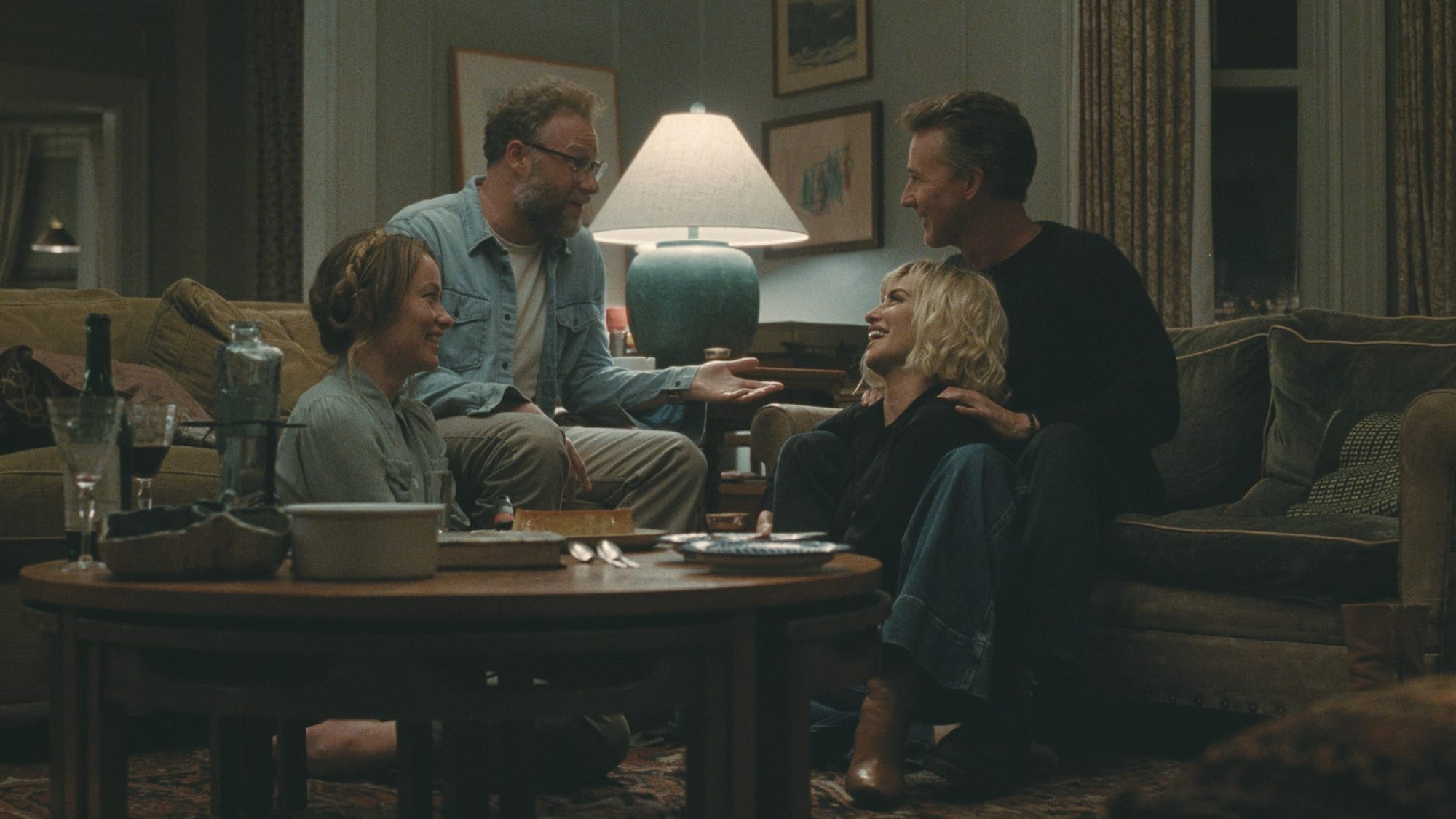
Though it’s based on the Spanish-language comedy The People Upstairs and opens with an Oscar Wilde quip about marital discord (“One should always be in love. That is the reason one should never marry”), Olivia Wilde’s spicy black comedy The Invite is more obviously indebted to Who’s Afraid of Virginia Woolf?—both the Edward Albee play and Mike Nichols’ superb adaptation. There’s even the same tabloid meta-narrative at work here, too, given the off-screen implications of Elizabeth Taylor and Richard Burton’s on-screen tangles and Wilde’s own messy public divorce from Jason Sudeikis. Yet there’s so much more to Albee’s play than two couples sharing a dark night of the soul together and precisely nothing more than that to The Invite, which feels more like the star at karaoke night, credibly belting out a tune that’s been separated from thornier notes around the shared fictions that sustain a long-term relationship.
It takes time for The Invite to settle into a groove. At their worst, Wilde’s previous films as a director, Booksmart and Don’t Worry, Darling, are too stylistically assertive in pushing the audience toward an emotional response. The pre-title action here, punctuated by the overbearing screech of Dev Hynes’ string-based score, doesn’t allow the toxic chemistry between Joe (Seth Rogen) and Angela (Wilde), the unhappy residents of a swanky San Francisco apartment, to establish itself organically. Fortunately, the aggressive score is more of a throat-clearing nature than a Birdman-level feature-length tic, but the film’s prodding instincts never entirely fade, even as the performances and the juicy conversation-starter of a script take over.
The Invite introduces Joe and Angela as seasoned combatants in a martial fight that’s about to escalate. As Joe drags himself home after another miserable day teaching music to students at a ho-hum local conservatory, he’s alarmed to learn that Angela has decided to host a last-minute dinner party for their glamorous upstairs neighbors. The gesture surprises Joe, too, because they mostly know Pína (Penélope Cruz) and Hawk (Edward Norton) from the loud orgasms they seem to be experiencing most nights, which not only keep them awake but remind them of their own flaccid union. There’s friction between the two couples as soon as the evening begins, triggered mostly by hosting hiccups and Joe’s inability to mask his resentment over the whole affair. But Pína and Hawk have a cool, ingratiating confidence that changes the temperature in the room, leading to more tantalizing possibilities than a night nibbling awkwardly on cheese and “jamón.”
Rogen’s persona as an affable stoner-type with a gift for improvisation can make you forget that he’s a real actor who excels in roles, like in Neighbors and Take This Waltz, where he’s in the middle of a fractious domestic partnership. Of the four actors here, Rogen is the most adept at comedy and his bitter japes help stabilize The Invite as it finds its legs. Once the two couples go off in pairs, with Joe and Pína surreptitiously smoking joints in Joe’s office, and Hawk marveling over Angela’s flair for interior design, the film gains confidence and barrels swiftly toward a proposition that doubles as a marital stress test. It never rises above a superficial treatment of modern relationships, but when the cast really gets popping, it’s lively company. — Scott Tobias
You can accept The Invite in select theaters this weekend.




Discussion