In Review: 'You Can See Everything,' 'Once Upon a Time in Harlem'


(Programming note: Welcome to the "sterling documentary" portion of this week's review slate. Later this afternoon, you'll get a second newsletter with reviews of Whalefall and Sense and Sensibility.)
You Can See Everything
Dir. Nathan Fielder, Lance Oppenheim
174 min.
The fundamental truth about Theranos, the fraudulent company that Elizabeth Holmes founded as a Stanford dropout in 2003 and raised billions to support, is that the technology was never going to work. The dream of a portable blood analyzer that could provide comprehensive test data from finger drop samples was an idea that investors loved but science itself couldn’t support. That hasn’t stopped Silicon Valley scam artists from goosing valuations with absurd promises—the richest man in history wears “Occupy Mars” t-shirts to promote SpaceX—but Holmes and her shady, domineering partner, Ramesh “Sunny” Balwani, actively orchestrated systems to fool regulators and sustain a lie that was quite literally hazardous to people’s health. Juries convicted both of them, and a judge sentenced Holmes to a little over 11 years in federal prison, though between a revised sentence, an appeal for a presidential pardon, and a recent transfer approval to a halfway house in 2027, her time behind bars may be limited.
We hope you're enjoying these reviews but The Reveal has much more than reviews to offer. Become a paid subscriber and you'll get access to everything we publish—from articles to lists to audio commentaries—and help support independent film criticism.
In April 2023, Holmes and her romantic partner, Billy Evans, invited a film crew, led by directors Nathan Fielder and Lance Oppenheim, into their coastal California rental home for the last 34 days before she needed to report to a minimum security prison in Bryan, Texas. It defies belief that Fielder, a deadpan comic who’s toyed brilliantly with the documentary and reality TV form on shows like Nathan For You and The Rehearsal, is the man Holmes and Evans chose for this peculiar exercise in radical transparency. Yet Fielder and Oppenheimer’s You Can See Everything, a title that’s at once absolutely true and totally deceptive, is a miraculous piece of work, an endlessly fascinating documentary that explores the mysteries of human behavior while testing the limits (and possibilities) of the form itself. It is rich beyond measure.
It is also rich beyond fathomability. The one obvious point of comparison is Albert Brooks’ 1979 debut feature Real Life, which parodied An American Family, the multi-part documentary that chronicled the Louds, a large middle-class family from Santa Barbara who daily dramas captivated TV audiences in 1973. Brooks’ comic twist on the concept was to cast an Arizona family for a Hollywood feature that could win Oscars and scientific awards, but the experiment is ruined by invasive cameras and a narcissistic director, played by Brooks, who brings himself into the story. For You Can See Everything, Fielder is upfront about his constant presence in Holmes and Evans’ lives, which is akin to a magician who shows you your card before making it disappear. He and Oppenheim are ethically rigorous in disclosing their presence to the audience and actively encouraging them to question what they witness. Being upfront about their deception doesn’t mute the revelations that follow.
The conceptual twists in You Can See Everything are not worth spoiling in this review, but a sizable chunk of the documentary does exactly what the logline describes, with Fielder and his crew embedded in an intimate beachside home for the month before Holmes starts serving her sentence. With their two small children, including a newborn daughter Invicta (Latin for, sigh, “unconquered”), Holmes and Evans display a loving partnership while also planting seeds for a future health-tech venture they intend to launch together. True to his on-screen persona—and possibly his actual nature—Fielder becomes an awkward fixture in their lives, especially once they double down on the experiment by allowing him to occupy the guest bedroom. Yet Fielder isn’t a pushover or a clown: He has uncomfortable questions to ask about Theranos, about the transactional nature of Holmes and Evans’ relationship, and about how their minds operate, especially Holmes’, which fascinates him the most.
Of particular interest to Fielder is Holmes’ contention that she never lies, which feeds into the all-access opacity of the entire project. Holmes has a habit of making assertions that are not false so much as deliberately confusing and half-formed, like when she tries to demonstrate Theranos’ technology to Fielder. Then there are moments where she seems genuinely amiss, like an incredible scene where Fielder shows her the famous Abbott and Costello “Who’s On First?” skit and she cannot explain why it’s funny. As her sentence approaches, Holmes reveals more signs of stress and vulnerability, but even then we’re left to question whether it's genuine or a grand manipulation of the sort that’s landing her in prison. And that’s to say nothing of Evans, whose control of Holmes only begins with re-whisking their morning eggs.
Though all the material in the house is riveting in its way, even the stretches of mundane domesticity, You Can See Everything is like other Fielder ventures in looking at a subject through an array of different lenses. Suffice to say, this is not fly-on-the-wall nonfiction but a creative effort by Fielder and Oppenheim to understand a truly vexing figure. After watching it, there are scenes that play back in your mind like the Zapruder film, and start to make you wonder if your take on Holmes is a simple shot from the book depository or a murkier conspiracy of influence. Fielder and Oppenheim respect the audience enough to bring them into their never-ending thought experiment as it touches on scam culture, misogyny, performance art, and the unknowable essence of human beings. It will be talked about now and forever. — Scott Tobias
You Can See Everything opens in select cities tonight and theaters everywhere next week.

Once Upon a Time in Harlem
Dir. David Greaves
100 min.
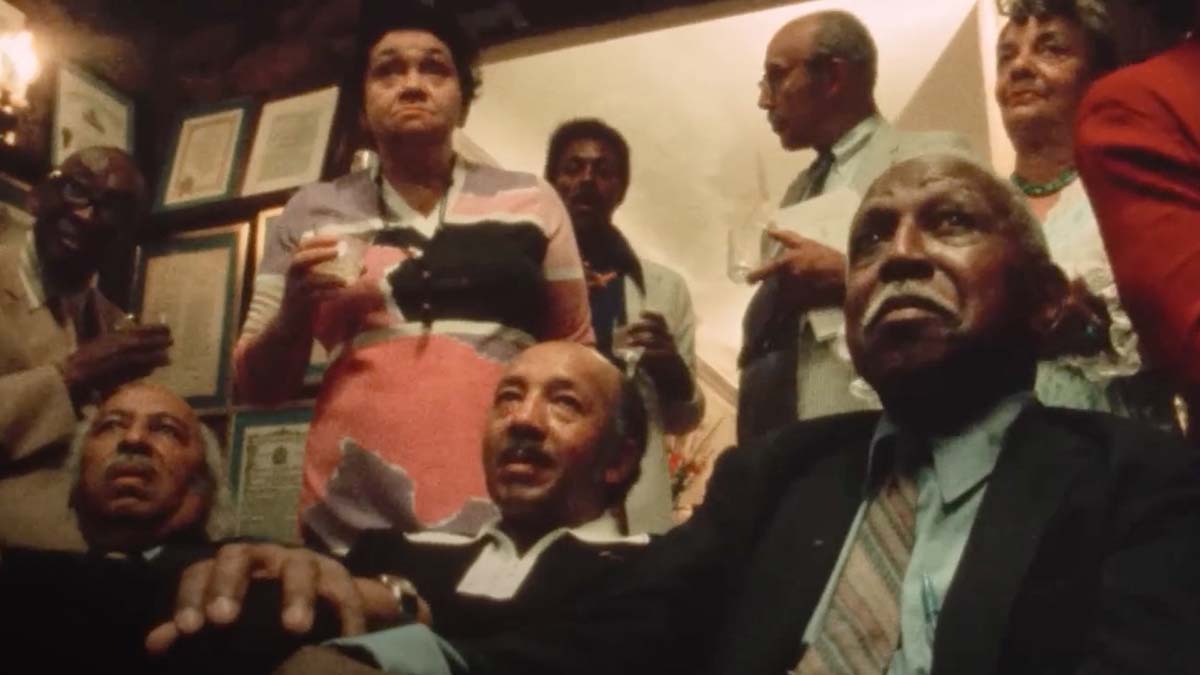
In August 1972, William Greaves threw an afternoon party in Duke Ellington’s Harlem townhouse with a guest list made up entirely of contributors to the Harlem Renaissance, the flood of arts, culture, politics, and ideas that began to flow through the New York borough in the early years of the 1920s. An actor turned documentarian, now probably best known for his reality-bending metafilm Symbiopsychotaxiplasm: Take One, Greaves believed that simply bringing together the era’s surviving members in one place would lead to an event worth filming. His instincts were, to put it mildly, sound, but that didn’t mean he knew what to do with what he shot.
Greaves would continue to work on the film on and off for the rest of his life, but it remained unfinished when he died in 2014. Directed by William’s son David Greaves (who served as one of the camera operators at the original gathering), Once Upon a Time in Harlem brings that long unseen footage to light, but it’s as much a time machine as an historical document, turning viewers into crashers of a party filled with fascinating guests. (Greaves has also said that footage not included in the film material his father shot in subsequent decades, will later be available as part of an archive.)
Packed with notable attendees that include the Shuffle Along songwriting team of Eubie Blake and Noble Sissel, artist Aaron Douglas, photographer James Van Der Zee, and historian Louise Thompson Patterson, Once Upon a Time in Harlem draws many of the participants away for one-on-one conversations complemented by archival photos and footage. Combined, these provide enough context for each of the partygoers to establish a sense of the roles they played (and will likely inspire the film’s viewers with a list of figures for further study). But it’s the sometimes joyful, sometimes heated, always animated interactions of the party itself that dominate the film. No one at Ellington’s house that day thought of themselves as historical figures whose time had come and gone. They seem to regard themselves as participants in a conversation that they’d merely paused for a couple of decades.
That conversation often alternates between the celebratory and the mournful, as the guests recall highlights of their Harlem Renaissance experiences with an emphasis on the novels, poetry, plays, visual art, and music that came to define it, some of it made by absent friends. But as the party goes on (and the cocktails flow), the talk expands to lingering debates and unclear definitions. When did the Harlem Renaissance begin and end? Who were its major figures? (Ida Mae Cullen, widow of the poet Countee Cullen, makes a point of her husband’s importance at every opportunity.) What should be made of Marcus Garvey? To what degree was it a response to the politics of the day and events like the wave of lynchings and the Tulsa race massacre that coincided with the years of its inception?
“There’s never very much for anyone to say about a period through which they have lived,” writer, poet, and self-described dilettante Richard Bruce Nugent tells an interviewer. The film serves a respectful rebuke to that notion. More accurately, those who live through a particular historical moment have a hard time agreeing on what that moment meant, and that’s what gives Once Upon a Time in Harlem its charge. It’s a look at a fascinating and important chapter in American history as told by those who think of it less as history than a time and place shaped by Black art and achievement like no time and place in America ever had been before. “There was no way not to be caught up,” librarian Regina Andrews tells Greaves. “In fact, you were pulled along in such a way that you couldn’t stop yourself.” —Keith Phipps
Once Upon a Time in Harlem opens in New York tomorrow and rolls out from there.


Discussion