In Review: ‘La Bola Negra,' ‘Wild Horse Nine'
An ambitious Spanish drama follow three queer men through multiple timelines while John Malkovich gets an ideal star vehicle.

(Programming note: This is another review-heavy week at The Reveal, so you can expect two more review newsletters in short order. Later this afternoon, we'll have reviews for Mouse and Godzilla Minus Zero. Then tomorrow morning, we'll have Club Kid and Being Heumann.)
La Bola Negra
Dir. Javier Ambrossi, Javier Calvo
159 min.
A middlebrow epic of immense ambition and clanging banality, La Bola Negra draws inspiration from Federico García Lorca, the Spanish poet and playwright who died at the hands of Nationalist forces at the beginning of the Spanish Civil War in 1936. His status as a prominent gay artist with socialist politics made him a target and his remains were never found, which lends his fate an air of mystery that writer-directors Javier Ambrossi and Javier Calvo spin into a florid literary puzzle. Cross-cutting breathlessly between queer protagonists in three interconnected timelines, La Bola Negra has a sturdy conceit, unified by a secret, tragic history of the country that can now be said out loud. But even though it adds up to more than the sum of its parts, only one of the three timelines has much dramatic force, and the rhythmic cutaways to the other two feel like wearying sags in momentum.
We hope you're enjoying these reviews but The Reveal has much more than reviews to offer. Become a paid subscriber and you'll get access to everything we publish—from articles to lists to audio commentaries—and help support independent film criticism.
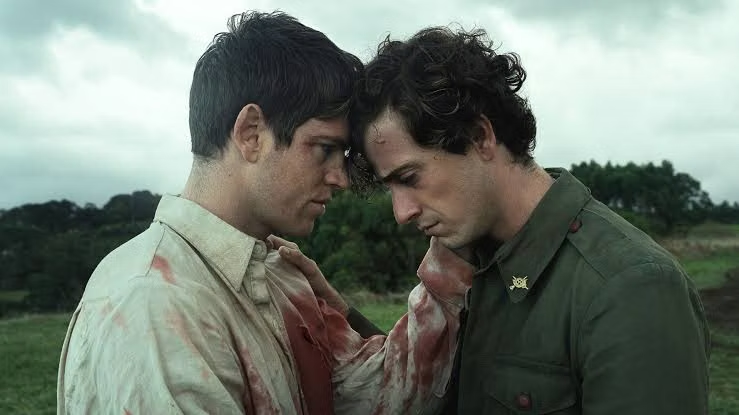
Putting their best foot forward, Ambrossi and Calvo lead with a harrowing sequence in small village in 1937, where Sebastián (Guitarricadelafuente), a gay trumpeter of amusingly limited skill, joins the community in welcoming the Italian fascists during the Spanish Civil War. When their guests attack them through the air instead, Sebastián escapes with his life and survives by posing as a Nationalist, hoping not to arouse suspicion over his loyalties and sexuality. That becomes a challenge when he’s asked to guard Rafael (Miguel Bernardeau), a wounded yet defiant Republican prisoner of war who was once part of Lorca’s theater company.
Sebastián and Rafael’s relationship opens up connections to two other timelines, though the film keeps any major revelations close to the vest. In 1932 Grenada, Carlos (Milo Quifes) expects admission into an exclusive casino club based on his wealthy family’s connections, but he’s blackballed by the committee (hence the title La Bola Negra) over suspicions of his homosexuality. Then in 2017, Alberto (Carlos González), a queer historian from Madrid, receives the surprising notice that his estranged grandfather has died and strikes out to the country to claim a special item from his will.
Ambrossi, Calvo, and their editor, Alberto Gutièrrez, assemble an intricate and pleasingly intuitive tapestry out of Sebastián, Carlos, and Alberto’s stories, which speak to each other long before the plot ties them together more explicitly. It’s a credit to the film, too, that it feels cohesive despite each subplot having its own particular visual and emotional texture, bookended by Carlos’ poetic, abstracted story-within-a-story and Alberto’s more grounded investigation. Yet only Sebastián’s time as a Nationalist imposter, which is dangerous even if it's complicated by his longing for Rafael, carries true dramatic tension. Ambrossi and Calvo seem to know that well enough to give special weight to that timeline, but Carlos’ subplot, tied to the unfinished Lorca play, floats off into the ether while Alberto’s investigation plays like the repurposing of a dull framing device.
As soon as La Bola Negra brings these timelines together into a thesis statement about queer history in Spain, it loses a lot of its intrigue and only fitfully compensates for it emotionally. Ambrossi and Calvo add to the prestige gloss by offering cameo appearances by Penélope Cruz and Glenn Close, but the two stars cancel each other out, with Cruz doing electrifying work as a performer brought in to mollify the troops and Close stopping the action cold as a scholar who confers with Alberto in phonetic Spanish. Though La Bola Negra never gets as turgid as The Hours, the film it most closely resembles, the drama sputters forward in fits and starts, reaching for an operatic majesty that it can never sustain. — Scott Tobias
La Bola Negra is now playing in limited release. It will start streaming on Netflix on December 2nd.

Wild Horse Nine
Dir. Martin McDonagh
117 min.
There’s a high floor to a Martin McDonagh movie simply because so few people can write dialogue with his musicality and wit, especially in scenarios like In Bruges, The Banshees of Inisherin, and the new Wild Horse Nine where two old friends talking (or not-quite-talking in Inisherin’s case) are the structural beam that hold the whole thing together. The context McDonagh provides for these relationships affects the ceiling, of course, but when he hands over the scripts to go-to actors like Sam Rockwell, Brendan Gleeson, and Colin Ferrell, they invariably spring to life, whether they’re casually shooting the shit or picking at scars in their relationships. McDonagh seems conscious enough about his talent for nonsense talk that he made it the premise of Inisherin, where one man abruptly decides not to engage in any more of it, but he always sneakily locates the vulnerabilities his characters work so hard to obscure.
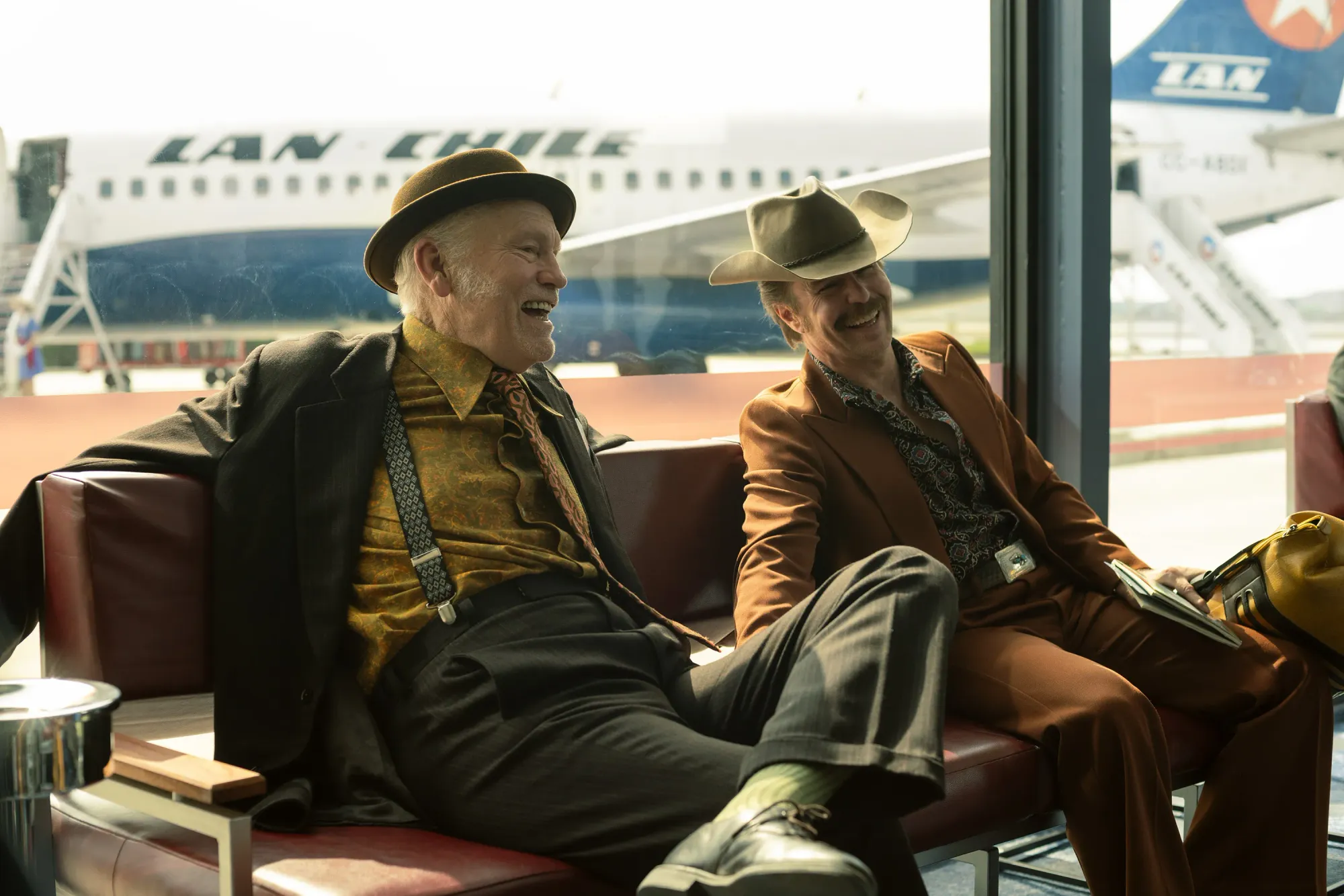
Rockwell, who had excelled in lesser (albeit still compelling) McDonagh films like Seven Psychopaths and Three Billboards Outside Ebbing, Missouri, fits into the world of Wild Horse Nine with predictable seamlessness, but it’s John Malkovich, the other half of this two-hander, who’s the true revelation. Much like Being John Malkovich cashed in on his outsized gravity on stage and screen, McDonagh’s film allows his decades-long presence to bring dramatic weight to an international rogue whose soul was lost several covert wars ago. As Chris Carlisle, a CIA veteran who jokes of killing people in countries his partner and protégé Lee Chesterfield (Rockwell) can’t spell, Malkovich references past “successes” at the agency with a casual tone that’s deliberately provocative and distasteful (and, in the McDonagh way, hilarious). But like the cancer Carlisle is carrying through the last days of his life, he also projects, bit by bit, the regret that’s devouring him from the inside.
Wild Horse Nine opens in Santiago, Chile in 1973, just before the military coup that would sweep Salvador Allende, Latin America’s first democratically elected Marxist, from power and replace him with the oppressive 16-year dictatorship of Augusto Pinochet. Carlisle and Chesterfield treat the coming violence like the hosts of a surprise birthday party, but they’re due for a vacation to Easter Island, because Carlisle wants to see the “big heads” before he dies. (The two scoff when told they should refer to the island and the heads by their indigenous names, Rapa Nui and “moai” respectively.) Carlisle’s loose talk becomes a problem at the airport, however, when he boasts out loud about destabilizing the country, and his boss MJ (Steve Buscemi) worries that he’ll spill CIA secrets in a memoir he’s planning. Chesterfield finds himself torn between his close friendship with Carlisle and his duty to keep him under control, especially when Carlisle takes a liking to Monica (Mariana di Girolamo), a leftist college student.
The tug of genuine emotion from Malkovich and Rockwell is critical to Wild Horse Nine, which sometimes feels perilously close to reflecting the glib attitudes of CIA ratfuckers rather than reflecting on them. Reminiscences about upending governments, political assassinations, and what really happened on 11/22/63 are played here for laughs—and big ones at that—but there’s an unsettling disconnect between the fun of watching these professional Ugly American types banter and the actual real-world damage caused by the CIA. Wild Horse Nine is about Carlisle confronting that legacy in the eleventh hour, but it’s a trick of the superior writing and performances that it never feels heavy. Malkovich himself provides the little bit of weight it needs. — Scott Tobias
Wild Horse Nine opens in theaters everywhere this weekend.



Discussion