In Review: ‘The Mandalorian and Grogu,’ ‘I Love Boosters’
A small-screen Star Wars story makes the leap to the big screen while the latest from Boots Rileuy offers a wild ride through late capitalism.



The Mandalorian and Grogu
Dir. Jon Favreau
132 min
Back when George Lucas returned to the Star Wars franchise in 1999 with The Phantom Menace, the first in his “prequel” trilogy, there was some scoffing over the idea that this $115 million production, financed by Lucasfilm Ltd. and merely distributed by 20th Century Fox, was the biggest independent movie ever made. It may technically be true, the thinking went, but the return of the greatest blockbuster phenomenon in history was not exactly John Lurie in a sparsely appointed studio apartment, explaining the concept of TV dinners to his Hungarian cousin. When Disney forked over $4 billion to wrest control over the Star Wars universe from its creator in 2012, the prevailing hope is that Lucas’ world-building could be preserved while his ever-more-glaring weaknesses for clunky dialogue and stilted performances might be ironed out.
The Mandalorian and Grogu feels like the right moment to reflect on where a Lucas-free Star Wars has gotten us and why the word “independent” doesn’t seem as laughable now as it did 27 years ago. Without Lucas managing the franchise down to the last pixel—to sometimes exasperating effect, as Keith detailed earlier this week—Star Wars has turned into a synergistic content mill only a couple of filmmakers have managed to wrest from the grind of a multimedia integration strategy. And now we’re looking at a 2026 summer movie season kicked off by a film-esque project that’s built on three seasons of the Disney+ show The Mandalorian, plus assorted characters and bits of mythology from The Book of Boba Fett, Star Wars: The Clone Wars, The Rise of Skywalker, and so on. It is at once a patchwork and a plan so carefully devised by Disney’s creative managers that it doesn’t matter who directs it.
We hope you're enjoying these reviews but The Reveal has much more than reviews to offer. Become a paid subscriber and you'll get access to everything we publish—from articles to lists to audio commentaries—and help support independent film criticism.
With a structure that feels like two expensive episodes of The Mandalorian smushed together, the film is all chorus, no verse, with nothing resembling a theme and only enough character work to bridge action sequences together. Since the TV show already did the labor of establishing the relationship between Din Djarin (Pedro Pascal), a helmeted bounty hunter of the Man with No Name school, and his adorable infant sidekick Grogu, The Mandalorian and Grogu can cut to the chase. In the unsettled period after the fall of the Galactic Empire, Mando gets plenty of work hunting down the Imperial warlords still causing trouble on the Outer Rim, but his mercenary role once again cannot suppress the nobility under the surface. His latest job for Col. Ward (Sigourney Weaver), a New Republic leader, turns into a much more consequential affair.
Originally sent on a mission to rescue Rotta the Hutt (voiced by Jeremy Allen White), the swole son of Jabba the Hutt, from captors that have turned him into a gladiator, Mando and Grogu instead find themselves engulfed in more pressing threats to the Republic. Though they succeed in freeing him, Rotta’s relatives, a pair of Hutts known as “The Twins,” have been scheming themselves into greater power and they draw our heroes into a battle against multiple forces, not least a poisonous dragon-snake that sinks its jaws into Mando’s chest. That leaves the diminutive Grogu to caretake his caretaker until they can figure out a way to fight back.
Despite all the mythology that the show’s creators, Jon Favreau and Dave Filoni (who co-wrote the script here along with Noah Kloor, with Favreau directing), pour into The Mandalorian and Grogu, the appealing simplicity of the series carries over into the film, along with a hard sell to the younger set. On those limited terms, the basic formula of a bounty hunter and his lovable, Force-wielding companion delivers the goods, even if the setpieces tend to bleed into each other after a while. What’s missing is variety and soul, replaced by the dusty returns of Favreau and Filoni still playing around in someone else’s sandbox. — Scott Tobias
The Mandalorian and Grogu begins playing everywhere tonight.

I Love Boosters
Dir. Boots Riley
113 min.
The radical Bay Area hip-hop group The Coup’s 2006 track “I Love Boosters!” finds frontman Boots Riley paying tribute to the female entrepreneurs behind a robust underworld of black market fashion, the “women running out the Gap / with arms full of clothes still strapped to the rack.” Riley’s paean to their services begins with his own desire to pick up pricey clothes at a deep discount before considering the political implications of boosters’ actions. Those clothes are made by child labor in Asia and sold in stores that exploit their workers. In a way, isn’t boosting, if not a fundamentally revolutionary act, at least a way to start understanding the completely fucked up forces that keep the global economy afloat in the 21st century?
Riley’s second feature film as a director—a follow-up to his 2018 debut Sorry to Bother You and the Prime Video series I’m a Virgo—I Love Boosters begins at the same starting point as the song that inspired it, but uses it as a launch pad to some far-out destinations. Yet no matter how wild the excursions taken by the freewheeling, breezily surreal satire, Riley’s vision of a late capitalist dystopia never strays too far from the world we know. It’s a funhouse mirror reflection, but one that doesn’t bend its reflective surface that far, despite the inclusion of everything from skinless stop-motion antagonists to a handheld sci-fi device whose powers begin with teleportation but hardly end there.
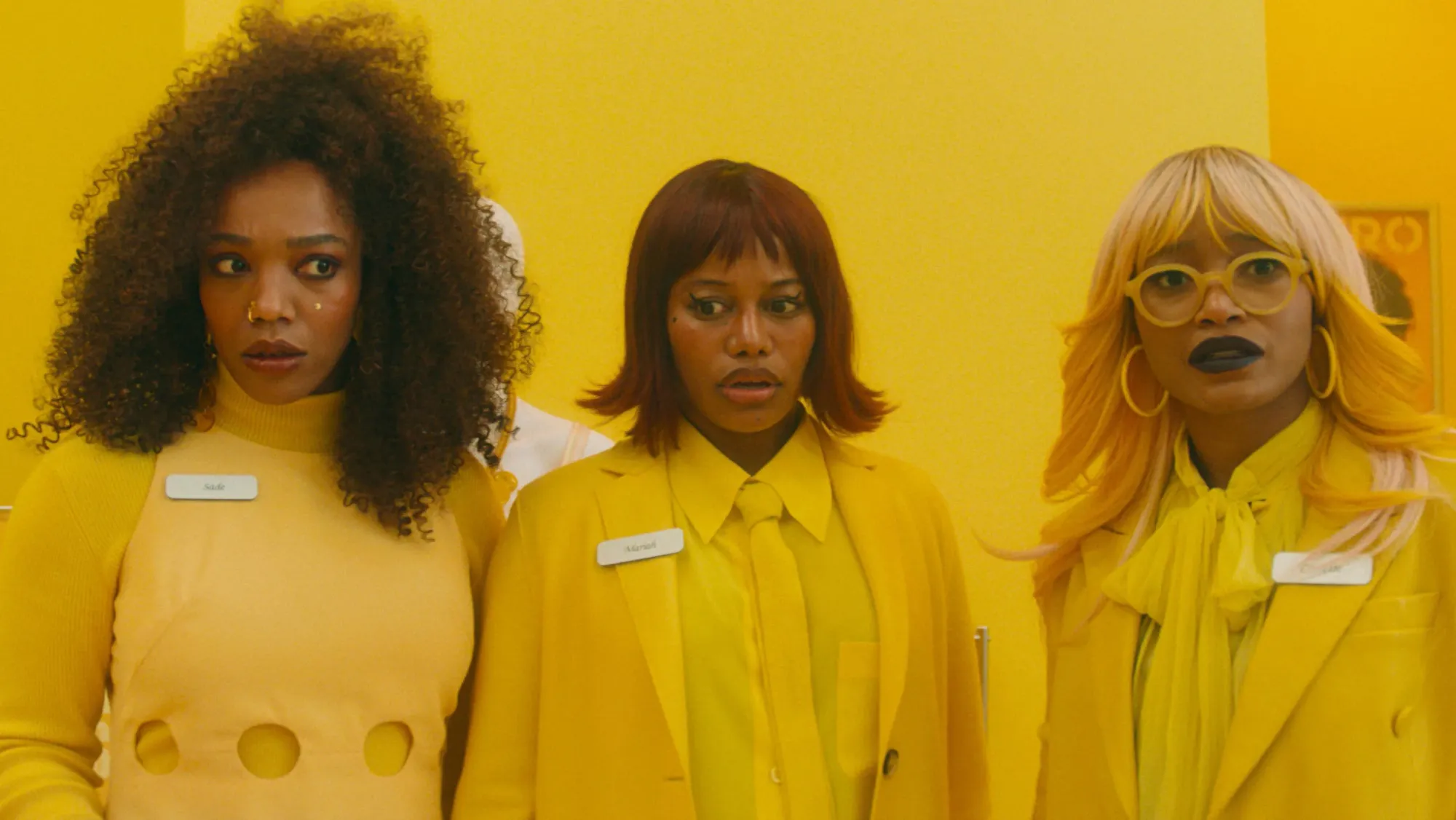
Keke Palmer stars as Corvette, whose career as a booster has yet to allow her to move out of the abandoned chicken restaurant in which she squats with her best friend Sade (Naomie Ackie). With Mariah (Taylour Paige) they make-up The Velvet Gang and spend their days shoplifting from Bay Area outlets of Metro, a ubiquitous fashion store specializing in bold colors (each location features only a single shade) and owned by the unscrupulous mogul Christie Smith (Demi Moore). But the self-described “fashion-forward filanthropists” (the screwed-up spelling is in service of branding) have a complicated relationship with Metro. They covet the clothes for the money they can make from them but they’re also drawn to them in other ways. An aspiring designer, Corvette both admires and despises Christie, feelings that curdle into a desire for revenge after Christie steals one of her ideas (a different sort of boosting) and insults the boosters on the news.
If that sounds like a normal-sounding premise for a movie, rest assured I Love Boosters is anything but normal. Also in the mix: a self-help pyramid scheme called Friends Being Friendly led by the charismatic Dr. Jack (Don Cheadle); LaKeith Stanfield as a mysterious man (?) so seductive that he distorts the frame of the film when seen in close-up; Christie’s downtown apartment, which slopes to one side, requiring those inside to climb uphill when attempting to exit; and the aforementioned teleportation device, which brings the boosters into contact with Jianhu (Poppy Liu), a worker at one of Christie’s hazardous Chinese factories. Along the way, they also pick up Violeta (Eiza González), a constantly vaping labor organizer who recognizes that the strange device also demonstrates the Marxist principle of dialectical materialism. One setting allows it to deconstruct a situation to its base elements—a zapped character transforms into her parents making love—another serves as a “situational accelerator” that takes an item to its next level. Point it at a police car, for instance, and you’ll get an armor-plated machine of fascist enforcement.
That last detail suggests the full range of Riley’s critique. With its easy-to-skewer absurdities, the fashion industry provides a gateway into a nightmare vision of an all-encompassing power structure that’s (maybe) two degrees situationally accelerated from the world in which we live. Get-rich quick scams help ensure that the poor stay poor. News chyrons reading “Crying Woman Demands More Police” help ensure that the powerful remain in power and maintain the status quo. Yet while I Love Boosters might be polemical by design, Riley delivers it with disarming humor, visual inventiveness, and Looney Tunes energy (setting it all to an earwormy score by Tune-Yards). It’s a lot, occasionally too much, but it’s pointed and funny and Palmer’s vulnerable performance serves as an emotional anchor no matter how wild the world around her becomes. Beneath the film’s heady ideas and bizarre flights of fancy are characters pursuing happiness in the midst of a system set up with strict, if invisible, limits on how far they can go. —Keith Phipps
I Love Boosters opens nationwide tonight.



Discussion