In Review: ‘Toy Story 5,’ ‘The Death of Robin Hood,’ ‘Rose of Nevada,’ ‘Girls Like Girls’
Toys, bandit heroes, long-lost ships, and teen girls in love: All can be found in this week's new releases.


Toy Story 5
Dir. Andrew Stanton
102 min.
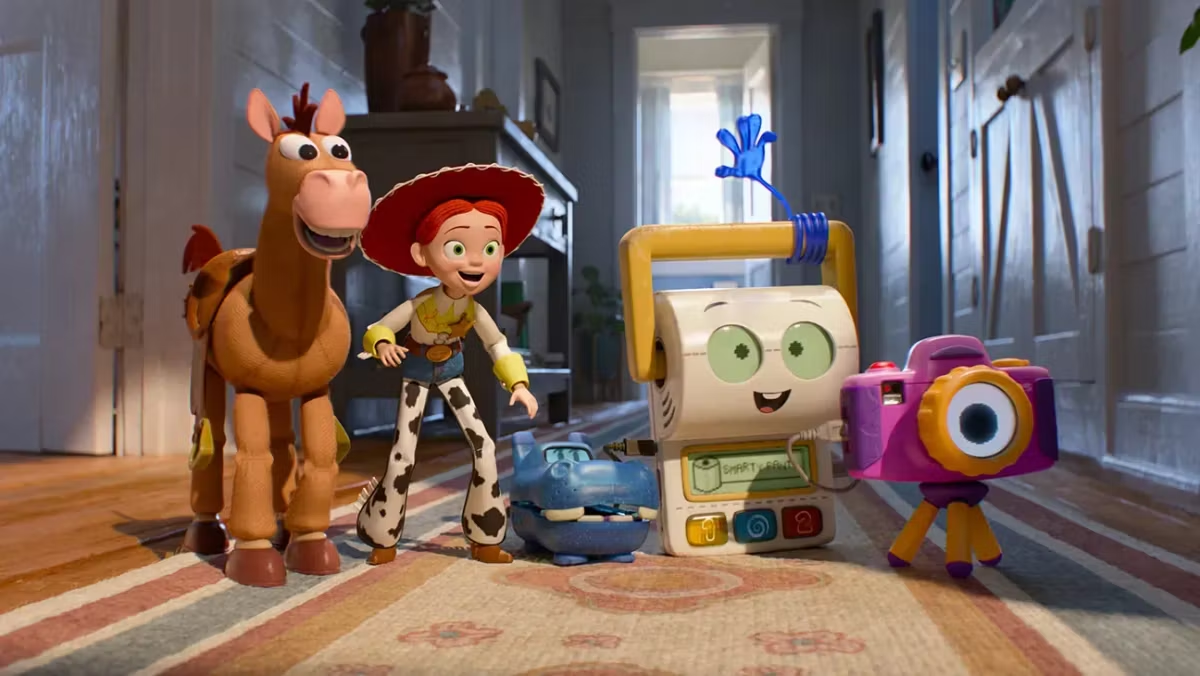
Through all the ups and downs Pixar has experienced over the years, the Toy Story series has remained remarkably consistent. Maybe that’s because the studio got so much right with its first effort, 1995’s Toy Story, including the creation of winning characters that moviegoers were happy to welcome for repeat visits across the years. That appealing cast has only expanded with each installment which, remarkably, have continued to feel vital no matter how high the numbers next to the titles get. Even Toy Story 4, which mostly served as a fun, water-treading romp without that much going on beneath the surface, managed to be both endearing and clever. The introduction of “Canada’s Greatest Stuntman” Duke Caboom (voiced by Keanu Reeves) alone justified its existence.
It seemed likely that any future installments would be in the same victory lap mode, which makes Toy Story 5, directed by Pixar A-lister Andrew Stanton from a script by Stanton and co-director Kenna Harris, even more of a pleasant surprise. Not only does a premise in which the toys find themselves competing for attention with an iPad-like device give this entry a sense of urgency, it provides an opening that allows Toy Story 5 to explore the emotional depths of its best predecessors. The film finds added relevance by exploring the looming threat of irrelevancy.
We hope you're enjoying these reviews but The Reveal has much more than reviews to offer. Become a paid subscriber and you'll get access to everything we publish—from articles to lists to audio commentaries—and help support independent film criticism.
All seems well enough in the film’s early moments, which include a scene of young Bonnie (Scarlett Spears) staging an elaborate wedding between Forky (Tony Hale) and Karen Beverly (Melissa Villaseñor), the sentient plastic knife introduced in Toy Story 4’s mid-credits scene. What drama there is mostly stems from Buzz’s (Tim Allen) attempts to summon the courage to ask Jessie (Joan Cusack) if she’ll marry him. (Weddings have a way of stirring these sorts of feelings.) But there’s trouble beneath the surface. Bonnie’s shy and has a hard time making friends. Her efforts aren’t helped, she believes, by her parents’ reluctance to buy her a Lilypad, a device owned by seemingly every other kid she knows that serves as both a plaything and a hangout space. But when “Lily” (Greta Lee) arrives, she introduces a new set of problems, from a text chain dominated by mean girls to, most pressingly for the toys, Bonnie’s near-total neglect for her old playthings. In fact, it seems like none of the kids play with toys anymore, a situation that leads to an emergency visit from the semi-retired Woody (Tom Hanks).
Though Buzz and Woody find plenty to do, it’s Jessie who serves as the film’s focal character, particularly once the plot machinations return her to the farm she once called home. There’s no sign of Emily, the girl that gave her up years ago, but Jessie does (eventually) make friends with a handful of obsolete tech devices led by Smarty Pants (Conan O’Brien), a toilet-training device who, in one of the film’s funniest moment, expresses pride in observing that Blaze (Mykal-Michelle Harris), the girl he once helped potty train, can now use the toilet on her own. That’s also one of the most poignant moments. Having served his purpose in helping Blaze advance to the next stage in life, Smarty Pants feels a bit useless. These are films about childhood, sure, but this fifth entry is at least as much about the bittersweetness of parenthood.
Toy Story 5 is also considerably more nuanced in its treatment of device culture than the toys vs. tech set-up might initially suggest. Beneath her know-it-all attitude, Lily clearly cares about Bonnie’s well-being as deeply as any of the toys. Others find uses that bypass her good intentions but that doesn’t make her bad. In Toy Story 5 the kids are, as usual, all right (or at least the kids who have a significant presence outside Bonnie’s group chat). It’s the world in which they’re growing up that’s worrisome. But perhaps the right helping hands (or paws or talons or whatever) might change that as well. —Keith Phipps
Toy Story 5 boots up in theaters today.

The Death of Robin Hood
Dir. Michael Sarnoski
122 min.
Say what you will about The Godfather Part III, Francis Ford Coppola’s maligned 1990 sequel has one undeniably great scene. When Michael Corleone (Al Pacino) visits Rome, Cardinal Lamberto (Raf Vallone), whom Michael suspects may become the next pope, coaxes him into offering his first confession in 30 years. “I’m beyond redemption,” Michael tells him, with no irony, then proceeds to offer a kind of greatest hits version of his many offenses, including the assassination of his brother Fredo. “Your sins are terrible, and it is just that you suffer,” the Cardinal tells him, continuing, “Your life could be redeemed, but I know that you don’t believe that. You will not change.” Michael can’t disagree. He knows what he’s done and if there is a road back, he knows it’s too long and hard for him to walk.
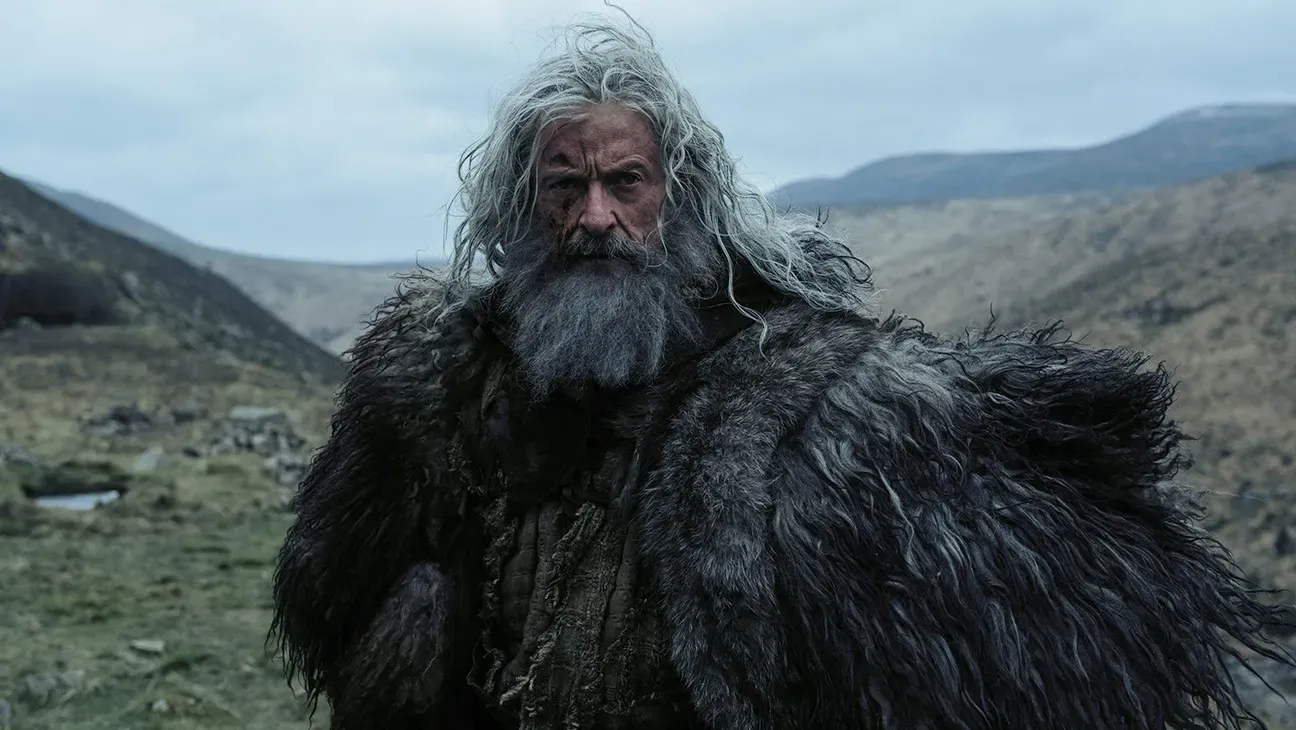
Were they not separated by centuries, Michael might have offered a sympathetic ear to the Robin Hood (Hugh Jackman) of The Death of Robin Hood, a dark reimagining of the outlaw hero in his autumn years that keeps the outlaw part while losing any traces of heroism. How bad is this Robin Hood? Before writer and director Michael Sarnoski’s (Pig, A Quiet Place: Day One) third feature has reached its half-hour mark, he’s killed two children, brutally and dispassionately. It’s one thing when Unforgiven’s William Munny, another seemingly beyond redemption protagonist, confesses to being haunted by the women and children he killed long ago. It’s something else when the first display of Robin’s legendary archery skills we see is an arrow delivered the the back of a boy’s skull as he attempts to flee.
Sarnoski spends the first act of The Death of Robin Hood plunging into a moral crevasse so deep that it seems impossible for Robin, or maybe even the film, to escape. Only later does it become clear that this is by design. After dispatching a teenaged girl who tracks him down as part of a mission of revenge for some murder Robin can’t even remember committing, Robin reconnects with Little John (Bill Skarsgård). His old companion wants his help driving off the men who’ve taken over the farm where he lives with his wife (Katie Breen) and daughter (Faith Delaney), both named Margaret. Sure, John took them by force in the first place, but that’s beside the point. The ensuing violence leaves Robin grievously wounded and, accompanied by the young Margaret, headed toward a remote island priory known as a place of healing.
It’s at this point that Sarnoski narrows his film’s aspect ratio and The Death of Robin Hood shifts into a more intimate, contemplative mode. And while storytelling logic might suggest that scope will later widen as Robin returns to action to fight for a good cause, don’t wait for it. Anyone expecting a rip-roaring good time or even, after a certain point, an action film of any kind will find themselves frustrated. What begins as a film defined by unrelenting graphic violence and moral indifference—in one telling early scene, Robin simply stares off into the distance, unmoved by Little John murdering an innocent traveler nearby—becomes the story of internal struggle. Robin falls under the sway of Sister Bridget (Jodie Comer), the prioress who’s created a peaceful island community built upon Christian principles of forgiveness and good deeds. But even it might not be able to withstand the truth of its newest residents’ past.
Beautifully, gloomily shot by Sarnoski regular Pat Scola—the misty far reaches of Northern Island sub in for medieval England—The Death of Robin Hood lets Jackman’s weary performance guide its journey into quietness and, as its title suggests, death. The film draws on the 17th century ballad “Robin Hood’s Death” less to demythologize the story of Robin Hood—Richard Lester’s great 1976 film Robin and Marian did that already—than as a way to explore the contradictions of a medieval world in which piety and bloodshed often lived side by side. The Death of Robin Hood considers the possibility of grace for even the most stained souls as Robin confronts both the past via the friendship he forges with a bandage-covered leper (Murray Bartlett) who seems to know him and the future via the responsibility he begins to feel for the young Margaret, the feelings he develops for Bridget, and the arrival of Arthur (Noah Jupe), a young man who has every right to want to take his revenge on the outlaw. Maybe redemption is truly beyond Robin’s grasp. Or maybe, however late in life and however many sins he’s committed, he can reach an understanding of what it is and why even he might hope to find it. —Keith Phipps
The Death of Robin Hood opens tonight.

Rose of Nevada
Dir. Mark Jenkin
114 min.
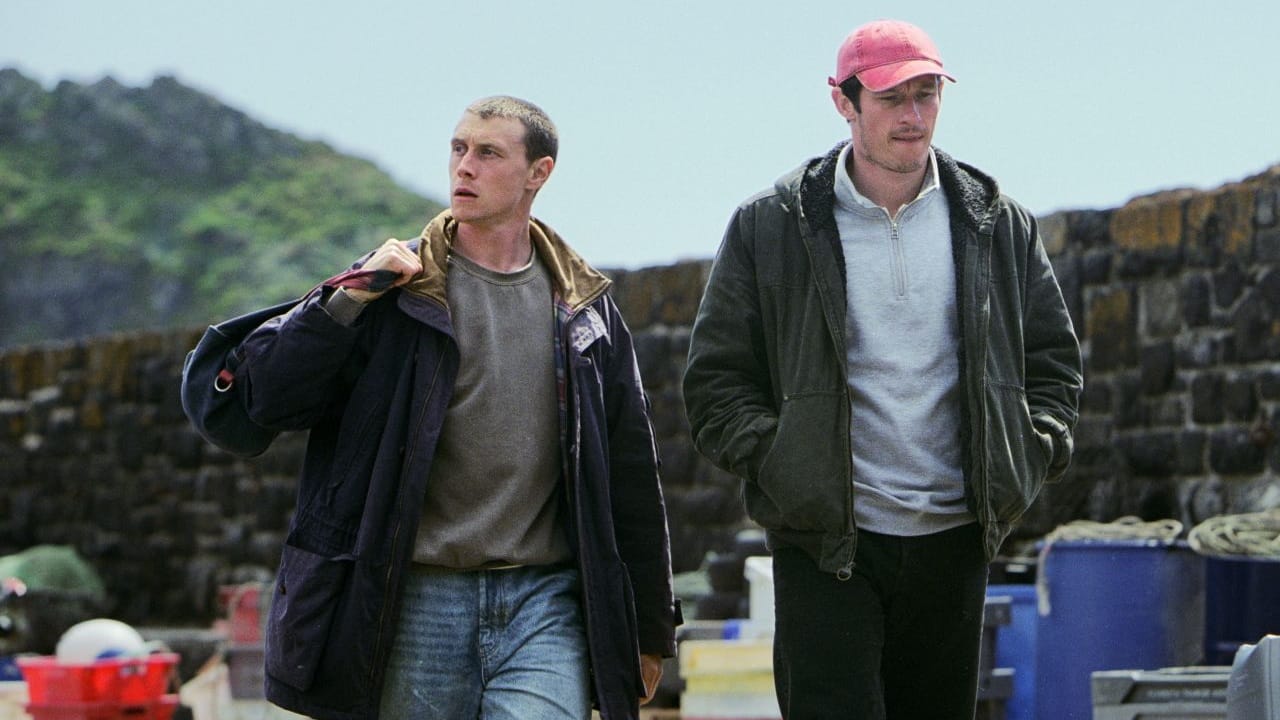
The final film in a Cornwall trilogy that includes 2019’s Bait and 2022’s Enys Men, Mark Jenkin’s Rose of Nevada considers the miraculous reappearance of a shipping boat that was lost at sea 30 years ago. Yet Jenkin’s excavation project feels like it’s been landed at the dock another 20 years before that, with grainy 16mm images that bear a close textural resemblance to the Cornwall of Sam Peckinpah’s 1971 thriller Straw Dogs or the fictional Scottish “Summerisle” of the 1973 cult classic The Wicker Man. While Rose of Nevada counts as a relatively more conventional effort than the previous entries in the trilogy, Jenkin still operates in abstractions, using dense soundscapes and detailed imagery to evoke the uncanny rather than walk the audience through a more conventional narrative. He’s a man out of time, making movies that are now instantly recognizable because of it.
This time around, Jenkin does his version of surrendering to commercial concerns by casting two recognizable young British actors, George MacKay and Callum Turner, as the crew members of a ship that doubles as a time-traveling vessel. In the opening minutes, Jenkin expertly establishes a fishing village in decline, with rusty anchors and chains along the empty shoreline and dilapidated homes where the steady rain has carved into the roofs and ceilings. When the eponymous ship of the title turns up on the dock, an older resident can’t believe what he’s seeing: “Jesus Christ,” he mutters. “She’s back.” Jenkin takes his time revealing that the ship and two of its young crew members have been presumed lost for 30 years and it feels like a slow curse has settled into the town like the mysterious mist in John Carpenter’s The Fog.
While it would seem difficult to turn the page on such a mysterious event, the ship is quickly recommissioned for duty, with Nick (MacKay), a family man desperate for money, and Liam (Turner), an itinerant worker, setting off with a grizzled captain (Francis Magee) at the helm. The two-day trip yields a great fishing haul, but Nick notices a much more robust town than the one he left and soon discovers that he’s landed in the year 1993, three years before his birth. Jenkin doesn’t try to explain this bizarre time warp or how it might be unwound, as if this were a miserablist Back to the Future, but rather lets the mystery settle in like the damp cold and turns Rose of Nevada into a mood piece that brings it closer to his other work. The borderless toggle between past and present can make the film difficult to parse, but the time conceit allows Jenkin to suggest the profound grief and loss experienced by a community on the decline. It’s a horror/sci-fi scenario that’s anchored firmly in the everyday. — Scott Tobias
Rose of Nevada arrives on the docks of New York and Los Angeles tomorrow and expands from there.


Girls Like Girls
Dir. Hayley Kiyoko
95 min.
Beginning life in 2015 as a single and music video before getting expanded into YA book in 2023 and now a full-length feature film, Girls Like Girls, from pop polymath Hayley Kiyoko, boils down to a love story between teenage girls, jostled by the tides of heteronormativity. Alongside co-director Austin S. Winchell, Kiyoko translated her own song, an appealing nugget of dreamy electro-pop, into a luscious story-video about two girls whose flirtatious friendship grows into something more physical, which breaks up a straight relationship and leads the boy to lash out violently. Kiyoko ultimately celebrates this first blush of sapphic tenderness, but bluntly acknowledges that queer love doesn’t always come easy and sometimes it leaves a mark.
There’s something to be said for the simplicity and economy of a five-minute music video, because the extra 90 minutes of space that Kiyoko has added for the film version of Girls Like Girls prove more vexing for her to fill, especially once the coquettish looks end and gravity starts to assert itself. Kiyoko does offer a hugely appealing heroine in Coley (Maya de Costa), a shy and melancholy transplant to a small Oregon community where everyone knows each other—not a great place for a kid who’d rather disappear into the woodwork. Still mourning the loss of her mother, Coley has to live with her father (Zach Braff), an earnest bachelor who wants to support her, but isn’t yet in a position to do so. In the meantime, Coley quickly befriends the pretty, outgoing Sonya (Myra Molloy), who has a boyfriend (Levon Hawke), but who’s also sending out signals that she’s open to change.
Kiyoko turns the clock back to the early 2000s for this story, which seems about right for the low-level hostility that surrounds Coley and Sonya’s relationship and adds some nice incidental details, like the clunky chatting they do through AOL Instant Messenger. A near-unrecognizable Braff has some nice scenes, too, as Coley’s father, who knows he doesn’t have much credibility with her but tries to earn her trust anyway. The romantic relationship in Girls Like Girls flounders the instant it gets going, however, because Sonya’s hot-and--cold (mostly cold) attitude toward Coley is so confusing and poorly articulated. It seems obvious enough that the invisible enemy here is a hetero disapproval that Sonya can’t quite get past, but Kiyoko doesn’t do enough to identify those pressure points, other than shots of Sonya trying to appease her temperamental boyfriend. Contrast that with a movie like Lukas Moodysson’s 1998 film Show Me Love (a.k.a. Fucking Åmål), the gold standard of lesbian coming-of-age movies, and the biggest difference is how little Kiyoko lets the audience feel the emotional stakes. We just have to join Coley as she rolls her eyes and shakes her head, waiting for the girl she loves to finally, at long last, figure her shit out. — Scott Tobias
Girls Like Girls opens in select cities this weekend.



Discussion