No, Seriously, Wait: Is ‘Ricki and the Flash’ Actually the Ultimate August Movie?
Jonathan Demme's swan song about a never-was rock star is one of the great orphans of August.

Keith and I have an affinity for the films of August, a month when the summer movie season has faded into anticlimax and studios start releasing the misfits that are neither blockbusters nor awards contenders. Some of these films are unmitigated disasters—which, honestly, are compelling in their own right—but others simply don’t fit the commercial mold, whether they’re mid-budget base hits in an industry addicted to home runs or auteur projects that flummox the marketing team. For the longest time, my go-to August movie was Sam Raimi’s Darkman, a scrappy attempt at an original superhero that teased audiences all summer with posters that read “Who is Darkman?” and found only a modest fraction of people curious enough to discover the answer. But here at The Reveal, we’ve made it an annual tradition to celebrate the dog days of summer by appreciating other candidates for the “Ultimate August Movie”: Keith on Wes Craven’s ruthlessly efficient thriller Red Eye, me on the Looney Tunes-inflected bicycle thriller Premium Rush, and then Keith again on Hard Target, John Woo’s first attempt to bring his balletic action style to Hollywood. Now we consider another candidate: Jonathan Demme’s narrative swan song Ricki and the Flash, a rambunctious musical comedy-drama that was released to middling reviews and passable box office in early August 2015.
One of my favorite sequences in a Jonathan Demme picture is the closing montage of Philadelphia, a wake held after Andrew Beckett (Tom Hanks), an lawyer with AIDS who accused his firm of discrimination in a wrongful termination lawsuit, finally succumbs to the disease. Set to Neil Young’s “Philadelphia”—a lovely bookend to Bruce Springsteen’s “Streets of Philadelphia,” which opens the film—the sequence allows the song and some low-level ambient patter to underscore an event where Beckett’s family and friends have gathered to grieve and pay their respects. Some people are hugging and crying or lighting votive candles, and the final moments settle on a TV showing old home movies of Beckett as a carefree boy, playing on the beach with his siblings. Children are dashing around, oblivious to the gravity of the occasion. Casseroles are exchanged. Babies are passed. The camera surveys a great spectrum of generations and races and romantic partnerships, and it all feels achingly, touchingly familiar—“messy” in the best sense of the word. Despite the occasion, there is no one dominant emotion on display but all of them at once, which is true to how wakes actually work and to how Demme understood the American family. He was our most generous director.
The last two narrative features of Demme’s career, the acclaimed indie drama Rachel Getting Married and the far-less-acclaimed studio orphan Ricki and the Flash, celebrate family life as a rolling shitshow of wounded relationships, broken and reconstituted units, and longstanding beefs that spill out at inopportune moments. Both are about black sheep who turn up at a wedding where they’re mostly unwanted and insist on giving a toast that virtually no one wants to hear. They’re also about the odd resilience of connections that were thought to have been lost, and the spontaneous moments where joy and grace slip through the din like those carefree kids who snake around the mourners in Philadelphia. These films are an implicit rejection of traditional American family values and an embrace of a more shambling reality where the pieces don’t fit quite as tidily, because they come in so many shapes and colors.
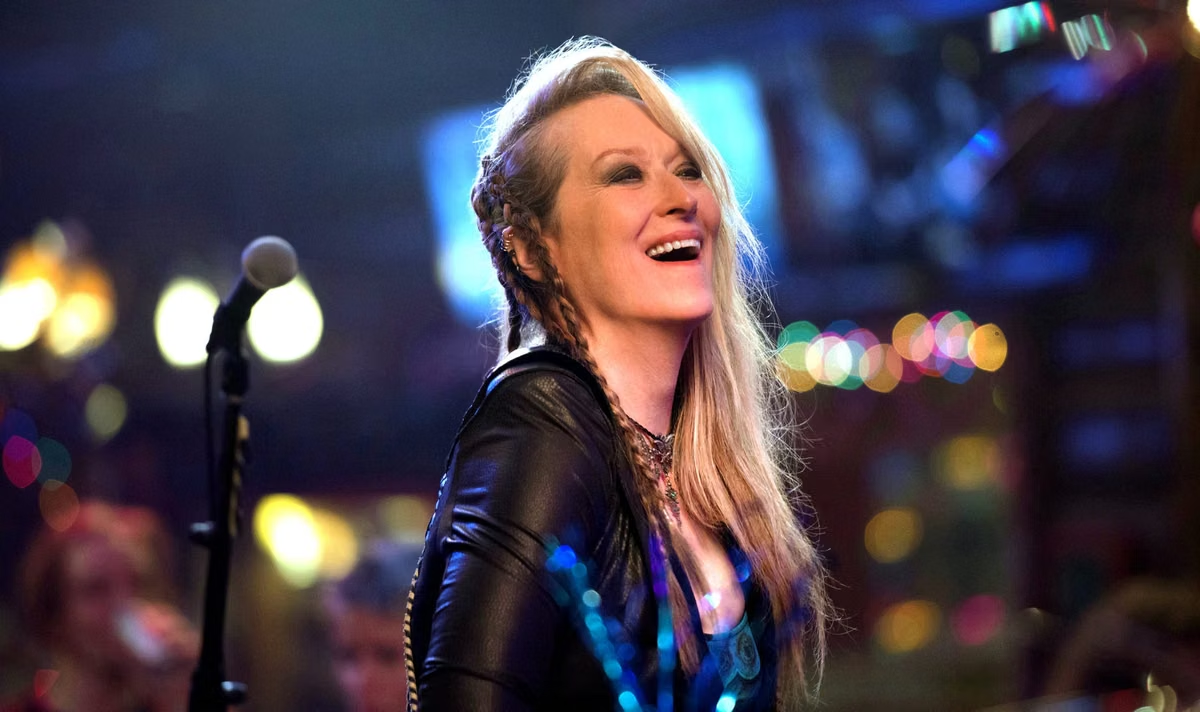
As I wrote in my original review for NPR, “Ricki and the Flash could be called Ragged Glory if Neil Young, Demme’s friend and frequent collaborator, hadn’t already taken the title for himself.” Then and now, I was stunned by how little interest most critics seem to have in a film that so beautifully articulated the values of a beloved director, with the added pedigree of Meryl Streep in the title role and a script by Diablo Cody, who’d won an Oscar for Juno and who seemed to share Demme’s affinity for oddballs and screw-ups. Perhaps the sheer August-ness of Ricki and the Flash gave this prestige project an odor of failure that critics couldn’t whiff their way past, though I don’t love assigning sinister motives to people who disagree with me. In fact, it would defy the whole spirit of this film to believe that everyone should like it, given a heroine whose flaws are too egregious for many to forgive. Even the happy ending acknowledges that half the celebrants at a wedding still wish that the mother of the groom had never been invited.
This post is for paying members only
Sign up now to read the post and get access to the full library of posts for subscribers only.
✦ Sign up