#45 (tie): ‘North by Northwest’: The Reveal discusses all 100 of Sight & Sound’s Greatest Films of All Time
Cary Grant is a man wrongfully accused in the first of four Hitchcock films to make the list. Is it one of Hitch's masterpieces or just frothy entertainment? We'll try to figure it out.


On December 1st, 2022, Sight & Sound magazine published “The Greatest Films of All Time,” a poll that’s been updated every 10 years since Bicycle Thieves topped the list in 1952. It is the closest thing movies have to a canon, with each edition reflecting the evolving taste of critics and changes in the culture at large. It’s also a nice checklist of essential cinema. Over the course of many weeks, months, and (likely) years, we’re running through the ranked list in reverse order and digging into the films as deep as we can. We hope you will take this journey with us.
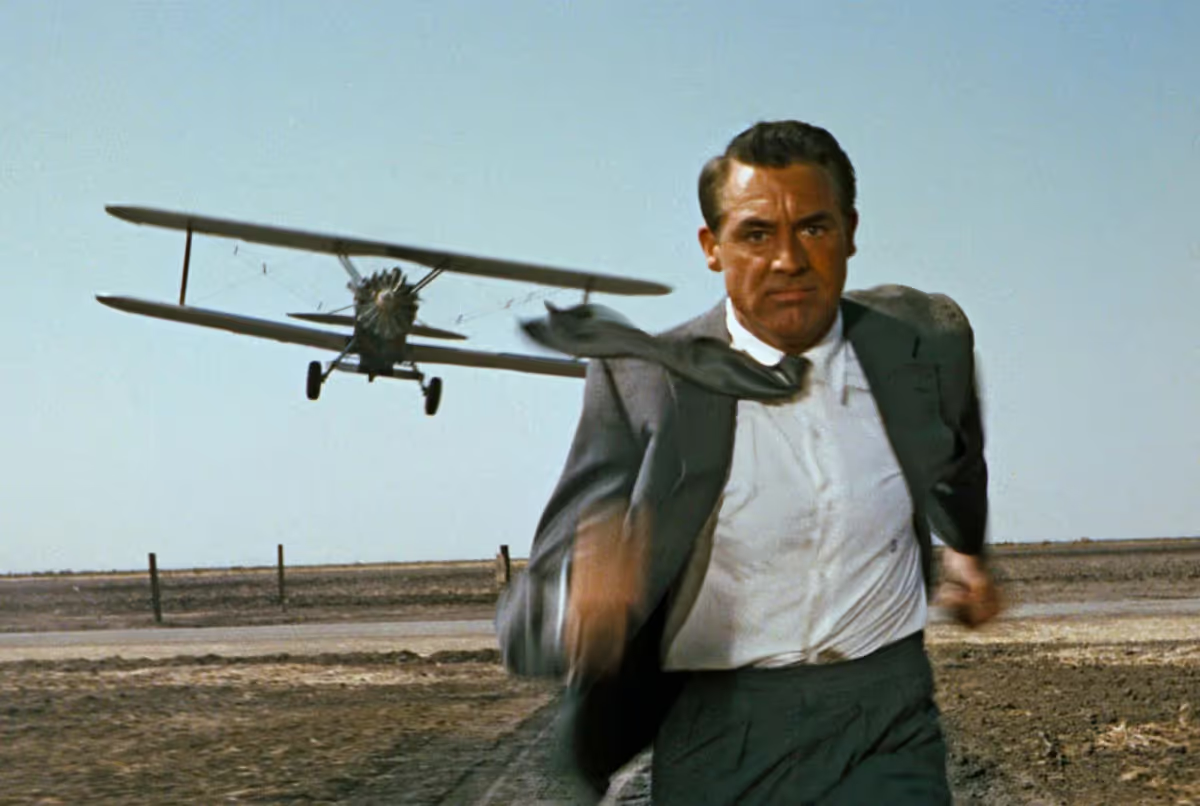
North by Northwest (1959)
Dir. Alfred Hitchcock
Ranking: #45 (tie)
Previous ranking: #53 (2012), #76 (2002), #53 (1992).
Premise: Roger Thornhill (Cary Grant) is a successful Madison Ave. advertising exec who, as the film opens, lives a carefree New York existence filled with cocktails and nights at the theater (with his mother, played by Jessie Royce Landis, but there are other women in the picture, too). When toughs in the employ of foreign agent Phillip Vandamm (James Mason) mistake him for “George Kaplan,” a non-existent intelligent operative created as a decoy, they first attempt to kill him, then frame him for a murder committed at the United Nations. While fleeing for his life on a train, Thornhill meets Eve Kendall (Eva Marie Saint), a beautiful woman who falls for him and decides to help him. Or does she?
Keith: They’re after the wrong man! Everyone’s after an object that drives the plot! Our hero falls for a beautiful but distant blonde! Scott, I believe we are watching and discussing an Alfred Hitchcock movie. Some quick stats: this is one of six Hitchcock films in the Top 250. The others: The Birds (#185), Notorious (#133), North by Northwest (#45), Rear Window (#38), Psycho (#31), and Vertigo (#2). If anything, that number surprises me. Hitchcock’s filmography spans decades and is littered with masterpieces. What’s the first Hitchcock film that comes to mind that you’re surprised didn’t make the cut? Can you narrow it down to one? That said, if you had to pick six representative Hitchcock films, these are pretty good choices. And it doesn’t surprise me that Rear Window, Psycho, and Vertigo placed as high as they did. These are cinematic cornerstones.
So where does North by Northwest fit in? It would be easy to dismiss the film as too light, too fleet, and just too entertaining to deserve such a lofty perch. At some point, you might have even caught me making that argument. I’ve always liked North by Northwest, but I think it’s taken a while for me to fully appreciate it as one of Hitchcock’s masterpieces. This is Ernest Lehman’s only screenplay that doesn’t adapt pre-existing material. But in some ways, it kind of does, and not just because Lehman was running with story concepts he and Hitchcock brainstormed together. (Maybe. Accounts vary.) Lehman doesn’t just throw in familiar Hitchcock themes and plot devices, he borrows freely from past Hitchcock plots. At heart, the film is essentially Saboteur, only with the hero heading in a different direction and a different national landmark as the site of its climactic scene. The Roger/Eve/Vandamm dynamic, and Roger’s attraction then repulsion then attraction as he figures out Eve’s true loyalties, essentially plays out like Notorious in miniature. (That one even had Cary Grant.)
The Reveal is a reader-supported newsletter dedicated to bringing you great essays, reviews and conversation about movies. If you are not paid subscriber, we would love for you to click this button below and join our community.
Is it just the scale of the film that sets it apart? Ultimately, no. Lehman’s brisk, funny dialogue and comic set pieces like Roger forcing his own arrest by disrupting an art auction keep it buoyant, but the film does an awful lot of dancing on the edge of a void. Roger begins the film with a firm sense of himself and plenty of grounding elements: a steady job, an unseen sweetheart, a secretary who looks after his every need, a mother who dotes on / disapproves of him, a drinking habit he can predict down to the number of martinis he’ll consume at any point in time. Yet it only takes a simple mistake to make it all fall away. He knows he’s Roger Thornhill and so do those around him, but is he? Is Roger Thornhill just a construction of elements? Is he really that different than “George Kaplan,” a non-existent man but one who’s been imagined down to the smallest detail. (Almost literally: he suffers from dandruff.) And who is he when he’s cut off from all those building blocks? He’s not just a man falsely accused, he’s a man adrift. It’s a Hitchcock film you could easily slip into a survey of mid-century existentialist texts. (See also: Strangers on a Train.)
Scott, are you as surprised as I am that we’re just now getting to Hitchcock? And where do you rank North by Northwest? There’s a lot to talk about here, so I’ll throw it over to you with a question about the very beginning of the film: What do you make of the way the Saul Bass opening gives way to the image of a grid-patterned skyscraper towering over a grid-like city and the prevalence of straight lines throughout the film?
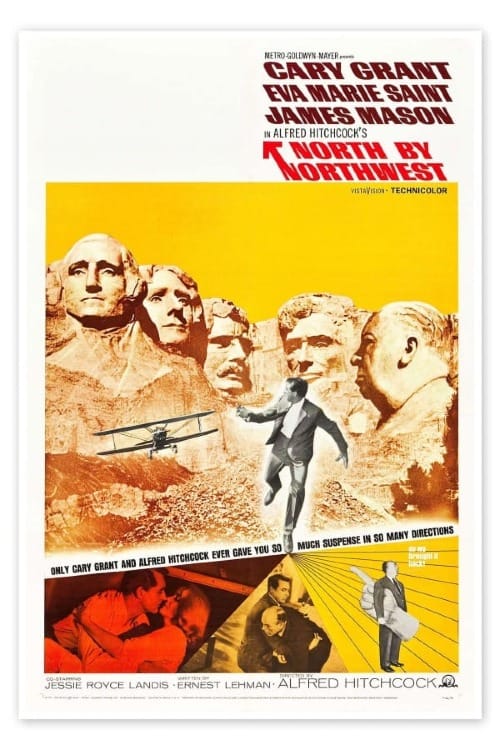
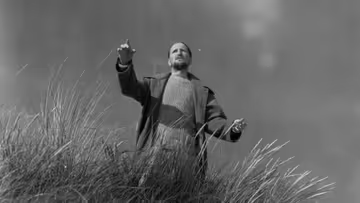
Scott: Lots of questions for me here, but I’ll start with the one about where to place North by Northwest on the list of Hitchcock masterpieces. I think I share your line of thinking about the lightness of North by Northwest by comparison to the other Hitchcock films that are still to come in the top half of the list or on the outside of the Top 100, which in the grand scope of 130 years of cinema history, we can file under Very Honorable Mention. When you’re talking about Rear Window, Psycho, and Vertigo, you can certainly rave about the director’s superior craft and commercial touch, but they’re each undergirded by big themes about voyeurism, duality, sexual desire and deviance, and the devices of cinema itself. And so when you’re a critic jotting down a 10-title list of the greatest films ever made, you can point to those themes as a justification for how these generous entertainments are also as “serious” as Ordet or News from Home or Ugetsu.
North by Northwest just isn’t that type of experience, which isn’t to say that Hitchcock has nothing on his mind, but that the film doesn’t feel nearly so intellectually loaded. Its presence on this list reminds me of the reaction to many of the Pedro Almodóvar movies that have played in competition at Cannes since All About My Mother: Critics were grateful to bite into one of Almodóvar’s delicious bonbons after a nonstop diet of high-fiber cinema from other global auteurs. Speaking personally, it wasn’t until a recent 35mm screening of North by Northwest at Music Box here in Chicago that I could acknowledge how much I cherish the film and feel like it belongs in the upper echelon of Hitchcock titles. (If you’re looking for one I’d like to see among the six already receiving votes in the Top 200, I’d personally submit Shadow of a Doubt.) And I’m feeling that Cannes-like relief to have it appear where it does on the Sight and Sound list, knowing that the reliable yet rare pleasures of the film awaited me.
The key word here is “rare,” I think, because North by Northwest is the true exemplar of Hollywood craft at its absolute peak, made right on the edge of the 1960s, when the studio system (and Hitchcock, starting with Psycho) would reflect some of the disruption of the culture surrounding it. We can break down these individual sequences later, but when you have a scene like Roger getting framed for a stabbing at the United Nations or fleeing the descending crop-duster in Indiana, you’re left breathless by the Swiss-watch mechanics of the staging and the elegance with which we’re whisked into the next part of the story. I’m reminded of my favorite exchange from Whit Stillman’s Barcelona, when one character complains about how everybody talks about the hidden messages and meaning of the subtext without ever referencing the open and obvious stuff on the surface—which is to say “the text.” The text of North by Northwest is peerless. And it’s okay for us to celebrate that.
And now to get to your other question, we can start with the opening titles and those Saul Bass grids and how they figure into the straight compositional lines elsewhere. Though I think it’s worth noting upfront how much Hitchcock wanted to emphasize North by Northwest as a commercial entertainment, starting with the color overlay to the MGM logo, the extremely robust orchestration of Bernard Herrmann’s score (one of his best for sure), and the large-format VistaVision process, which we’ve seen revived recently for The Brutalist, One Battle After Another, and The Testament of Ann Lee. To me, those grids in the title feed into the images that follow immediately after, with Hitchcock giving us a vision of New York that’s full of hustle-bustle but also a certain amount of order, as if the city’s denizens were animals in a pen. Roger Thornhill is a master of the grid, but the moment he’s abducted by accident at a three-martini lunch—quite literally, all three men he’s meeting have a martini in front of them—his sense of order is shaken and he spends the rest of the film trying to recover it.
I have thoughts on some more granular aspects of the film, Keith, but here’s a big claim I want to throw at you first: Is North by Northwest the true birth of the modern blockbuster? I think we tend to give that honor to Jaws, because it recalibrated the industry toward producing what would become the summer movie season, but here is an adventure with high production values and scale that covers a lot of territory and delivers splashy setpieces like the crop-duster sequence and the climax at Mt. Rushmore. Do you feel, Keith, like this film was the start of something new in that respect? What do you see as its imprint on movies to come?
Keith: Before I get to your question, let me propose another, less obvious influence: those opening scenes of bustling New York life accompanied by Herrmann music that keeps circling back to the same theme feels like the seed from which Koyaanisqatsi would sprout. But, yes, I think the real influence here is on the Hollywood blockbuster, it just took a while for that model to be fully adopted. And that it wasn’t exactly Hollywood that adopted it first. I think its influence can most immediately be felt in the James Bond series, for which North by Northwest often seems like the template, with its witty hero, globetrotting adventures, and set pieces staged in colorful locations. From Russia with Love took the danger-on-a-train sequence and built upon it, but it’s the third Bond, Goldfinger, that fully adopts the model which has been used by every Bond film since. That said, I don’t think Jaws particularly fits that model beyond Spielberg obviously being an honor roll student of Hitchcock. It’s too small and confined. But everything from Star Wars and Raiders of the Lost Ark to John Wick 4 and Avengers: Endgame are made primarily of North by Northwest DNA.
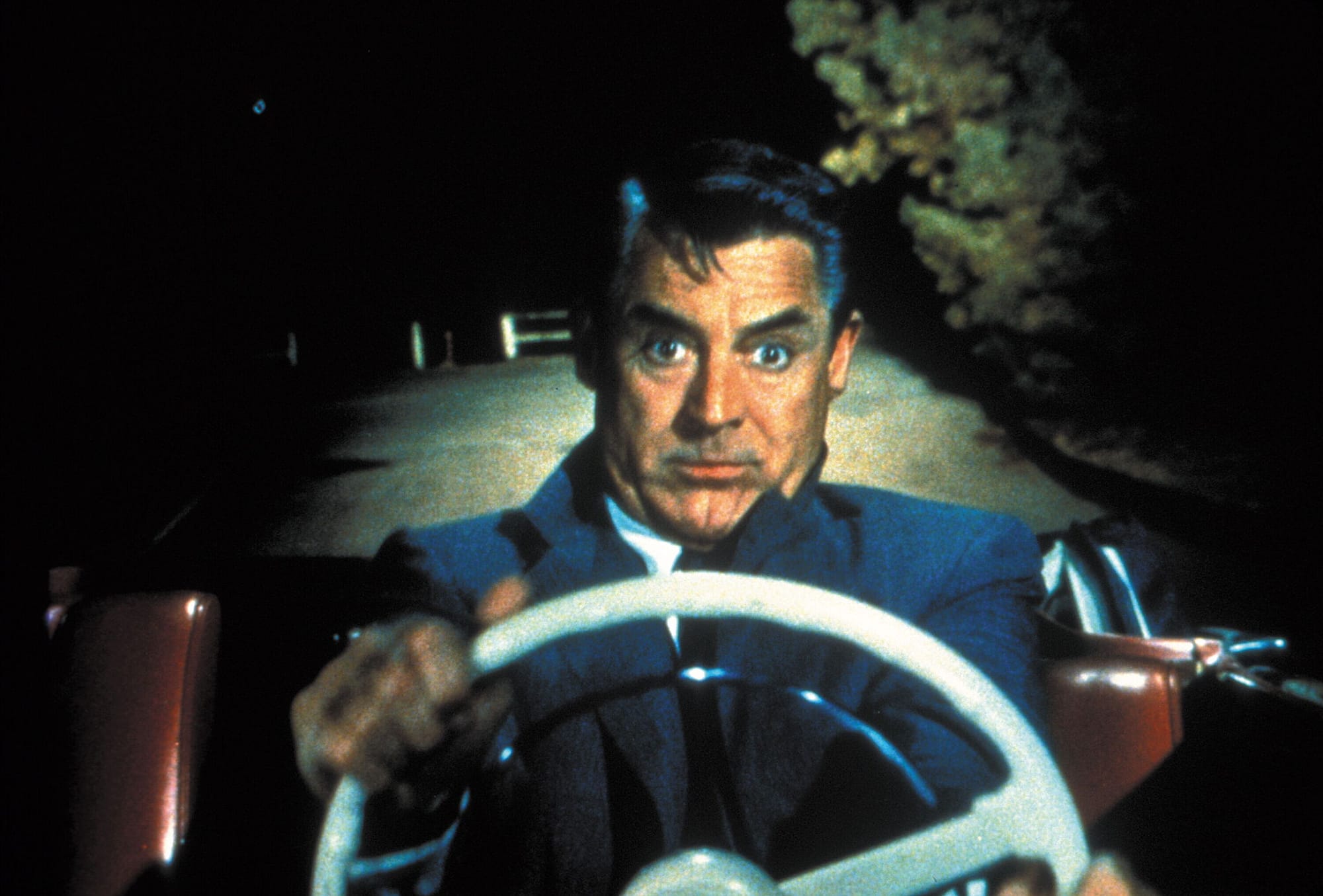
Can we talk about how everyone in the cast is operating at the top of his or her game? Grant was starting to slow his pace and would only make a handful of films before retiring in 1966, but I’m not sure he’s ever been more Cary Grant than he is in North by Northwest, bringing wit and sophistication to the movie even as Roger is having his dignity beaten down by his adventures. Saint brilliantly conveys Eve’s vulnerability, even in the scenes that require her to play the role of the unflappable seductress. But I think Mason might be the MVP here. Casting two English actors as the hero and villain of this otherwise very American movie gives North by Northwest a weird energy. Grant plays everything Yanks like about Brits while Mason gets to play the opposite. There’s something rotten beneath those impeccable manners and literate airs. He might be impossibly handsome and clever, but, here and elsewhere, Grant seems approachable. Mason plays Vandamm as a man who looks at almost everyone else like something he scraped off his shoe. That he’s betraying and trying to escape the uncultured United States of America makes a lot of sense for the character. Mason was always great at playing complicated, often morally compromised characters. You can easily group this performance in with his work in A Star is Born and Lolita.
We should probably talk about some of the film’s blockbuster-y moments. I first encountered the crop-duster scene via one or more of the salute-to-classic-movies shows that were on TV when I was growing up. I didn’t fully get what the big deal was because they would invariably just show Grant falling flat as the plane swept above him. That’s a striking visual, but it’s the slow build-up leading to that moment that makes the scene work. It’s just a beautifully timed piece of suspense filmmaking in which, for the longest time, nothing happens and then everything happens at once.
It’s a highlight, but the film stacks one brilliant scene atop another. So it almost seems churlish to suggest—though I think you share this opinion—that the finale atop Mt. Rushmore is one of North by Northwest’s weaker moments. It’s a cool idea and I love the smash cut in which Roger taking Eve’s hand abruptly shifts the gesture from one context to another. But, even beyond the set not being that convincing, the scene falls short of the expert calibration of the rest of the film. It lacks the slow-building tension. Mostly it just seems like a handful of people scrambling on rocks. Still, by that point I’ve been so stuffed by the preceding feast that I don’t really care.
Scott, am I wrong? And do you have any thoughts on the characters? Roger’s an interesting hero, for instance, with his failed marriages and close relationship with his disapproving mother. Do those details feel meaningful to the overall film?
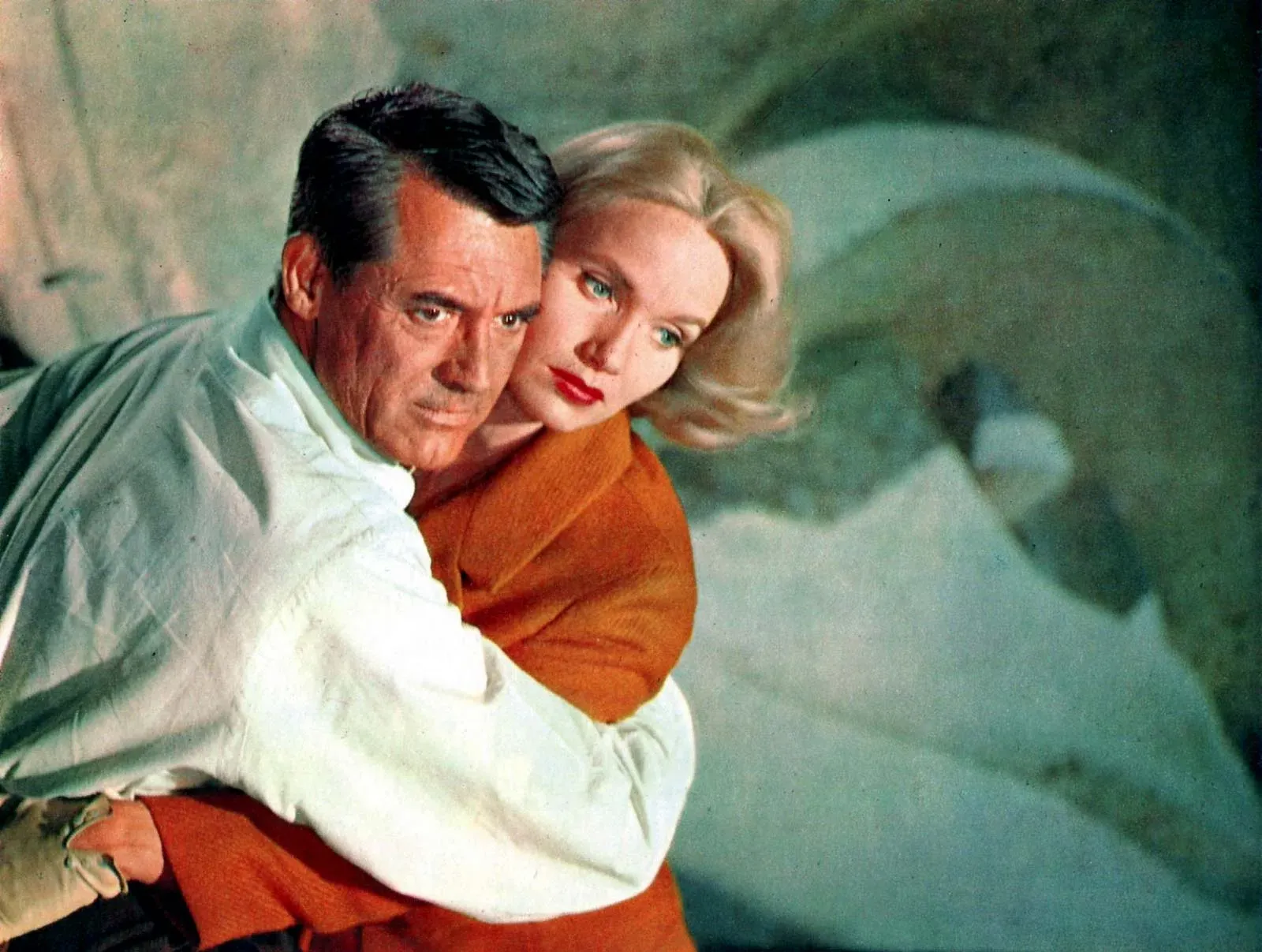
Scott: Keith, you are not wrong. The Mt. Rushmore sequence is the clunkiest in the film, though it oddly strengthens the argument that North by Northwest is the proto-blockbuster. I mean, how many times have we been seduced by the thought of a massive climactic setpiece, only to be mildly let down when its size limits the more satisfying deftness of smaller sequences earlier in the film? Take Mission: Impossible, a film by famous Hitchcock admirer/mimic Brian De Palma: The Langley break-in sequence is, to my mind, one of the all-time great suspense setpieces. But the climactic bit with the train and the helicopter and the ho-hum special effects? It pales by comparison, perhaps because that requirement to scale it up as much as possible overwhelms a director’s capacity to pull it off, even craftsmen of Hitchcock and De Palma’s rare skill. The Mt. Rushmore sequence would start a tradition of movies that tease audiences with spectacles beyond what they could ever imagine, but can’t quite satisfy them. (See also: The climaxes of virtually every Marvel movie, the blame for which falls more on the production process than any individual director. Poor Ryan Coogler!)
But I’m happy to gawp some more over the crop-duster sequence, though, which remains not only masterful but timeless, in the sense that any kind of digital tinkering could not “improve” the quality of what Hitchcock and his team were able to accomplish in 1959. Hitchcock’s patience in establishing this location and building suspense slowly is key: That money shot of Roger running through the cornfield as the plane bears down over his right shoulder arrives after a tremendous amount of set-up. We have time to share Roger’s unease in being dropped off in the middle of an arid rural stretch in Indiana, an unease that’s heightened by the appearance of a stranger he (like us) assumes is George Kaplan. Hitchcock lets us know that there’s a plane in the area, but tucks it so far out in the distance that we don’t worry about it until the stranger tells Roger, “That’s funny. That plane's dusting crops where there ain’t no crops.” It’s only then that the plane starts to dive and pepper Roger with machine-gun fire and we’re off and running.
But I think the end of the crop-duster sequence is extraordinary, too, in how it fits with the filmmaking ethos of the rest of North by Northwest. When the plane smashes into the back of that oil tanker and explodes—another blockbuster moment—a couple of vehicles pull over and their passengers naturally walk out to take a look, which gives Roger the chance to hijack a truck and peel off towards Chicago. There’s such fluidity and grace to the way Hitchcock takes us out of the sequence and into the next section of the film. And I think it’s that fluidity that helps account for why North by Northwest ranks in such high esteem among Sight and Sound voters. You feel completely whisked away on this adventure, tied to an impossibly elegant and witty hero as he pinballs around America in an effort to solve a mystery and clear his name at the same time.
Hitchcock loved the “wrong man” premise and exploited it in various ways throughout his career, from his early British classic The 39 Steps in 1935 to the 1956 drama The Wrong Man with Henry Fonda, which carries a much more sober tone as an innocent man faces hard time for someone else’s armed robbery. North by Northwest has much more in common with The 39 Steps, including an imported, very British sophistication that’s tied to Grant and Mason’s performances, which never run too hot, no matter how desperate the situation. To me, that leaves Eva Marie Saint with the critical job of injecting emotion and heat into a film that might otherwise be cool to the touch. Amid all the spy games and double-crosses, the unmistakable authenticity of Eve’s desire is a kind of North Star for Roger (and for us) in terms of nodding to her genuine loyalties.
If we’re talking about performances, I don’t want to leave out Martin Landau as Leonard, who’s scary and intimidating as Vandamm’s henchman. While Mason is completely at ease tossing veiled threats and bon mots in Grant’s direction, Landau makes it clear that the boss means business, which is crucial to maintaining a sense of danger. And I’m endlessly tickled by Jessie Royce Landis as Roger’s mother, who never seems at all surprised that her son has gotten himself into trouble and is mostly bemused by it. (“You gentlemen aren’t really trying to kill my son, are you?”)
I think it’s worth noting, too, that Grant was approaching the end of his career as a leading man, and were it not for the miracle of Charade a few years later, we might look at North by Northwest as a true end-of-an-era movie. Even at the peak of his powers, Grant would have seemed out of place in the ’60s and beyond. Hitchcock would pivot dramatically to Psycho just a year later, as if to indicate that he knew where the wind was blowing. He would never make an entertainment as polished as North by Northwest again. And Hollywood would rarely do it, either.
Did I say that film might look a little different as we head into the 1960s? Because the revolutionary cinema of Gillo Pontecorvo’s 1966 The Battle of Algiers is next for us.
Previously:
#95 (tie): Get Out
#95 (tie): The General
#95 (tie): Black Girl
#95 (tie): Tropical Malady
#95 (tie): Once Upon a Time in the West
#95 (tie): A Man Escaped
#90 (tie): Yi Yi
#90 (tie): Ugetsu
#90 (tie): The Earrings of Madame De…
#90 (tie): Parasite
#90 (tie): The Leopard
#88 (tie): The Shining
#88 (tie): Chungking Express
#85 (tie): Pierrot le Fou
#85 (tie): Blue Velvet
#85 (tie): The Spirit of the Beehive
#78 (tie): Histoire(s) du Cinéma
#78 (tie): A Matter of Life and Death
#78 (tie): Celine and Julie Go Boating
#78 (tie): Modern Times
#78 (tie): A Brighter Summer Day
#78 (tie): Sunset Boulevard
#78 (tie): Sátántangó
#75 (tie): Imitation of Life
#75 (tie): Spirited Away
#75 (tie): Sansho the Bailiff
#72 (tie): L’Avventura
#72 (tie): My Neighbor Totoro
#72 (tie): Journey to Italy
#67 (tie): Andrei Rublev
#67 (tie): The Gleaners and I
#67 (tie): The Red Shoes
#67 (tie): Metropolis
#67 (tie): La Jetée
#66: Touki Bouki
#63 (tie): The Third Man
#63 (tie): Goodfellas
#63 (tie): Casablanca
#60 (tie): Moonlight
#60 (tie): La Dolce Vita
#60 (tie): Daughters of the Dust
#59: Sans Soleil
#54 (tie): The Apartment
#54 (tie): Battleship Potemkin
#54 (tie): Blade Runner
#54 (tie): Sherlock Jr.
#52 (tie): Contempt
#52 (tie): Ali: Fear Eats the Soul
#50 (tie): The Piano
#50 (tie): The 400 Blows
#48 (tie): Wanda
#45 (tie): Ordet


Discussion