#48 (tie): ‘Ordet’: The Reveal discusses all 100 of Sight & Sound’s Greatest Films of All Time
Faith, family, and miracles all factor into Carl Dreyer's 1955 film, in which a humble family finds themselves visited by death and, maybe, God incarnate.


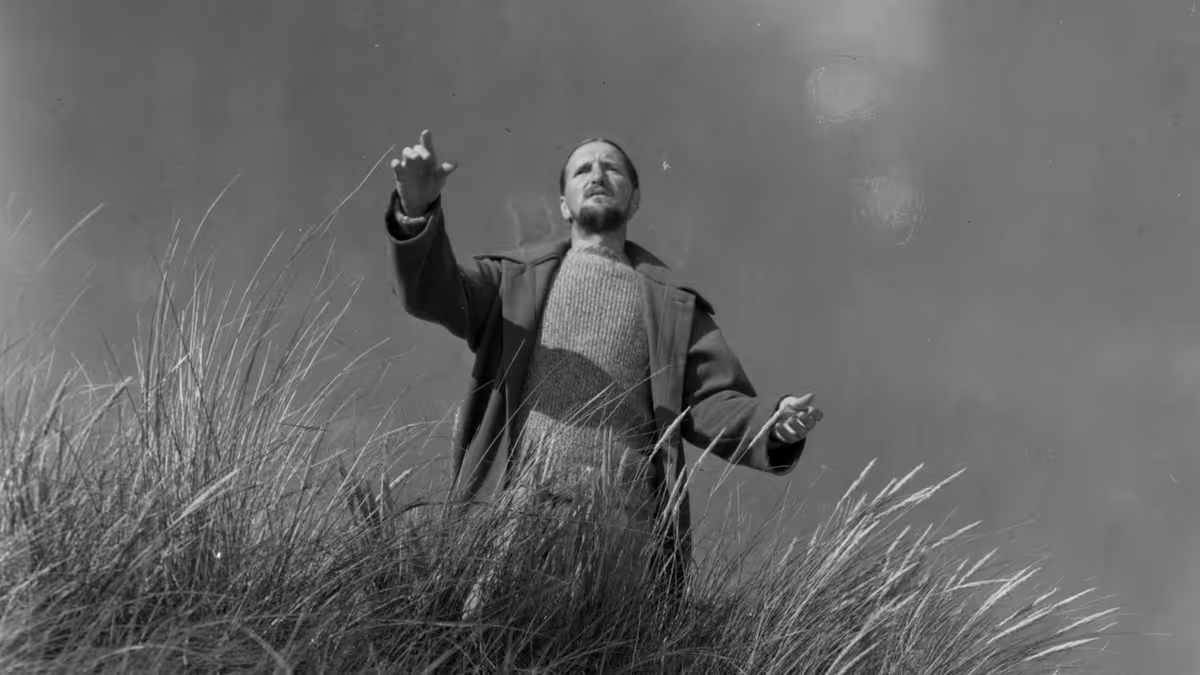
On December 1st, 2022, Sight & Sound magazine published “The Greatest Films of All Time,” a poll that’s been updated every 10 years since Bicycle Thieves topped the list in 1952. It is the closest thing movies have to a canon, with each edition reflecting the evolving taste of critics and changes in the culture at large. It’s also a nice checklist of essential cinema. Over the course of many weeks, months, and (likely) years, we’re running through the ranked list in reverse order and digging into the films as deep as we can. We hope you will take this journey with us.
Ordet (1970)
Dir. Carl Theodor Dreyer
Ranking: #48 (tie)
Previous ranking: #25 (2012); #55 (2002); #34 (1992).
Premise: At the Borgen family farm in rural Denmark in the mid-1920s, devout widower Morten (Henrik Malberg) sternly presides over his three adult sons. The oldest, Mikkel (Emil Hass Christensen), doesn’t share his father’s faith but leads a seemingly contented life with his wife Inger (Birgitte Federspiel) and their two young daughters. (A third child is on the way.) Morten’s middle son Johannes (Preben Lerdorff), by contrast, has embraced religion all too fervently, believing himself to be a reincarnated Jesus Christ. Meanwhile, Morten’s youngest son Ander (Cay Kristiansen) has fallen in love with Anne (Gerda Nielsen), but neither Morten nor Anne’s father Peter (Ejner Federspiel) approve of the relationship, citing irreconcilable differences in their religious practices. The fates of all these characters are upended by a crisis… and a miracle.
Scott: Do you believe in miracles, Keith? No, I’m not talking about the Winter Olympics here. I’m talking about the events of Ordet, Carl Dreyer’s 1955 masterpiece, which has the audacity to confront the audience with a miracle and leave us to sort out how we feel about it. But I’m not ready to get into the famous and oft-imitated ending right away, because there’s a lot of context to get into first. I first saw Ordet when I was just starting a masters program in film studies and was so knocked out by it that I initially resolved to write my thesis around it, with other Dreyer films sprinkled in there for context. I got as far as ordering VHS tapes of silent works he made before his 1928 masterpiece The Passion of Joan of Arc, like 1921’s Leaves from Satan’s Book and 1925’s Master of the House, before abandoning the idea for a thesis on Albert Brooks instead. I was able to repurpose some of my knowledge for the least flashy “Gateways to Geekery” column ever—under “Why it’s daunting,” I wrote that Dreyer “makes Ingmar Bergman look like Stanley Donen—but I remain fascinated by a director whose work is so singular and almost sui generis.
The Reveal is a reader-supported newsletter dedicated to bringing you great essays, reviews and conversation about movies. If you are not paid subscriber, we would love for you to click this button below and join our community.
The most fascinating aspect of Dreyer’s work is that it’s timeless—not merely in that his major works (The Passion of Joan of Arc, Vampyr, Day of Wrath, Ordet, and Gertrud) are admired and studied and influential, but in the more unique sense that they are without precedent and without any firm connection to the contemporary time. The power of Joan of Arc, for example, arises from the near-total absence of conventional staging; our heroine’s persecution and suffering is divorced from spatial grounding of any kind, which makes it abstract and beautiful to witness. On the other end of things, his final film Gertrud was largely ridiculed as hopelessly mannered and tedious when it premiered in 1964, mainly because it didn’t behave like anything else that was coming out at the time, as if Dreyer had been living under a rock as the medium was rapidly changing without him. (For what it’s worth, Jean-Luc Godard cited Gertrud as his favorite film of the year, and other critics, like Andrew Sarris, were more appreciative.)
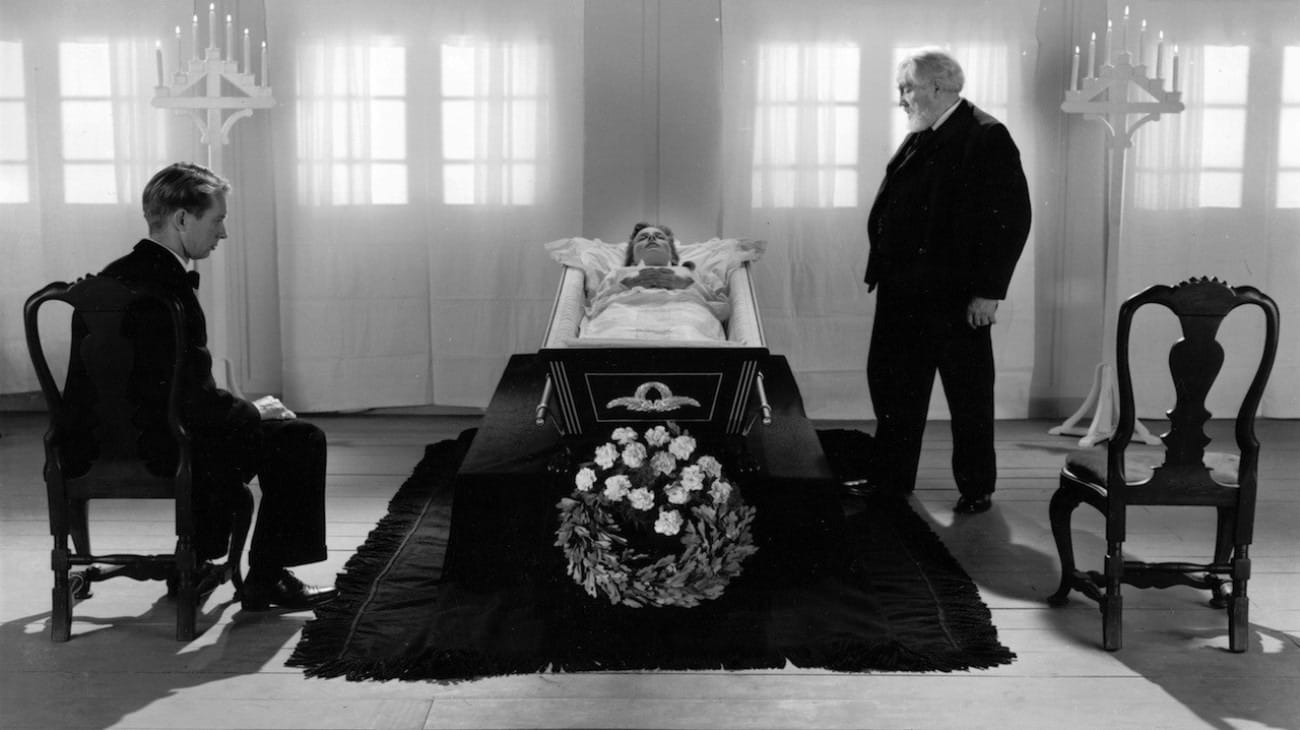
I think you can see the mesmeric appeal of Dreyer’s “timelessness” all over Ordet, which remains my favorite of his films. While Dreyer does offer more conventional staging than The Passion of Joan of Arc, the simplicity and intimacy of this austere farmhouse setting nonetheless leads to striking images and subtle feats of style. As carefully composed as many of the scenes are—that tableaux of Inger in her coffin, tilted up against the light streaming through the windows behind her, is unforgettable—Dreyer’s camera is surprisingly dynamic, with the frequent use of pans to set up the relationship between on-screen and off-screen space. There are a lot of characters and dramatic subplots to manage in Ordet, and Dreyer insistently pulls them together, so the fates of everyone are completely intertwined for the third act. He imposes order on dramatic chaos.
Order is certainly not easy for poor Morten Borgen to restore. His bitterness and exasperation are written plainly on his face, because none of his children have turned out as he’d hoped. He appreciates the stability of his son Mikkel—and flatly adores Inger, like everyone else in the house—but he’s disappointed in his eldest son’s firm rejection of faith. He’s concerned and embarrassed by Johannes, who discovered Kierkegaard in his studies and now believes himself to be the son of God, which would be blasphemous if it weren’t more readily dismissed as “crazy.” His youngest son Anders doesn’t seem terribly worrisome but he’s not particularly introspective, either, and he’s annoyed that Anders has taken a romantic interest in the daughter of an orthodox sect leader he can’t stand. The only chance Anders has to get his father’s approval is to leave the talking to Inger, who’s the one person in the house he respects unreservedly and who has the ability to cajole him with a full pipe and a cup of coffee.
The conflict between Morten and Peter, the father of Anders’ would-be bride Anne, is an important dramatic thread that I think figures into the miracle we witness in the film’s climax. Morten is dead set against Anders courting a young woman whose family doesn’t share his religious beliefs, but he’s incensed to learn that Peter has forbidden his child from continuing the relationship, too. When Morten suddenly drops his objections and visits Peter in a huff, demanding that his rival change his mind, the two are at loggerheads over the issue. There’s an uncomfortable history between them and in the Borgens’ relationship to the community at large, but the obstacles these men are placing between their two children, Anders and Anne, are rooted more in pettiness than righteousness.
There’s a lot to unpack here, Keith, about the divisions within these families and this community, and about how religious faith (and perhaps human compassion and understanding) figure into the transcendent event that leads the film to a close. And how about that transcendent event, Keith? There’s a certain amount of dramatic chutzpah to stage an honest-to-goodness miracle and confront the audience with what it might mean. I think Dreyer has that kind of courage, despite the austerity of his work.
Keith: I’d say chutzpah but also a sweeping sense of compassion. Ordet isn’t a simple work but there is a kind of clarifying simplicity to its finale. The film’s characters fret over matters of faith and fall short of their own stated beliefs throughout the film and then, nonetheless, they’re gifted a miracle. Most of the film’s conflicts concern differences in systems of belief and, as someone who’s not terribly familiar with the distinction between the mainline Church of Denmark and the more conservative Inner Mission branch, the conflict can look a little obscure. (I found my thoughts turning to Emo Phillips’ classic routine about minute differences between belief and heresy.) But that also seems to be part of the film’s design. Wherever a character falls on the spectrum of belief—from Mikkel’s skepticism to Johannes' deluded (?) fanaticism—Inger’s resurrection provides a powerful reminder of the core Christian concept of God’s grace being granted to everyone despite being deserved by no one.
That’s the end of the film, however. And though God’s presence ultimately wipes away such squabbles, both the characters of Ordet and the film’s viewers have to live with them until that miracle arrives. Am I wrong to say that everyone within the Borgen home seems to be at peace with not seeing eye-to-eye on the matter of faith? Morten seems to have resigned himself to Mikkel’s lack of belief. That Inger provides a compassionate buffer certainly helps, and Inger herself does not seem particularly upset at her husband’s lack of piety. Only Johannes throws the Borgen family out of balance. I’m not expert enough on Kierkegaard (another Dane) to say whether there’s anything in particular about the philosopher’s thoughts on faith that might have driven Johannes to madness or if Kierkegaard is just being used as shorthand for getting intellectually overwhelmed by questions of faith. I suspect the former, but that doesn’t mean the latter reason doesn’t work, too.
I referred to Johannes being mad, but I don’t know that we’re supposed to see his condition as madness given that his prophecies come true. Then again, I’m not sure what we’re supposed to think of Johannes. Putting aside that he believes himself to be the embodiment of Christ, you can look at him as the character with the purest faith. Yet it’s also a kind of impossible faith for others to follow. Even if Johannes is right on every point, what are the other Borgens supposed to do about this? Should they, too, abandon all worldly thoughts and wander around talking about God all the time? If the Borgens’ “bright, happy” Christianity and Anne’s family’s more severe beliefs are supposed to be polar opposites, where does Johannes fall?
We should probably back up a little and state that Ordet is based on a play by Kaj Munk, a Danish playwright and Lutheran pastor who vocally opposed the Nazi occupation of Denmark and was killed by the Gestapo for his beliefs in 1944. Written in 1925—the same year in which the film is set—Ordet, of course, predated those events, but they wouldn’t have been obscure to viewers of the film in 1955, particularly those in Dreyer’s homeland. That information might be outside the scope of the film itself, but it might be worth remembering, as Dreyer undoubtedly did, that the questions of faith explored in the film weren’t purely theoretical. Those who adhered to their beliefs sometimes suffered for them.
Scott, I want to hear your thoughts on the ending, and on some of the films that have drawn from it. (A few that immediately come to mind: Ingmar Bergman’s The Virgin Spring; Breaking the Waves, by Dreyer’s fellow Dane, Lars Von Trier; and (maybe) Andrew Semans’ 2022 film Resurrection.) And what are your thoughts on Johannes?
Scott: My first thought on Johannes: What evidence do we have that he isn’t the living embodiment of Christ? Not only does Inger’s miraculous resurrection happen exactly how he so serenely predicts it, he also senses when Death itself arrives with its hourglass and its scythe for Inger’s baby and then for Inger herself. (“Look, now he’s going through the wall.”) The latter death happens after the doctor has labored to stabilize Inger and leaves feeling satisfied that she’s resting. It takes the persistent faith of Maren Borgen, Mikkel and Inger’s little girl, to put Johannes in a position to help raise the dead—and let’s be honest, Keith, kids that age believe in Santa Claus, too. Faith comes more easily for them.
I don’t know that I agree with you about the Borgen household being settled when the film begins. I feel like Morten, our patriarch, is bitterly disappointed with how his life has turned out, with his faithless older son, his seemingly crazy older son, and a younger son who wants to marry into a family that he despises. Inger is the only person in the house who he seems to love without reservations, and of course her fate is what throws the farmhouse into crisis. Yet from that crisis comes new order and new life, which may turn on the climactic miracle, but which the film builds to in various ways. For as much as faith seems required to raise the dead—in the moments before it happens, Johannes chides everyone in the room for “[blaspheming] God with your lukewarm faith”—the reconciliation between Morten and Peter over their religious schism informs the moment, too. Inger’s return seems as much a celebration of human grace as it is an act of divine intervention.
Also divine is Dreyer’s staging of the sequence, which makes this space look like a place where a miracle of this kind is possible. With Inger’s coffin in the center, framed by seven-candle mounts on each side of her, the sparsely appointed room has a gentle, diffused light coming through the translucent curtained windows before her. There’s a lot of drama preceding the moment when the lid is finally having to get lowered over Inger’s body, including Mikkel finally bursting into tears, without the Christian comfort of feeling like she’s gone to Heaven. (“It is all so meaningless, so meaningless,” he says. “I only know that everything I loved and worshiped is now to be buried in the earth to rot, to rot and rot.”)
It’s also important to note that Johannes arrives on the scene seeming more “normal,” at least in the sense that he pleads to Christ to intervene with Inger, rather than claiming to be Christ himself. But what I love about Inger’s awakening is that Dreyer narrows it to a moment between husband and wife, with Mikkel being the person who witnesses the miracle—and, perhaps, is its most intended beneficiary. The two are able to acknowledge the loss of their infant—Mikkel conceding that it lives at home with God now—and they look forward to a new life together.
I’m glad you mentioned the films that seem directly inspired by Ordet, most notably Breaking the Waves, by Dreyer’s fellow Dane Lars Von Trier, whose interest in the faith and torment of persecuted women connects firmly to The Passion of Joan of Arc, too. But one clear Ordet-influenced film I’m eager to mention is Silent Light, Mexican director Carlos Reygadas’ brilliant drama about a Mennonite colony that echoes Dreyer’s film in the premise (a young Mennonite man falls in love with a woman outside his community) and in the transcendental conclusion. There’s a natural lushness to the setting of Silent Light, starting with the sunrise that opens the film, that defies the hermetic interiors of Ordet, but otherwise it seems intended as a companion piece of sorts. Truly one of great films of the current century yet it feels like it’s in need of rediscovery.
Any final thoughts on Ordet, Keith? You and I were talking the other night about how surprised we were about the boldness of Dreyer’s visual language, because you expect something more austere and static. What stood out for you on that front? And what’s coming up next? Quite a parade of masterpieces from here on out, no?
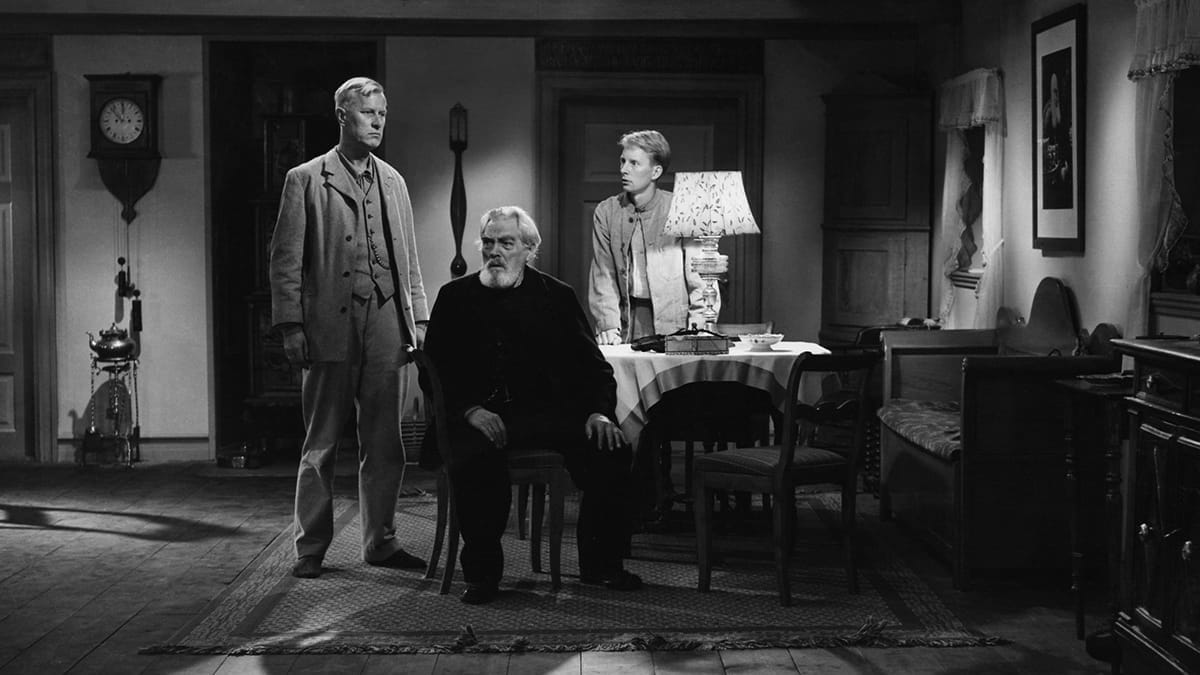
Keith: I had not seen Ordet in quite a few years before this rewatch and as deep an impression as it made on me the first time, I recalled it as a far more austere film. Not that it’s not austere. Dreyer made a practice of removing all but what he felt were the most essential items from a set, which is very much in evidence here, as is the feeling that the film has been stripped down to its most essential elements. But I misremembered it as a work of long, static shots instead of one with a lot of purposeful camera movement that shifts the mood within a scene without cuts. Dreyer creates a sense of the larger space that remains present even as the camera moves into tighter compositions. Beyond that, Dreyer just knows how to construct a composition (as I’m obviously far from the first person to notice). Look at the way he positions Morten in relation to his sons. He’s telling us a lot about their relationships just with lighting and posture. I’m just going to say it: Dreyer was a pretty good filmmaker!
We can’t leave this conversation without talking about one of my favorite moments. You’re right that the resurrection becomes an incredibly intense moment between husband and wife, one in which Mikkel has to break the news to Inger that their son has died in childbirth. (I found that scene, though not at all graphic, as hard to watch as some of the more stomach-churning moments on The Pitt.) She’s returned to life, but also to life’s hardships. And yet they’re both incredibly overwhelmed at her resurrection, however much sadness they might face, that they share a kiss of unbridled, sloppy passion. Part of what makes the end of this movie so powerful is a sense of release: after all that talk of spiritual matters, the film uses an intimate moment between husband and wife to embody the joy we can find on Earth, whatever awaits us when we leave it.
Oh, boy, do we have some great movies coming up as part of this project! Not that we haven’t had plenty already, but the top half of the Sight and Sound list is filled with some of the biggest titles in film history. And we’ll be talking about all of them. We’ll see taxi drivers! And bicycle thieves! Do some like it hot? We’ll find out! The rules of the game? We’ll learn ‘em. But first, it’s time to cross the country with Cary Grant and Eva Marie Saint when we discuss North by Northwest in three weeks.
Previously:
#95 (tie): Get Out
#95 (tie): The General
#95 (tie): Black Girl
#95 (tie): Tropical Malady
#95 (tie): Once Upon a Time in the West
#95 (tie): A Man Escaped
#90 (tie): Yi Yi
#90 (tie): Ugetsu
#90 (tie): The Earrings of Madame De…
#90 (tie): Parasite
#90 (tie): The Leopard
#88 (tie): The Shining
#88 (tie): Chungking Express
#85 (tie): Pierrot le Fou
#85 (tie): Blue Velvet
#85 (tie): The Spirit of the Beehive
#78 (tie): Histoire(s) du Cinéma
#78 (tie): A Matter of Life and Death
#78 (tie): Celine and Julie Go Boating
#78 (tie): Modern Times
#78 (tie): A Brighter Summer Day
#78 (tie): Sunset Boulevard
#78 (tie): Sátántangó
#75 (tie): Imitation of Life
#75 (tie): Spirited Away
#75 (tie): Sansho the Bailiff
#72 (tie): L’Avventura
#72 (tie): My Neighbor Totoro
#72 (tie): Journey to Italy
#67 (tie): Andrei Rublev
#67 (tie): The Gleaners and I
#67 (tie): The Red Shoes
#67 (tie): Metropolis
#67 (tie): La Jetée
#66: Touki Bouki
#63 (tie): The Third Man
#63 (tie): Goodfellas
#63 (tie): Casablanca
#60 (tie): Moonlight
#60 (tie): La Dolce Vita
#60 (tie): Daughters of the Dust
#59: Sans Soleil
#54 (tie): The Apartment
#54 (tie): Battleship Potemkin
#54 (tie): Blade Runner
#54 (tie): Sherlock Jr.
#52 (tie): Contempt
#52 (tie): Ali: Fear Eats the Soul
#50 (tie): The Piano
#50 (tie): The 400 Blows
#48 (tie): Wanda


Discussion