#41 (tie): ‘Rashomon’: The Reveal discusses all 100 of Sight & Sound’s Greatest Films of All Time
The Reveal continues its look at every film in the top 100 of the most recent Sight and Sound poll arrives at an Akira Kurosawa classic that questions the nature of truth itself.


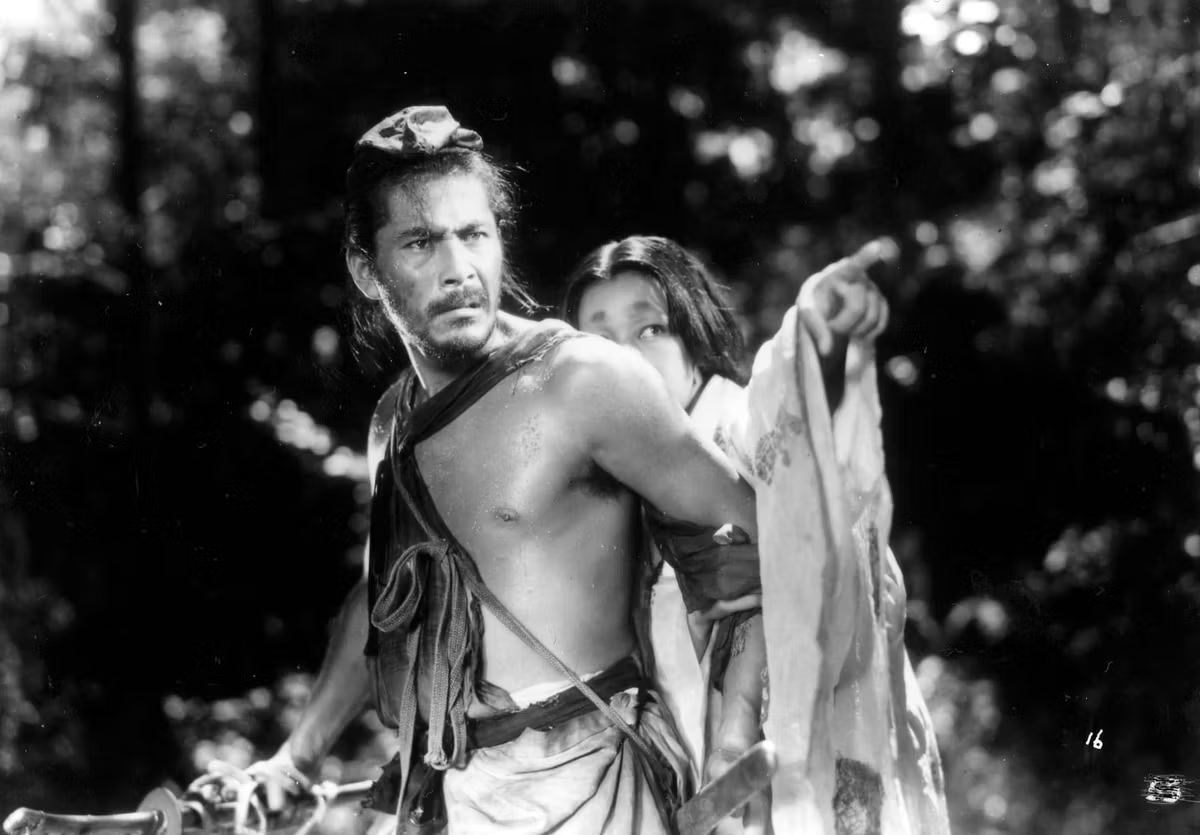
On December 1st, 2022, Sight & Sound magazine published “The Greatest Films of All Time,” a poll that’s been updated every 10 years since Bicycle Thieves topped the list in 1952. It is the closest thing movies have to a canon, with each edition reflecting the evolving taste of critics and changes in the culture at large. It’s also a nice checklist of essential cinema. Over the course of many weeks, months, and (likely) years, we’re running through the ranked list in reverse order and digging into the films as deep as we can. We hope you will take this journey with us.
Rashomon (1950)
Dir. Akira Kurosawa
Ranking: #41 (tie)
Previous ranking: #26 (2012), #13 (2002), #118 (1992), #108 (1982), #29 (1972).
Premise: At an unspecified moment in Japan’s Heian Era, a woodcutter (Takashi Shimura), a Buddhist monk (Minoru Chiaki) and a commoner (Kichijirō Ueda) take shelter in what’s left of the Rashōmon gate outside Kyoto. The woodcutter and the monk recount the story of a horrific crime about which each has offered testimony at a recent trial. The film then depicts this story from the perspectives of each character involved in the incident. Undisputed in each account is that a bandit named Tajōmaru (Toshiro Mifune) has raped a woman named Masago (Machiko Kyō), the wife of a samurai named Kanazawa (Masayuki Mori). Also undisputed: that Kanazawa died in the events following this rape. But the real truth of what happened remains unclear.
Keith: Scott, I think that, being who we are, we may as well acknowledge The Simpsons’ Rashomon joke up top to get it out of the way. This is from the 10th-season episode “Thirty Minutes Over Tokyo”:
I don’t doubt that many watching the episode did not get the joke, but its presence still suggests just how synonymous Rashomon has become with elusiveness of truth and the human tendency to remember events in the ways that best suit them. Co-written by Akira Kurosawa and his frequent collaborator Shinobu Hashimoto, the film’s restaging of the same events has been much imitated over the years. I first encountered the approach via an episode of Diff’rent Strokes in which different characters offer varying accounts of a failed burglary attempt. (A little research reveals it was even titled “Rashomon II.”) Yet I don’t think familiarity and homage have diminished the original’s impact.
Enjoying The Reveal? Now's a great time to become a paid subscriber. You'll get access to everything we publish—from articles to audio commentaries—and help support independent film criticism.
That’s in part because Rashomon immediately establishes that it’s about much more than one sordid event by the framing device, which takes place at the gate that marked the division between the civilization of Kyoto and the ungoverned world beyond its city limits. But the gate has fallen into deep disrepair, as did the real Rashomon, which became a place with a bad reputation by the 12th century. That detail about it being used to stash bodies is taken from history. That Rashomon also depicts it as a place where one might abandon a baby makes it a kind of perverse embodiment of the circle of life. But here it’s also a big, powerful symbol, not just of the fragility of human civilization but the notion that humanity itself has any kind of nobility that sets us apart from the animals.
At the heart is a story that allows the film’s earnest, young monk to question his faith. But it’s not the story itself that forces this crisis, as awful as the tale of rape and murder is, but the way the trial unsettles the notion of truth itself. Each participant—even the one speaking from the spirit world, where he seemingly has nothing left to lose—can only present an account that casts him or her in the most favorable light. But I think what so unsettles the monk is not the revelation that people lie or that they tell a version of the truth that reflects their own interests. Because, duh. It’s the revelation that there’s no way of getting at the truth except by telling stories and that all narrators are unreliable narrators. And that many, maybe all, those narrators tell stories filled with lies and evasions even when they don’t realize that’s what they’re doing. The human search for truth and meaning is itself built on the false assumption that we can see it at all. Like the gate used for the framing device, it’s doomed to fall apart no matter how sturdy it appears at first.
Scott, apologies for kicking this off with some thoughts on the big picture when so much of Rashomon’s power comes from the elements that make up that big picture: the ingenious narrative device, of course, but also the performances that shift between retellings, the lattice-like patterns of light and darkness created by the forest setting… I could go on but I’ll hand it over to you by asking what beyond the clever, much-imitated structure makes this film work?
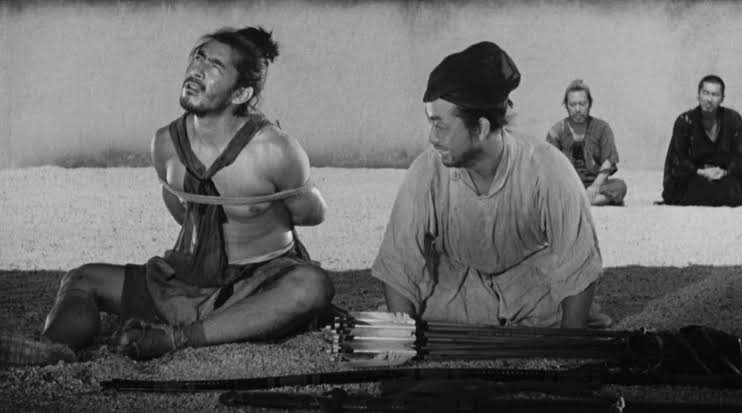
Scott: I’m glad you ask that question, Keith, because I think I’m as guilty as anyone else in thinking about Rashomon in terms of its structure and themes rather than its direction, because there are so many other Kurosawa movies (Ran, Throne of Blood, High and Low, et al.) that are so much more immediately striking for their cinematic bravado. Yet there are many visual touches here that give the film its dramatic punch, starting with the rain-soaked ambience of the Rashomon gate itself, where the woodcutter, the monk, and the commoner sit in a kind of symbolic purgatory until the downpour stops and the sun comes out. (When Ran came out, I remember often joking that what made Kurosawa such a singular director is that he can control the weather.)
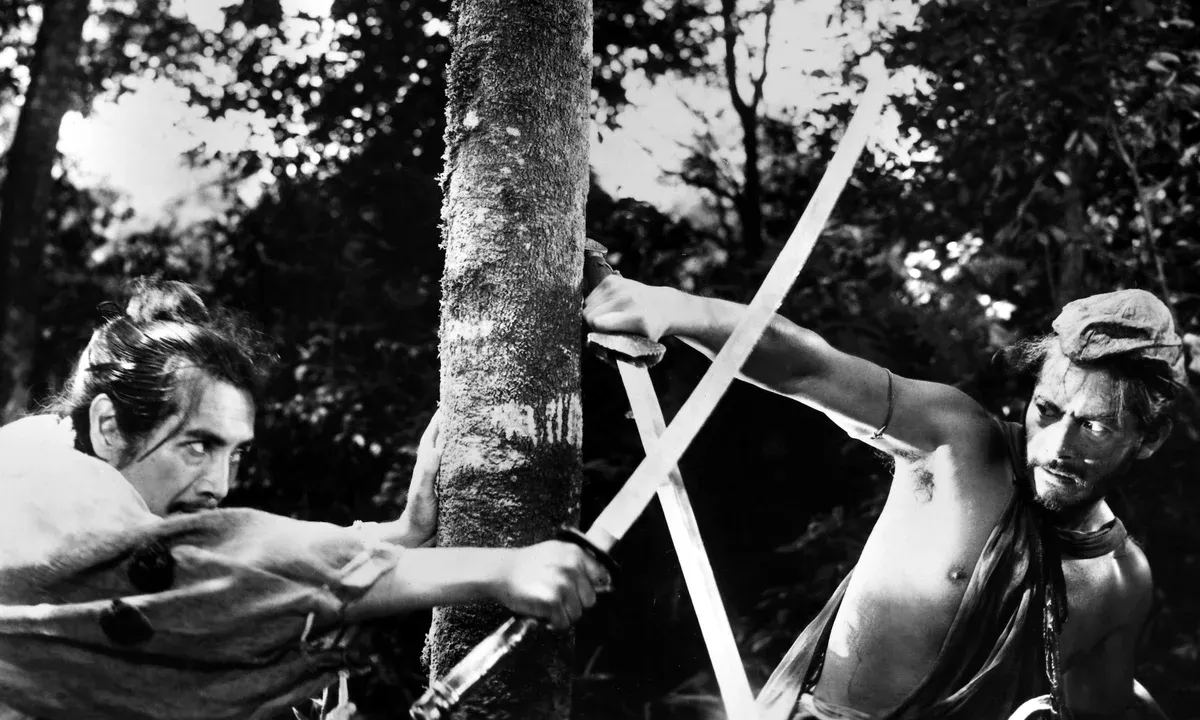
A few other aspects of the staging stand out, too: One is how elegantly Kurosawa lays out the crime scene initially, following the woodcutter through the forest in exhilarating tracking shots until he comes upon the wife’s hat and veil in the tree, and then makes his way through the rest of the physical evidence as if it were a trail of breadcrumbs. As a viewer, Rashomon puts us in a position that’s like a juror on a trial, examining evidence and conflicting testimony in order to arrive at some plausible construction of the truth. For the film to work, Kurosawa has to set the scene clearly and compellingly enough for us to imagine the various scenarios we’re being offered by this series of unreliable narrators. He does that beautifully.
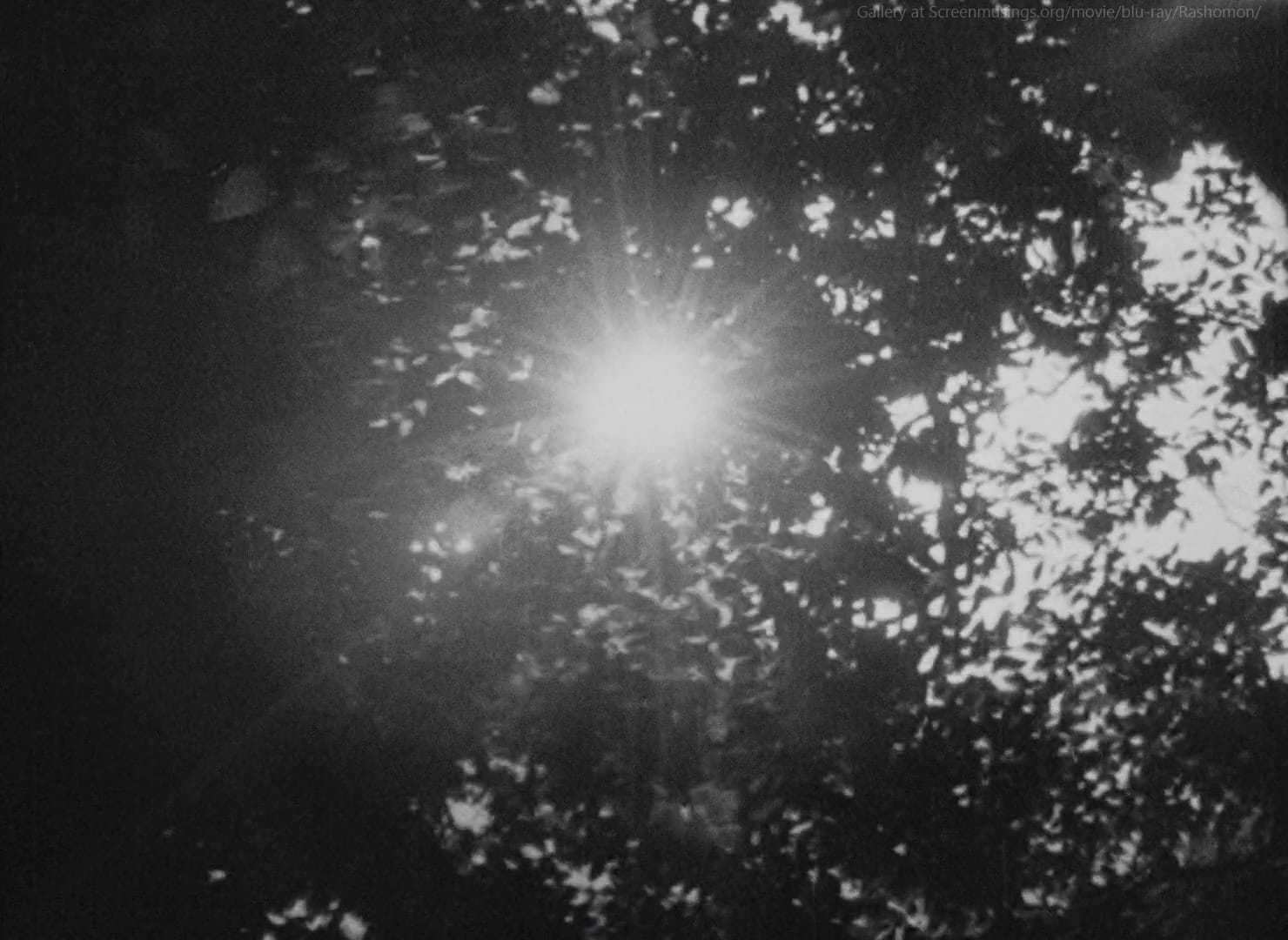
My other notes on the visual details are smaller: I admire the simple effectiveness of the scenes where the three witnesses give their official testimony, because we only see the witness in the foreground and the woodcutter and the monk in the background. Whatever else might be present in that scene, like the judge and/or inquisitor asking the questions, is not included. I also think the one dramatization we get of the rape is remarkably powerful, particularly Kurosawa’s choice to cut away to the wife’s point-of-view, which is looking straight up through the treetops with the sunlight trickling around the leaves. It suggests a combination of helplessness and disassociation that extends beyond the physical violation.
To shift back to the bigger picture here, Rashomon is not necessarily my go-to Kurosawa film—I’m a High and Low guy, and Ran really hit me at a formative moment—but it reminds me so much of Hitchcock’s Rear Window as a foundational movie, one that shows you how storytelling itself works. Maybe it is a “duh” that people tell the truth in the self-serving way that they perceive it, but how Kurosawa and Hashimoto circle back to those three witness accounts—plus, more crucially, the woodcutter’s seemingly “objective” story, which he didn’t disclose in the trial—makes you reflect on how difficult it can be to land on the real story. We’re put in the odd position of understanding the perspective of all these unreliable narrators without actually being able to triangulate a definitive version of what happened.
I have some more thoughts on the philosophical nuggets that are dropped throughout Rashomon, but I’m curious to hear any other standout moments for you, Keith, and how the film might fit in Kurosawa’s career more broadly. I’m fascinated by the wild see-saw the film seems to have taken up and down the Sight and Sound poll over the years, too. Did we not care about the nature of truth as much in ‘80s and ‘90s as much as the early ‘00s? You can sometimes point to a big restoration/re-release to understand why a film suddenly spikes in the poll like this one (e.g. Killer of Sheep), but I’m at a loss here.
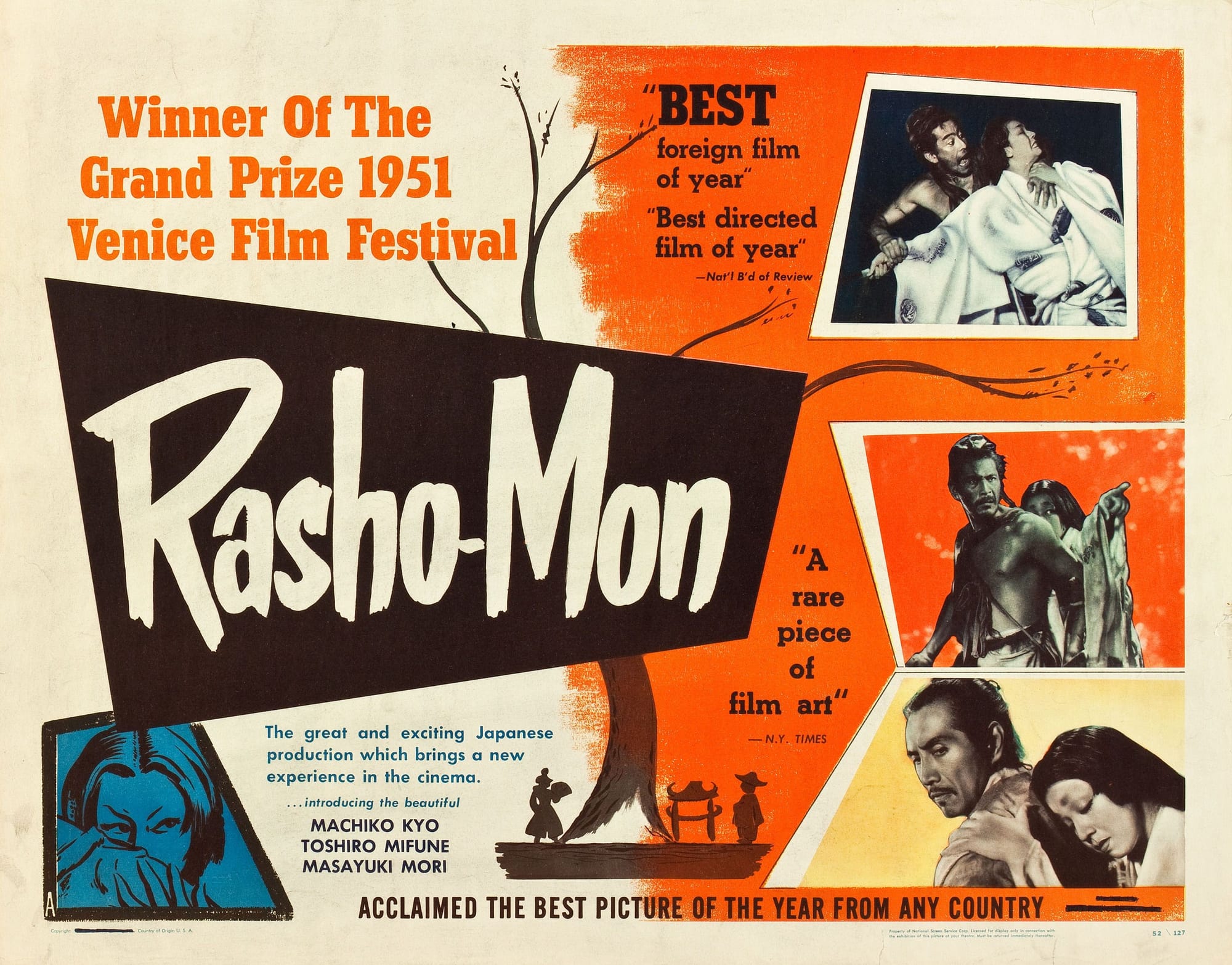
Keith: I wonder if it’s a case of particular phases of Kurosawa’s career going in and out of fashion? The two films that made this list come from the 1950s. And while that’s undeniably Kurosawa’s most artistically fruitful (and just plain fruitful) phase, it’s not the only decade in which he did remarkable work. (Ran lands at #185.) Or maybe the consensus taste has settled on his jidaigeki films as the most representative of his work, which leaves your beloved High and Low (not ranked) and the great Ikiru (#147) as outliers. Or perhaps just Kurosawa himself going in and out of fashion? I’m not sure if that’s the case, since his influence remains pretty much everywhere, thanks to all the American blockbuster directors influenced by his work and the films they in turn inspired.
It’s a bit of a head-scratcher, but I do wonder if Rashomon might have a secure place in the top 50 going forward. It seems so central not just to Kurosawa’s career or post-war world cinema but to the way the understanding of the world itself shifted in the second half of the 20th century. On the film’s audio commentary, Donald Richie argues that Rashomon’s central concern isn’t dramatizing that people lie to make themselves the hero of their own story but how everyone creates their own reality unknowable to and irreconcilable with the reality of others, a theme that’s only grown more relevant over the decades.
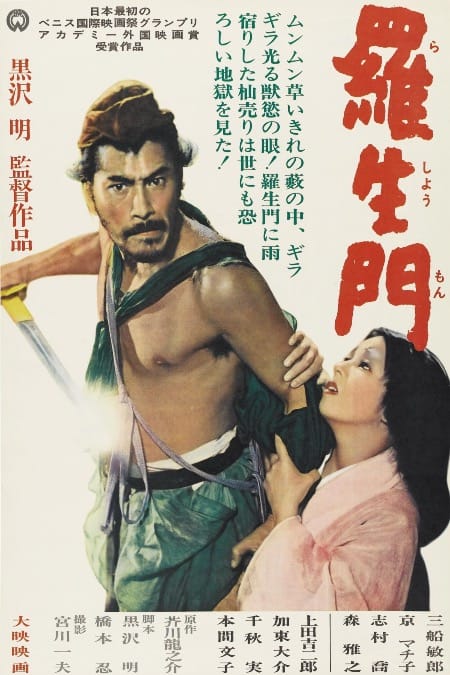
As for how Rashomon fits into the rest of Kurosawa’s career, on a thematic level you can see deluded characters and shattered notions of reality in everything from I Live in Fear to Seven Samurai (where Mifune plays a character who insists he’s a samurai despite his humble origins, then sort of wills that identity into being through his actions) to Ran. Kurosawa was also interested in exploring the gap between the ideal and the reality of the samurai class and, by extension, its role in shaping Japanese identity. (It’s worth noting that Hashimoto also scripted Masaki Kobayashi’s Harakiri, which essentially attempts to blow up the samurai ideal and all it represents.) Here, Mori (who was the biggest name in the cast at the time) plays Kanazawa as a man who looks the part of the noble samurai but whose actions don’t live up to what a samurai is supposed to be, even if he is a victim in every version of the story.
As for standout moments, I’m always in awe of how big Mifune plays Tajōmaru without going over the top. (I know others might see that performance differently.) Would it surprise you to learn that, with Kurosawa’s encouragement, he studied animal behavior, specifically lions and monkeys, to prepare for the role? I more or less knew what Rashomon was about before I saw it for the first time, but I think with Tajōmaru’s account of his duel, Kanazawa provides an early clue that he might not be a reliable narrator even before we get the first conflicting account. He’s a brute who sees himself as Robin Hood. And, like you, I was struck by the care put into every detail. The trial shots, for instance, in which the character being questioned is positioned in the foreground while the woodcutter and the monk react in the background creates some memorable moments. Watch Shimura’s face when the medium channeling Kanazawa’s spirit mentions the dagger. There’s a brief flash of panic before he regains his composure. Another highlight: the unsettling sequence in which the medium (Noriko Honma) speaks in Mori’s distorted voice, a deeply unsettling low-fi effect.
Scott, before we wind this down, has this revisit clarified why Rashomon made the list instead of other Kurosawas? Even beyond Ikiru, High and Low, and Ran we’ve mentioned, there are other Kurosawas that wouldn’t feel out of place on a list of all-time great films. The Seven Samurai still awaits us, but I think you could easily make a case for Throne of Blood and Yojimbo. But Rashomon feels undeniable to me. It’s a film only Kurosawa could have made that gets at a universal truth via a route only Kurosawa could guide us.
Scott: I understand its presence on the list ahead of other Kurosawas, because part of big canonical lists like Sight and Sound is noting work that’s more than just great, but has a larger sphere of influence. For example, I’d been meaning to write a piece on Brian De Palma’s Casualties of War for a long time now, because it’s such a remarkable benchmark in his career and among war movies more broadly, and Rashomon, another drama about rape and murder and the deceptive storytelling around it, prompted me to finally do it. (The piece runs tomorrow.) But like I said with Rear Window—a film that’s ranked barely ahead of Kurosawa’s on the list—Rashomon has the quality of a meta-narrative in that it encourages us to be conscious of how stories are told. And while it didn’t invent the framing device, I can’t think of many more effective examples of it—how it not only transitions us in and out of the narrative through the striking image of these rain-soaked ruins, but establishes the monk’s disillusionment about humanity as its most important theme.
To that end, there are a few individual lines that stood out to me most notably one from the scene after we’ve heard the fourth and final testimony, as the woodcutter has finished describing the incident to the commoner and the monk. I think we’re prepared to accept the woodcutter’s account as the truest one, because he was a witness to the event rather than an active participant. But when he’s done telling his side of the story, the commoner laughs and questions its veracity. (The last line before the commoner leaves, “If you’re not selfish, you can’t survive,” is breathtaking in its cynicism.) The monk recoils from this conclusion and says, “If men don’t trust each other, the Earth might as well be hell.”
One thing that I think about all the time in our present historical moment is what it’s like to live without a shared truth. To echo the monk’s words, if we can’t all acknowledge some basic, agreed-upon facts—if we’re so caught up in affirming our own biases, regardless of the truth—then we are indeed lost. What can you talk about when a reality that’s plain as day to you is refused by your neighbor? Rashomon takes us to the precipice of this “hell” before drawing back from the edge in the final moments, when the monk’s faith in humanity is restored by the woodcutter opting to take in the abandoned baby as one of his own. The woodcutter’s selfless act doesn’t negate all that we’ve learned about this incident and the conflicting testimony surrounding it. But it does at least signal that people are capable of looking past themselves and empathizing with the plight of others, which is a glimmer of hope.
One other random line before I go: There’s an exchange in the framing story between the commoner and the monk that expresses some of the film’s themes. The commoner talks about how we can’t even be honest with ourselves most of the time, to which the monk replies that men lie because they’re “weak.” Then the commoner says, “I don’t care if it’s a lie, as long as it’s entertaining.” Quite a comment on storytelling, I think, in the context of a movie where different accounts are competing for our attention. We like the stories that appeal to us the most, not necessarily the most truthful ones.
Heavy stuff, Keith, so I’m grateful for the chance to switch gears to a movie that’s not at all heavy for our next conversation: Billy Wilder’s Some Like It Hot.
Previously:
#95 (tie): Get Out
#95 (tie): The General
#95 (tie): Black Girl
#95 (tie): Tropical Malady
#95 (tie): Once Upon a Time in the West
#95 (tie): A Man Escaped
#90 (tie): Yi Yi
#90 (tie): Ugetsu
#90 (tie): The Earrings of Madame De…
#90 (tie): Parasite
#90 (tie): The Leopard
#88 (tie): The Shining
#88 (tie): Chungking Express
#85 (tie): Pierrot le Fou
#85 (tie): Blue Velvet
#85 (tie): The Spirit of the Beehive
#78 (tie): Histoire(s) du Cinéma
#78 (tie): A Matter of Life and Death
#78 (tie): Celine and Julie Go Boating
#78 (tie): Modern Times
#78 (tie): A Brighter Summer Day
#78 (tie): Sunset Boulevard
#78 (tie): Sátántangó
#75 (tie): Imitation of Life
#75 (tie): Spirited Away
#75 (tie): Sansho the Bailiff
#72 (tie): L’Avventura
#72 (tie): My Neighbor Totoro
#72 (tie): Journey to Italy
#67 (tie): Andrei Rublev
#67 (tie): The Gleaners and I
#67 (tie): The Red Shoes
#67 (tie): Metropolis
#67 (tie): La Jetée
#66: Touki Bouki
#63 (tie): The Third Man
#63 (tie): Goodfellas
#63 (tie): Casablanca
#60 (tie): Moonlight
#60 (tie): La Dolce Vita
#60 (tie): Daughters of the Dust
#59: Sans Soleil
#54 (tie): The Apartment
#54 (tie): Battleship Potemkin
#54 (tie): Blade Runner
#54 (tie): Sherlock Jr.
#52 (tie): Contempt
#52 (tie): Ali: Fear Eats the Soul
#50 (tie): The Piano
#50 (tie): The 400 Blows
#48 (tie): Wanda
#48 (tie): Ordet
#45 (tie): North by Northwest
#45 (tie): The Battle of Algiers
#45 (tie): Barry Lyndon
#43 (tie): Killer of Sheep
#43 (tie): Stalker
#41 (tie): Bicycle Thieves
You might also like
#36 (tie): ‘City Lights’: The Reveal discusses all 100 of Sight & Sound’s Greatest Films of All Time
#38 (tie): ‘Rear Window’: The Reveal discusses all 100 of Sight & Sound’s Greatest Films of All Time
Discussion