#41 (tie): ‘Bicycle Thieves’: The Reveal discusses all 100 of Sight & Sound’s Greatest Films of All Time
With his neorealist masterpiece, Vittorio De Sica depicted post-war Rome as a city filled with residents on the verge of poverty, despair, but filled with an inextinguishable desire to push on.


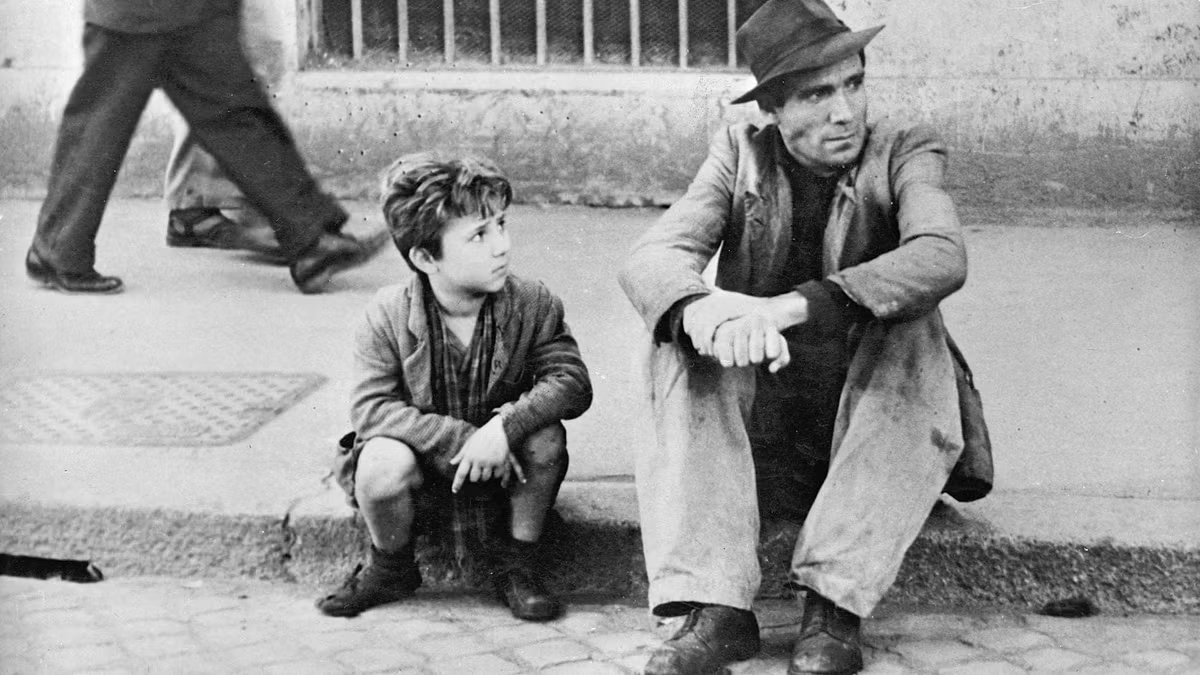
On December 1st, 2022, Sight & Sound magazine published “The Greatest Films of All Time,” a poll that’s been updated every 10 years since Bicycle Thieves topped the list in 1952. It is the closest thing movies have to a canon, with each edition reflecting the evolving taste of critics and changes in the culture at large. It’s also a nice checklist of essential cinema. Over the course of many weeks, months, and (likely) years, we’re running through the ranked list in reverse order and digging into the films as deep as we can. We hope you will take this journey with us.
Bicycle Thieves (1948)
Dir. Vittorio De Sica
Ranking: #41 (tie)
Previous ranking: #33 (2012), #6 (2002), #12 (1992), #6 (1962), #1 (1952)
Premise: Set in Rome during the aftermath of World War II, where unemployment is high and the streets are still pocked from battle, Vittorio De Sica’s neorealist classic follows Antonio Ricci (Lamberto Maggiorani), a common laborer desperate for work of any kind. When he lucks into a job pasting posters for the city, Antonio is initially elated until he learns that owning a bike is a prerequisite. Having already pawned his bike during a particularly fallow period for his family, Antonio gets it back when his wife Maria (Lianella Carell) sells her dowry bedsheets to get it back. But while Antonio glues up a Rita Hayworth poster on his first day, two thieves steal the bike, sending Antonio and his son Bruno (Enzo Staiola) on an impossible needle-in-a-haystack quest through the city to track it down.
Scott: Keith, we did it. We reached the number one movie on the Sight and Sound list… from 1952. The very first poll, according to the site, invited 85 critics from Europe and the United States to participate and of the 63 who agreed to do it, Bicycle Thieves topped the poll with 25 votes, easily besting the 19 split among two Charlie Chaplin films, City Lights and The Gold Rush. (We still have City Lights coming up, but The Gold Rush did not even crack the Top 225 in the 2022 poll! Modern Times, which we covered at #78, has replaced it in critical estimation.) The remarkable—and, in my opinion, pertinent—fact about Bicycle Thieves is that 63 critics were so impressed by a film that had come out only four years earlier that they considered it the greatest of all time. When I reflected on the 2022 poll and the rationale behind the ballot I submitted for it, I talked about my reluctance to include newer movies, because I still wanted to “identify those watershed moments that changed the medium forever” and those are usually titles that have stood the test of time.
But what if film critics in 1952 were right to identify Bicycle Thieves as a watershed moment that quickly? Italian neorealism didn’t start with Bicycle Thieves—that credit usually goes to Luchino Visconti’s excellent 1943 film Ossessione, a Postman Always Rings Twice adaptation that’s grounded in social realism—and a number of other classics predated the film, too, including De Sica’s own 1946 film Shoeshine and Roberto Rossellini’s Rome, Open City. Yet Bicycle Thieves was a true international sensation, picking up an Honorary Oscar in 1949, and would become the defining film of a movement that emphasized certain principles (location shooting, the use of nonprofessional actors, a heightened social consciousness, etc.) that would change the medium forever. As far as I can tell, A.O. Scott didn’t even have a particular prompt to write the essay, “Why You Should Still Care About ‘Bicycle Thieves’” in 2020, but he points to American indie films like Ramin Bahrani’s Chop Shop and Kelly Reichardt’s Wendy and Lucy as examples of the film’s enduring influence.
Enjoying The Reveal? Now's a great time to become a paid subscriber. You'll get access to everything we publish—from articles to audio commentaries—and help support independent film criticism.
I’d point to a little over a month ago, Keith, when we talked about Charles Burnett’s 1977 film Killer of Sheep, which now ranks right alongside the De Sica film. I’m thinking specifically of the sequence when the main characters, a married couple living hand-to-mouth in Watts, pile into a car with their friends and drive out of the city for the day. Their plans are completely foiled when they get a flat tire and don’t have a spare, which is about as clean a metaphor for poverty as you could imagine. Given the amount of scrimping and saving our hero has to do just to buy a used engine at one point—an engine that tumbles off the bed of a pick-up truck immediately—we can see that the poor don’t have the luxury of an emergency back-up plan. When Michelle Williams’ car stalls out at a random town in Wendy and Lucy, too, it’s over for her. She can only act out of desperation.
That’s the basic situation that Antonio finds himself in when his wife pawns off her dowry bedsheets to buy back the bicycle that he needs for his job. (One incredible shot among many: The glimpse Antonio gets of the ceiling-high stacks of bedsheets in the pawn shop’s storage room, evidence that many former brides like Maria have had to sacrifice a precious luxury from their wedding day.) The bike is his family’s only ticket to sustainability and he’s so grateful to have it back that he carries it into the administrative office that’s handling his new job assignment. But he has to leave it unguarded when he’s up on the ladder pasting posters—of the unfathomably glamorous Rita Hayworth, which is a statement in itself—and the bike gets taken out from under him, which is a catastrophe.
Watching Bicycle Thieves for the first time in decades, so many new things stuck out for me that maybe I didn’t appreciate as a younger person. But one thought I had was that Antonio’s decision to steal another person’s bike at the end brings the film full circle, right? We don’t know the circumstances of the original thieves, though it does seem to be a criminal scheme rather than an impulse decision, yet who can be sure that they’re men of lesser nobility than Antonio? If we followed them around instead, I’m guessing we’d also discover a story of desperate people who are finding some way to survive. At the same time, De Sica makes Bicycle Thieves into a searing commentary on post-war Italian society, where any sense of common cause has been abandoned and people are reduced to hostility and tribal resentment. When Antonio finally succumbs to that environment, it’s one of the most heartbreaking moments in cinema.
I have a lot more to say about De Sica’s depiction of Rome, but I want to throw it over to you first, Keith. What stood out for you about Bicycle Thieves this go-around? I remembered the film as sentimental, which it is to an extent, but I don’t think I appreciated until now what a tough, even cynical portrait of post-war Italy it actually is. (That’s how I remember De Sica’s Umberto D., so I guess it tracks.) What are your impressions of the world De Sica created for the film? And what about his artistry in doing it?
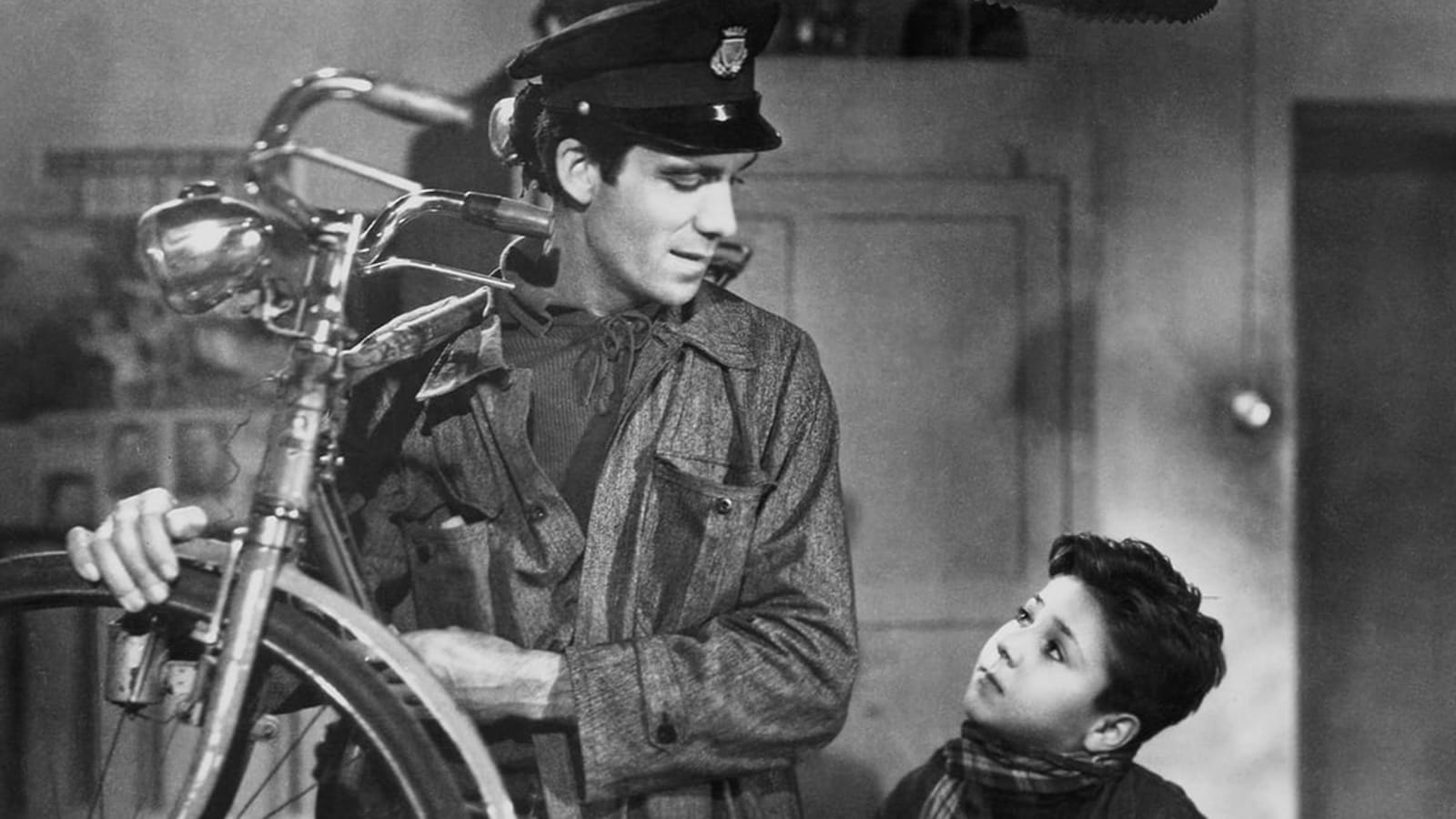
Keith: Scott, every time I watch this movie I find myself hoping maybe this time Antonio’s bike won’t get stolen. Then, later, I hope that he doesn’t choose to steal the bike. It’s irrational, I know, but the film so effectively draws viewers into Antonio’s sense of pride at finding a job and getting an opportunity to support his family through honest work and his desperation when that opportunity is quite literally snatched away from him that it’s easy to forget art is fixed and unchangeable. The bike is always going to get stolen. Antonio’s always going to become a bicycle thief himself.
If there’s sentimentality—and, to be clear, I don’t think there’s anything wrong with a little sentimentality—it’s entirely tied to the relationship between Antonio, Maria, and Bruno. But there’s a toughness even to this. In one of the film’s saddest moments, Antonio smacks Bruno, who clearly idolizes him, leading him to keep his distance. It’s the sort of childhood memory that doesn’t go away, and it seems likely Bruno will never look at his father the same way again, even before he sees him steal a bike then be shamed for it by an angry crowd. There’s no reason to doubt Maria’s love, but we see her optimism fade over the course of the film. Then, after a certain point, we don’t see her at all, nor do we see Antonio’s friends. In the end, only Bruno is by his side, and even their relationship has changed profoundly over the course of a single day.
I think you’re right to call Bicycle Thieves a world De Sica has created, even though much of it he found by stepping out into the streets of Rome. The artistry is in what he chooses to show and how he chooses to show it. That’s not a profound observation, I know, but I think it can be a little too easy to underestimate a creation when it’s, by design, this humble-seeming. But look at how vast Rome appears at the moment when the bicycle thief makes his escape. And the way De Sica frames Antonio’s face against the sky from a low angle, letting us see him from Bruno’s perspective. Or the shots of the bicycles at the market or outside the soccer stadium. It’s a world of abundance, for some. Others can only look.
De Sica probably wasn’t thinking about how Bicycle Thieves would look nearly 80 years later, but the years since its release have only made the accomplishment seem greater. The film captures a sense not just of how post-war Rome looked but what it was like to live there, and specifically to live on its margins. The phrase “tribal resentment” is an apt one. In more than one scene, Antonio meets hostility because he’s an outsider to the neighborhood in which he’s visiting. Their residents’ bonds never seem tighter than when they’re attempting to cast him out. For all the humanism on display in the movie, there’s a touch of pessimism, too. Those on the lower reaches of society have to fight one another for what few resources are available and nothing in the film suggests that will change. In the end, Antonio mercifully evades arrest, but now what? Chaplin concluded Modern Times—to cite one of the Chaplin masterpieces that didn’t make the 1952 poll—on a similarly downbeat note but added a sunny grace note before fading to black. Here we get the sense that Antonio will persevere. How remains unclear.
One thing I like about this movie is that it doubles as a tour of post-war Rome, not just in the way it films big public spaces, but in the private spaces Antonio and Bruno visit, like the church/charity house, the brothel, and the straight-talking fortune teller’s chambers. Scott, what about these moments stand out for you and what do they contribute to the story? Also, is there any reason not to be bummed out by this film’s ending?
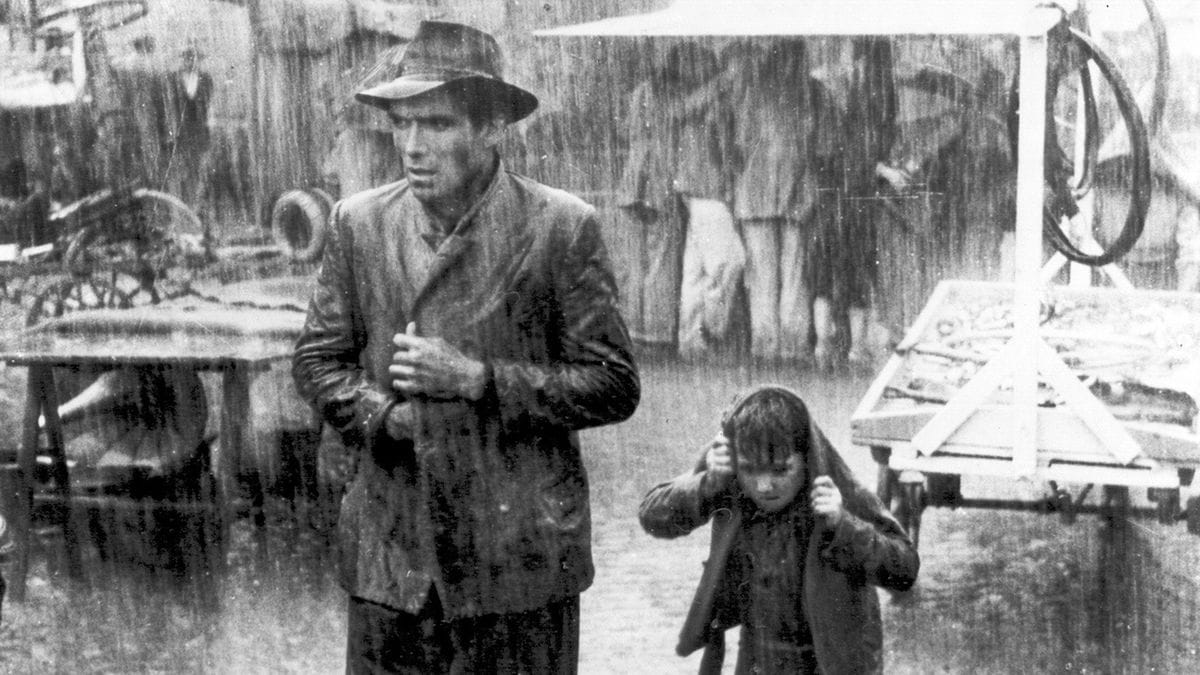
Scott: Watching Bicycles Thieves again, I’m struck by how much post-war cinema worldwide, from the American noir to Italian neorealism, was defined by cynicism and despair, as well as a prevailing feeling of societal unrest. We’ve already discussed such an environment in the Vienna of The Third Man, where borders are being redrawn and the Allied piece of the city is rife with black market activity and lawlessness. It’s a place where opportunistic scoundrels like Harry Lime can thrive, at least until order is restored. But that’s not quite the situation in the Rome of Bicycle Thieves, which is similarly unsettled but defined more by a combination of desperation and discord. You can see physical evidence of a damaged city in De Sica’s location shooting, and you can imagine, too, the reckoning that Italians were facing as a result of their participation (and loss) in the war. The war’s end, the film plainly implies, was not a unifying event for the culture.
You ask for standout moments and I’ll immediately point to the scene where Antonio takes Bruno out for a mozzarella sandwich that he cannot afford. The scene happens in the wake of Antonio striking the boy, so the restaurant visit arises from his guilt over that low moment, along with a deeper despair over the impossible task of tracking down the stolen bike and resuming a job that will keep the family afloat. Bruno is a perceptive boy, but he doesn’t seem to realize any of the darker motives for his father taking him to this high-end restaurant. He just enjoys the live band and the long string of melted cheese hanging off his sandwich, which is the only item on the menu his dad can afford. De Sica then gives us a moment where Bruno trades glances with a well-to-do boy at the next table, who has access to a more generous spread and who sizes up Bruno quickly as not in the same class. Antonio recognizes it, too: “To eat like them,” he says “you’d have to earn a million lira a month.”
I’m also struck by the two scenes we get of the “Holy One,” the fortune teller who occupies a large apartment and collects fees from the suckers who believe she possesses some special insight. (In Pee-wee’s Big Adventure, a film more heavily indebted to Bicycle Thieves than I realized, she would be the seer who tells our hero that his missing bicycle is in the basement of the Alamo.) When Antonio gets the bill-posting job, his wife feels like she needs to pay this woman for her spiritual contribution, but Antonio is irritated by the gesture and De Sica seems to be on his side. Scam artists thrive most in destabilized societies, when the poor are searching for some kind of answer to their problems, and the film reveals that faith can be a predatory business, too. Between the coins Maria offers to the fortune teller and the money Antonio spends at the restaurant—not to mention a bike that costs more than they sold it for—we’re made acutely aware of how much every lire matters to this family. You can see it on Bruno’s face at the restaurant, too: No boy has ever appreciated a simple cheese sandwich more, but the moment he becomes aware of how little money they have in relation to the wealthy family at the restaurant, it must taste like ash in his mouth.
As for your question about the bummer of an ending, I don’t see any kind of silver lining here, other than maybe some spark of understanding on Bruno’s part about why his father would do such a shameful thing. I had forgotten plenty about Bicycle Thieves in the two or three decades since I’d seen it last, but three images in the climax remain seared in my memory: That dramatic push-in on Bruno as his father zips by on the stolen bike with other men in close pursuit; the look on Antonio’s face as he stands in the middle of an angry mob, absorbing their fury with shame and resignation; and, of course, the shot of Antonio crying as he holds Bruno’s hand and shuffles forward toward an uncertain (and likely bleak) future. You could perhaps see some hope in the mob’s merciful decision just to let Antonio go, but the tone seems to be that a man like him isn’t worth their attention.
De Sica wasn’t done critiquing post-war Italian society after Bicycle Thieves, either, because he’d later direct the equally brilliant Umberto D., a film about an old man’s journey through a system that doesn’t care about his plight. But there’s humanity here, right Keith? What are these De Sica films but a plea for audiences to right social wrongs and appeal to their better angels? Do you see some hope here? And what are we looking at next?
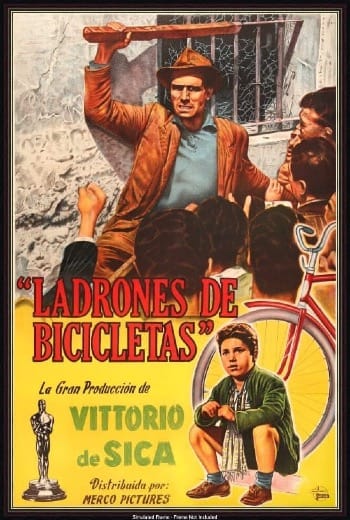
Keith: I think the humanity is the hope. Antonio ends the film having been laid low, but I don’t think he’s broken, just as I don’t think Umberto is broken at the end of Umberto D. Antonio and his family are victims of an unfair system, but I don’t think Bicycle Thieves suggests that situation has to be permanent and, yes, I think there’s a call to action woven into the text. If this isn’t your lot in life, what can you do to change the world for those whose lot it is?
To speak in the broadest possible terms, you won’t find an impassioned embrace of humanism, even in the midst of dire circumstances, in every film as part of that tremendous blossoming in international cinema that followed World War II, but you will find it in many of them. It’s one of the defining qualities of Sansho the Bailiff, to choose a film we’ve covered as part of this series, and it’s evident throughout other Italian neorealist films and elsewhere, even if it sometimes seemed to be locked in battle with more hopeless visions. (Sometimes from the same director: Kon Ichikawa’s dark but hopeful The Burmese Harp and the hellish Fires on the Plain, made just a few years apart from one another, offer a dizzying study in contrasts.) Bicycle Thieves is a sad, unsparingly clear-eyed film, but it’s not a despairing film. That’s an important distinction.
Also: I really want a mozzarella sandwich now. I should have time to consume at least one of those before we return in three weeks with a discussion of the other post-war masterpiece in the film’s #41 spot: Akira Kurosawa’s Rashomon. We’ll see you then.
Previously:
#95 (tie): Get Out
#95 (tie): The General
#95 (tie): Black Girl
#95 (tie): Tropical Malady
#95 (tie): Once Upon a Time in the West
#95 (tie): A Man Escaped
#90 (tie): Yi Yi
#90 (tie): Ugetsu
#90 (tie): The Earrings of Madame De…
#90 (tie): Parasite
#90 (tie): The Leopard
#88 (tie): The Shining
#88 (tie): Chungking Express
#85 (tie): Pierrot le Fou
#85 (tie): Blue Velvet
#85 (tie): The Spirit of the Beehive
#78 (tie): Histoire(s) du Cinéma
#78 (tie): A Matter of Life and Death
#78 (tie): Celine and Julie Go Boating
#78 (tie): Modern Times
#78 (tie): A Brighter Summer Day
#78 (tie): Sunset Boulevard
#78 (tie): Sátántangó
#75 (tie): Imitation of Life
#75 (tie): Spirited Away
#75 (tie): Sansho the Bailiff
#72 (tie): L’Avventura
#72 (tie): My Neighbor Totoro
#72 (tie): Journey to Italy
#67 (tie): Andrei Rublev
#67 (tie): The Gleaners and I
#67 (tie): The Red Shoes
#67 (tie): Metropolis
#67 (tie): La Jetée
#66: Touki Bouki
#63 (tie): The Third Man
#63 (tie): Goodfellas
#63 (tie): Casablanca
#60 (tie): Moonlight
#60 (tie): La Dolce Vita
#60 (tie): Daughters of the Dust
#59: Sans Soleil
#54 (tie): The Apartment
#54 (tie): Battleship Potemkin
#54 (tie): Blade Runner
#54 (tie): Sherlock Jr.
#52 (tie): Contempt
#52 (tie): Ali: Fear Eats the Soul
#50 (tie): The Piano
#50 (tie): The 400 Blows
#48 (tie): Wanda
#48 (tie): Ordet
#45 (tie): North by Northwest
#45 (tie): The Battle of Algiers
#45 (tie): Barry Lyndon
#43 (tie): Killer of Sheep
#43 (tie): Stalker

You might also like
#38 (tie): ‘Rear Window’: The Reveal discusses all 100 of Sight & Sound’s Greatest Films of All Time
#38 (tie): ‘Breathless’: The Reveal discusses all 100 of Sight & Sound’s Greatest Films of All Time
Discussion