#36 (tie): ‘M’: The Reveal discusses all 100 of Sight & Sound’s Greatest Films of All Time
Our trip through Sight & Sound's 100 greatest films stops at Fritz Lang's 1931 classic, in which a child murderer exposes deep fractures within the city he terrorizes.

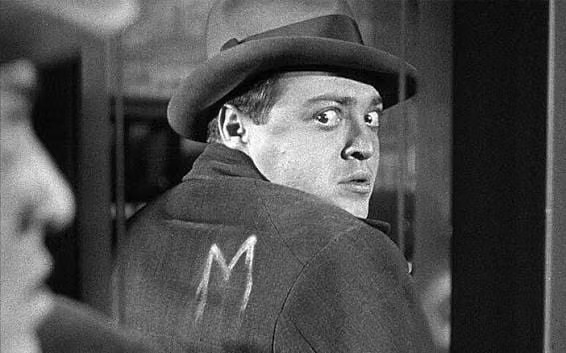
On December 1st, 2022, Sight & Sound magazine published “The Greatest Films of All Time,” a poll that’s been updated every 10 years since Bicycle Thieves topped the list in 1952. It is the closest thing movies have to a canon, with each edition reflecting the evolving taste of critics and changes in the culture at large. It’s also a nice checklist of essential cinema. Over the course of many weeks, months, and (likely) years, we’re running through the ranked list in reverse order and digging into the films as deep as we can. We hope you will take this journey with us.
M (1931)
Dir. Fritz Lang
Ranking: #36 (tie)
Previous ranking: #56 (2012), #26 (2002), #45 (1992).
Premise: In Berlin, a series of child abductions and murders have set the populace on edge, triggering a city-wide manhunt in search of the perpetrator, Hans Beckert (Peter Lorre), who continues to evade capture while seeking out new victims. As more children disappear and the police are more aggressive in investigating underworld networks, the crime bosses of Berlin’s “Ringvereine” are motivated to track down Beckert themselves, in defiance of law and order. Their vigilante tactics lead to a conflict with the authorities and an extra-legal solution for handling Beckert once they find him.
Scott: Where to even start with Fritz Lang’s M, Keith? We’re edging close to the top third of the Sight and Sound list, and it’s gotten to the point where the sheer audacity of the films continue to take your breath away, because they stand out so starkly from other work of their era. It’s exciting for our purposes that M came out in 1931, the same year as our last S&S entry, Charlie Chaplin’s City Lights, which found Chaplin defying the advent of sound by continuing to do silent comedy, albeit with some keenly placed sound effects to augment the action. Broadly speaking, the technical requirement of shooting in sound often limited what filmmakers could do with the camera, but that is absolutely not an issue with M, which Lang and his cinematographer, Fritz Arno Wagner, film with the graphically arresting flair we associate with the best of German expressionism. There are crane shots and dramatic camera movements, and even when the camera is still, they’re hitting you with overhead shots, odd angles, and bold shadow play—the sort of imagery you might expect from the director of Metropolis.
Enjoying The Reveal? Now's a great time to become a paid subscriber. You'll get access to everything we publish—from articles to audio commentaries—and help support independent film criticism.
Maybe that atmosphere is a good place to start with M, because it’s so critical to Lang’s thematic agenda. There’s a lot of detail put into the procedural elements of this story, as well as the psychological profile of Lorre’s child murderer, but I think M is foremost about German society itself and those tensions are part of the fabric of the filmmaking itself. M begins with children on a playground doing an “eeny-meeny-miny-moe” counting game, but the space is notably dark and unadorned and the song mythologies the boogeyman that’s been hunting kids their age. (“Just you wait, it won’t be long. The man in black will soon be here. With his cleaver’s blade so true. He’ll make mincemeat out of you.”) Shades of A Nightmare on Elm Street, no? The camera then pans up to an older woman hanging laundry on the balcony above, screaming at them to stop. In just this short sequence alone, Lang establishes the fact that these child murders have infiltrated the culture enough to where it’s been mythologized by potential young victims and suggests the pervasive fear that has gripped the city. (The line “As long as we hear them singing, at least we know they’re still here” is a dark one indeed.)
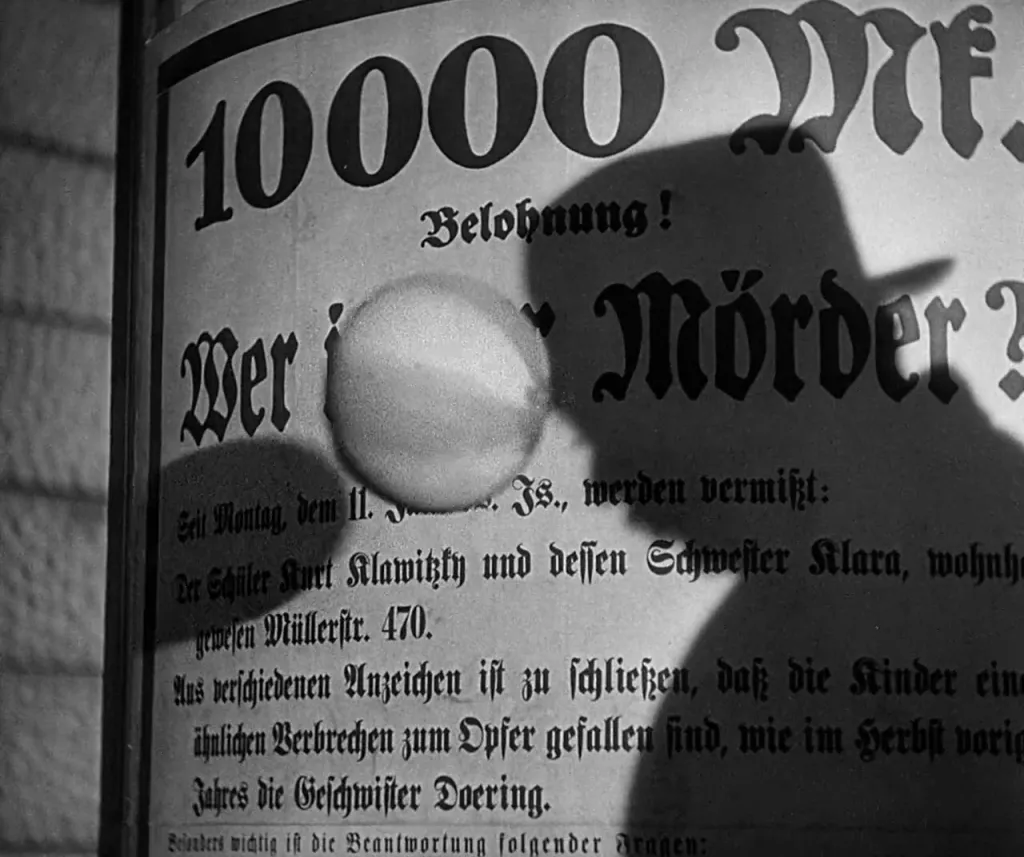
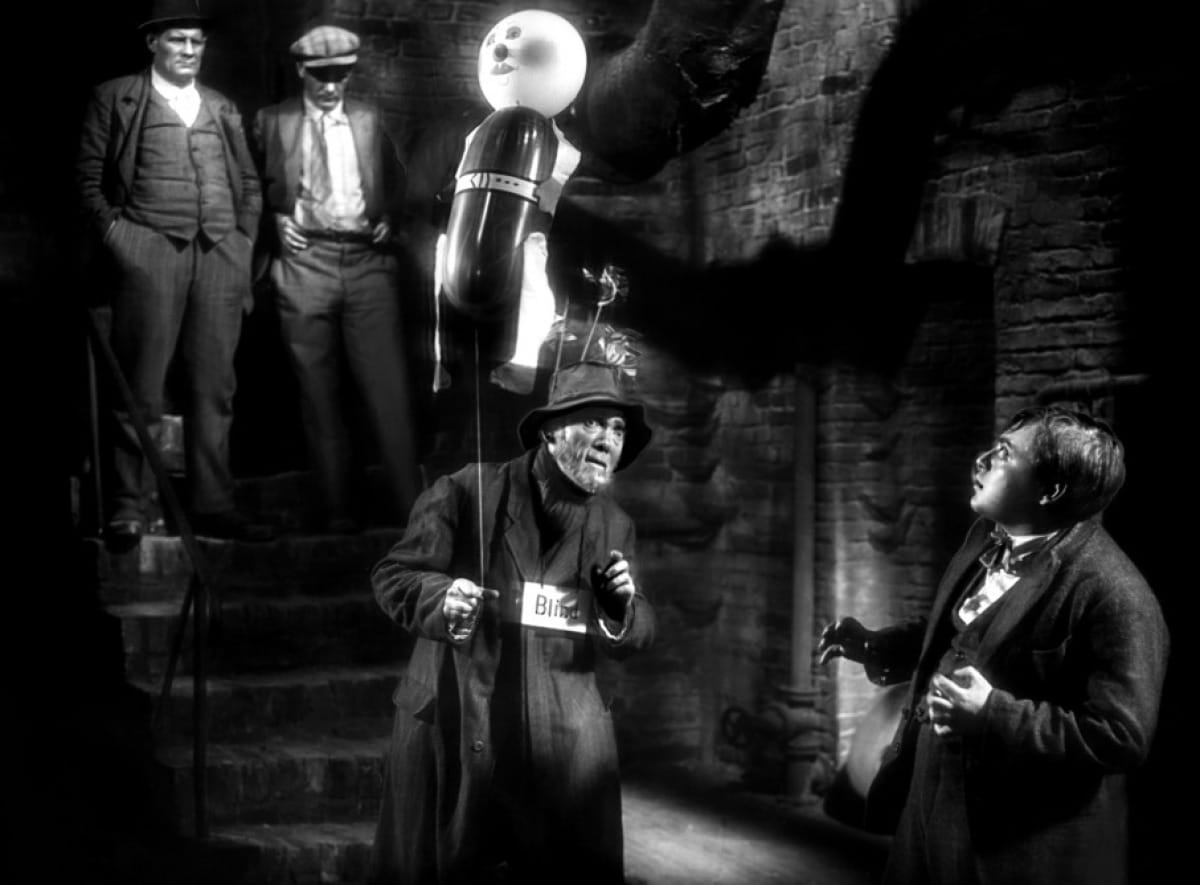
Lang continues to establish the situation through a thrillingly cinematic sequence that cuts between a mother preparing for her child, a little girl named Elsie, to return from school with the rest of her classmates. Meanwhile, we see Elsie innocently bouncing her ball along the street until she gets to a large pillar where a sign has been posted to warn citizens about the killer at large. Though Lang holds off on showing Lorre’s face until later, he gives us this chilling introduction where Beckert’s shadow extends across the pillar and we hear him complimenting her on her “pretty ball,” as if he were the Big Bad Wolf. From there, Lang introduces still another brilliant conceit with Beckert whistling “In the Hall of the Mountain King” as he’s buying her a balloon from a blind man. The sequence ends with a mother fretting over an empty place-setting at the dinner table and a shot of the balloon dancing in the telephone lines above. Elsie is gone.
With great efficiency and style, Lang is able to suggest a city that itself seems hijacked by this one looming menace, and I’m guessing that David Fincher was thinking about M quite a bit when he made Zodiac, which also evokes a moment when a serial killer had infiltrated the collective psyche of an entire urban area. (Both Beckert and the Zodiac Killer liked to communicate through taunting letters to the newspaper, too.) But Lang’s agenda goes beyond just establishing Beckert and the threat he represents to Berlin. He’s also curious about how society itself responds to such a threat, because to him it’s like a stress test that reveals fractures in the culture. Germany under the Weimar Republic was full of fierce political division and mutual suspicion, and Lang creates a scenario that exposes those flaws in the face of a serious challenge.
The separate investigations of the police and the criminal underworld are a major part of the story, of course, and it’s what ultimately leads to Beckert being put on trial in an extremely unofficial court. But I’m most struck by how Lang uses the tools of the medium to make Berlin itself alive with menace, which may be triggered by Beckert’s reign of terror but isn’t entirely owed to it. There’s no unified response among the citizenry but the opposite—an assumption that your neighbor may be the guilty party and zero willingness to extend the benefit of the doubt or unite in common cause. A father walking his child down the street, for example, starts to look to others like an abduction happening in plain sight, and you can see the accusatory glares and the mob mentality that starts to build around them. Beckert is a menace, but the response to him has a kind of multiplying effect on the entire city.
How does M play for you now, Keith? What stands out to you about Lang’s style and his take on this particular moment in German society? And I’m sure you have some thoughts on Peter Lorre’s legendary performance in the lead. It seems notable that he’s the only truly multi-dimensional character we get in this movie.
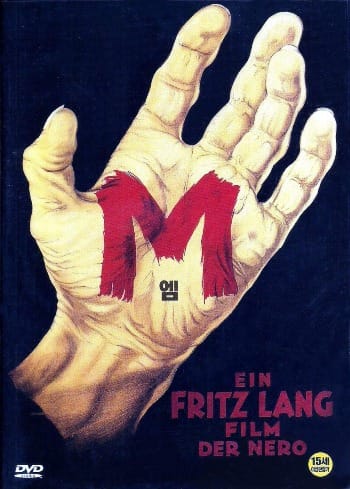
Keith: I know this is a weird place to start, but I’d forgotten how funny this movie is. I wouldn’t call it a funny movie. I’d call it “haunting,” “chilling” and a bunch of other similar adjectives first. But Lang and—credit where it’s due, however problematic—his co-writer Thea von Harbou pepper the grimness with little bits of humor. The way the “Ringvereine” conducts their criminal activities like a legitimate business (which the real “Ringvereine” apparently tried to do), the “beggars” (to use the film’s word) keeping careful inventory of what they’ve scavenged and noting which items they’re finding more frequently, the police inspector’s frustrating interaction with Beckert’s neighbor: all these contribute to making the setting feel like a real, bustling city and not just a nightmare version of Berlin. Without them, M might be unbearably grim. (Hey, that’s another good adjective for it!)
You mention Lang’s visual flair, Scott, and I could add on to that. But it’s worth considering the film’s excellent use of sound. This might not have occurred to me were it not for Kristin Thompson’s excellent “Observations on Film Art” video essay on the Criterion Channel, but Lang is blazing a trail with this film’s sound design. Where a lot of early talkies featured little sound beyond the dialogue, Lang gives us traffic sounds and street chatter. There are also innovative moments like the crooks finishing the cops’ thoughts in the sequence that cuts back and forth between them, as both groups try to figure out what to do with the threat in their midst.
I was particularly struck this time by the scene in which the police patrol the streets both for those stunning aerial shots but also because of the way Lang keeps the soundtrack silent and only gives us the visuals until the patrol reaches a turning point. Lang wasn’t the first director to take full advantage of film’s new dimension—All Quiet on the Western Front, released the year before, comes to mind as another example of a film in which the soundtrack is as crucial as any other element—but he was definitely on the frontier in ways that might not be obvious now.
I think you accurately describe how the film captures Germany as a place of tremendous unease. I have to wonder if this is something the film itself was meant to express or if it’s something we see in retrospect. Was Lang maybe just drawing on the atmosphere around him without trying to make a larger point about where Germany has headed? It doesn’t really matter, of course. It’s in the film one way or another. And those chilling final lines about protecting the children hit all the harder knowing what we know now. Do you know the Randy Newman song “In Germany Before the War,” which was inspired by M? The chorus is built around the lines “I’m looking at the river / but I’m thinking of the sea.” It’s hard not to look at this river without thinking of the sea it was feeding.
Lorre is, of course, brilliant here, in part because he plays Beckert as a monster who doesn’t realize he’s a monster. M never makes you sympathize with Beckert but it does make him look pathetic. When the criminals give chase he turns into a cowering weakling. On “trial” he talks about murders being the result of an uncontrollable urge and it’s hard not to believe him. As disturbing as its vision of vigilante justice is, M never argues that Beckert shouldn’t be arrested and punished for his crimes. But it does make you fully consider the nature of those crimes and the mind of the man committing them, which may be in the grip of forces he does not have the ability to control. Beckert’s the perpetrator of horrific crimes, but he’s not just that.
I’ll hand this over to you with a couple of related topics. First, what do you think M’s attitude is toward Beckert and of Lorre’s performance? In a different sort of film, Beckert might have been a Count Orlock-like villain. M seems generally interested in the emerging field of psychology and its relationship with crime. Similarly, I’m always struck by the then-cutting edge technology on display in this film. Fingerprinting and graphology had been in use in criminal investigations since the 19th century but we’re seeing them in more advanced forms here, as evidenced by elements like the fingerprint blow-up. (And, in another case of the film drawing parallels, we see the safecracker has his own set of specialized tools.) I think the office building is a fascinating setting, too, particularly its advanced security system. Is there a point being made here or is Lang just exploring the world around him?
Scott: Lang’s treatment of Beckert is perhaps the most audacious element of a film that’s nothing but audacious elements. As Lorre plays him, Beckert is driven by compulsions that he cannot control and he’s persecuted by a fear-driven mob that doesn’t respect the law and social order, much less possesses the ability to understand the nuances of his aberrant psyche. There’s this incredible shot in M where Beckert is looking into a store window and a little girl appears as a reflection, which of course compels him to follow her—and, finally, get noticed for doing so. But the look on Lorre’s face is not lust or menace but a sickness over this urge that he has to follow. You say the film doesn’t make you sympathize with Beckert, and I agree there are times when “pathetic” is the operative term to describe him. But I think the film creates some separation between the monstrousness of Beckert’s actions and his presumed monstrousness as a person, because he’s so overwhelmed by mental illness.
Whatever the case, German society is not equipped to handle him at any point during the movie. His sickness exposes theirs, too, in both the compromised, violent, extra-legal manhunt and in the kangaroo court that’s set up to bring him to justice. Lang may have been identifying specific—and, we would learn, historically significant—fractures within the country, but there’s no more reviled person in any society than someone who harms children as Beckert does and it’s a test of the system how it might process such a menace. However you feel about Beckert right up to the moment when he’s finally captured in the abandoned distillery—and hey, maybe you’re a big fan of anything-goes justice when it comes to criminals of his kind—Lang puts him in a position where he is unambiguously wronged and unambiguously righteous about this perversion of the process.
His recognition of the situation leads to Lorre’s famous monologue, which is worth quoting in part here:
Who are you anyway? Who are you? Criminals? Are you proud of yourselves? Proud of breaking safes or cheating at cards? Things you could just as well keep your fingers off. You wouldn't need to do all that if you'd learn a proper trade or if you'd work. If you weren't a bunch of lazy bastards. But I... I can't help myself! I have no control over this, this evil thing inside of me, the fire, the voices, the torment!
There’s no doubt that Beckert is trying to evade capture from the police and the criminal mob, but you sense that he’d concede that he should be arrested and tried. The specific hypocrisy of being brought before this kangaroo court full of criminals who actively choose to break the law puts him in the odd position of moral superiority. The illegitimacy of this jury ends up being the point of M as a social document, because it suggests the instability of the social contract itself in German society. If justice can be outsourced to scoundrels who willfully break every law except the ones that Beckert has broken, then what can be said about the country’s present and future?
I’m glad you mentioned the amount of focus given to the technical particulars of the investigation here, because they’re so unusual for a movie of this period and would become so important to the very best police procedurals decades later. One odd effect of Beckert falling to the criminal underworld is that you feel disappointment over all this meticulous work coming to naught. The process of sniffing out clues, sorting through tips, gathering evidence, and devising a coordinated surveillance system takes leadership, ingenuity, and the dedication of those putting in extra time due to the urgency of the hunt. You already mentioned the fingerprints, but I was particularly wowed by the way investigators were able to use breaks in Beckert’s handwritten postcard to the newspaper to determine exactly where he would have written it. I think it’s an early sign that such attention to forensic detail can heighten suspense in a thriller rather than bogging audiences down in sequences that are the opposite of “action-packed.”
Speaking of details, what are some other ones that stand out to you in M, Keith? The telltale whistle of “In the Hall of the Mountain King” is such an effective device as both an aural trigger to Beckert on the hunt and something that the blind balloon salesman can “see” that others might not. There are certainly examples of insidious forms of conspiracy in M, but the sequence where Beckert is identified involves a more inspired form of collaboration between ordinary citizens. Also, Keith, I mentioned Zodiac, but surely this film’s influence looms large. Any other films or filmmakers you see as indebted to it?
Keith: It’s one of those films where you see its influence everywhere once you start to look for it, isn’t it? The emphasis on the then-cutting edge technology in White Heat immediately comes to mind. A lot of TV comes to mind, too, particularly the tech-focused procedurals of the 21st century. And while I wouldn’t claim that M was the first film to use this structure, it’s also something of a “howdunit,” in which we see a criminal commit a crime and then watch others try to crack the mystery. (Columbo’s the most famous example there.) More than anything, however, it reminded me of The Silence of the Lambs, which also features the dogged-but-methodical pursuit of a murderer who’s driven by compulsions beyond his control, and whose psyche we’re asked to understand—a pursuit that brings together both law enforcement and the insights of another criminal.
As for standout details, I’m always struck by the clown balloon Beckert chooses, which is at once jovial and a little sinister, or at least made to seem sinister in this context. Lang makes the visuals do a lot of work for him in this film, like the shadow that appears on the wanted poster. It’s not a silent film, as we’ve discussed, but it has a lot of strong instincts left over from the silent era, like the “M” itself, which becomes a kind of Mark of Cain. Another such element: the long, dialogue-free shot of the crowd of the criminals and members of the underclass gathered to watch Beckert’s trial. I’m just going to say it: Lang knew what he was doing.
Before we leave this discussion, let me drop a couple of further recommendations to supplement Lang’s film. Joseph Losey directed a remake released in 1951 that’s worth watching, one that retells the story in the noir language Lang’s film helped create. The biggest problem with it is that it’s not Lang’s M, but it’s pretty compelling in its own right and features a lot of great Los Angeles details, like the Angels Flight funicular. It also features, after Blade Runner, the best use of the Bradbury Building. Comics artist and children’s book illustrator Jon J. Muth also created a striking graphic novel adaptation of M in the early ’90s that was reprinted a few years back.
As for what’s next, we’re going to move up a couple of decades and travel halfway around the world for Satyajit Ray’s Pather Panchali, the first installment of what would come to be known as The Apu Trilogy. We’ll see you in a few weeks.
Previously:
#95 (tie): Get Out
#95 (tie): The General
#95 (tie): Black Girl
#95 (tie): Tropical Malady
#95 (tie): Once Upon a Time in the West
#95 (tie): A Man Escaped
#90 (tie): Yi Yi
#90 (tie): Ugetsu
#90 (tie): The Earrings of Madame De…
#90 (tie): Parasite
#90 (tie): The Leopard
#88 (tie): The Shining
#88 (tie): Chungking Express
#85 (tie): Pierrot le Fou
#85 (tie): Blue Velvet
#85 (tie): The Spirit of the Beehive
#78 (tie): Histoire(s) du Cinéma
#78 (tie): A Matter of Life and Death
#78 (tie): Celine and Julie Go Boating
#78 (tie): Modern Times
#78 (tie): A Brighter Summer Day
#78 (tie): Sunset Boulevard
#78 (tie): Sátántangó
#75 (tie): Imitation of Life
#75 (tie): Spirited Away
#75 (tie): Sansho the Bailiff
#72 (tie): L’Avventura
#72 (tie): My Neighbor Totoro
#72 (tie): Journey to Italy
#67 (tie): Andrei Rublev
#67 (tie): The Gleaners and I
#67 (tie): The Red Shoes
#67 (tie): Metropolis
#67 (tie): La Jetée
#66: Touki Bouki
#63 (tie): The Third Man
#63 (tie): Goodfellas
#63 (tie): Casablanca
#60 (tie): Moonlight
#60 (tie): La Dolce Vita
#60 (tie): Daughters of the Dust
#59: Sans Soleil
#54 (tie): The Apartment
#54 (tie): Battleship Potemkin
#54 (tie): Blade Runner
#54 (tie): Sherlock Jr.
#52 (tie): Contempt
#52 (tie): Ali: Fear Eats the Soul
#50 (tie): The Piano
#50 (tie): The 400 Blows
#48 (tie): Wanda
#48 (tie): Ordet
#45 (tie): North by Northwest
#45 (tie): The Battle of Algiers
#45 (tie): Barry Lyndon
#43 (tie): Killer of Sheep
#43 (tie): Stalker
#41 (tie): Bicycle Thieves
#41 (tie): Rashomon
#38 (tie): Some Like it Hot
#38 (tie): Breathless
#38 (tie): Rear Window
#36 (tie): City Lights (1931)

You might also like
#36 (tie): ‘City Lights’: The Reveal discusses all 100 of Sight & Sound’s Greatest Films of All Time
#38 (tie): ‘Rear Window’: The Reveal discusses all 100 of Sight & Sound’s Greatest Films of All Time
Discussion