#36 (tie): ‘City Lights’: The Reveal discusses all 100 of Sight & Sound’s Greatest Films of All Time
The Tramp falls in love and encounters the best and the worst a big city has to offer in Charlie Chaplin's 1931 masterpiece.

On December 1st, 2022, Sight & Sound magazine published “The Greatest Films of All Time,” a poll that’s been updated every 10 years since Bicycle Thieves topped the list in 1952. It is the closest thing movies have to a canon, with each edition reflecting the evolving taste of critics and changes in the culture at large. It’s also a nice checklist of essential cinema. Over the course of many weeks, months, and (likely) years, we’re running through the ranked list in reverse order and digging into the films as deep as we can. We hope you will take this journey with us.
City Lights (1931)
Dir. Charlie Chaplin
Ranking: #36 (tie)
Previous ranking: #2 (1952), #9 (1962), #10 (1992), #45 (2002), #50 (2012).
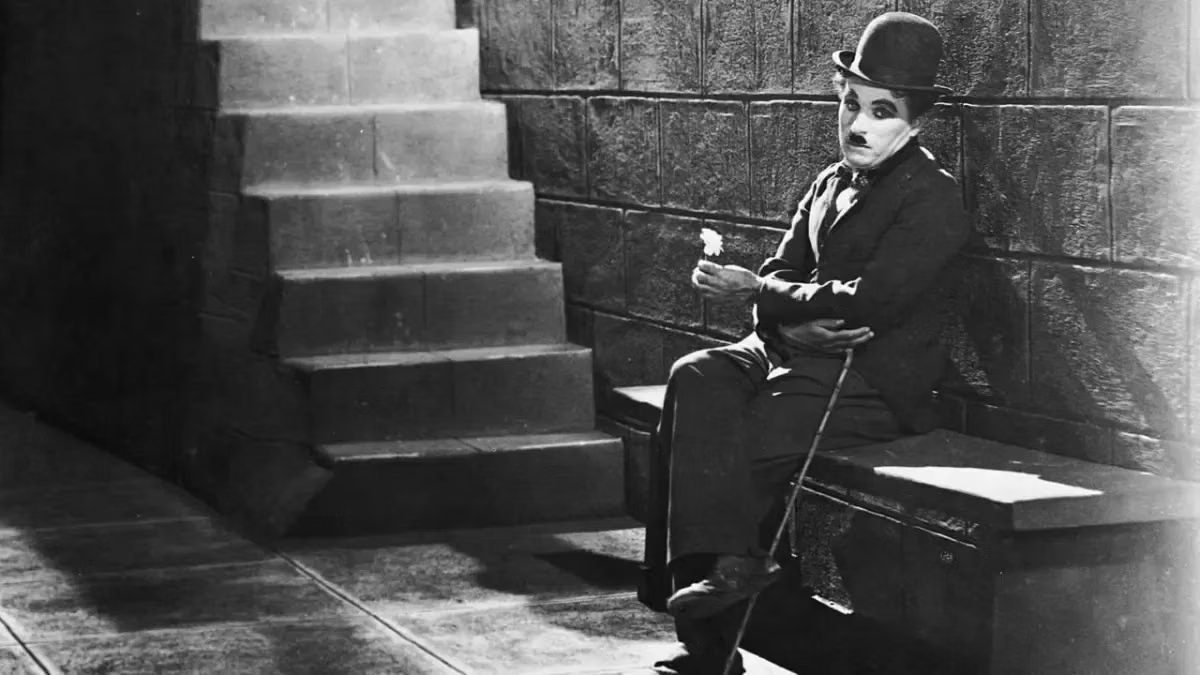
Premise: In an unnamed city, The Tramp (Charlie Chaplin) awakens at the unveiling of a statue dedicated to the virtues of “Peace and Plenty.” It doesn’t take long for his experiences to reveal that these principles do not apply evenly to all the city’s residents. In short order, The Tramp meets two people who will change his life: a blind girl (Virginia Cherrill) who peddles flowers on the street and an eccentric millionaire (Harry Myers). The former mistakes him for a wealthy patron. The latter befriends him after The Tramp prevents him from taking his own life. The millionaire proves to be a warm friend and generous with his money while drunk but unable to recognize The Tramp when sober, at which point he resumes his parsimonious habits. As the blind girl’s economic circumstances worsen and news breaks of a miraculous cure for blindness to all those who can travel to Vienna, The Tramp takes desperate measures to earn enough money to provide help.
Keith: You know what I’ve never given much thought to until now, Scott? The title of this movie. City Lights is a film I’ve seen many times but I’m not really sure how to read it. Chaplin could sometimes be specific, choosing titles that referred directly to his films’ characters or settings (The Kid, The Circus, The Gold Rush, “The Rink,” etc.) but sometimes went broader, as with Modern Times and this film. There’s a literal meaning. Much of the film takes place beneath the lights of the film’s unnamed city, an amalgam of various metropolises that allows the movie to be about any city anywhere. There are a couple of ironic readings, too. Shining a light on the city reveals it as a place of inequality and cruelty, no matter what civic virtues its monuments trumpet. Alternately, while the wealthy of the city might be thought of as its brightest lights, City Lights makes heroes of the overlooked and forgotten. The film itself invites multiple readings of the title (though it’s entirely possible that Chaplin just wanted something broad, given that The Tramp, the Blind Girl, and the Millionaire would be a terrible title).
City Lights is one of those films that’s so packed with incident and detail that you inevitably notice something new—or understand the importance of an element you’ve noticed before—each time. There’s a moment about a third of the way into the film that stood out for me this time. After his first night in the company of the millionaire, The Tramp has access to his new friend’s Rolls Royce. (The millionaire gives it to him, but this gift doesn’t last.) On his way back from dropping off the blind girl after buying out her stock of flowers (and leaving a generous tip), The Tramp spies a pedestrian discarding a cigar with a few good puffs left on it and stops the car to retrieve it. That’s funny because here’s a man in a fancy car who’s so in the habit of grabbing whatever scraps life offers him that he slams the brakes to pick up garbage. But the gag is complicated by The Tramp pushing a competitor out of the way. He’s unable to let go of his old, desperate ways. But his new circumstances have almost immediately made this otherwise kindly character—a character that will ultimately be defined by self-sacrifice—to put himself above another.
Enjoying The Reveal? Now's a great time to become a paid subscriber. You'll get access to everything we publish—from articles to audio commentaries—and help support independent film criticism.
It’s a brief moment that complicates the film and it’s not the only such moment. I’m tempted to talk about the ending now, but it feels too early in the conversation for that. So let’s talk about something else: sound. Chaplin fought off any pressure to make City Lights a talkie. His previous film, The Circus, had premiered just a few months after The Jazz Singer and much had changed between then and 1931. Chaplin still had the clout to make the film as a silent—he’d be able to do that just once more, with Modern Times in 1936—but sound plays a significant role in this movie, thanks to the score Chaplin composed for it (with the help of others and with the uncredited borrowing of a melody by José Padilla) and the extensive use of sound effects. Nowhere is this more evident than in the party scene where The Tramp swallows a whistle, leading to mounting complications that climax with a pack of dogs crashing the party.
So let me turn this over to you with some questions: Do you leave this movie wishing more room had been made for this kind of silent/sound hybrid? Chaplin’s surely in a class by himself, but certainly others might have been able to explore this space as well. And what do you make of The Tramp? Do we see him as an Everyman in this movie or a specific character? And we haven’t even talked about the other two main characters yet, have we? Consider this a request to do just that.
Scott: I definitely did not find myself pining for more sound, certainly not in terms of dialogue. As you know, the transition from silent to sound wasn't always so smooth because the technical requirements of the recording on a set often hamstrung what a filmmaker could do cinematically. When I think about my favorite silent-era productions, for so many of them—The Passion of Joan of Arc, The Last Laugh, Sunrise, The Docks of New York, the best of Chaplin and Keaton—the absence of sound allowed for a more liberated camera, more expressive lighting techniques, and, of course, the imperative to find other means to tell a story. The great ones (again, see all movies I mentioned above) rely on minimal titles and come up with creative solutions to move the plot forward or suggest the turbulent emotions at play.
For City Lights, the use of sound effects are ingeniously targeted, because you pick up on exactly when they’re deployed and marvel at their effectiveness. You wonder if the Peanuts cartoon creators took some inspiration from the mush-mouthed, blah-blah-blah effect of various city officials unveiling the monument in the opening sequence. But we don’t get a dialogue title until significantly later, when The Tramp tries to talk the drunken millionaire out of throwing himself in the canal. (“Tomorrow the birds will sing!,” he says.) In between, you get the long, sound-free stretch where The Tramp meets the blind girl on the street corner and, for the first time, she mistakes him for a much wealthier man. (Those monstrous newspaper boys are also set up here.) You’ve already cited some of the most memorable sound effects in the film, like the slide whistle (great for pasta/balloon string consumption) and the actual whistle that The Tramp swallows just as a solo vocalist is about to wow the elites at a party. But given his past success, Chaplin seems to have put himself in a position where he could buck the sound tread a little long while using it when it suits him.
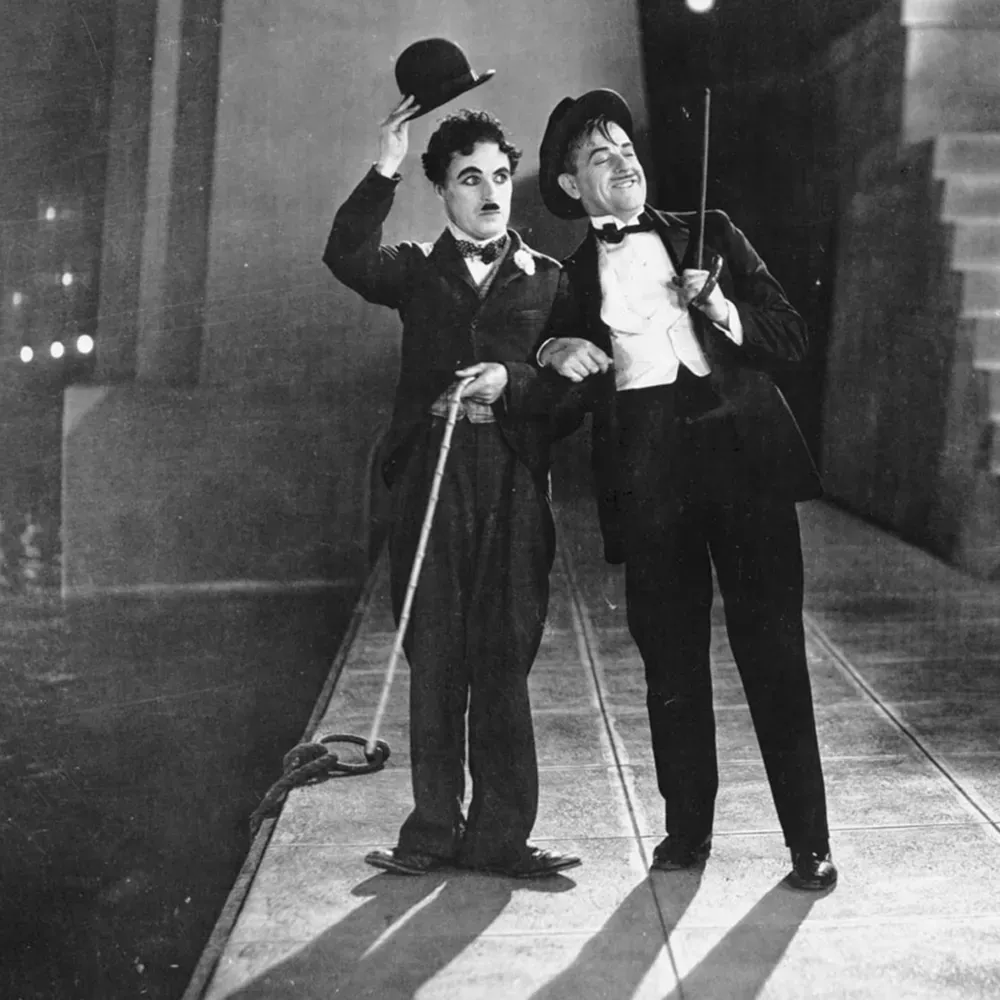
To answer your other questions about The Tramp character, he’s obviously familiar to us in broad strokes from previous Chaplin films as a put-upon ragamuffin who stumbles in and out of trouble, and tries to participate in a money-driven society where he doesn’t fit in. He’s a hapless prospector in The Gold Rush, literally gets caught in the metaphorical gears of a factory in Modern Times, and doesn’t exactly seem like the most reliable city employee here, either. At the same time, the nobler aspects of The Tramp are allowed to shine through in City Lights. There are small comic tics like his tendency to tip his hat humbly whenever his clumsiness is gumming up the works, but between his willingness to help the millionaire (and forgive him endlessly when the man is sober and forgets about him) and his acts of care and self-sacrifice with the blind girl, the film grants him more emotional depth than we’ve seen in other Tramp stories, despite Chaplin’s embrace of sentimentality.
As for the other major characters, the millionaire and the blind girl, City Lights doesn’t grant them too many layers beyond the former’s alcohol-fueled capriciousness and the latter’s pure-heartedness. I’d put a big fat asterisk on the blind girl, though, whose virtue is certainly tested in the film’s closing moments but I think it’s worth noting that the millionaire never comes around to showing any gratitude to The Tramp, which may be a function of his drinking problem but may also be connected to his corrupted place in society. When he’s drunk, he loses his inhibitions and can accept The Tramp for who he is, but when sober, there’s a class protocol that he needs to follow—one that his butler works to reinforce for him, too. The Tramp’s assumption is that everyone will see him dangling from the bottom rung of society and treat him accordingly, so he finds someone who can’t see at all and fakes a rich guy. Yet the only evidence we ever get that the blind girl would treat him differently comes at the end, when she has undergone the miracle eye surgery and laughs along with everyone else as he makes a fool of himself.
But it doesn't end there, does it, Keith? I’d venture to say that as good as City Lights is, it would not come within sniffing distance of the Sight and Sound list if it didn’t have five of best, most affecting closing minutes in cinema history. (It’s like Howard Hawks said about making a good movie: “No bad scenes, one greatest scene of all-time contender.”) I have my thoughts on it, of course, and some other standout sequences, but let me give you the floor here.
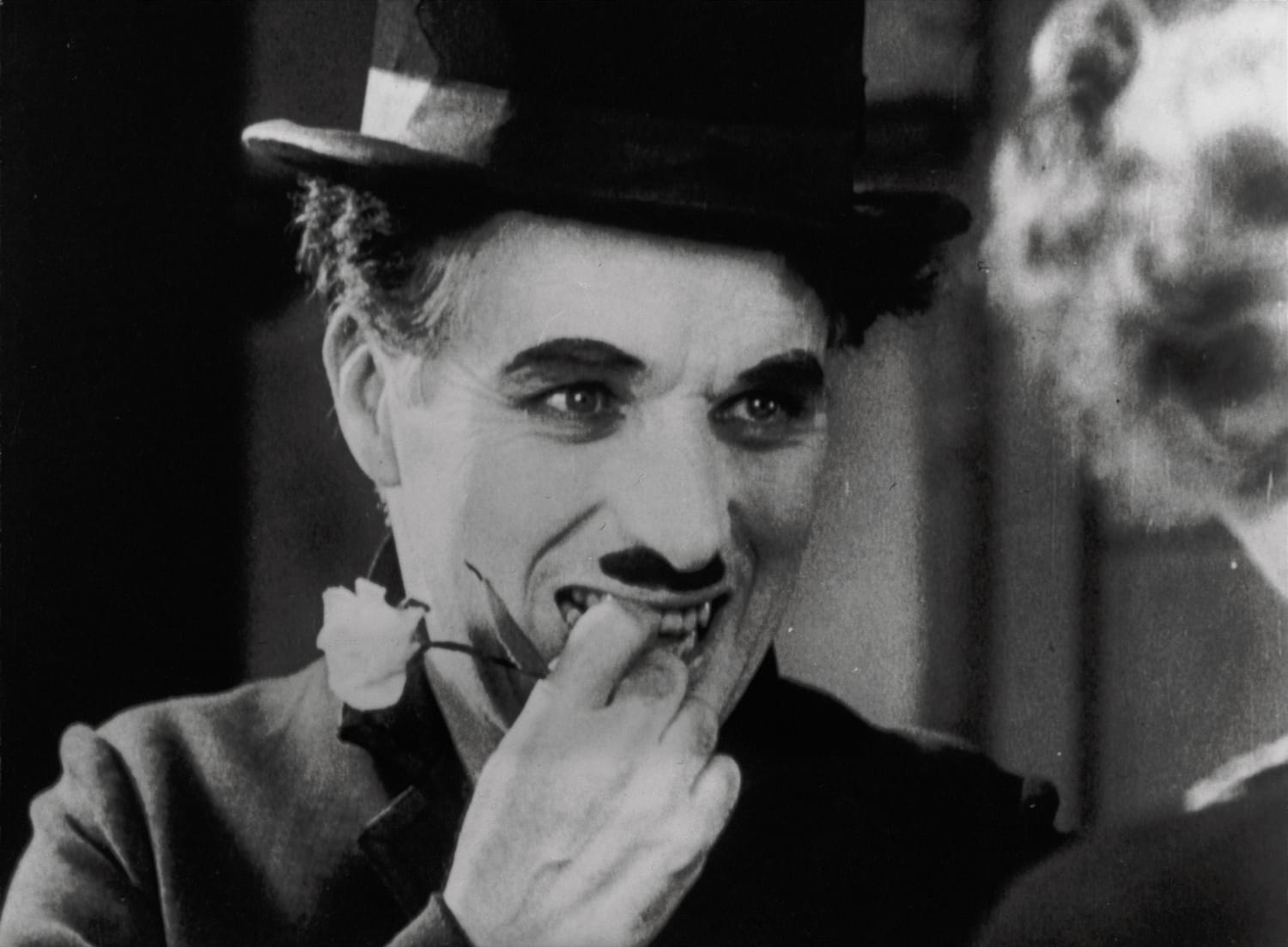
Keith: Almost every discussion of City Lights pulls out a James Agee quote in which he calls it “the greatest single piece of acting ever committed to celluloid.” That’s a bit of a misquote, however. It’s part of a longer Life magazine cover story published in 1949 called “Comedy’s Greatest Era,” in which Agee discusses the “four eminent masters” of silent comedy: Chaplin, Buster Keaton, Harold Lloyd, and Harry Langdon. (If that last name is unfamiliar to you, poke around and find some of his movies. He was pretty good, if not quite in the class of the other three.) Agee’s actual quote goes further than the corrupted version that gets passed around, but he wasn’t just making a declaration without any support. I think it’s worth revisiting the fuller context, which reads:
At the end of City Lights the blind girl who has regained her sight, thanks to the Tramp, sees him for the first time. She has imagined and anticipated him as princely, to say the least; and it has never seriously occurred to him that he is inadequate. She recognizes who he must be by his shy, confident, shining joy as he comes silently toward her. And he recognizes himself, for the first time, through the terrible changes in her face. The camera just exchanges a few quiet close-ups of the emotions which shift and intensify in each face. It is enough to shrivel the heart to see, and it is the greatest piece of acting and the highest moment in movies.
A few things struck me revisiting that moment this time. Chaplin plays the Tramp with a dignity that defies his circumstances no matter how bad his luck but, in this moment, life seems to be getting the better of him. He looks bedraggled and his clothes have started to fray. His pockets have torn and you can see the soot on his jacket. We’ve spent the whole movie until this point laughing at his mishaps yet it’s awful to witness the cruelty of others as they laugh at him, first the newspaper boys and then, shockingly, the blind girl herself. You previously mentioned Chaplin’s judicious use of titles, so it’s significant that he gives the blind girl the last line of the film with a title reading “Yes, I can see now.” She recognizes who he is but also the humanity she was denying him, just as her own humanity had so recently been denied by her blindness. It’s one of those final scenes that doesn’t just put a bow on the movie but deepens what we’ve just seen. Everything has been building up to this moment.
Do we have any sense of what happens next? When I first saw this movie I understood it as a last-moment happy ending. Surely the blind girl had fallen in love with the Tramp when she thought he was a millionaire and now that love would overcome her surprise that he did not match her expectations. Now I think it’s a stronger ending for not confirming that, or even providing that strong a suggestion that the two are headed in this direction. In fact, I’m not sure it even matters. What matters is this connection they share, one that feels deeper than romance.
I think you’re right to suggest that it’s this moment that makes City Lights a masterpiece, and probably explains why it’s been placed so consistently high on these lists from the start. (We don’t have data for the 1972 and 1982 lists beyond the top 10, but it’s safe to assume it did pretty well on those as well.) It also survived a period that I think has passed in which some dismissed Chaplin (usually in the service of praising Keaton) as “too sentimental.” I’ve never bought that. There’s no denying that Chaplin liked to tug at the heartstrings, but I can’t think of a Chaplin film in which the sentiment felt unearned, and here it’s what makes City Lights great.
Scott, am I way off base there? Is Chaplin the silent clown equivalent of a Precious Moments figurine in your eyes? Also, I’d love to hear your thoughts on the ending.
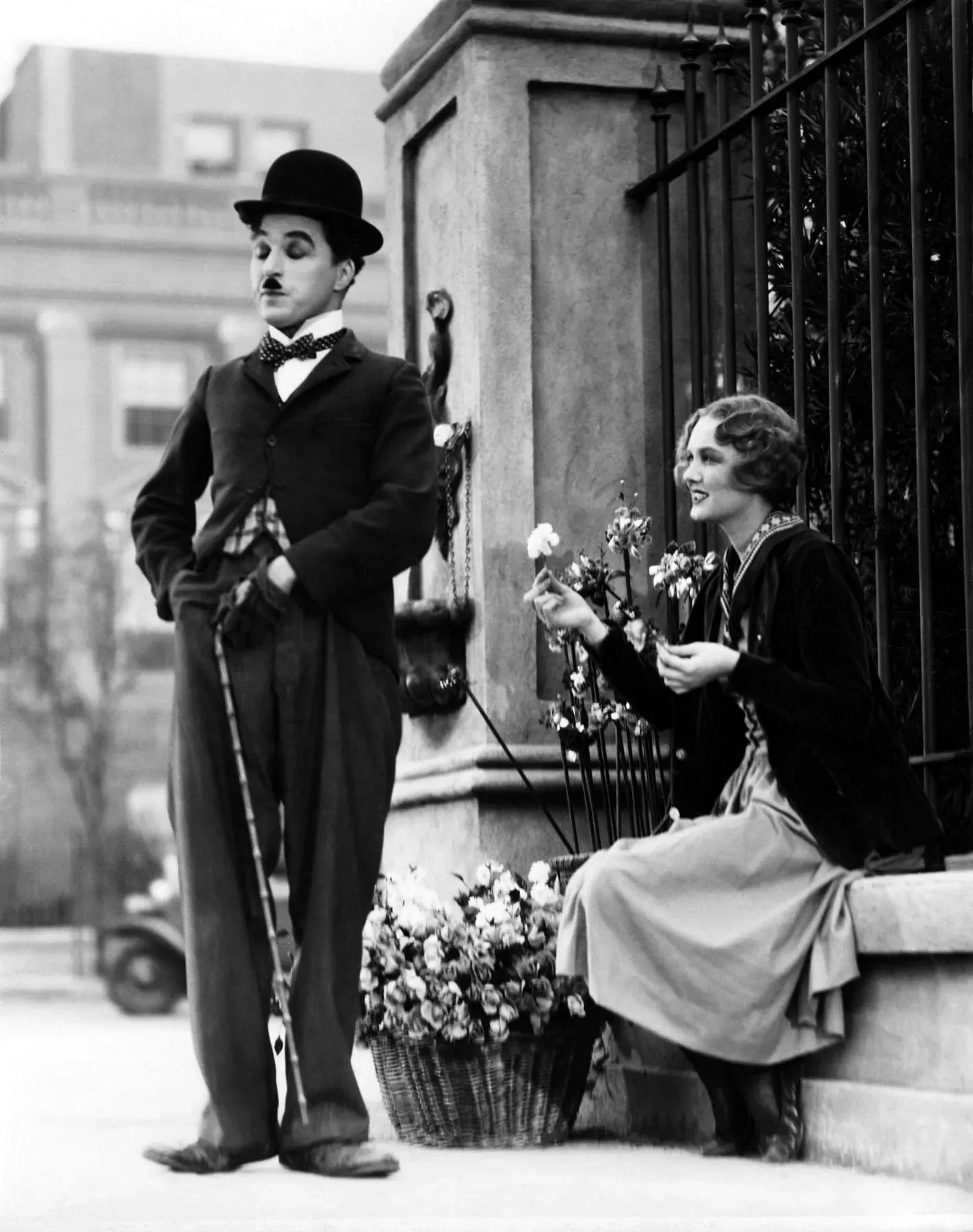
Scott: I’m so tempted to shock you by likening Chaplin to a Precious Moments figurine, but I can’t bring myself to do it. You are absolutely correct, though, in noting a time when Chaplin seemed to fall out of favor with critics and cinephiles, mainly because Buster Keaton, the beneficiary of a fantastic and comprehensive Kino box set, was ascendent and it was apparently impossible to keep from picking sides. And who wouldn’t look sentimental next to the famously stone-faced Keaton, especially when The Tramp is this sweet, humble, pitiable representative of the underclass? I’m quite certain that I was one of those nefarious side-pickers 30 years ago or so, but now that I’ve seen Modern Times and now City Lights again for this project, I fear that I may have been talking nonsense. There is great feeling in the endings of these films to be sure, but “sentimental” is too much of a slur to feel adequate to describe them.
But maybe I can surprise you by admitting that I don’t agree with Agee’s interpretation of the ending. Agee writes, “She has imagined and anticipated him as princely, to say the least; and it has never seriously occurred to him that he is inadequate.” The first part of that sentence is undeniably true, because it’s a fiction that The Tramp has carefully cultivated throughout the movie, which is where so much of the comedy arises. But he does this because it absolutely occurs to him that he is inadequate, because it’s reinforced every day by the people who can see him—the crowd at the unveiling, the paperboys mocking him on the corner, the millionaire when he’s sober, and the millionaire’s butler, who’s not exactly given to class solidarity.
The rest of Agee’s analysis is spot on, of course, but I do think it’s so meaningful that the not-blind-anymore girl laughs at The Tramp like the others before she has that moment of recognition and catches herself. As you say, the title “Yes, I see can now” is such a killer because it now goes beyond the literal and her vision is transformed in a second and equally profound way. (If this were made in 2026, perhaps The Tramp responds, “I feel seen!”) The performances are wonderful, but let’s not undersell how much Chaplin’s meticulous staging of the whole sequence, leading to these huge, expressive close-ups on the actors, brings the moment across. And as far as Sight and Sound poll placement is concerned, I think we’ve seen enough evidence lately, between City Lights, Bicycle Thieves, and Some Like It Hot, that sticking the landing gets you points from the judges in movies just as it does in gymnastics.
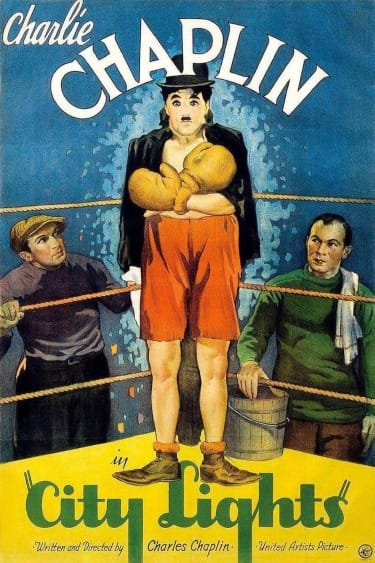
A few more odds and sods before I wrap this up: I’d be remiss if I didn’t express my admiration for the episode where The Tramp tries to earn enough money to pay the blind girl’s rent by fighting a fixed boxing match. When circumstances lead him to have to box straight-up, Chaplin treats us to a hilariously resourceful Tramp who gains an early edge on his opponent by hiding behind the referee and sucker-punching him whenever he gets the chance. The funny thing to me about that sequence is that the fight isn’t that different from the one in the first Rocky, where our overmatched hero does better than expected and nearly pulls off the upset before ultimately losing.
(Another short acknowledgment of a comic scene I love: When the blind girl unknowingly draws thread from The Tramp’s ragged clothes rather than the skein he’s holding, but he doesn’t stop it from continuing. It’s generosity born out of diminished self-worth. Sentimental? Who cares!)
Lastly, I’m a sucker for movies about self-sacrifice. That’s the theme of my favorite “women’s weepie,” Stella Dallas, where only the audience knows of the personal sacrifice Barbara Stanwyck makes for her daughter’s happiness. And I think you could look at a film like Lars Von Trier’s Dancer in the Dark as a spiritual successor to City Lights, only with Bjork’s character, a woman losing her eyesight, going to incredible lengths to make sure her son gets a surgery to avoid the same fate. As with the ending of City Lights, I’ve never watched the “I’ve Seen It All” number without welling up.
Remarkably enough, Keith, we are staying in 1931 for our next movie, Fritz Lang’s M, but we’re going across the ocean and appreciating one of the early sound masterpieces, because Lang would never deny us Peter Lorre’s mellifluous voice.
Previously:
#95 (tie): Get Out
#95 (tie): The General
#95 (tie): Black Girl
#95 (tie): Tropical Malady
#95 (tie): Once Upon a Time in the West
#95 (tie): A Man Escaped
#90 (tie): Yi Yi
#90 (tie): Ugetsu
#90 (tie): The Earrings of Madame De…
#90 (tie): Parasite
#90 (tie): The Leopard
#88 (tie): The Shining
#88 (tie): Chungking Express
#85 (tie): Pierrot le Fou
#85 (tie): Blue Velvet
#85 (tie): The Spirit of the Beehive
#78 (tie): Histoire(s) du Cinéma
#78 (tie): A Matter of Life and Death
#78 (tie): Celine and Julie Go Boating
#78 (tie): Modern Times
#78 (tie): A Brighter Summer Day
#78 (tie): Sunset Boulevard
#78 (tie): Sátántangó
#75 (tie): Imitation of Life
#75 (tie): Spirited Away
#75 (tie): Sansho the Bailiff
#72 (tie): L’Avventura
#72 (tie): My Neighbor Totoro
#72 (tie): Journey to Italy
#67 (tie): Andrei Rublev
#67 (tie): The Gleaners and I
#67 (tie): The Red Shoes
#67 (tie): Metropolis
#67 (tie): La Jetée
#66: Touki Bouki
#63 (tie): The Third Man
#63 (tie): Goodfellas
#63 (tie): Casablanca
#60 (tie): Moonlight
#60 (tie): La Dolce Vita
#60 (tie): Daughters of the Dust
#59: Sans Soleil
#54 (tie): The Apartment
#54 (tie): Battleship Potemkin
#54 (tie): Blade Runner
#54 (tie): Sherlock Jr.
#52 (tie): Contempt
#52 (tie): Ali: Fear Eats the Soul
#50 (tie): The Piano
#50 (tie): The 400 Blows
#48 (tie): Wanda
#48 (tie): Ordet
#45 (tie): North by Northwest
#45 (tie): The Battle of Algiers
#45 (tie): Barry Lyndon
#43 (tie): Killer of Sheep
#43 (tie): Stalker
#41 (tie): Bicycle Thieves
#41 (tie): Rashomon
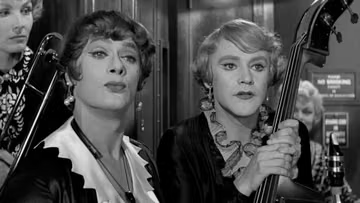
#38 (tie): Some Like it Hot
#38 (tie): Breathless
#38 (tie): Rear Window
You might also like
#38 (tie): ‘Rear Window’: The Reveal discusses all 100 of Sight & Sound’s Greatest Films of All Time
#38 (tie): ‘Breathless’: The Reveal discusses all 100 of Sight & Sound’s Greatest Films of All Time
Discussion