#38 (tie): ‘Rear Window’: The Reveal discusses all 100 of Sight & Sound’s Greatest Films of All Time
Alfred Hitchcock's 1954 masterpiece is a movie about someone who watches and the act of watching.

On December 1st, 2022, Sight & Sound magazine published “The Greatest Films of All Time,” a poll that’s been updated every 10 years since Bicycle Thieves topped the list in 1952. It is the closest thing movies have to a canon, with each edition reflecting the evolving taste of critics and changes in the culture at large. It’s also a nice checklist of essential cinema. Over the course of many weeks, months, and (likely) years, we’re running through the ranked list in reverse order and digging into the films as deep as we can. We hope you will take this journey with us. 100
Rear Window (1954)
Dir. Alfred Hitchcock
Ranking: #38 (tie)
Previous ranking: #53 (2012), #80 (2002), #27 (1992).
Premise: After an on-the-job injury that’s left him confined to a wheelchair, in-demand photojournalist L.B. Jeffries (“Jeff” to his friends) has picked up the habit of spying on the neighbors who live across the courtyard of his Greenwich Village apartment building, despite the chiding of his insurance company nurse Stella (Thelma Ritter) and his glamorous model girlfriend Lisa (Grace Kelly). Jeff’s hobby takes a dark turn when he begins to suspect one neighbor, Lars Thorwald (Raymond Burr), of murdering his wife.
Keith: As I often like to do when we’re talking about a classic film, I decided to dig up some contemporary reviews to see how it was talked about at the time. Some of the movies we’ve covered were acclaimed in their time but others were underestimated (e.g. Blade Runner) or completely overlooked (e.g. Wanda). Rear Window’s an interesting case because it earned rave reviews from contemporary critics but few of them looked past the surface. There are reviews that praise the suspense and the construction and the “Hitchcock touch,” but not a lot of interest in, say, moments like Jeff ignoring the beautiful woman in his arms to pursue voyeuristic kicks.
I don’t mean this as a knock against frontline critics. We’ve filled that role for years and I know I’ve sometimes focused on the wrong elements or just plain gotten it wrong. (Like, say, being initially underwhelmed by a certain 2009 World War II movie I now consider to be one of its creator’s best films or thinking that another major director’s presidential biopic was merely good instead of great.) But it’s curious, isn’t it, how it now seems obvious to talk about some films in terms of their themes and subtext and, especially in the case of a director like Hitchcock, their director’s abiding obsessions.
So, just as a thought experiment, can we start this conversation with a discussion of Rear Window as a suspense film? I definitely want to get into all the underlying perversity and Hitchcock of it all, but pretend it’s 1954 and you’re seeing this for the first time without the weight of years of scholarship attached to it. It’s a pretty nifty thriller, isn’t it? But it’s also a counterintuitive thriller until, arguably, the climactic scene. Nobody chases anybody. There’s no moving from one memorable location to another. There’s (maybe) a murder, but the central characters aren’t in any real danger until they enter the scene of the (possible) crime and Jeff himself is never in jeopardy until he practically invites his suspect into his apartment. We barely even get any score to tell us how to feel. Instead, Hitchcock uses the ambient sounds of life in a New York apartment building suffering under an oppressive summer sun.
About those parentheticals: Of course we now know that Thorwald killed his wife and because you and I weren’t going to movies in 1954, we likely knew that when we saw it for the first time. But going in blind, we probably would have thought it more likely than not that Jeff was onto something with his suspicions. But, working from a Cornell Woolrich story, Hitchcock and screenwriter John Michael Hayes nicely balance the evidence for Thorwald’s guilt with the evidence against it and let Jeff’s detective buddy Tom Doyle (Wenell Corey) make a pretty good case for Thorwald’s innocence.
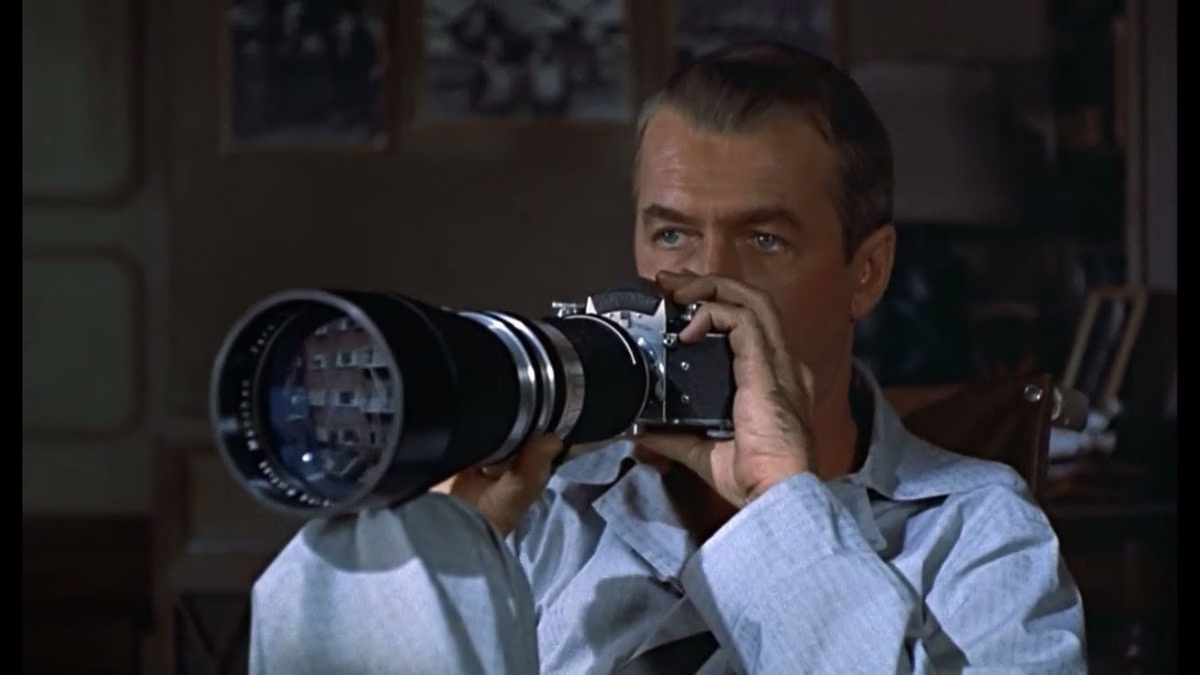
Then there’s the brilliant way Hitchcock works within his self-imposed limitations. We’re not entirely locked into the view from Jeff’s apartment. Hitchcock sometimes uses closer shots, even when Jeff’s not looking through the long lens of his camera (that usually rests in his lap… wait… no subtext yet). This isn’t a technical exercise like Rope, but it’s still quite disciplined. The result is a film that creates suspense using a different set of tools than such films usually use, in the process creating a uniquely claustrophobic experience of the kind no other suspense film had achieved before (or since, really).
OK, I could keep going, Scott, but I want to hand it over to you. Why do you think this movie works so well? And, like Jeff, I want to talk about the neighbors. There are a lot of little stories playing out in the midst of the central story. What do you think of them?
Scott: Keith, I find it extremely funny that you’re basically evoking my favorite exchange from Whit Stillman’s Barcelona, when one character complains about how everybody focuses on subtext while ignoring “completely open and obvious” meaning right there on the surface. (“What do you call what’s above the subtext?” “The text.”) Anyway, I will suppress the urge to talk about subtext for our purposes, Keith, but only because Hitchcock’s cinematic text is so sophisticated. One thing I will say upfront about Rear Window, which I guess will mostly fall under the “subtext” or “meta-text” category, is that if I were a film professor teaching a 101-level course, it’s the first title I’d put on the syllabus. It is an extraordinarily illuminating demonstration of how movies work and why they’re so alluring to audiences. (Plus, who doesn’t like Rear Window? You’re guaranteed to have the students in your corner.)
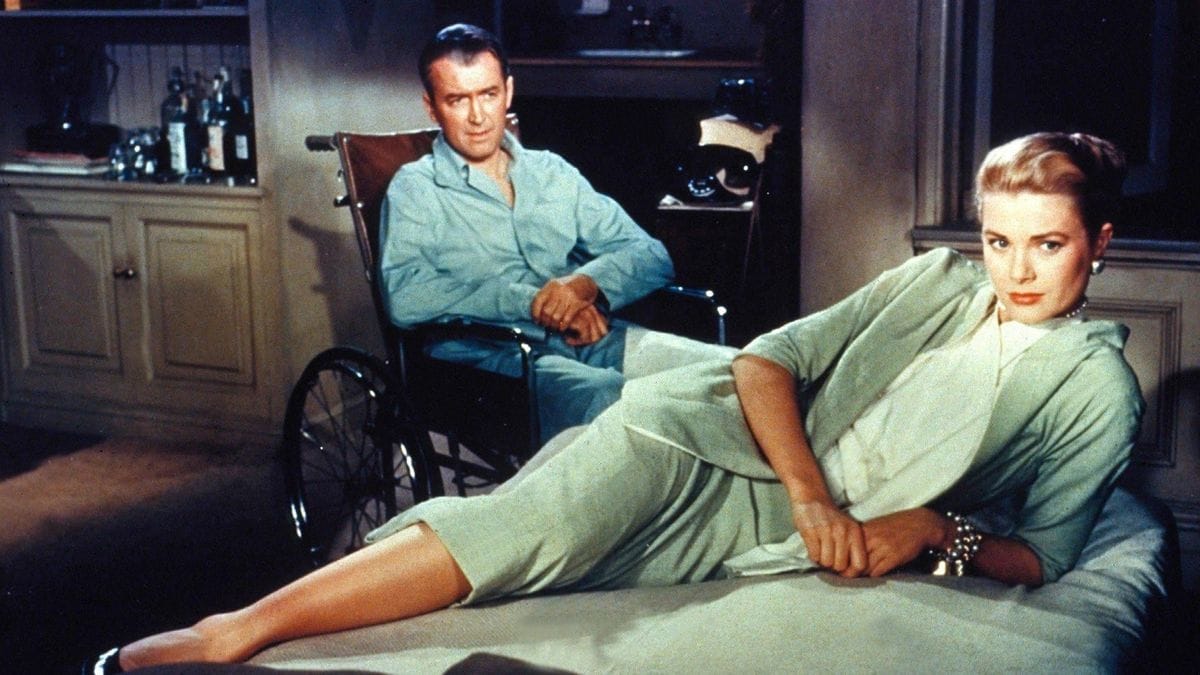
But yes, Hitchcock was the “Master of Suspense” and I like your reading of the surface-level craft of Rear Window, which is accessible and satisfying while defying convention in the ways you describe. Yet I wonder if the thing it teaches us is that suspense is unrelated to action and more often about vulnerability. We might thrill at the splashy setpieces in North By Northwest as Roger Thornhill dashes around planes, trains, and automobiles to escape the men who have framed him, but the pit in our stomach comes from connecting his “wrong man” helplessness and feeling like the odds are heavily stacked against him. Having Jeff confined to a wheelchair gives him the motivation to slake his boredom by scanning the courtyard for narratives (and kicks), but once he actively intervenes in a murder narrative that may or may not be true, we’re reminded of what little he can do to defend himself if things get hairy. There’s something illicitly pleasurable (and sexy) about playing detective with his girlfriend—who had previously bored him, despite being the most extravagantly beautiful woman on earth—but there’s never any expectation that it’ll lead to danger. Not to step too far into subtext yet, but Jeff and Lisa are like moviegoers who never expect the villain to notice them and step through the screen.
One thing I admire about Rear Window is how it’s mostly limited to two suspense setpieces and they’re both entirely staked on Jeff’s near-inability to take action. He is planted in his wheelchair when Lisa climbs into Thorwald’s apartment and faces mortal danger when Thorwald returns unexpectedly. Stewart’s face crumples as he witnesses the scene and we’re invited to share in his agonized powerlessness. (This sequence strikes me as a primary influence on the climax of Brian De Palma’s Blow Out, which leads to a different outcome.) Then you get the big climactic moment when Thorwald barges into Jeff’s apartment and all he can do is blind the bigger man with his flashbulbs until the authorities come along to bail him out. (Jonathan Demme was surely taking notes for the climax of The Silence of the Lambs, when our heroine tries to get the upper hand while literally being in the dark.)
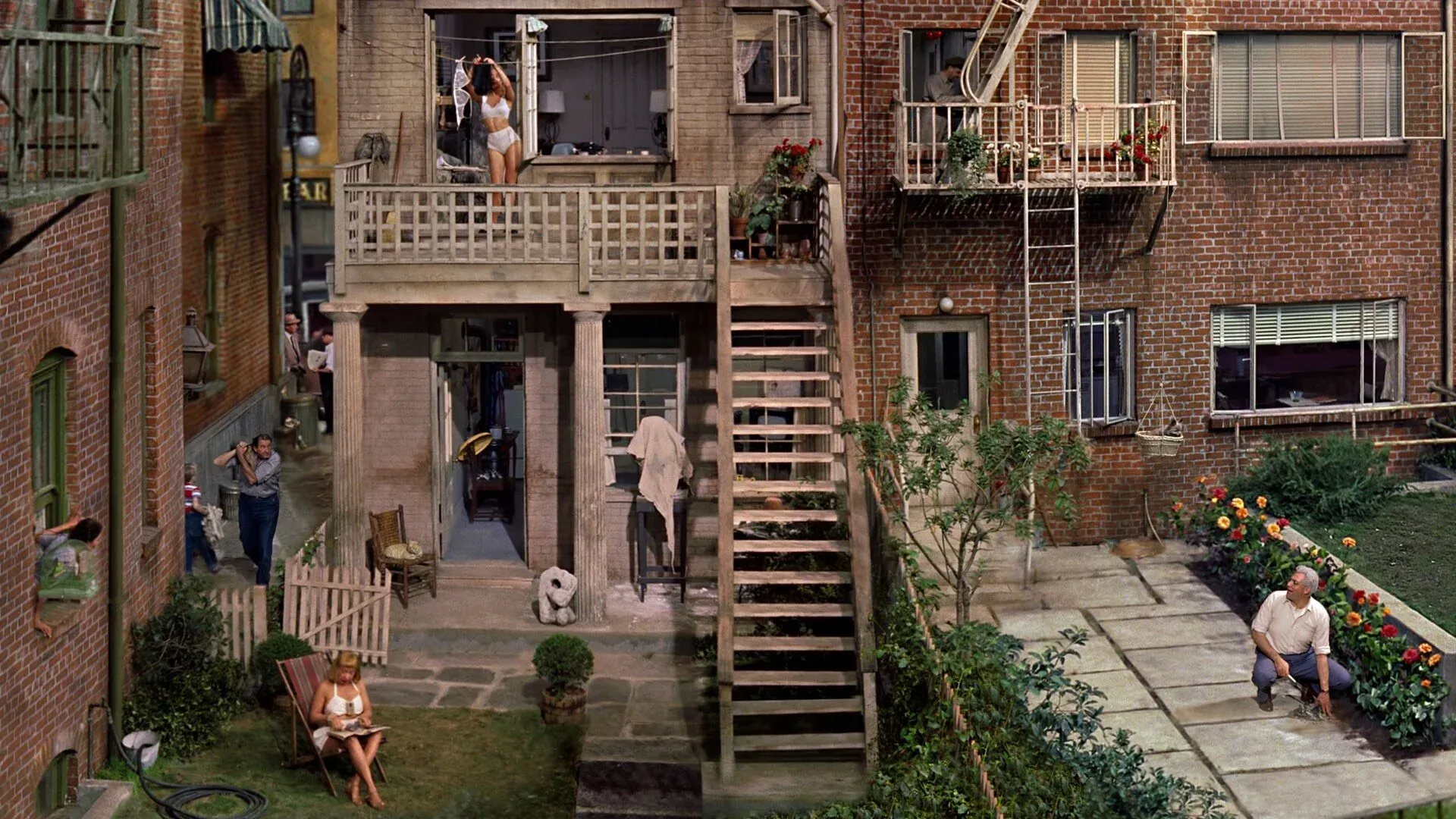
Yet suspense is only part of the agenda here, right? While the Thorwald murder subplot undoubtedly takes center stage, Rear Window is a slice-of-life that gives Jeff (and us) some level of investment in other narratives, too. What will happen to Miss Lonely-Hearts, who’s always primping for a Mr. Right that’s so slow to materialize that Jeff and Lisa wonder at one point if she intends to overdose on pills? How about Miss Torso, the ballet dancer whose daily routine is a voyeur’s feast but who has the abundance of suitors that Miss Lonelyhearts lacks? (The twist on that story is sweet.) Then we have more comic check-ins with a couple that sleeps on their balcony and newlyweds whose fruitful yet exhausting consummation leads into a none-too-promising marital routine.
Hitchcock has the dexterity to juggle all these subplots at once while developing a cinematic conceit that mirrors—and breaks down—the experience of watching a movie. Jeff’s blinds go up at the beginning like the curtains at a theater and we’re invited to survey a multiplex of screens (even before multiplexes were a thing). The device that impresses me the most, however, is how the windows are not screens so much as on-screen space and the building facade between the window is off-screen space. As Martin Scorsese once said, “Cinema is a matter of what’s in the frame and what’s out.” Hitchcock makes Rear Window as explicit a demonstration of that idea as you’ll ever see. We are acutely aware that Jeff is operating with incomplete information and filling in missing details with his imagination, which can be deceiving. (And also subject to selectivity: Jeff and Lisa have such a fixed idea that Thorwald killed his wife that they can’t accept evidence to the contrary. Lisa even talks about how ridiculous it is for them to feel glum about the possibility that a woman wasn’t murdered.)
But now I feel like I’m starting to veer into subtext. So Keith, what about all that stuff below the text that critics at the time were not writing about?
Keith: Does it even count as subtext that Jeff is a voyeur? I guess the next question is which definition of “voyeur” do we want to apply to him? Here’s the American Heritage Dictionary’s definition of the word:
1. Psychology. A person who derives sexual gratification from covert observation of an unsuspecting person who is naked, undressing, or engaging in sexual activity.
2. An enthusiastic observer of sordid or sensational subjects.
Is Jeff someone who gets off sexually at spying on others? I don’t think we’re supposed to literally think that is true, which is to say I don’t think there are moments between scenes when Jeff is taking his spying to another level. But Hitchcock doesn’t shy away from using his telephoto lens as a phallic symbol and there are several moments when Jeff favors the camera or binoculars over a clearly hot-for-him Lisa. It’s not like he’s uninterested in her, but she definitely has to compete with the action outside his window for his attention and he becomes increasingly open to that attention the more involved she gets with the mystery.
The second definition, however, certainly applies. But it doesn’t just apply to Jeff. Rear Window makes us complicit in his voyeurism, and not just when it comes to the Thorvald case. As you suggested, there’s an array of little movies playing out in Jeff’s apartment building. On some base level, movies appeal to our own sense of voyeurism, letting us watch human drama without being watched. Moviegoing is an inherently voyeuristic activity, and Hitchcock keeps reminding of this throughout the film.
I’m not, of course, delivering a groundbreaking original revelation about Rear Window. This is a pretty standard reading of the film and, as we cover above, there’s a lot that makes it great sitting right there on the surface. It’s also, in some ways, a much less damning exploration of this theme than in, say, Psycho (where voyeuristic impulses gets knotted up with murderous actions) or Vertigo (where a darker Stewart character acts first as a spy then obsessively attempts to rework a woman into the image he obsessively desires to see). Jeff watches from a distance and isn’t immune to, say, the pleasures of seeing Miss Torso. But he also feels empathy for his neighbors, wanting the best for Miss Lonely-Hearts and the others and attempting to bring Thorvald to justice for his crime. Maybe a desire to watch others doesn’t make him a bad person (or, by extension, us). It’s a benign sort of perversity, maybe even one that makes him better understand what it means to be human.
You know what scene in this movie haunts me, Scott? The discovery of the little dog’s body, and not because of my aversion to seeing animals come to harm on screen. The dog owner’s shock quickly curdles into anger then becomes a kind of damning accusation of everyone around her. She has seemed a fundamentally happy character until now, but this reveals the previously unseen depths of her loneliness and alienation from her neighbors, as if confirming her worst thoughts about those around her. Rear Window ends with some of the building’s stories coming together, like Miss Lonely-Hearts finding comfort and companionship with the songwriter (played by future Chipmunks creator Ross Bagdasarian) and a sense that order has been restored (including the arrival of a new dog). But her howls underline just how uncaring the city can seem.
Scott, please, go deeper into the subtext than I have gone if you can. There’s a lot going on here and I feel like I just delivered the most basic summary of the film’s most obvious theme.
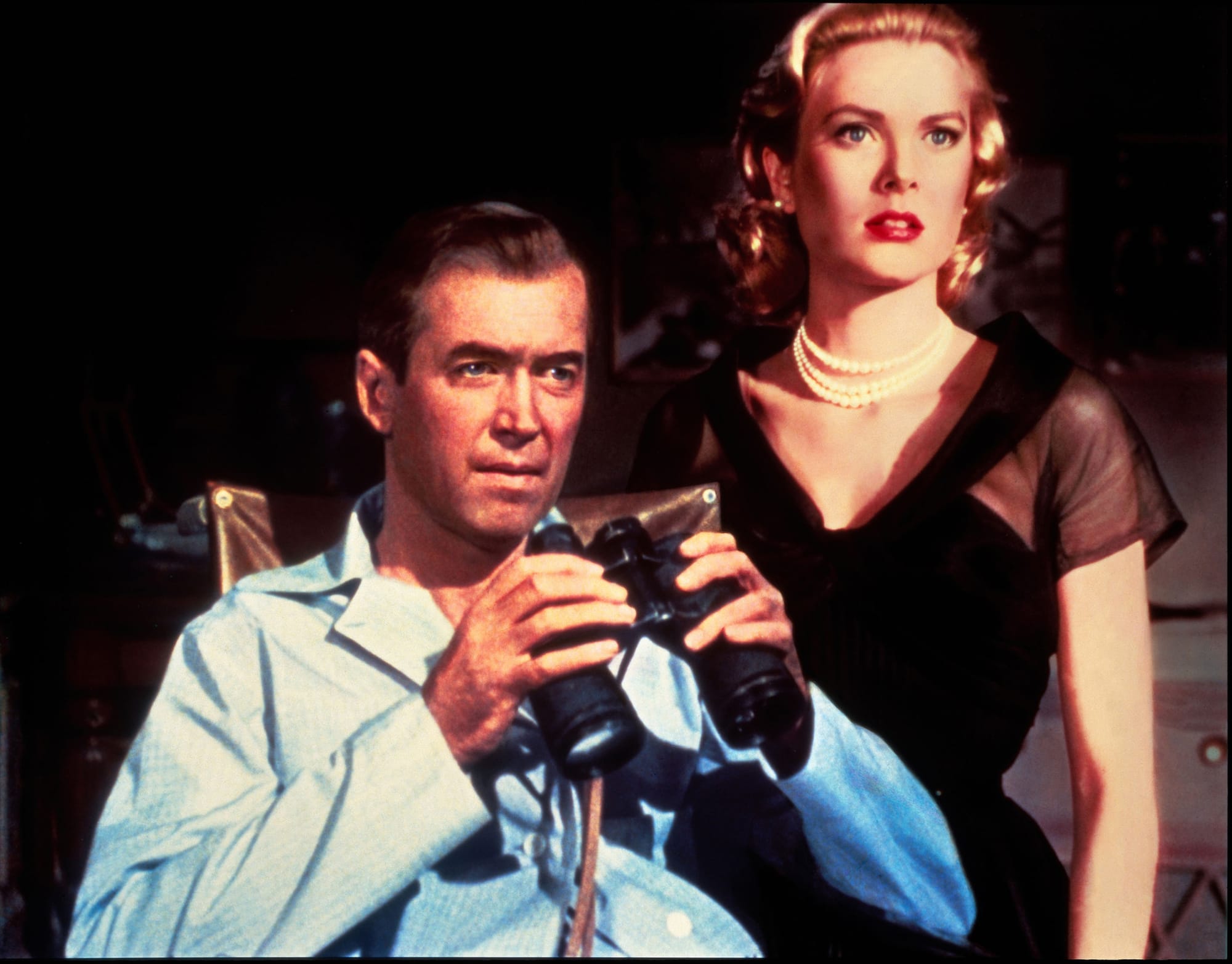
Scott: One thing that’s always stood out to me about Rear Window is how perceptive it is about how images can alter our perception of a person. You and I have interviewed plenty of movie stars in our career, Keith, and I’m always struck by the experience of an actor I’ve only seen in two dimensions appear a foot away from me as a three-dimensional, flesh-and-blood human being. I’ve often marveled at how much more beautiful and alien-like all of them tend to be in person—like even a humble character actor can seem like a different species—but maybe that’s a trick of the movies, too. Once we’ve seen a person on a screen, he or she seems larger-than-life off of it.
Hitchcock suggests that phenomenon from Grace Kelly’s very first appearance in Rear Window, when we in the audience see this astonishing woman lean forward from Jeff’s perspective and cannot comprehend why he’s so bored by her. In the context of the movie, Jeff explains his unwillingness to return Lisa’s devotion to him as an irreconcilable difference between his job as a global adventurer and her connection to all the finer things in life. But I think it has more to do with what compels him as a voyeur. When Lisa starts participating in the Thorwald investigation and becomes part of the cinematic narrative that he’s been following across the courtyard, she finally possesses the movie-star allure to him that had been so obvious all along to us. That’s the power of cinema, baby!
I think Rear Window is also superb as a metaphor for “persistence of vision,” the phenomenon that allows us to experience still images as moving images when they’re run through a projector at 24 frames per second. As I had written above, Hitchcock is brilliant in using the windows (clear) and the building facade (opaque) to suggest on- and off-screen space, and how the mind works to plug in those gaps between what Jeff actually sees and what he doesn’t. I don’t know if Rear Window would have been quite the sensation had Thorwald been completely innocent, but you can imagine a scenario where Jeff talks himself into a crime that never actually happened, all because he’s filling in that off-screen space with information that confirms his biases. He’s “completing” an illusion, just as we do every time we go to the movies.
I’m glad you removed Jeff from the pervy definition of “voyeur” too, Keith, because his curiosity about the mini-narratives playing out in front of him seem based on a more balanced diet. If Jeff were a certain type of fella, I imagine his binoculars and phallic lenses might be aimed exclusively at Miss Torso’s apartment, but to paraphrase Peter Sobcznyski, our longtime colleague in Chicago, Jeff enjoys all the meats of our cinematic stew. Yet before closing out, I think we can certainly say that many important directors took ball and ran with it, not least Hitchcock himself, who as you noted would codify a more malevolent form of voyeurism six years later with Psycho. Also in 1960 was Michael Powell’s career-killing masterpiece Peeping Tom, which went so far as to turn the camera itself into a weapon. And surely David Lynch was paying attention, given the similarity between Jeff watching Lisa getting assaulted by Thorwald and his own Jeff (Kyle MacLachlan) witnessing an assault from an apartment closet in Blue Velvet.
But let’s end the conversation here for now because we still have Psycho and Vertigo, two more prurient Hitchcock classics, ahead of us on the Sight and Sound list. The next two up on the S&S list straddle the line between silent and sound era, but let’s stay in the silent side and cover Charlie Chaplin’s heartbreaking comedy City Lights next.
Previously:
#95 (tie): Get Out
#95 (tie): The General
#95 (tie): Black Girl
#95 (tie): Tropical Malady
#95 (tie): Once Upon a Time in the West
#95 (tie): A Man Escaped
#90 (tie): Yi Yi
#90 (tie): Ugetsu
#90 (tie): The Earrings of Madame De…
#90 (tie): Parasite
#90 (tie): The Leopard
#88 (tie): The Shining
#88 (tie): Chungking Express
#85 (tie): Pierrot le Fou
#85 (tie): Blue Velvet
#85 (tie): The Spirit of the Beehive
#78 (tie): Histoire(s) du Cinéma
#78 (tie): A Matter of Life and Death
#78 (tie): Celine and Julie Go Boating
#78 (tie): Modern Times
#78 (tie): A Brighter Summer Day
#78 (tie): Sunset Boulevard
#78 (tie): Sátántangó
#75 (tie): Imitation of Life
#75 (tie): Spirited Away
#75 (tie): Sansho the Bailiff
#72 (tie): L’Avventura
#72 (tie): My Neighbor Totoro
#72 (tie): Journey to Italy
#67 (tie): Andrei Rublev
#67 (tie): The Gleaners and I
#67 (tie): The Red Shoes
#67 (tie): Metropolis
#67 (tie): La Jetée
#66: Touki Bouki
#63 (tie): The Third Man
#63 (tie): Goodfellas
#63 (tie): Casablanca
#60 (tie): Moonlight
#60 (tie): La Dolce Vita
#60 (tie): Daughters of the Dust
#59: Sans Soleil
#54 (tie): The Apartment
#54 (tie): Battleship Potemkin
#54 (tie): Blade Runner
#54 (tie): Sherlock Jr.
#52 (tie): Contempt
#52 (tie): Ali: Fear Eats the Soul
#50 (tie): The Piano
#50 (tie): The 400 Blows
#48 (tie): Wanda
#48 (tie): Ordet
#45 (tie): North by Northwest
#45 (tie): The Battle of Algiers
#45 (tie): Barry Lyndon
#43 (tie): Killer of Sheep
#43 (tie): Stalker
#41 (tie): Bicycle Thieves
#41 (tie): Rashomon
#38 (tie): Some Like it Hot
#38 (tie): Breathless

Discussion