#38 (tie): ‘Breathless’: The Reveal discusses all 100 of Sight & Sound’s Greatest Films of All Time
Our trip through Sight and Sound's top 100 films list arrives at one of those movies that changed everything.

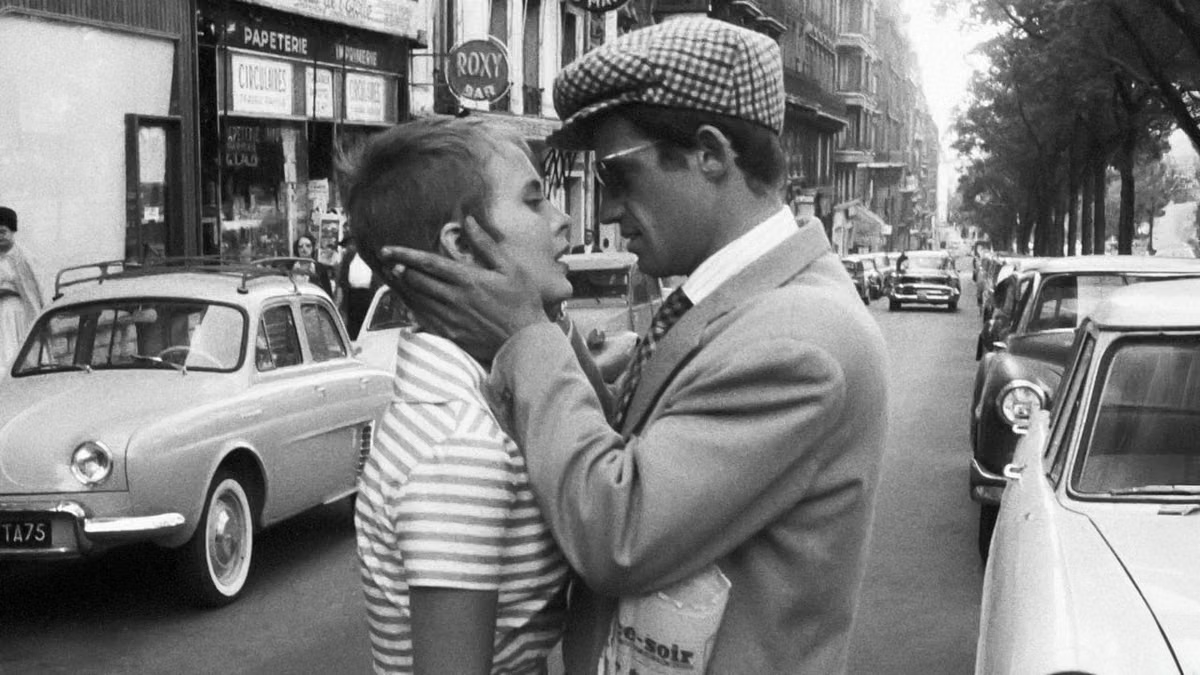
On December 1st, 2022, Sight & Sound magazine published “The Greatest Films of All Time,” a poll that’s been updated every 10 years since Bicycle Thieves topped the list in 1952. It is the closest thing movies have to a canon, with each edition reflecting the evolving taste of critics and changes in the culture at large. It’s also a nice checklist of essential cinema. Over the course of many weeks, months, and (likely) years, we’re running through the ranked list in reverse order and digging into the films as deep as we can. We hope you will take this journey with us.
Breathless (1960)
Dir. Jean-Luc Godard
Ranking: #38 (tie)
Previous ranking: #13 (2012), #16 (2002), #22 (1992)
Premise: After impulsively stealing a car in Marseilles and speeding down the RN7 (Route nationale 7) to Paris, brash young hoodlum Michel Poiccard (Jean-Paul Belmondo) gets pulled over by a motorcycle cop and shoots him with the revolver he found in the glove compartment. Continuing on to Paris, Michel seeks the company of Patricia Franchini (Jean Seberg), an American student and aspiring journalist that he’s slept with previously. When the authorities uncover Michel’s identity and his face is plastered on the front of the newspaper, the two hole up at various apartments until Patricia arrives at a fateful decision about their relationship.
Scott: Keith, as we move further up the Sight and Sound list, we’re going to encounter more and more examples of benchmark films that are as significant for what they started as they are as works unto themselves. Just two months ago, we talked about Bicycle Thieves, the premier example of the Italian neorealist movement and all that it represented, from the verisimilitude of real post-war locations and nonprofessional actors to the impact a film might have in heightening empathy and social awareness. It’s funny to think about Jean-Luc Godard’s Breathless as monolithic and “important” in the same way, given its playful mode of self-awareness and deconstruction, but it’s one of those films that legitimately changed the medium forever. It constantly violates the rules of how movies are supposed to be shot, recorded, edited, and dramatized, and in so doing, liberated filmmakers to do likewise decades into the future. And while no one violated rules with quite the same experimental moxie as Godard, who was just getting started and would get far more radical from here, it’s still remarkable to consider Breathless as a moment when the aesthetic horizon had been broadened forever.
Last year, I had a great time watching Richard Linklater’s Nouvelle Vague, an affectionate film about the making of Breathless that made me appreciate Godard’s iconoclasm all the more, because he was just so determined to defy the conventions of film production at every turn. Godard and cinematographer Raoul Coutard shot the film with a handheld camera and almost no lighting, which required a specific camera that was too loud for synchronized sound, leading all the dialogue in the film to be overdubbed. Godard flummoxed his actors further by writing much of the script on the fly, and the production days could range from 15 minutes to 12 hours, depending on how inspired he happened to be that day. In one of the funnier scenes in Nouvelle Vague, his frustrated producer, Georges de Beauregard, is enraged to discover Godard playing pinball on a day that he’d called in “sick.” Even as a first-time director, his instinct was to crumple up 60 years’ worth of accumulated wisdom about how movies should be made and toss them in the trash.
Breathless opens with a dedication to Monogram Pictures, an American studio that produced low-budget genre films from the early ’30s to the early ’50s, a cinematic dimestore of westerns, film noirs, and horror movies that’s part of the clay that Godard uses to shape this film and his career going forward. Godard and his filmmaking friends at Cahiers du Cinema—which gets a fun shoutout in this movie—were cinephiles with a lot of affection for American imports, and you can see the dynamic elements of those films (outlaws, guns, women, sex) get reconfigured in work like Breathless and my favorite François Truffaut film, Shoot the Piano Player, which came out the same year. The character of Michel and the supercool attitude of Jean-Paul Belmondo’s performance here are rooted in the thrill-kill allure of American genre movies, but treated from the perspective of someone who’s seen it all and wants to rethink it on screen. It’s a feature-length act of film criticism, which partly accounts for its steady presence on the Sight and Sound list.
There’s a lot to break down here about the technique, the structure, and the morality of Breathless, but one thing that strikes me about this film and the best of Godard’s work is ability to conjure movie moments, which speaks more to artistic instincts that go beyond film-as-film-criticism. That famous introduction of Jean Seberg as Patricia selling papers on the street with her pixie haircut and her New York Herald Tribune t-shirt, underscored by the jazz that percolates on the soundtrack, is such a profound justification of Godard’s entire method of making Breathless. The handheld camera, the real location, the allure of Seberg’s casting and costuming—it all feels so spontaneous. And the film just keeps on accumulating other moments from there: Michel zipping through traffic on the tree-lined R7, Belmondo and Seberg pulling faces during a lighter moment in Patricia’s apartment, those shots of Paris landmarks like the Arc de Triomphe and the Eiffel Tower are appear almost incidentally through car-shot angles.
One question I have for you, Keith: Where does Breathless land for you among the Godard films you’ve seen? We’ve already covered a couple Sight and Sound 100 list-makers, Pierrot le Fou and Contempt, that build significantly on what he started here. Do they seem richer because of it? Is Breathless the highest ranked Godard on the list because of its historic significance? Or is there a particular magic to the film that Godard (and others influenced by him) were always doomed to chase?
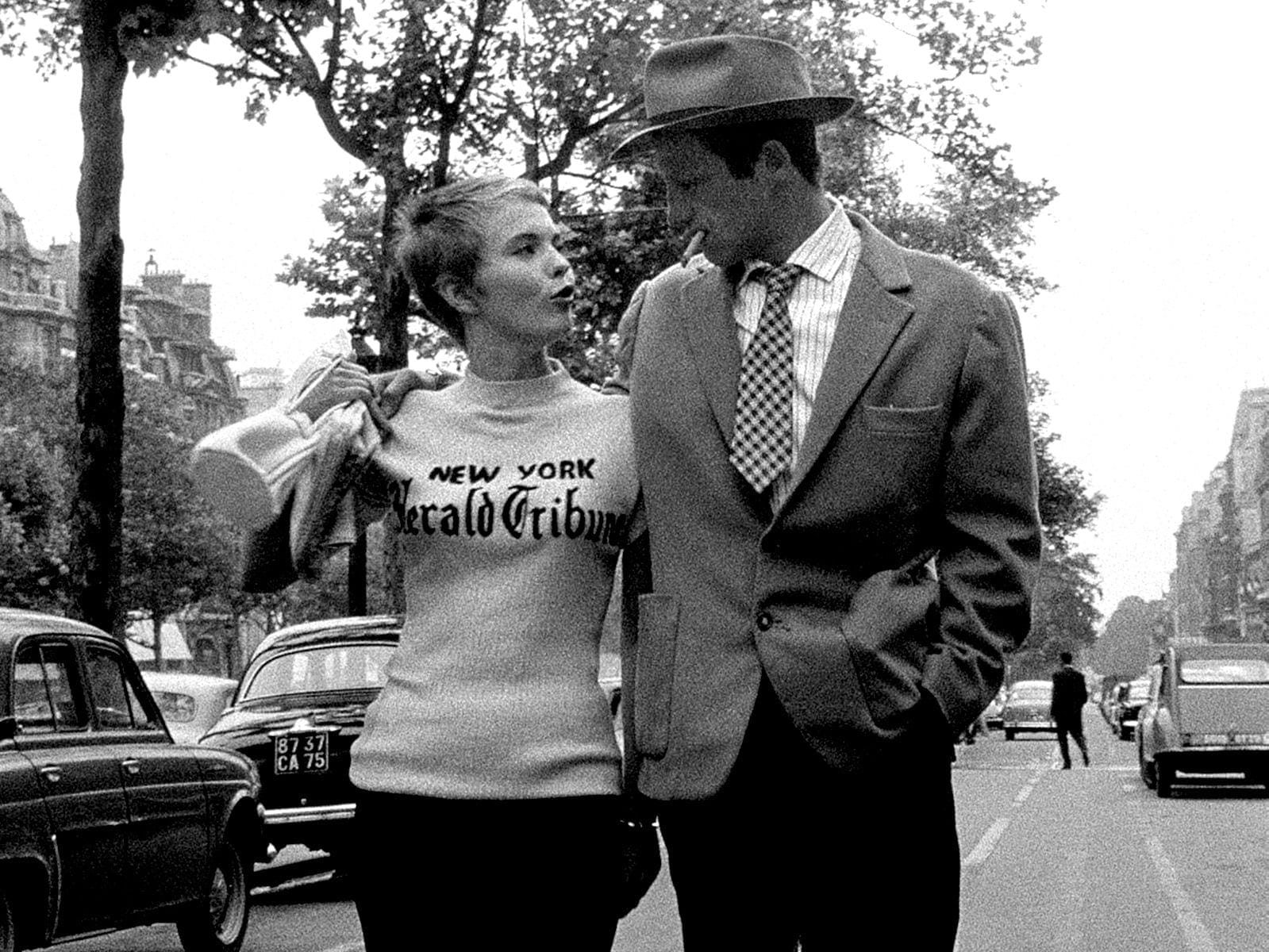
Keith: As far as personal favorites go, I’d probably pick Masculin/Féminin or Alphaville. Or maybe Bande à Part? He really did have a Beatles-esque run of towering classics in the 1960s, didn’t he? And like that discography, it’s almost less a matter of what movie’s best than what mode, or mood, of Godard you want to spend time with. To continue the metaphor, I guess this would be his Please Please Me, an impossible-to-ignore debut that also pointed the way forward.
You really can’t understate how important this movie was in telling a whole generation of filmmakers, and filmgoers, that you could throw out the rulebook and make movies your own way and that alone would have to earn it a spot on any list of all-time great movies, to say nothing of its influence on fashion and on early ’60s notions of coolness and its role in creating a generation that turned to arthouses for revelatory new ideas. But it also works as a crime film, if a more abstracted one than the films that inspired it. I think it’s a great film, one of Godard’s best, and an ideal introduction to him versus something like, say, Week-End, which requires newcomers to jump in the deep end of the pool and figure out how to swim.
Enjoying The Reveal? Now's a great time to become a paid subscriber. You'll get access to everything we publish—from articles to audio commentaries—and help support independent film criticism.
It also works, I think, as a character study. Michel essentially never stops talking and every sentence sounds like it comes from a deeply held belief. But he also can’t stop contradicting himself. He’s a lout and a lousy boyfriend. Yet he also seems to genuinely love Patricia. Unless he hates her. His final words might be sincere or a dying joke. I couldn’t say for sure. We spend the whole film with him, but do we really get to know him? I wonder if the one time we see the real Michel is when he’s staring at that picture of Humphrey Bogart. He obviously idolizes Bogey, having built much of his personality around the actor’s screen persona. But there’s a real vulnerability to that moment, as if he’s wondering if he’s gotten it right. Whatever the case, he’s deeply committed and in over his head from pretty much the film’s opening moments. This outlaw persona might have started as starstruck affectation, but it’s become his life.
I’m not sure Patricia is any easier to understand. She seems serious about her journalistic ambitions and generally seems to have her act together, apart from her love life. What does she see in Michel and why does she suffer his endless, hamhanded come-ons? One of the film’s best jokes is that when she finally does relent, it plays like a non-event, one accompanied by a radio station playing music designed for the work day. I know Godard’s work attracts accusations of misogyny. I don’t want to speak to his films as a whole, but I don’t see it in this film, in which Patricia continually attempts to define the terms of her relationship with Michel, only to find she’s dealing with an unreasonable pest. That said, she must know she’s destroying his life by turning him in, even if she can’t know her betrayal will end it.
I wrote “I think” up above because maybe it’s wrong to think about Michel and Patricia as characters. Godard puts quotation marks around so many elements of his films, and that practice is already evident here. I love Martial Solal’s score, for instance, but it’s deployed in a way that calls attention to itself, sometimes by ironic placement and sometimes by repetition. They sometimes seem like ideas of characters, stand-ins for notions about men and women, France and America, and crime and respectability. Scott, what do you make of our protagonists? Do you feel for them or is that the wrong reaction? I often find myself responding emotionally to Godard’s films almost in spite of the films themselves. And, to turn the question back to you, I’m curious where you would rank this within Godard’s filmography.
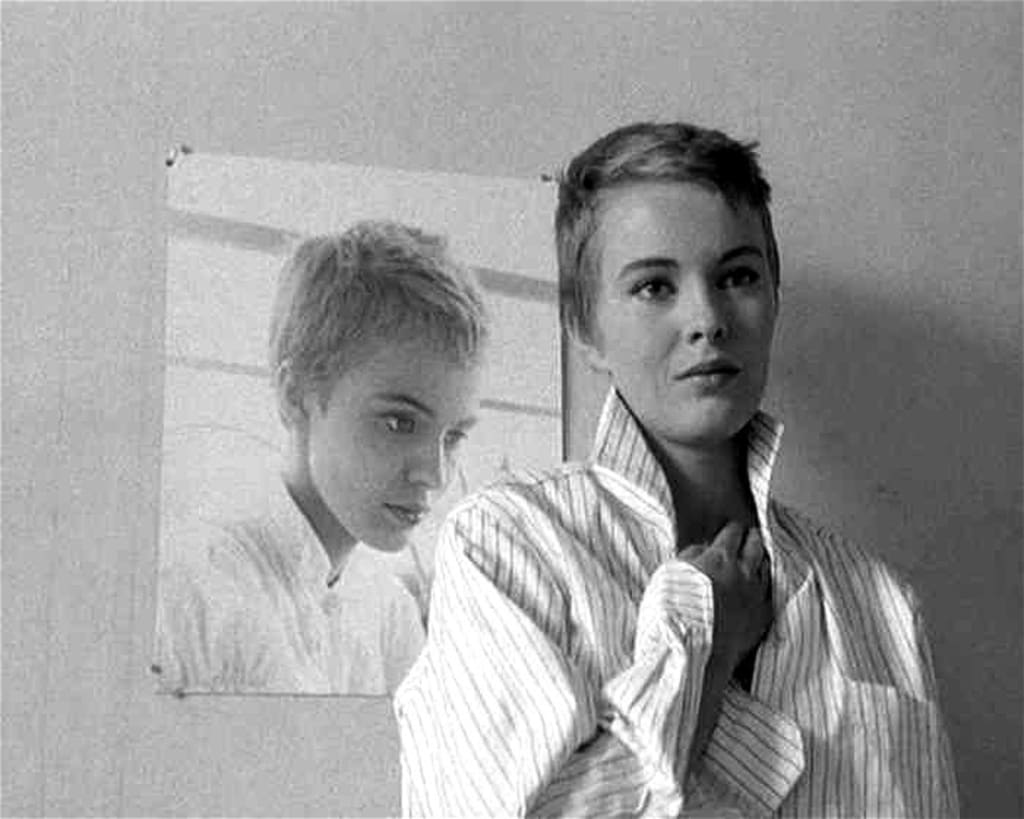
Scott: Honestly, it never occurred to me to think about Michel and Patricia as characters, at least in the way we normally unpack the motives and psychology of the leads in conventionally scripted films. When Michel regards that Bogart photo, I see the quotation marks of the director rather than a character whose profile is anchored to the real world. That doesn’t mean I’m right to draw that conclusion, however: You do well in articulating what Michel and Patricia might be thinking, and the long stretch where the two are holed up in Patricia’s apartment recalls the famously extended middle section of Contempt, when Godard halts the momentum of his movie-within-a-movie premise to contend with a relationship on the brink. Their extended argument, which is disrupted by more playful moments as well as domestic longueurs, struck me as psychologically credible beyond serving as a radical structural experiment on Godard’s part.
Maybe my compromise with Breathless is that while I don’t feel Michel and Patricia’s relationship wriggles out of those quotation marks, it does feel personal to Godard, who folds their dynamic into a film that channels his desires and obsessions. His love of American crime pictures is plain in having a protagonist who consciously models himself after someone as unimpeachably cool as Bogart, even if Bogie wasn’t generally cast as an unrepentant heel on a crime spree. As Breathless goes on, it’s almost as if Michel is aestheticizing his own life, play-acting as a devil-may-care hoodlum who is gifted a handgun from a stolen car and responds accordingly. Patricia is Godard’s idea of a love object, a mysterious and alluring pixie of the kind we’d see reproduced later by actresses like Anna Karina. I honestly cannot theorize about what binds her to him other than the chemistry that comes out in more casual moments between them, like when they’re pulling faces together. In the end, her betrayal of him is a rational response to a partnership that was doomed to land badly for her, too.
As for how I’d rank Breathless in Godard’s filmography, I think we’re on the same page in picking something like Masculin/Féminin from his ’60s run—he and John Frankenheimer are the two directors I generally think were unimpeachable that decade, though I’m not sure they’d get along—but the film remains an extraordinary touchstone and among his most accessible and pleasurable works. I’ve already talked about Godard’s instinct for the “movie moment,” like our introduction to Patricia or the sequence when Michel finally gets taken down. But there are so many other examples of Godard throwing out the rulebook and signaling to viewers (and future filmmakers) that other things are possible. It seems like absolute madness, for example, to ditch diegetic sound because you’ve committed yourself to using a camera that’s too noisy for normal sound recording, but it does no damage to this movie at all. And the sequence where Godard uses jumpcuts to break up an editor’s conversation with Patricia is a brilliant way to yadda-yadda past the remarks of someone she (and we) find too uninteresting to consider.
One major theme we haven’t discussed yet, Keith, is morality in Breathless, because that’s another area where Godard breaks radically from what’s expected of a movie. By 1960, international cinema had advanced well beyond the moral policing of earlier eras, but it’s nonetheless striking to be presented with a hero like Michel, who thinks nothing of gunning down a police officer off the side of a highway. Patricia, too, doesn’t seem all that troubled to be in his presence, even though she eventually turns on him. We’d see the fruit of Breathless later in films like Bonnie and Clyde, where we’re asked to spend time with self-styled outlaws who are coolly disconnected from the violent crimes they commit. It’s a radical idea for Godard to allow his characters to be so blasé about their sins, but it’s also weirdly palatable because the film is always in that mode of deconstruction. Moral detachment is a kind of liberation that’s in keeping with the aesthetic freedom Godard is claiming for himself, too.
What are your thoughts on the remorselessness of our glamorous heroes, Keith? And what are some of the other lasting images and moments that you carry out of Breathless?
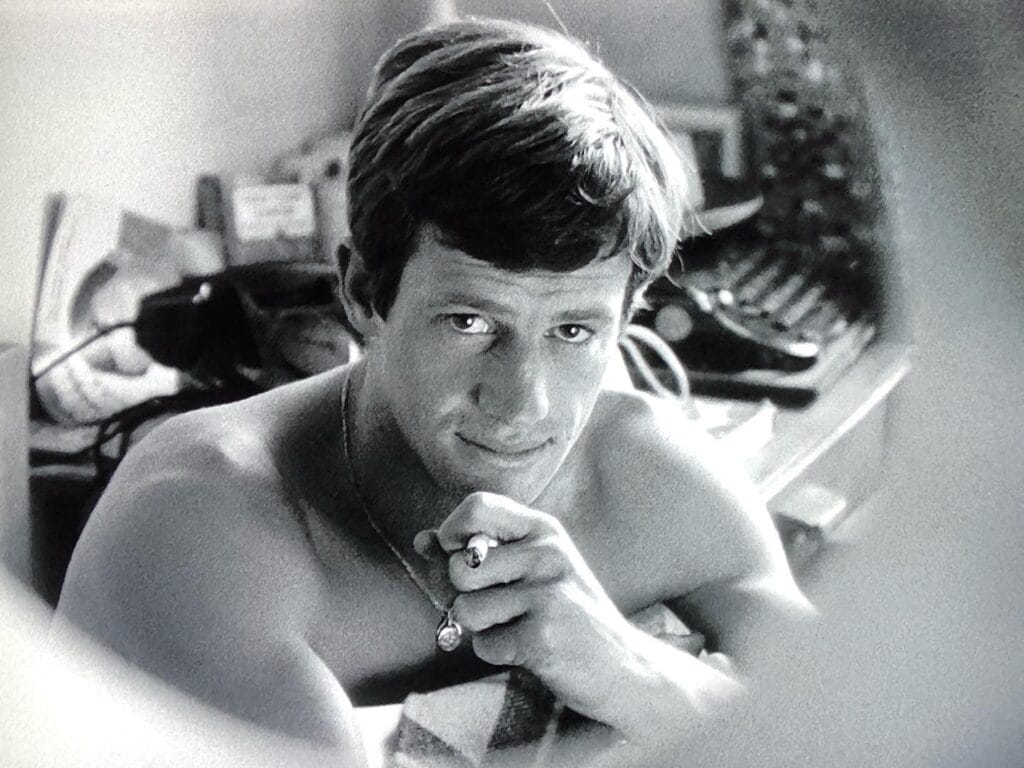
Keith: Breathless’s glamorization of crime and other anti-social behavior plays like a pendulum swing away from the crime-doesn’t-pay outcomes required by the Hays Code that constrained the Monogram Pictures films that inspired it. (Note to self: It might be time for a Monogram deep dive. Hillbilly Blitzkrieg, Ghost Guns, Women in Bondage, Black Market Babies: the titles sell themselves.) With Patricia at his side (at least part of the time), Michel breaks all the rules and looks good doing it. At least up to a point. In the end, crime doesn’t pay. Yet even as the police close in on him, Michel expresses no fear. He can’t bring himself to care. Having previously declared he wanted an all or nothing existence, he lives up to it by embracing nothing and making insulting words of defiance his last words. Morality and law and order look pretty square by comparison. It’s not like that isn’t true of crime films since time eternal, but Breathless practically promotes it from subtext to text. That feels fitting for a film so at odds with convention, even if the laws Godard is breaking remain confined to the filmmaking world.
You’ve already nabbed some of the most memorable images. Let me add the moment the streetlights come on behind Michel as he stands in the street and the shot of Patricia staring at him through a poster that turns into a slow zoom. Some of the most striking visuals come from the decision to film on the street in natural light, which allows the film to capture the everyday shifts in light. Bits of the film’s dialogue are just as memorable as the images. Godard was the master of the aphorism both within his movies and in interviews, but in both locations, it often seems like he’s throwing out lines we’re supposed to contemplate more than take as expressions of deeply held beliefs. When Parvulesco (played by Jean-Pierre Melville), the writerthat Patricia interviews, says his greatest ambition in life is, “To become immortal, and then to die” it sounds profound. Whether there’s any truth in it, or if it even means anything at all, is another matter.
Scott, you’re probably wondering what our next movie is. Well, let me tell you: There’s one more film tied with Breathless and Some Like it Hot in the #38 spot and that’s Rear Window.
Previously:
#95 (tie): Get Out
#95 (tie): The General
#95 (tie): Black Girl
#95 (tie): Tropical Malady
#95 (tie): Once Upon a Time in the West
#95 (tie): A Man Escaped
#90 (tie): Yi Yi
#90 (tie): Ugetsu
#90 (tie): The Earrings of Madame De…
#90 (tie): Parasite
#90 (tie): The Leopard
#88 (tie): The Shining
#88 (tie): Chungking Express
#85 (tie): Pierrot le Fou
#85 (tie): Blue Velvet
#85 (tie): The Spirit of the Beehive
#78 (tie): Histoire(s) du Cinéma
#78 (tie): A Matter of Life and Death
#78 (tie): Celine and Julie Go Boating
#78 (tie): Modern Times
#78 (tie): A Brighter Summer Day
#78 (tie): Sunset Boulevard
#78 (tie): Sátántangó
#75 (tie): Imitation of Life
#75 (tie): Spirited Away
#75 (tie): Sansho the Bailiff
#72 (tie): L’Avventura
#72 (tie): My Neighbor Totoro
#72 (tie): Journey to Italy
#67 (tie): Andrei Rublev
#67 (tie): The Gleaners and I
#67 (tie): The Red Shoes
#67 (tie): Metropolis
#67 (tie): La Jetée
#66: Touki Bouki
#63 (tie): The Third Man
#63 (tie): Goodfellas
#63 (tie): Casablanca
#60 (tie): Moonlight
#60 (tie): La Dolce Vita
#60 (tie): Daughters of the Dust
#59: Sans Soleil
#54 (tie): The Apartment
#54 (tie): Battleship Potemkin
#54 (tie): Blade Runner
#54 (tie): Sherlock Jr.
#52 (tie): Contempt
#52 (tie): Ali: Fear Eats the Soul
#50 (tie): The Piano
#50 (tie): The 400 Blows
#48 (tie): Wanda
#48 (tie): Ordet
#45 (tie): North by Northwest
#45 (tie): The Battle of Algiers
#45 (tie): Barry Lyndon
#43 (tie): Killer of Sheep
#43 (tie): Stalker
#41 (tie): Bicycle Thieves
#41 (tie): Rashomon
#38 (tie): Some Like it Hot

You might also like
#36 (tie): ‘City Lights’: The Reveal discusses all 100 of Sight & Sound’s Greatest Films of All Time
#38 (tie): ‘Rear Window’: The Reveal discusses all 100 of Sight & Sound’s Greatest Films of All Time
Discussion