#35: ‘Pather Panchali’: The Reveal discusses all 100 of Sight & Sound’s Greatest Films of All Time
Satyajit Ray’s 1955 debut depicts a coming-of-age story in a Bengali village where tradition is fast giving way to modernity.


On December 1st, 2022, Sight & Sound magazine published “The Greatest Films of All Time,” a poll that’s been updated every 10 years since Bicycle Thieves topped the list in 1952. It is the closest thing movies have to a canon, with each edition reflecting the evolving taste of critics and changes in the culture at large. It’s also a nice checklist of essential cinema. Over the course of many weeks, months, and (likely) years, we’re running through the ranked list in reverse order and digging into the films as deep as we can. We hope you will take this journey with us.
Pather Panchali (1955)
Dir. Satyajit Ray
Ranking: #35
Previous ranking: #41 (2012), #24 (2002), #9 (1992), #69 (1982), #12 (1962)
Premise: In a small village in Bengal sometime near the end of the 1910s, the Roy family lives an existence perilously close to total poverty while living in a house that’s falling into ruin. Harihar (Kanu Banerjee), the patriarch, remains cheerful, and dreams of developing his literary ambitions, despite the beyond-modest income he draws as a priest. His wife Sarbajaya (Karuna Banerjee) is less optimistic and finds herself having to tend both to her two children—her daughter Durga (Runki Banerjee as a small child, Uma Dasgupta as a teen) and her son Apu (Subir Banerjee)—but also her husband’s elderly cousin Indir (Chunibala Devi). Time passes and the children explore the world around the village while starting to consider what lies beyond its borders. Meanwhile, the family’s circumstances worsen, opening the door to tragedy.
Keith: The special features accompanying Pather Panchali on the Criterion Channel include a handful of interviewers with an assortment of admirers like Bill Hader, novelist Michael Cunningham, and Karyn Kusama, who all end up echoing each other in one respect: Satyajit Ray’s debut film introduced them to a world they knew nothing about. That’s obviously not true of everyone who sees the film. I suspect even most Indian viewers in 1955 may not have been intimately familiar with life in a remote Bengal village in the early part of the 20th century. But I also suspect this has been the experience of most viewers since the film became an international hit in the 1950s. Adapting a semi-autobiographical novel by Bibhutibhushan Bandyopadhyay, Ray doesn’t do a lot of handholding and explaining. He mostly observes life in the village as it’s lived and expects viewers to follow along.
Part of what makes the film great is the way Ray makes following along quite easy, in part by focusing on the Roy family’s everyday routines and needs. Harihar goes off to work and his job as a priest seems more of a workaday occupation than a calling. Sarbajaya tends to the housework and has to be careful with the family’s resources, lest they run out. Meanwhile, the kids behave like kids, flitting around on a kind of parallel reality to the adult world (where they’re occasionally joined by their auntie Indir, who’s become as much a dependent as they are). The specifics might be unfamiliar, but the pulsing humanity of the Roy family, and the lives of those around them, certainly isn’t.
Enjoying The Reveal? Now's a great time to become a paid subscriber. You'll get access to everything we publish—from articles to audio commentaries—and help support independent film criticism.
Not to get too deep into the extratextual stuff, Scott, but the very existence of this film is kind of unlikely. Ray grew up in a literary family and first encountered Pather Panchali when working on a children’s edition while employed at Signet in the ’40s. He created the cover and the illustrations for that version and his love for the book dovetailed with his filmmaking ambitions. That was already on his mind when he worked as a location scout for Jean Renoir when Renoir made The River in India. He worked on the film version of Pather Panchali off and on for several years in the early 1950s while repeatedly running out of money. Neither Ray nor his cinematographer Subrata Mitra had worked on a feature film before. Yet when it was done, Pather Panchali earned worldwide acclaim and, based on past Sight and Sound polls, was considered one of the greatest films of all time within a decade of its release.
I bring all this up not just because it’s a cool story but because I’m wondering if you think that background helps explain what made it to the screen. Despite his inexperience, Ray was a sophisticated cineaste who devoured American movies and ran a film society screening international films. He was no naif when he stepped behind the camera and you can certainly see, for starters, why he considered Italian neorealism to be a key influence. But I think it’s his confidence that he could tell a huge story about families and growing up filled with beauty and tragedy while pointing his camera at a little-seen pocket of the world.
We’ve barely even gotten into the substance of the film though, have we? Let me hand it over to you with a few questions: What did you make of Indir? I think the film treats her with a lot of compassion while still making Sarbajaya’s frustration understandable. What do you think of the way it depicts Durga’s death? The film could easily blame Harihar’s absence but it almost feels like part of the course of nature. And what do you make of the fact that one of the film’s most beautiful shots, the image of Durga in the rain—the one that everyone who’s seen the film remembers—is also the moment that seals her fate? Also, Pather Panchali is part of a trilogy and I’m sure we’ll touch on the other films at some point, but it wasn’t made with sequels in mind. Ray had to fight off suggestions that he give it a happy ending. What do you think of this ending as the close of the chapter?
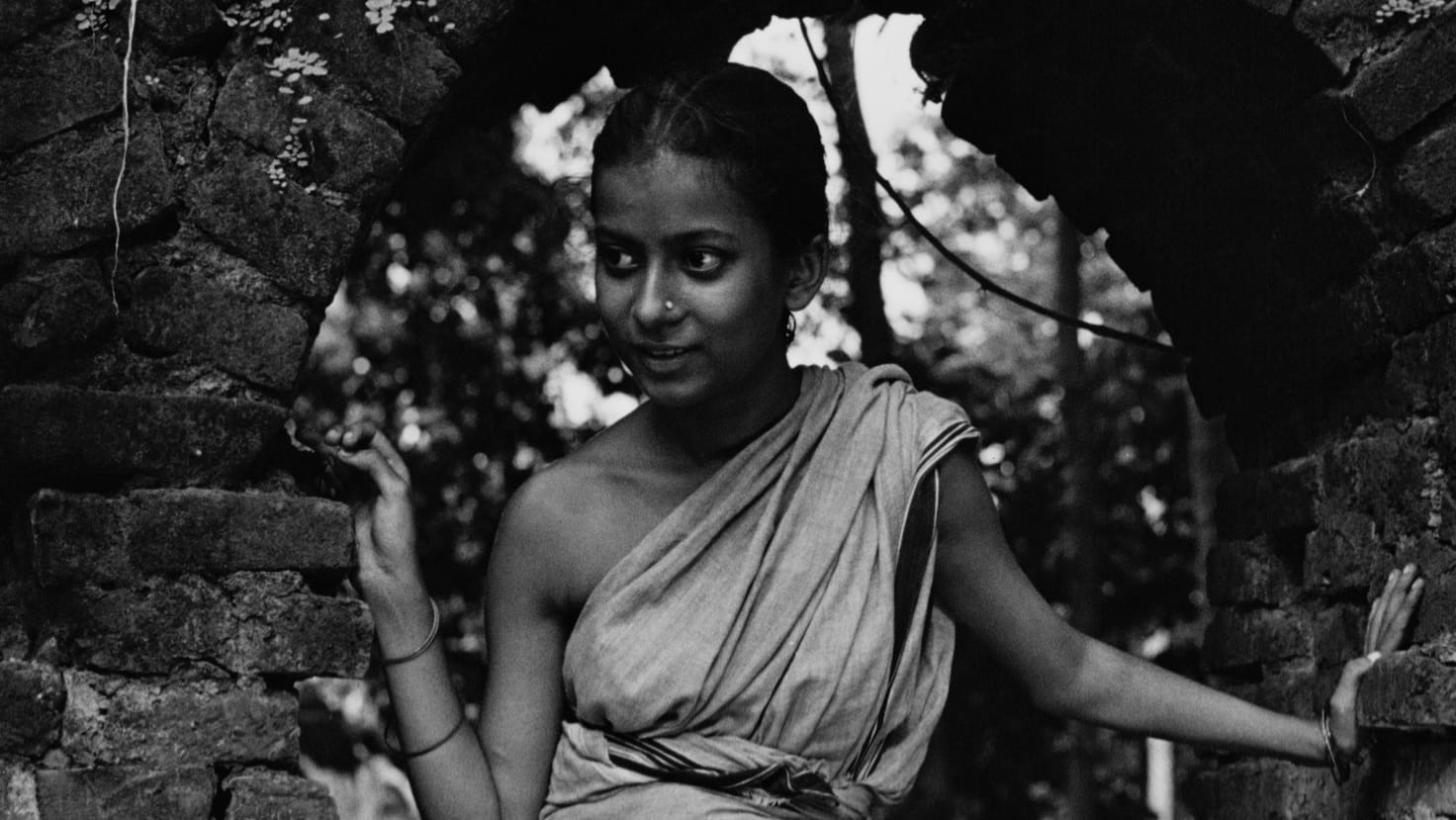
Scott: Keith, you’ve asked so many questions here that I’m inclined to act like a seasoned politician and answer the question I wanted to be asked. But before getting into the meat of the story, which is where these questions are heading, I have to express my own awe over how extraordinary Pather Panchali is as a first-time feature. In general, the 2022 Sight and Sound 100 list has been excellent in acknowledging art from unexpected or outright unrepresented corners of the world, including many first-time features like Ousmane Sembène’s Black Girl, Charles Burnett’s Killer of Sheep, and Barbara Loden’s Wanda or a breakthrough like Djibril Diop Mambéty’s Touki Bouki. The response to these films strikes me as similar to the response you note to Pather Panchali from various people on the Criterion Channel: They’d never seen a world like that on film. That in itself is revelatory and it’s the reason you thirst for work from outsiders, whether they’re from countries that don’t have a filmmaking infrastructure or from and about people who are not often visible, like the Watts of Burnett’s Killer of Sheep or Loden’s coal country in Wanda.
The other common denominator here is poverty. It’s not just the location but the condition of being poor and how it informs both the everyday stakes of getting by and the long-term psychological stress that can affect relationships and lead to tragic outcomes. You think about the young maid in Black Girl traveling all the way to the French Riviera from Dakar, Senegal, only to never be allowed to see the beach or even leave the apartment. Or the sequence in Killer of Sheep where two men pool their paychecks for an engine block and haul it down the stairs, only for the thing to flop onto the street from a truckbed. It feels like a miracle whenever these films get made and discovered, and they’re a reminder that the business of movies, with its gatekeeping and expense, often keeps us from knowing how many people live. We can watch Will Smith and Martin Lawrence literally drive through a shantytown in Bad Boys II, but rarely pause to consider who lives there.
Okay, I did not expect to bring Bad Boys II into a discussion of Pather Panchali, so let me get back on track by noting that Ray’s film straddles the line between outsider art and an astonishingly seasoned effort from someone who was inspired by Italian neo-realism and the lyrical qualities of Renoir’s The River. Despite the shoestring nature of a production that had to start and stop for budgetary reasons, Pather Panchali feels cohesive because Ray has designed it as a slice-of-life, a film that arcs toward tragedy but is mostly composed of smaller observations, vignettes, and character details. You get such a vivid sense of how this marriage between Harihar and Sarbajaya breaks down over practical concerns, about their specific material needs at any different points, about how it affects (or sometimes, in Apu’s case, doesn’t affect) their children’s experiences, about their status in the neighborhood, and about the village itself, with its vendors and festivals. We talk so much about “world-building” when it comes to elephantine productions, but that’s what Ray is doing here. And the emotional payoffs follow.
Now finally to your questions, Keith. What do I think of Indir? I love that character as a complex representative of what family means, because she’s beloved by the children, Durga especially, and a major hassle for Sarbajaya, who already has too many mouths to feed. It’s a credit to Ray that Sarbajaya’s treatment of Indir can at times seem extremely harsh and unforgiving without us losing sympathy with Sarbajaya over it. Indir is a lovely woman but Sarbajaya doesn’t need a third dependant to rely on her to eat or to have clothes on her back, and those basic conditions of survival—to say nothing of a home falling into deep disrepair—preoccupy her at every waking moment. And for as kind and buoyant a spirit as he is, Harihar is a dreamer who doesn’t care enough about when he’s getting paid.
Though Pather Panchali is the first in the Apu Trilogy, Sarbajaya and Durga are arguably the central relationship in the film, and Durga’s death is the shattering dissolution of a complex bond. Durga’s habit of stealing fruit from the neighbor’s orchard puts the two at odds and the accusation that Durga also stole a beaded necklace leads to a memorable scene of physical abuse, where her mother drags her around by the hair. Yet how different are they in their sense of justice or their shared hostility toward a well-to-do neighbor who can’t let the theft of a single mango go unanswered? When you talk about Durga’s death feeling like the “course of nature,” related to that justly famous sequence of her in the rain, I guess I’d respond that her subsequent illness from the storm is the end result of a life lived on the precipice. Pather Panchali is often reminding us of how little food the Roys have to eat sometimes and how their home is falling apart. It’s not “natural” per se for them to live in these conditions, but it makes death a real possibility.
Are there other relationships in the film that intrigued you, Keith? What do you think of Hirihar and the journey he takes here? Were you as struck as I was by the festival and performance troupes that come along to give village life a little more flavor? And what stands out to you about Ray as a filmmaker?
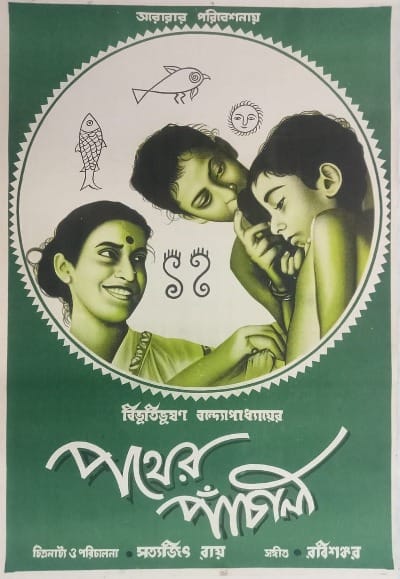
Keith: I think you’re right to point to the relationship between Durga and Sarbajaya being central to the film, yet there really isn’t a pairing between the family members that isn’t explored to one degree or another, and each one is complex in its own way. In some ways, Durga and Indir could be seen as the central relationship. They’re often the ones driving the action and the bond between them, which spans two generations, taps directly into the film’s exploration of life in the village and how it’s changed with time. (Also, one line of dialogue reveals that the orchard from which they’re stealing once belonged to the Roys.)
But I think the relationship between Durga and Apu is ultimately the most important to the film, even if this isn’t made clear until the end. If you didn’t know this was part of what would come to be known as The Apu Trilogy, Apu wouldn’t seem like the protagonist until the final stretch. Apu’s a baby in the film’s opening scenes.* As a boy, he follows his older sister around and explores the world with her as a guide, including an excursion that takes them far enough to see trains for the first time. (The significance of that moment echoes in the later films where trains serve as a motif.) Apu loves her and Indir and seems blissfully unaware of his family’s struggles until he loses them both before the end of the film. Then both are gone and, shortly after, the only life he knows falls apart as his parents depart for the city. It’s been his growing up story all along, but what that means—to him and to those watching the film—isn’t fully apparent until the end.
(* Runki Banerjee plays the young Durga in these scenes. She’s the real-life daughter of Karuna Banerjee. There are many cast members with the Banerjee surname in the cast but only these two are related to one another.)
That’s not to say that those around him don’t have fully developed stories of their own. Sarbajaya’s low temper and unhidden frustration make her seem thorny in the first half of the film but later developments confirm her disposition to be merely pragmatic. Ultimately, however, she can’t counterbalance her husband’s idealism and sense that everything will just work out for the best as he pursues his literary ambitions at the expense of his family’s well being. His neglect isn’t intentional. He loves his family and it seems not even to occur to him that his long absence could have dire consequences. He’s a dreamer brought down to earth. (And while the other two films in the trilogy are outside the scope of this discussion, his actions will resonate in Apu’s own pursuit of art and learning in later films.)
As for the traveling performers and entertainers, yes, they’re fascinating for several reasons. For Durga and Apu, they offer a glimpse of lives and stories beyond the boundaries they know. That’s also true of the traveling bioscope show, an early form of cinema I only know from this movie. Its presence also helps create a sense that we’re looking at a vanishing way of life and that changes will soon make many of these customs and forms of entertainment things of the past.
As for what stands out for me about Ray as a filmmaker, I think it’s a sense of confidence that every shot is exactly the right shot. There are the remarkable shots of nature, of course, but this is true of everything, from his habit of using frames within the movie frame—doorways, windows, hanging laundry—to great effect to his ability to make every camera movement feel significant. Ray had a background in visual art (among other disciplines) before making this film and he made Pather Panchali without a script. What he had were drawings, including some inspired by his art for that illustrated edition, that he turned into detailed storyboards. The film itself took years to make but in some ways it already existed in Ray’s head. But focusing on that sells short the contributions of others, like cinematographer Subrata Mitra, who’d never touched a movie camera before shooting Pather Panchali, and the extraordinary cast, some of whom had considerable acting experience, some of whom did not. That he could bring all this together for his first film, then keep rolling out great movies for years to come suggests to me someone who was born to do what he did.
I’d love to turn that question back to you, Scott, if you have any thoughts on what set Ray apart. But I’d also love to hear your thoughts on what traditions to which you see him belonging. Neorealism is certainly in the mix, but are there others? I’ll confess that I don’t have a great sense of the larger scope of Indian film history and I don’t think you do either, but how do you see him fitting into the great blossoming of international filmmaking in the years after World War II?
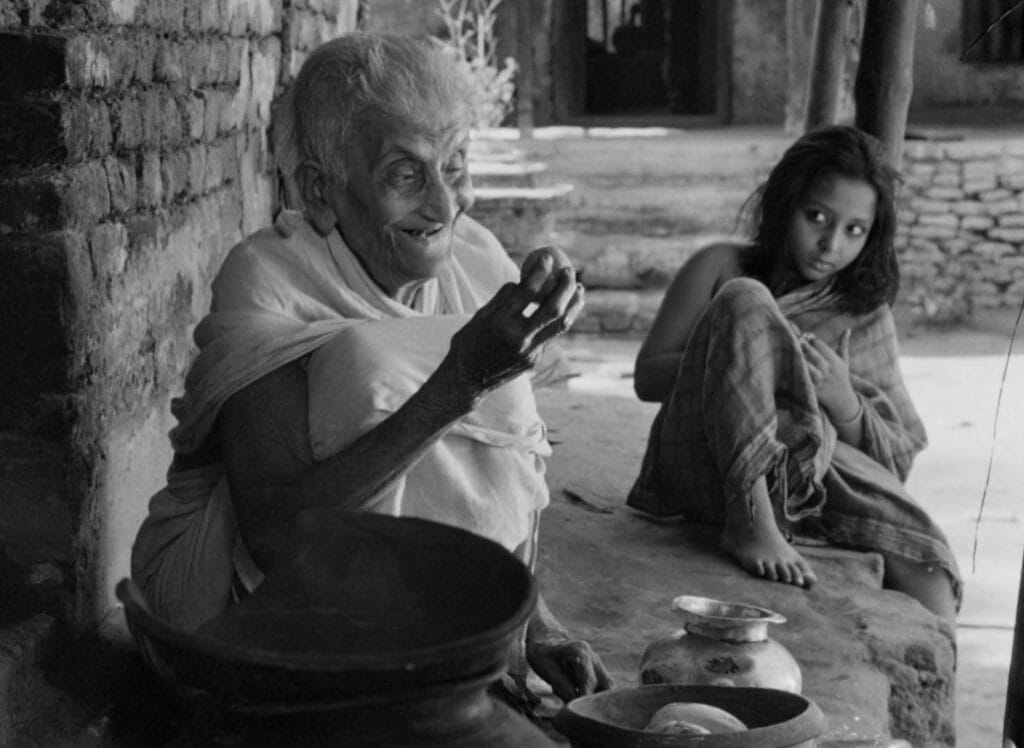
Scott: I also lack any authority when it comes to putting Ray’s work in the context of Indian film history, particularly of the kind of social realism that Pather Panchali represents. Yet whenever Ray’s influences for this film are discussed, the touchstones are the Italian neorealist movement and Renoir’s The River, which had influenced him directly as a location scout. That The River and Ray’s work both were major influences on Wes Anderson’s The Darjeeling Limited speaks to the international appeal of a film like Pather Panchali, which bypassed every obstacle that might keep it from the broadest possible appreciation. It competed for the Palme D’Or at Cannes, won awards from various festivals and critics groups, ran for eight months at the Fifth Avenue Playhouse in New York, and hit #12 on the Sight and Sound list in 1962, seven years after it was made, which makes it the filmic equivalent to a first-ballot Hall of Famer.
I don’t want to make any grand statements about the Western influence on Pather Panchali, because it feels like a minimization of its country of origin—and elements like Ravi Shankar’s wonderful sitar score, which is so critical to enhancing the lyricism and emotion of Ray’s filmmaking. But it’s one of those truly universal films that speak to the dreams and oft-humbling realities of the human experience. I have only seen a couple of other Ray films outside the Apu Trilogy, but a masterpiece like 1958’s The Music Room, which he directed between Aparajito and The World of Apu, is about a fading aristocrat rather than a rural family, and it couldn’t be categorized as neorealism, despite its attention to its hero’s crumbling estate and money woes. Whatever the case, there are plenty of world masters, including several on the Sight and Sound list, whose work is grounded in references and stylistic techniques that are regionally specific and occasionally hard to parse. Ray is not one of them.
That said, if you want to compare Pather Panchali with a neorealist classic like Bicycle Thieves, I think it’s worth noting that Ray’s film doesn’t have the same narrative engine propelling it forward. Bicycle Thieves uses a simple sequence of events—a jobless man needs a bike to secure a job, hocks everything he can to get one, has the bike stolen, and then commits the desperate act that pluralizes the film’s title—as a pathway through the blighted physical and economic landscape of post-WWII Italy. Pather Panchali has a similar clarity about the Roy family’s needs and their own sense of desperation, but there’s much more sketchwork involved in Ray’s filmmaking, which is what makes it more of a slice-of-life. Tensions within Harihar and Sarbajaya’s marriage come out as their situation worsens and Harihar’s pie-in-the-sky ambitions clash with his wife’s longstanding anxieties about money and increasing domestic squalor. But it’s not so bluntly defined that we don’t see moments when his presence is a comfort to her (and his absence a reminder of her loneliness and isolation from her neighbors), not to mention the sequences when the kids are at play, with young Apu looking as carefree as a boy his age should.
On a final note, I’d say that if we’re going to cite the universality and accessibility of Pather Panchali as key to why it was such an international hit from the start, I think you have to give Ray equal credit as an image-maker. The emphasis on the faces and reaction shots of his actors, particularly children, are these “Spielbergian” qualities that Steven Spielberg surely owes partially to Ray, whose young characters display such curiosity at important moments. Through their eyes and through the camera lens, we get such a textured look at how the Roys live, what they eat, where they stand socially in relation to their neighbors and other villagers, and the verdancy and decay of the landscape around them. Ray was one of those rare talents who arrived on the scene almost fully formed, despite his production limitations.
Next up in our Sight and Sound project, we get to enjoy another great image-maker in Jean Vigo, whose career only yielded about two-and-a-half hours and one single feature, 1934’s L’Atalante.
Previously:
#95 (tie): Get Out
#95 (tie): The General
#95 (tie): Black Girl
#95 (tie): Tropical Malady
#95 (tie): Once Upon a Time in the West
#95 (tie): A Man Escaped
#90 (tie): Yi Yi
#90 (tie): Ugetsu
#90 (tie): The Earrings of Madame De…
#90 (tie): Parasite
#90 (tie): The Leopard
#88 (tie): The Shining
#88 (tie): Chungking Express
#85 (tie): Pierrot le Fou
#85 (tie): Blue Velvet
#85 (tie): The Spirit of the Beehive
#78 (tie): Histoire(s) du Cinéma
#78 (tie): A Matter of Life and Death
#78 (tie): Celine and Julie Go Boating
#78 (tie): Modern Times
#78 (tie): A Brighter Summer Day
#78 (tie): Sunset Boulevard
#78 (tie): Sátántangó
#75 (tie): Imitation of Life
#75 (tie): Spirited Away
#75 (tie): Sansho the Bailiff
#72 (tie): L’Avventura
#72 (tie): My Neighbor Totoro
#72 (tie): Journey to Italy
#67 (tie): Andrei Rublev
#67 (tie): The Gleaners and I
#67 (tie): The Red Shoes
#67 (tie): Metropolis
#67 (tie): La Jetée
#66: Touki Bouki
#63 (tie): The Third Man
#63 (tie): Goodfellas
#63 (tie): Casablanca
#60 (tie): Moonlight
#60 (tie): La Dolce Vita
#60 (tie): Daughters of the Dust
#59: Sans Soleil
#54 (tie): The Apartment
#54 (tie): Battleship Potemkin
#54 (tie): Blade Runner
#54 (tie): Sherlock Jr.
#52 (tie): Contempt
#52 (tie): Ali: Fear Eats the Soul
#50 (tie): The Piano
#50 (tie): The 400 Blows
#48 (tie): Wanda
#48 (tie): Ordet
#45 (tie): North by Northwest
#45 (tie): The Battle of Algiers
#45 (tie): Barry Lyndon
#43 (tie): Killer of Sheep
#43 (tie): Stalker
#41 (tie): Bicycle Thieves
#41 (tie): Rashomon
#38 (tie): Some Like it Hot
#38 (tie): Breathless
#38 (tie): Rear Window
#36 (tie): City Lights
#36 (tie): M

Discussion